Questions

3 Marks Question

🎯

Test yourself on this topic

20 questions · timed · auto-graded

Question 13 Marks
In the given figure, $\text{OACB}$ is a quadrant of a circle with centre $O$ and radius $3.5 \ cm$ . If $O D=2 \ cm$, find the area of the shaded region.
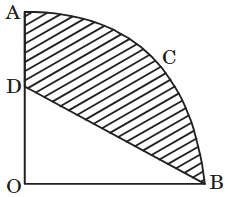
Image
Answer
We know that the area of a circle is given by the formula
$A=\pi r^2$
The given quadrant is quarter of a circle.
So, the area of the given quadrant will be
$=\frac{1}{4} \pi r^2$
Putting the values, we'll get
$\Rightarrow \text { Area }=\frac{1}{4} \times \frac{22}{7} \times(3.5)^2$
$\Rightarrow \text { Area }=\frac{1}{4} \times \frac{22}{7} \times \frac{35}{10} \times \frac{35}{10}$
$\Rightarrow \text { Area }=9.625 \ cm^2 \ldots \ldots(i)$
Now, the area of the triangle $\text{ODB}$ will be given by
$=\frac{1}{2} \times \text { base } \times \text { height }=\frac{1}{2} \times 3.5 \times 2$
$=3.5 \ cm^2 \ldots \ldots(ii) \text {. }$
Subtracting equation $(ii)$ from $(i)$ to find the area of the shaded region, we'll get
$=9.625-3.5=6.125 \ cm^2$
Hence, the area of the shaded region is $6.125 \ cm^2$
View full question & answer
Question 23 Marks
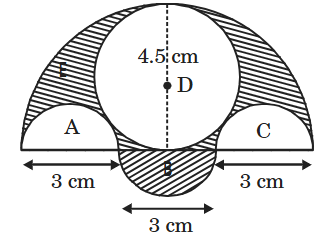
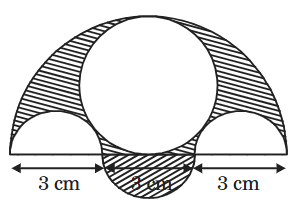
Three semicircles each of diameter $3 \ cm$ , a circle of diameter $4.5 \ cm$ and a semicircle of radius $4.5 \ cm$ are drawn in the given figure. Find the area of the shaded region.
Image
Answer
From the figure
Image
Area of the semi$-$circle.
Diameter $=9 \ cm$
Radius $=4.5 \ cm$
$\text { Area }=\frac{\pi r^2}{2}$
$=\frac{\pi(4.5)^2}{2}=\frac{\pi(4.5)^2}{2} \ cm^2$
Area of circle $D$ with Radius, $\frac{(4.5)}{2} \ cm$
Area $=\pi r^2=\pi\left(\frac{4.5}{2}\right)^2=\pi\left(\frac{4.5}{2}\right)^2 \ cm^2$
Area of region $(A+C)$
$r=\left(\frac{3}{2}\right)$
$=\pi\left(\frac{3}{2}\right)^2 \ cm^2$
Area $=2.25 \pi \ cm^2$
Area of region $B$
$r=\left(\frac{3}{2}\right)$
$\text { Area }=\frac{\pi}{2}\left(\frac{3}{2}\right)^2=\frac{\pi}{2}(2.25) \ cm^2$
Area of shaded region $=$ area of semi$-$circle area of circle $D\ - $ area of region $(A+C)\ +$area of region $B$
$=\frac{\pi(4.5)^2}{2}-\pi\left(\frac{4.5}{2}\right)^2-2.25 \pi+\frac{\pi}{2}(2.25) \ cm^2$
$=10.125 \pi-5.0625 \pi-2.25 \pi+1.125 \pi$
$=3.9375 \pi$
$=12.375 \ cm^2$
View full question & answer
Question 33 Marks
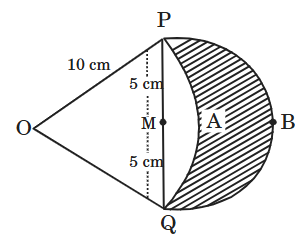
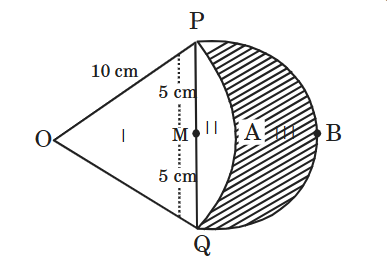
In the given figure, are shown two arcs $\text{PAQ}$ and $\text{PBQ}$. Arc $\text{PAQ}$ is a part of circle with centre $O$ and radius $OP$ while arc $\text{PBQ}$ is a semi $-$ circle drawn on $PQ$ as diameter with centre $M$. If $OP = PQ =10 \ cm$ show that area of shaded region is $25\left(\sqrt{3}-\frac{\pi}{6}\right) \ cm ^2$
Image
Answer
Image
It is given that $O P=O Q=10 \ cm$.
And we know the fact that tangents drawn from an external point to a circle are equal in length such that $O P=O Q=10 \ cm$
This makes $\triangle P O Q$ an equilateral triangle.
And
$\angle P O Q=\angle P Q O=\angle Q P O=60^{\circ}$
Now, Area of part $II =$ Area of the sectorArea of the equilateral $\triangle POQ$
$=\frac{\angle P O Q}{360^{\circ}} \times \pi r^2-\frac{\sqrt{3}}{4} \times(10)^2$
$=\frac{60^{\circ}}{360^{\circ}} \times \pi(10)^2-\frac{\sqrt{3}}{4} \times(10)^2$
$=100\left(\frac{\pi}{6}-\frac{\sqrt{3}}{4}\right) \text { sq units }$
Area of the semicircle on diameter $PQ =$ Area of part $II +$ Area of part $III$
$=\frac{1}{2} \times \pi(5)^2=\frac{25}{2} \pi \text { sq units }$
Area of the shaded region i.e. part $III =$
Area of the semicircle on diameter $P Q - $ Area of part $II$
$=\frac{25}{2} \pi-100\left(\frac{\pi}{6}-\frac{\sqrt{3}}{4}\right)$
$=\frac{25}{2} \pi-\frac{100}{6} \pi+25 \sqrt{3}$
$=25\left(\sqrt{3}-\frac{\pi}{6}\right) \text { sq units }$
Hence, we have shown that area of the shaded region is $=25\left(\sqrt{3}-\frac{\pi}{6}\right)\text { sq units }$
View full question & answer
Question 43 Marks
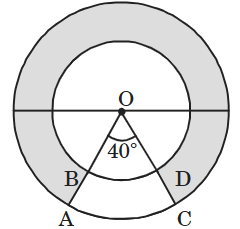
In the given figure, find the area of the shaded region, enclosed between two concentric circles of radii $7 \ cm$ and $14 \ cm$ where $\angle \text{AOC}=40^{\circ}. ($Use $\left.\pi=\frac{22}{7}\right)$
Image
Answer
According to the figure,
Area of the region $\text{ABDC} =$ Area of the sector $\text{AOC-}$Area of the sector $\text{BO}$
$=\left(\frac{40^{\circ}}{360^{\circ}} \times \frac{22}{7} \times 14 \times 14\right)-\left(\frac{40^{\circ}}{360^{\circ}} \times \frac{22}{7} \times 7 \times 7\right)$
$=\left(\frac{1}{9} \times 22 \times 14 \times 2\right)-\left(\frac{1}{9} \times 22 \times 7\right)$
$=\frac{1}{9} \times 22 \times(28-7)$
$=51.33 \ cm^2$
Now, area of the circular ring $=\frac{22}{7} \times 14 \times 14-\frac{22}{7} \times 7 \times 7$
$=22 \times 14 \times 2-22 \times 7$
$=22 \times(28-7)$
$=462 \ cm^2$
Therefore, required shaded area $=$ Area of the circular ring$-$Area of the region $\text{ABDC}$
$=462-51.33$
$=410.67 \ cm^2$
Thus, the area of the shaded region is $410.67 \ cm^2$
View full question & answer
Question 53 Marks
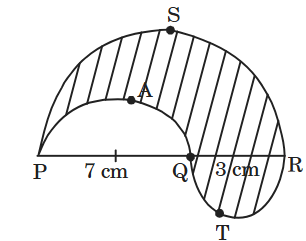
In the given figure, $\text{PSR, RTQ}$ and $\text{PAQ}$ are three semicircles of diameters $10 \ cm, 3 \ cm$ and $7 \ cm$ respectively. Find the perimeter of the shaded region. Use $\pi=3.14$
Image
Answer
Radius of Semicircle $\text{PSR}$
$=\frac{1}{2} \times 10 \ cm=5 \ cm$
Radius of Semicircle $\text{RTQ}$
$=\frac{1}{2} \times 3=1.5 \ cm$
Radius of semicircle $\text{PAQ}$
$=\frac{1}{2} \times 7 \ cm=3.5 \ cm$
Perimeter of the shaded region $=$ Circumference of semicircle $\text{PSR}\ + $ Circumference of semicircle $\text{RTQ}\ +$ Circumference of semicircle $\text{PAQ}$
$=\left[\frac{1}{2} \times 2 \pi(5)+\frac{1}{2} \times 2 \pi(1.5)+\frac{1}{2} \times 2 \pi(3.5)\right] \ cm$
$=\pi(5+1.5+3.5) \ cm$
$=3.14 \times 10$
$=31.4 \ cm$
View full question & answer
Question 63 Marks
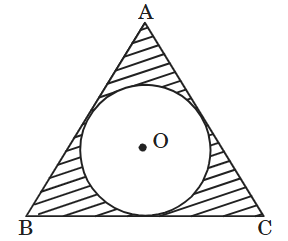
In the given figure, a circle is inscribed in an equilateral triangle $A B C$ of side $12 \ cm$ . Find the radius of inscribed circle and the area of the shaded region.
Use $\pi=3.14$ and $\sqrt{3}=1.73$
Image
Answer
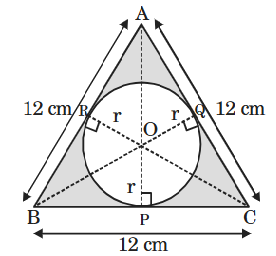
It is given that $\text{ABC}$ is an equilateral triangle of side $12 \ cm$ Construction:
Join $OA, OB$ and $OC$ Draw
$O P \perp B C$
$O Q \perp A C$
$O R \perp A B$
Image
Let the radius of the circle be $r \ cm$.
$\text { Area of } \triangle A O B+\text { Area of } \triangle B O C+\text { Area of } \triangle A O C$
$=\text { Area of } \triangle A B C$
$\frac{1}{2} \times A B \times O R+\frac{1}{2} \times B C \times O P$
$+\frac{1}{2} \times A C \times O Q=\frac{\sqrt{3}}{4} \times(\text { Side })^2$
$\frac{1}{2} \times 12 \times r+\frac{1}{2} \times 12 \times r$
$+\frac{1}{2} \times 12 \times T=\frac{\sqrt{3}}{4} \times(12)^2$
$3 \times \frac{1}{2} \times 12 \times r=\frac{\sqrt{3}}{4} \times 12 \times 12$
$r=2 \sqrt{3}=2 \times 1.73=3.46$
Therefore the radius of the inscribed circle is $3.46 \ cm$
Now, area of the shaded region $=$ Area of $\triangle ABC-$ Area of the inscribed circle
$=\left[\frac{\sqrt{3}}{4} \times 12^2-\pi(2 \sqrt{3})^2\right] \ cm^2$
$=[36 \sqrt{3}-12 \pi] \ cm^2$
$=[36 \times 1.73-12 \times 3.14] \ cm^2$
$=24.6 \ cm^2$
Therefore, the area of the shaded region is
$24.6 \ cm^2$
View full question & answer
Question 73 Marks
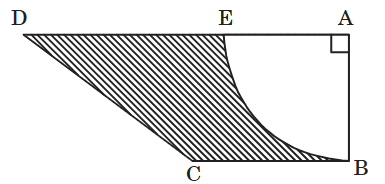
In the given figure, $A B C D$ is a trapezium of area $24.5 sq . cm$ In it, $A D \| B C$
$\angle DAB =90^{\circ}, AD =10 cm$ and $BC =4 cm$.If ABE is a quadrant of a circle, find the area of the shaded region. [Take $\left.\pi=\frac{22}{7}\right]$
Image
Answer
It is given that area of trapezium is $24.5 cm^2$
Area of trapezium
$=\frac{1}{2}($ Sum of parallel sides $) \times$ Height
Area of trapezium $=\frac{1}{2}(A D+B C) \times A B$
$24.5=\frac{1}{2}(10+4) \times A B$
$A B=\frac{49}{14}=3.5 cm$
Radius of the quadrant $=3.5 cm$
Area of the quadrant $=\frac{\pi r^2}{4}$
Area of the quadrant $=\frac{1}{4} \times \frac{22}{7} \times(3.5)^2$
Area of the quadrant $=9.625 cm^2$
Area of shaded region
$=$ Area of trapezium - Area of quadrant
Area of shaded region
$
=24.5-9.625=14.875 cm^2
$
The area of shaded region is $14.875 cm^2$
View full question & answer
Question 83 Marks
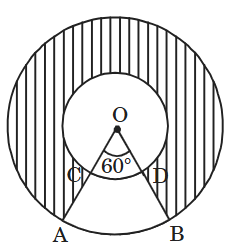
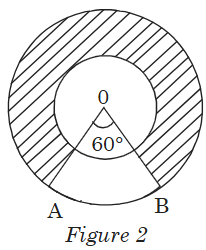
In the given figure, two concentric circles with centre $0 , $ have radii $21 \ cm$ and $42 \ cm$ . If $\angle A O B=60^{\circ},$ find the area of the shaded region.$[$Use $\pi=\frac{22}{7}]$
Image
Answer
It is given that radius of inner circle $=21 \ cm$ and radius of outer circle $=42 \ cm$
Area between the two circles $=\pi\left(R^2-r^2\right)$
Area between the two circles
$=\frac{22}{7}\left(42^2-21^2\right)$
Area between the two circles
$=\frac{22}{7}(1764-441)$
Area between the two circles
$=\frac{22}{7}(1323)=4158 \ cm^2$
Area covered by the sector of $60^{\circ}$ in the outer circle is $\frac{60^{\circ}}{360^{\circ}} \times \pi R^2$
Area covered by the sector of $60^{\circ}$ in the
$\text { outer circle }=\frac{60^{\circ}}{360^{\circ}} \times\left(\frac{22}{7}\right) \times 42^2$
Area covered by the sector of $60^{\circ}$ in the outer circle $=22 \times 42=924 \ cm^2$
Area covered by the sector of $60^{\circ}$ in the inner circle is $\frac{60^{\circ}}{360^{\circ}} \times \pi r^2$
Area covered by the sector of $60^{\circ}$ in the inner circle $=\frac{60^{\circ}}{360^{\circ}} \times\left(\frac{22}{7}\right) \times 21^2$
Area covered by the sector of $60^{\circ}$ in the inner circle $=21 \times 11=231 \ cm^2$
Area covered by the sector in between the circles $924-231=693 \ cm^2$
Area of shaded portion
$=\binom{\text { Area between }}{\text { the two circles }}- \binom{\text { Area covered by the sector }}{\text { in between the circles }}$
Area of shaded portion $=4158-693=3465 \ cm^2$
Thus, the area of shaded region is $3465 \ cm^2$
View full question & answer
Question 93 Marks
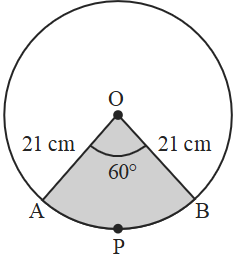
In a circle of radius $21 \ cm$ , an are subtends an angle of $60^{\circ}$ at the centre. Find: $(i)$ the length of the are $(ii)$ area of the sector formed by the arc. $[$Use $\left.\pi=\frac{22}{7}\right]$
Answer
We know that,
Radius of the circle $=21 \ cm$
Angle subtended by the arc is $60^{\circ}$
$(i)$ Length of the are
$=\frac{60^{\circ}}{360^{\circ}} \times 2 \times \frac{22}{7} \times 21$
$=\frac{1}{6} \times 2 \times 22 \times 3=22 \ cm$
Hence the length of the arc is $22 \ cm$
$(ii)$ Area of sector $=\frac{\theta}{360^{\circ}} \times \pi r^2$ Substituting the values again,
$=\frac{60^{\circ}}{360^{\circ}} \times \frac{22}{7} \times 21 \times 21$
$=\frac{1}{6} \times 22 \times 3 \times 21$
$=231 \ cm^2$
Hence the area of the sector is $231 \ cm^2$
View full question & answer
Question 103 Marks
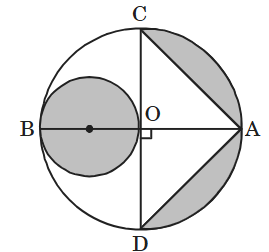
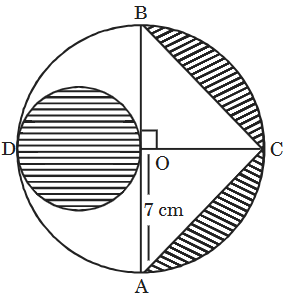
In the given figure $, AB$ and $CD$ are two diameters of a circle with centre $O,$ which are perpendicular to each other. $OB$ is the diameter of the smaller circle. If $OA =7 \ cm,$ find the area of the shaded region. $[$Use $\pi=\frac{22}{7} ]$
Image ​​​​​​​
Answer
We know that $A B$ and $C D$ are the diameters of a circle.
Hence,
$OA=OB=OC=OD=7 \ cm \ ($Radius$)$
Area of the shaded region $=$ Area of the circle with diameter $OB \ +\ ($Area of the semi $-$ circle $\text{ACDA} "$ Area of $\triangle ACD ) $
$=\pi r^2+\left(\frac{1}{2} \pi r^2-\frac{1}{2} \times C D \times O A\right)$
Substituting the values,
$=\frac{22}{7} \times\left(\frac{7}{2}\right)^2+\left(\frac{1}{2} \times \frac{22}{7} \times 7^2-\frac{1}{2} \times 14 \times 7\right)$
$=\frac{77}{2}+\left(\frac{22 \times 7}{2}-\frac{14 \times 7}{2}\right)$
$=38.5+77-49=66.5 \ cm^2$
Hence the area of the shaded part is $66.5 \ cm^2$
View full question & answer
Question 113 Marks
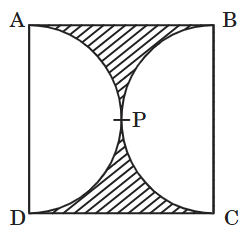
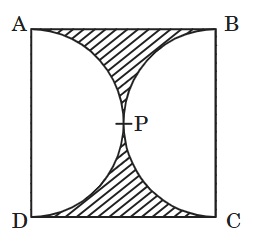
In the given figure, find the area of the shaded region, if $\text{ABCD}$ is a square of side $14 \ cm$ and $\text{APD}$ and $\text{BPC}$ are semicircles.
Image
Answer
Given that, side of the square is $14 \ cm$
$\Rightarrow$ Diameter of the semi$-$circles $\text{APD}$ and
$\text{BPC}=14 \ cm$
$\Rightarrow$ Radius of the semi$-$circle $\text{APD}$ and $\text{BPC}$
$=7 \ cm$
Image
Area of the square $=(\text { side })^2=(14)^2=196 \ cm^2$
Area of the semi$-$circle $\text{APD}$ will be equal to the area of the semi$-$circle $\text{BPC,}$
$=\frac{1}{2} \pi r^2=\frac{1}{2} \times \frac{22}{7} \times 7 \times 7=77 \ cm^2$
Therefore, area of the shaded region is
$\text { Area of square }- \text { (Area of two semicircles) }$
$=196-(77+77)$
$=196-154$
$=42 \ cm^2$
The area of shaded region is $42 \ cm^2$
View full question & answer
Question 123 Marks
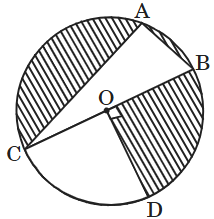
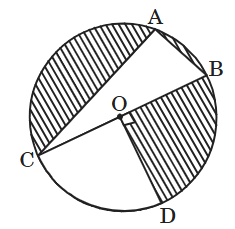
In the given figure, $O$ is the centre of the circle with $AC =24 \ cm, AB =7 \ cm$ and $\angle BOD =90^{\circ}$. Find the area of the shaded region.
Image
Answer
Since $O$ is the centre of the circle, therefore $,BC$ will be the diameter of the circle.
We know that, an angle in a semi $-$ circle is always a right angle.
$\therefore \angle B A C=90^{\circ}$
Image
Thus, $\triangle A B C$ is a right-angled triangle, rightangled at $A$.
$\therefore$ By Pythagoras theorem,
$A B^2+A C^2=B C^2$
$\Rightarrow 7^2+24^2=B C^2$
$\Rightarrow B C^2=625$
$\Rightarrow B C=25 \ cm$
Now, Area of the $\triangle A B C=\frac{1}{2} \times b \times h$
$=\frac{1}{2} \times 24 \times 7$
$=12 \times 7$
$=84 \ cm^2$
Again, since $O$ is the centre of the circle
and $ \angle B O D=90^{\circ}$
$\Rightarrow \angle C O D=90^{\circ}$
$BC$ is the diameter.
Therefore,
$OC =\frac{1}{2} BC =\frac{25}{2} \ cm$ is the radius of the circle.
Therefore, area of the quadrant $\text{COD} =\frac{1}{4} \pi r^2$
$=\frac{1}{4} \times \frac{22}{7} \times \frac{25}{2} \times \frac{25}{2}$
$=\frac{13750}{112}$
$=122.76 \ cm^2$
Lastly, area of the circle $=\pi r^2$
$=\frac{22}{7} \times \frac{25}{2} \times \frac{25}{2}$
$=\frac{13750}{28}$
$=491.07 \ cm^2$
Therefore, Area of the shaded region of the circle
$=\text { Area of circle }-\binom{\text { Area of Quadrant }+}{\text { Area of } \triangle ABC}$
$=491.07-(122.76+84)$
$=491.07-206.76$
$=284.31 \ cm^2$
The area of the shaded region is $284.31 \ cm^2$
View full question & answer
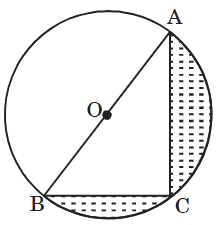
Question 133 Marks
In the given figure, $O$ is the centre of a circle such that diameter $A B=13 \ cm$ and $A C=12 \ cm$. $B C$ is joined. Find the area of the shaded region $($Take $\pi=3.14 )$
Image
Answer
According to the given figure,
$\angle A C B=90^{\circ} \ ($Angle in a semi $-$ circle$)$
Now, in $\triangle A C B$, using Pythagoras theorem, we have
$A B^2=A C^2+B C^2$
$(13)^2=(12)^2+(B C)^2$
$(B C)^2=169-144=25$
$B C=\sqrt{25}=5 \ cm$
Now, area of the shaded region $=$  Area of the circle $-$ area of the triangle Area of the shaded region
$=\frac{1}{2} \pi r^2-\frac{1}{2} \times B C \times A C$
$=\frac{1}{2} \times(3.14) \times(6.5)^2-\frac{1}{2} \times 5 \times 12$
$=66.33-30$
$=36.33 \ cm^2$
Thus, area of the shaded region is $36.33 \ cm^2$
View full question & answer
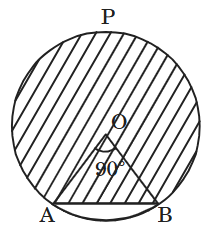
Question 143 Marks
Find the area of the major segment $\text{APB},$ in the given figure, of a circle of radius $35 \ cm$ and $\angle AOB =90^{\circ}.[$Use $\pi=\frac{22}{7} ]$
Image
Answer
Area of the given major sector $\text{PAOB}$ with
$\angle 270^{\circ}=\frac{270^{\circ}}{360^{\circ}} \times \pi r^2$
$=\frac{3}{4} \times \frac{22 \times 35 \times 35}{7}$
$=\frac{3}{2} \times 11 \times 5 \times 35$
$=\frac{5775}{2}$
$=2887.5 \ cm^2$
Area of right triangle
$\text{AOB}=\frac{1}{2} b h$
$=\frac{1}{2} \times 35 \times 35$
$=612.5 \ cm^2$
Now the area of the complete major segment $\text{APB}\ =$ area of major sector $\text{PAOB}\ +$ area of right triangle $\text{AOB}\ =2887.5+612.5$
$=3500 \ cm^2$
Hence the area of the major segment
$\text{APB}=3500 \ cm^2$
View full question & answer
Question 153 Marks
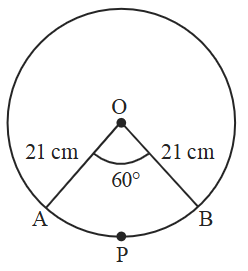
In a circle of radius 21 cm , an arc subtends an angle of $60^{\circ}$ at the centre.
Find the area of the sector formed by the arc. Also, find the length of the arc.
Answer

Image

The area formed by the arc will be:
$
\begin{aligned}
\text { Area of sector } OAPB & =\frac{\theta}{360} \times \pi r^2 \\
& =\frac{60}{360} \times \frac{22}{7} \times 21 \times 21 \\
& =\frac{1}{6} \times \frac{22}{7} \times 21 \times 21 \\
& =\frac{1}{6} \times 22 \times 3 \times 21 \\
& =231 cm^2
\end{aligned}
$
The length of the are will be:
Image
$\begin{aligned} \text { Length of Arc APB } & =\frac{\theta}{360} \times(2 \pi r ) \\ & =\frac{60^{\circ}}{360^{\circ}} \times 2 \times \frac{22}{7} \times 21 \\ & =\frac{1}{6} \times 2 \times \frac{22}{7} \times 21 \\ & =22 cm\end{aligned}$
View full question & answer
Question 163 Marks
Find the area of the sector of a circle of radius $7 \ cm$ and of central angle $90^{\circ}$. Also, find the area of corresponding major sector.
Answer
The area of a sector of a circle is given by:
Area of sector $=\left(\frac{\theta}{360}\right) \times \pi r^2$
where $\theta$ is the central angle in degrees and $r$ is the radius of the circle.
Given, the radius of the circle is $7 \ cm$ and the central angle is $90^{\circ}$.
Area of sector $ =\left(\frac{90}{360}\right) \times \pi(7)^2$
$ =\left(\frac{1}{4}\right) \times 49 \pi$
$ =12.25 \pi=38.48 \ cm^2$
To find the area of the corresponding major sector, we subtract the area of the minor sector from the area of the whole circle.
The area of the whole circle
$=\pi r^2=\pi(7)^2=49 \pi$
Area of major sector
$=\pi r^2- $ area of minor sector 
$=49-12.25 m$
$=36.75 \pi \approx 115.27 \ cm^2$
Therefore, the area of the major sector is approximately $115.27 \ cm^2$.
View full question & answer
Question 173 Marks
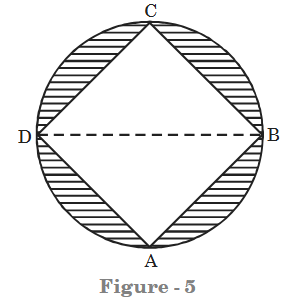
In Figure-5, ABCD is a square with side 7 cm . A circle is drawn circumscribing the square. Find the area of the shaded region.
Image
View full question & answer
Question 183 Marks
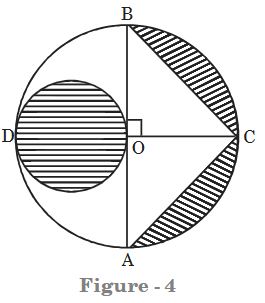
In Figure $4, AB$ and $CD$ are two diameters of a circle $($with centre $O)$ perpendiuclar to each other and $O D$ is the diameter of the smaller circle. If $OA =7 \ cm,$ then find the area of the shaded region.
Image
Answer
Image
$AB =CD\ ($ diameters of same circle$)$
$\Rightarrow \frac{A B}{2} =\frac{C D}{2}$
$\Rightarrow OA =OD=OB=OC$
$\Rightarrow OD =7 \ cm$
$\text { In } \triangle BOC, \operatorname{ar}(\text{BOC}) =\frac{1}{2} \times OB \times OC$
$ =\frac{1}{2} \times 7 \times 7$
$ =\frac{49}{2} \ cm^2$
$\operatorname{ar}(\text{ABC}) =2 \times \operatorname{ar}(\text{BOC})$
$ =2 \times \frac{49}{2}=49 \ cm^2$
area of semicircle $ \text{AOBC}$
$\frac{\pi r^2}{2} =\frac{22}{7} \times 7 \times 7 \times \frac{1}{2}=77 \ cm^2$
$OD =7 \ cm$
$r =\frac{7}{2} \ cm$
area of smaller circle 
$=\pi r^2$
$=\frac{22}{7} \times \frac{7}{2} \times \frac{7}{2}$
$=\frac{77}{2}=38.5 \ cm^2$
Area of shaded region 
$=($Area of semi $-$ circle $-\text{ar}(\text{ABC})  +$ Area of smaller circle$)$
$=\left(77 \ cm^2-49 \ cm^2\right)+38.5 \ cm^2$
$=28 \ cm^2+38.5 \ cm^2=66.5 \ cm^2$
View full question & answer
Question 193 Marks
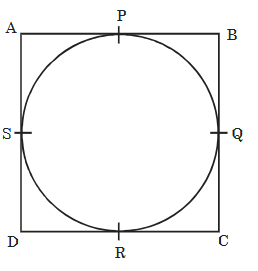
Aquadrilateral $\text{ABCD}$ is drawn to circumscribe a circle. Prove that $AB + CD = AD + BC$
Answer
Image
Given : $A$ quadrilateral $\text{ABCD}$ circumscribing a circle
To prove : $AB + CD = AD + BC$
Proof : We know that lengths of tangents drawn from a external point to a circle are equal
$\Rightarrow AP =AS (1)$
$BP =BQ \ldots \ldots(2)$
$DR =DS \ldots \ldots(3)$
$CR =CQ \ldots \ldots(4)$
Now $(1)+(2)+(3)+(4)$
$\Rightarrow AP+BP+CR+DR=AS+BQ+DS+CQ$
$\Rightarrow(AP+BP)+(CR+DR)=(AS+DS)+(BQ+CQ)$
$\Rightarrow AB+CD=AD+BC$
Hence proved
View full question & answer
Question 203 Marks
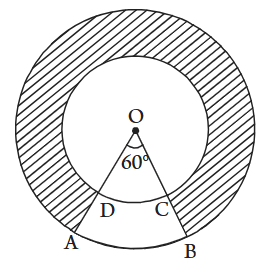
In figure $2$ , two concentric circles with centre $O$, have radii $21 \ cm$ and $42 \ cm .$ If $\angle \text{AOB}=60^{\circ}$, find the area of the shaded region.
Image
Answer
We have, Area of shaded region $=$
Area of the circular region$-$Area of region $\text{ABCD}$.
Image
Now, are of circular region
$=\pi\left(R^2-r^2\right)=\left[\frac{22}{7}\left(42^2-21^2\right)\right]$
$=\left[\frac{22}{7}(1764-441)\right]$
$=\left[\frac{22}{7} \times 1323\right]$
$=4158 \ cm^2$
and Area of the region $\text{ABCD}$
$=$ Area of sector $\text{OABO}-$ Area of sector $\text{ODCO}$
$=\frac{\theta}{360} \times \pi R^2-\frac{\theta}{360} \times \pi r^2$
$=\frac{\theta}{360} \times \pi\left(R^2-r^2\right)$
$=\frac{60}{360} \times \frac{22}{7} \times 1323$
$=\frac{22}{6 \times 7} \times 1323$
$=693 \ cm^2$
$\therefore$ Required shaded are $=(4158-693) \ cm ^2$
$=3465 \ cm^2$
View full question & answer
3 Marks Question - Maths STD 10 Questions - Vidyadip