Questions

5 Marks Questions

🎯

Test yourself on this topic

5 questions · timed · auto-graded

Question 15 Marks
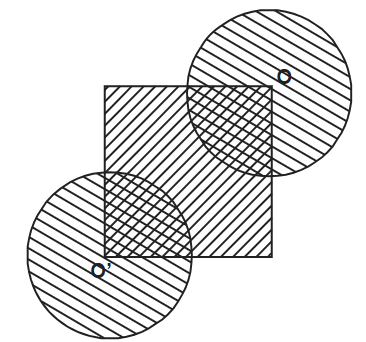
In the given figure, the side of square is 28 cm and radius of each circle is half of the length of the side of the square where $O$ and $O$ are centres of the circles. Find the area of shaded region.
Image
Answer
Area of the square is given by the formula
$\begin{array}{l}A=(\text { side })^2 \\=(28)^2 \\=784 cm^2\end{array}$
Area of the circle is given by the formula
$A=\pi r^2=\pi(14)^2$
We can see that 2 quadrants are overlapping with the area of the square.
$\therefore$ Area of the shaded region $=$ Area of the square $+2 \times$ Area of circle $-$ Area of two quadrants
$=784+\frac{22}{7} \times 14 \times 14\left(2-\frac{1}{2}\right)$
$=784+22 \times 2 \times 14 \times\left(\frac{3}{2}\right)$
$\begin{array}{l}=784+22 \times 14 \times 3 \\=784+924 \\=1708 cm^2\end{array}$
Hence, the area of the shaded region is $1708 cm^2$
View full question & answer
Question 25 Marks
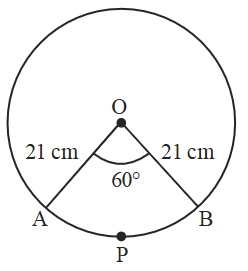
A chord $P Q$ of a circle of radius 10 cm subtends an angle of $60^{\circ}$ at the centre of circle. Find the area of major and minor segments of the circle.
Answer
To find the area of minor are we need to calculate the area of the sector OPRQ
Image
$\triangle O P Q$ is a isosceles triangle as $O P=O Q$ We know that in an isosceles triangle base angles are equal.
$\therefore \angle O P Q=\angle O Q P \quad \quad \ldots \ldots(i)$
Now, $\angle P O Q+\angle O P Q+\angle O Q P=180^{\circ}$
Using equation (i)
$\begin{array}{l}60^{\circ}+\angle O P Q+\angle O P Q=180^{\circ} \\2 \angle O P Q=120^{\circ} \\\angle O P Q=60^{\circ}\end{array}$
$\therefore$ All angles are of $60^{\circ}$ which is a property of equilateral triangle So, $\triangle O P Q$ is an equilateral triangle. Area of an equilateral is given by the formula
$\begin{array}{l}A=\frac{\sqrt{3}}{4} \times(\text { Length of the side })^2 \\A=\frac{\sqrt{3}}{4} \times(10)^2 \\A=\frac{50 \sqrt{3}}{2}=43.30 cm^2 \ldots \ldots(a)\end{array}$
Also, we know that the area of sector is given by the formula,
$A=\frac{\theta}{360^{\circ}} \times \pi r^2$
So, Area of sector OPRQ
$\begin{array}{l}=\frac{60^{\circ}}{360^{\circ}} \times \pi(10)^2 \\=52.33 cm^2 \ldots \ldots (b).\end{array}$
Now, to find the area of minor segment, we need to subtract the area of $\triangle O P Q$ from the area of the sector OPRQ.
so, area of minor segment is
Subtracting equation (a) from (b)
$\begin{array}{l}=52.33-43.30 \\=9.03 cm^2\end{array}$
Area of the circle is given by the formula
$\begin{array}{l}A=\pi r^2=3.14 \times(10)^2 \\=3.14 \times 10 \times 10 \\=314 cm^2\end{array}$
Area of the major segment $=$ Area of circle $-$ Area of minor segment
$\begin{array}{l}A=314-9.03 \\A=304.97 cm^2\end{array}$
Hence, the area of minor segment is $9.03 cm^2$ and the area of major segment is $304.97 cm^2$
View full question & answer
Question 35 Marks
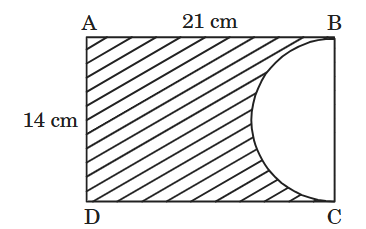
In the given figure, ABCD is a rectangle of dimensions $21 cm \times 14 cm$. A semicircle is drawn with BC as diameter. Find the area and the perimeter of the shaded region in the figure.
Image
Answer
Area of shaded region $=$ Area of rectangle $-$ Area of semicircle
$\begin{array}{l}=21 \times 14-\left\{\frac{1}{2} \times \pi \times\left(\frac{14}{2}\right)^2\right\} \\=294-\left\{\frac{1}{2} \times \frac{22}{7} \times 7 \times 7\right\} \\=294-77 \\=217 cm^2\end{array}$
So, the area of shaded region is $217 cm^2$.
Perimeter of shaded region
$\begin{array}{l}=A B+A D+D C+\overline{B C} \\=A B+A D+D C+\frac{1}{2} \times 2 \pi\left(\frac{14}{2}\right) \\=21+14+21+\frac{22}{7} \times 7 \\=56+22 \\=78 cm\end{array}$
So, the perimeter of shaded region is 78 cm.
View full question & answer
Question 45 Marks
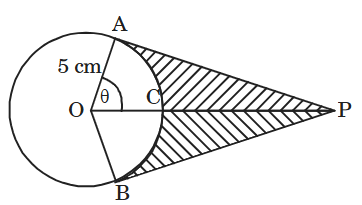
An elastic belt is placed around the rim of a pulley of radius 5 cm. (given figure). From one point C on the belt, the elastic belt is pulled directly away from the centre $O$ of the pulley until it is at $P , 10 cm$ from the point O . Find the length of the belt that is still in contact with the pulley. Also find the shaded area. ( Use $\pi=3.14$ and $\sqrt{3}=1.73)$
Image
Answer
We are given that $OA =5 cm$ and $OP =10 cm$ Now we know that the tangent at any point of a circle from an external point, P is perpendicular to the radius through the point of contact.
So, $\triangle O A P$ is a right-angled triangle,
$\Rightarrow \angle O A P=90^{\circ}$
Now, using the Pythagoras theorem,
$\begin{array}{l}O P^2=O A^2+A P^2 \\\Rightarrow 10^2=5^2+A P^2 \Rightarrow A P^2=75 \\\Rightarrow A P=5 \sqrt{3} cm\end{array}$
Now, $\cos \theta=\frac{O A}{O P}=\frac{5}{10}$
$\begin{array}{l}\Rightarrow \cos \theta=\frac{1}{2} \Rightarrow \theta=60^{\circ} \\\text { So, } \angle A O P=\angle B O P=60^{\circ} \$\text { as } \triangle O A P \cong \triangle O B P) \\\Rightarrow \angle A O B=120^{\circ}\end{array}$
Length of the belt still in contact with the pulley $=$ Circumference of the circle $-$ Length of the arc
$\begin{array}{l}AC=2 \times 3.14 \times 5-\frac{120^{\circ}}{360^{\circ}} \times 2 \times 3.14 \times 5 \\=2 \times 3.14 \times 5 \times\left(1-\frac{1}{3}\right) \\=2 \times 3.14 \times 5 \times \frac{2}{3} \\=20.93 cm\end{array}$
Now, Area of $\triangle O A P=\frac{1}{2} \times A P \times O A=$  $\frac{1}{2} \times 5 \sqrt{3} \times 5=\frac{25 \sqrt{3}}{2} cm^2$
Area of $\triangle O B P=\frac{25 \sqrt{3}}{2} cm^2$
So, Area of $\triangle O A P+$ Area of $\triangle O B P$
$=25 \sqrt{3} cm^2=25 \times 1.73=43.25 cm^2$
Area of sector OACB
$\begin{array}{l}=\frac{120^{\circ}}{360^{\circ}} \times 3.14 \times(5)^2 \\=\frac{1}{3} \times 3.14 \times 25 \\=26.17 cm^2
\end{array}$
Therefore, Area of the shaded region $=$ (Area of $\triangle O A P+$ Area of $\triangle O B P)$ - Area of the sector OACB
$\begin{array}{l}=43.25 cm^2-26.17 cm^2 \\=17.08 cm^2\end{array}$
Hence, the length of the belt is 20.93 cm and the area of the shaded region is $17.08 cm^2$
View full question & answer
Question 55 Marks
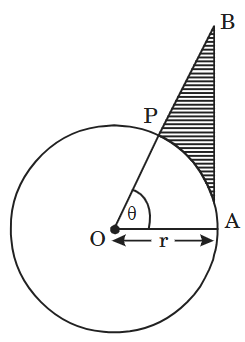
In the given figure, is shown a sector $OAP$ of a circle with centre $O$, containing $\angle \theta . AB$ is perpendicular to the radius $O A$ and meets $O P$ produced at B. Prove that the perimeter of shaded region is $r\left[\tan \theta+\sec \theta+\frac{\pi \theta}{180}-1\right]$
Image
Answer
From the figure,
Perimeter of shaded region
$\begin{array}{l}=A B+P B+A P\quad \quad \ldots \ldots \text {(i)} \\\angle O A B=90^{\circ} \\{\left[\begin{array}{l}\text { Tangent is perpendicular to } \\\text { radius through point of contact }\end{array}\right]}\end{array}$
$\begin{array}{l}\text { In } \triangle O A B, \\\tan \theta=\frac{A B}{O A} \\A B=O A \times \tan \theta \\A B=r \times \tan \theta \quad \quad \ldots \ldots \text {(ii)}\end{array}$
In $\triangle O A B$,
$\begin{array}{l}\sec \theta=\frac{O B}{O A} \\O B=O A \times \sec \theta \\O B=r \times \sec \theta \\\therefore P B=O B-O P \\=r \sec \theta-r\quad \quad \ldots \ldots \text {(iii)}\end{array}$
Therefore, the perimeter is
$\begin{array}{l}=A B+P B+A P \\\Rightarrow r \times \tan \theta+r \times \sec \theta-r+\frac{\theta}{180^{\circ}} \times \pi r\end{array}$
On solving it further,
$\Rightarrow r\left[\tan \theta+\sec \theta+\frac{\pi \theta}{180}-1\right]$
Hence Proved.
View full question & answer
5 Marks Questions - Maths STD 10 Questions - Vidyadip