MCQ 11 Mark
Directions: In the following questions, a statement of assertion $(A)$ is followed by a statement of reason $(R)$.Mark the correct choice as:
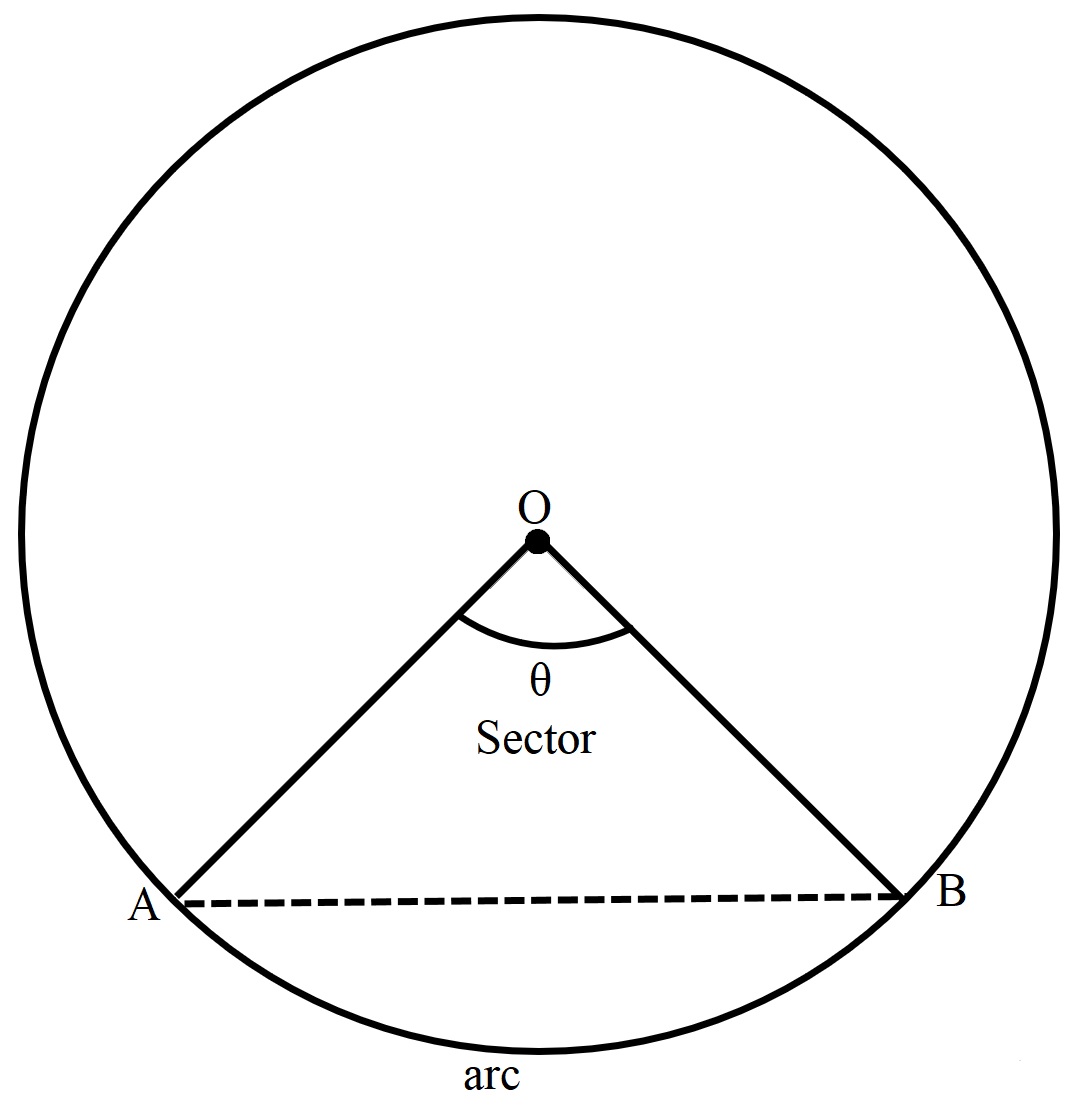
Assertion: The area of the sector of a circle of radius $5\ cm$ is $9.75\ cm^2$ if the corresponding arc length is $ 3.5\ cm.$
Reason: Area of a sector of a circle of radious r and central $\angle\theta$ is $\frac{\theta}{360^\circ}\pi\text{r}^2$
- A
Both assertion $(A)$ and reason $(R)$ are true and reason $(R)$ is the correct explanation of assertion $(A).$
- B
Both assertion $(A)$ and reason $(R)$ are true but reason $(R)$ is not the correct explanation of assertion $(A).$
- C
Assertion $(A)$ is true but reason $(R)$ is false.
- ✓
Assertion $(A)$ is false but reason $(R)$ is true.
AnswerCorrect option: D. Assertion $(A)$ is false but reason $(R)$ is true.
Let the central angle of the sector be $6$.Given that, radius of the sector of circle
$(r) = 5 \ cm$
and arc length $(l) = 3.5 \ cm$
$\therefore$ Central angle of the sector,
$\theta=\frac{\text{aren length(l)}}{\text{radius}}$
$\Rightarrow\theta=\frac{3.5}{5}=0.7\text{R}$
$\bigg[\because\theta=\frac{\text{l}}{\text{r}}\bigg]$
$\Rightarrow\theta=\bigg(0.7\times\frac{180}{\pi}\bigg)^\circ\bigg[\because1\text{R}=\frac{180^\circ}{\pi}\text{D}^\circ\bigg]$
Now, area of sector with $\angle\theta=0.7$
$\frac{\pi\text{r}^2}{360^\circ}\times(0.7)\times\frac{180^\circ}{\pi}=\frac{(5)^2}{2}\times0.7$
$=\frac{25\times7}{2\times10}\times\frac{175}{20}=8.75\text{cm}^2$
View full question & answer→MCQ 21 Mark
Directions : In the following questions, a statement of assertion $(A)$ is followed by a statement of reason $(R.)$ Mark the correct choice as:
Assertion : If a ball is in the shape of a sphere has a surface area of $221.76\text{ cm}^2$ hen its diameter is $8.4\ cm.$
Reason : If the radius of the sphere be $r,$ then surface area, $\text{S}=4\pi\text{r}^2$ i.e. $\text{r}=\frac{1}{2}\sqrt{\frac{\text{S}}{\pi}}$
- ✓
Both assertion $(A)$ and reason $(R)$ are true and reason $(R)$ is the correct explanation of assertion $(A)$.
- B
Both assertion $(A)$ and reason $(R)$ are true but reason $(R)$ is not the correct explanation of assertion $(A)$.
- C
Assertion $(A)$ is true but reason $(R)$ is false.
- D
Assertion $(A)$ is false but reason $(R)$ is true.
AnswerCorrect option: A. Both assertion $(A)$ and reason $(R)$ are true and reason $(R)$ is the correct explanation of assertion $(A)$.
View full question & answer→MCQ 31 Mark
Directions : In the following questions, a statement of assertion $(A)$ is followed by a statement of reason $(R).$ Mark the correct choice as:
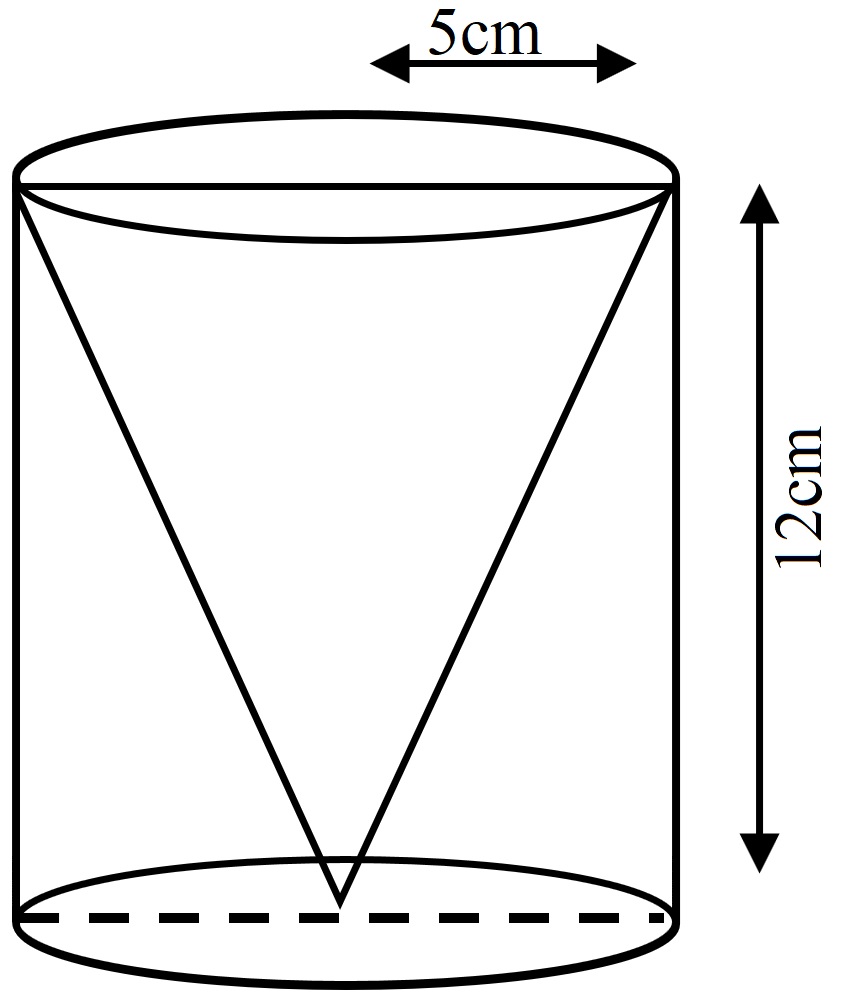
Assertion : From a solid cylinder, whose height is $12\ cm$ and diameter $10\ cm$ a conical cavity of same height and same diameter is hollowed out.Then, volume of the cone is $\frac{2200}{7}\text{ cm}^3$
Reason : If a conical cavity of same height and same diameter is hollowed out from a cylinder of height h and base radius r, then volume of the cone will be half of the volume of the cylinder.
- A
Both assertion $(A)$ and reason $(R)$ are true and reason $(R)$ is the correct explanation of assertion $(A)$.
- B
Both assertion $(A)$ and reason $(R)$ are true but reason $(R)$ is not the correct explanation of assertion $(A)$.
- ✓
Assertion $(A)$ is true but reason $(R)$ is false.
- D
Assertion $(A)$ is false but reason $(R)$ is true.
AnswerCorrect option: C. Assertion $(A)$ is true but reason $(R)$ is false.
$\because$ Volume of cylinder $=\pi\text{r}^2\text{h}$ and volume of conical cavity$=\frac{1}{3}\pi\text{r}^2\text{h}$
$\therefore$ Volume of cone $=\frac{1}{3}$ Volume of cylinder
So, Reason is wrong.
Now, diameter of cone $=10\text{ cm}$
$\therefore$ Radius of cone $\text{r}=5\text{ cm}$
Also, height of cone $,\text{h}=12\text{ cm}$
Volume of cone $=\frac{1}{3}\pi\text{r}^2\text{h}$
$=\frac{1}{3}\times\frac{22}{7}\times5\times5\times12$
$=\frac{6600}{21}\text{ cm}^3$
$=\frac{2200}{7}\text{ cm}^3$
View full question & answer→MCQ 41 Mark
Directions: In the following questions, a statement of assertion $(A)$ is followed by a statement of reason $(R)$.Mark the correct choice as:
Assertion: The area of the flower bed $($with semi$-$circular ends$)$ shown in figure.
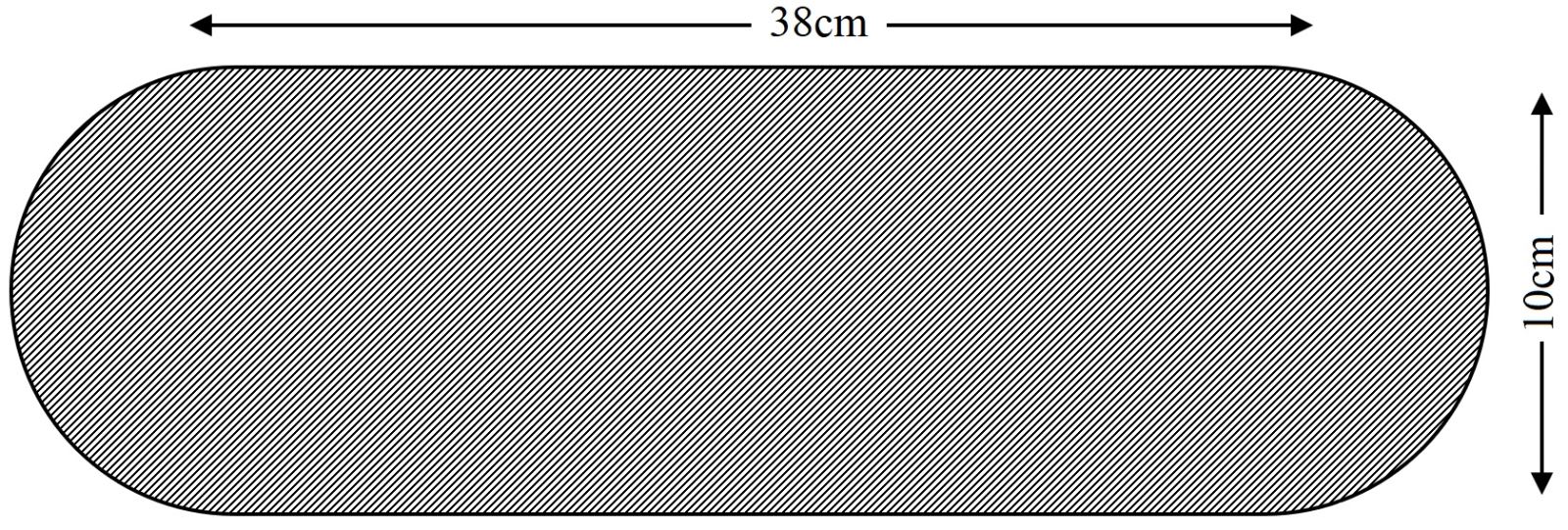
is $(380+50\pi)\text{cm}^2$
Reason: Area of the semi$-$circle is $\frac{\pi\text{r}^2}{2}$ and area of rectangle is length $\times $ breadth. - A
Both assertion $(A)$ and reason $(R)$ are true and reason $(R)$ is the correct explanation of assertion $(A).$
- B
Both assertion $(A)$ and reason $(R)$ are true but reason $(R)$ is not the correct explanation of assertion $(A).$
- C
Assertion $(A)$ is true but reason $(R)$ is false.
- ✓
Assertion $(A)$ is false but reason $(R)$ is true.
AnswerCorrect option: D. Assertion $(A)$ is false but reason $(R)$ is true.
Length and breadth of a circular bed are $38\ cm$ and $10\ cm$
$\therefore$ Area of rectangle $\text{ACDF}$
$=$ Length $\times $ Breadth
$= 38 \times 10 = 380\ cm^2$
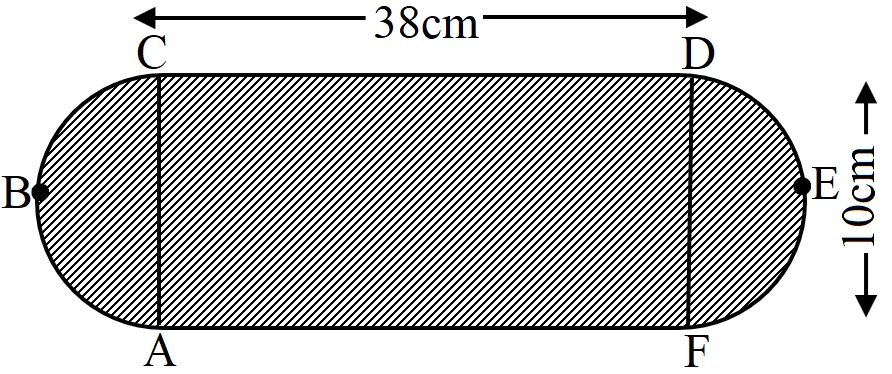
Both ends of flower bed are semi $-$ circles.
$\therefore$ Radius of semi $-$ circle
$=\frac{\text{DF}}{2}\frac{10}{2}=5\text{cm}$
$\therefore$ Area of one semi $-$ circles
$=\frac{\pi\text{r}^2}{2}=\frac{\pi}{2}(5)^2=\frac{25\pi}{2}\text{cm}^2$
$\therefore$ Area of two semi $-$ circles
$=2\times\frac{25}{2}\pi=25\pi\text{ cm}^2$
$\therefore$ Total area of flower bed
$=$ Area of rectangle $\text{ACDF} +$ Area of two semi $-$ circles
$=(380+25\pi)\text{cm}^2$ View full question & answer→MCQ 51 Mark
Directions : In the following questions, a statement of assertion $(A)$ is followed by a statement of reason $(R)$. Mark the correct choice as:
Assertion : $(A)$ The length of the minute hand of a clock is $7\ cm$.Then the area swept by the minute hand in $5$ minute is $\frac{77}{6}\text{ cm} ^2$
Reason : $(R)$ The length of an arc of a sector of angle $q$ and radius $r$ is given by $\text{l}=\frac{\theta}{360^\circ}\times2\pi\text{r}$
- ✓
Both assertion $(A)$ and reason $(R)$ are true and reason $(R)$ is the correct explanation of assertion $(A)$.
- B
Both assertion $(A)$ and reason $(R)$ are true but reason $(R)$ is not the correct explanation of assertion $(A)$.
- C
Assertion $(A)$ is true but reason $(R)$ is false.
- D
Assertion $(A)$ is false but reason $(R)$ is true.
AnswerCorrect option: A. Both assertion $(A)$ and reason $(R)$ are true and reason $(R)$ is the correct explanation of assertion $(A)$.
View full question & answer→MCQ 61 Mark
Directions : In the following questions, a statement of assertion $(A)$ is followed by a statement of reason $(R)$. Mark the correct choice as:
Assertion : If the volumes of two spheres are in the ratio $27 : 8$.Then their surface areas are in the ratio $3 : 2.$
Reason : Volume of the sphere $=\frac{4}{3}\pi\text{r}^3$ and its surface area $=4\pi\text{r}^2$
- A
Both assertion $(A)$ and reason $(R)$ are true and reason $(R)$ is the correct explanation of assertion $(A)$.
- B
Both assertion $(A)$ and reason $(R)$ are true but reason $(R)$ is not the correct explanation of assertion $(A)$.
- C
Assertion $(A)$ is true but reason $(R)$ is false.
- ✓
Assertion $(A)$ is false but reason $(R)$ is true.
AnswerCorrect option: D. Assertion $(A)$ is false but reason $(R)$ is true.
we have, $\frac{\frac{4}{3}\pi\text{r}^2}{4\pi\text{r}^2}=\frac{27}{8}$
$\Rightarrow\frac{\text{R}^3}{\text{r}^2}=\frac{27}{8}$
$\Rightarrow\frac{\text{R}}{\text{r}}=\frac{3}{2}$
Ratio of surface area $=\frac{4\pi\text{R}^2}{4\pi\text{R}^2}$
$=\frac{\text{R}^2}{\text{r}^2}$
$=\big(\frac{3}{2}\big)^2$
$=\frac{9}{4}$
View full question & answer→MCQ 71 Mark
Directions : In the following questions, a statement of assertion $(A)$ is followed by a statement of reason $(R).$ Mark the correct choice as:
Assertion $(A)$ : A bicycle wheel makes $5000$ revolutions in covering $11\ km$. Then diameter of the wheel is $35\ cm.$
Reason $(R)$ : Arca of segment of a circle is $\frac{\theta}{360}\times\pi\text{r}^2-\frac{1}{2}\text{r}^2\sin\theta.$
- A
Both $A$ and $R$ are true and $R$ is the correct explanation for $A.$
- B
Both $A$ and $R$ are true and $R$ is not the correct explanation for $A.$
- C
$A$ is true but $R$ is false.
- ✓
$A$ is false but $R$ is true.
AnswerCorrect option: D. $A$ is false but $R$ is true.
We have,
$2\pi\text{r}=\frac{11000}{5000}$
$=\frac{11}{5}\text{m}=\frac{11}{5}\times100\text{ cm}$
$\Rightarrow2\text{r}=\frac{11\times100}{5\times\pi}$
$=\frac{11\times20}{22}\times7$
$\Rightarrow2\text{r}=70$
$\Rightarrow$ Diameter $= 70\ cm$
View full question & answer→MCQ 81 Mark
Directions : In the following questions, a statement of assertion $(A)$ is followed by a statement of reason $(R).$ Mark the correct choice as:
Assertion $(A)$ : In a circle of radius $6\ cm,$ the angle of a sector is $60^\circ$.Then the area of the sector is $\frac{132}{7}\text{cm}^2$
Reason $(R)$ : Area of the circle with radius $\text{r}$ is $\pi\text{r}^2$
- A
Both assertion $(A)$ and reason $(R)$ are true and reason $(R)$ is the correct explanation of assertion $(A)$.
- ✓
Both assertion $(A)$ and reason $(R)$ are true but reason $(R)$ is not the correct explanation of assertion $(A)$.
- C
Assertion $(A)$ is true but reason $(R)$ is false.
- D
Assertion $(A)$ is false but reason $(R)$ is true.
AnswerCorrect option: B. Both assertion $(A)$ and reason $(R)$ are true but reason $(R)$ is not the correct explanation of assertion $(A)$.
View full question & answer→MCQ 91 Mark
Directions : In the following questions, a statement of assertion $(A)$ is followed by a statement of reason $(R)$.Mark the correct choice as:
Assertion $(A)$ : In a circle of radius $6 \ cm,$ the angle of a sector is $60^\circ .$ Then the area of the sector is $\frac{132}{7}\text{ cm}^2$
Reason $(R)$ : Area of the circle with radius is $\pi\text{r}^2.$
- A
Both assertion $(A)$ and reason $(R)$ are true and reason $(R)$ is the correct explanation of assertion $(A)$.
- ✓
Both assertion $(A)$ and reason $(R)$ are true but reason $(R)$ is not the correct explanation of assertion $(A)$.
- C
Assertion $(A)$ is true but reason $(R)$ is false.
- D
Assertion $(A)$ is false but reason $(R)$ is true.
AnswerCorrect option: B. Both assertion $(A)$ and reason $(R)$ are true but reason $(R)$ is not the correct explanation of assertion $(A)$.
View full question & answer→MCQ 101 Mark
Directions : In the following questions, a statement of assertion $(A)$ is followed by a statement of reason $(R).$ Mark the correct choice as:
Assertion $(A)$ : The length of the minute hand of a clock is $7 \ cm$. Then the area swept by the minute hand in $5$ minutes is $12\frac{5}{6}\text{ cm}^2.$
Reason $(R)$: ‘Lhe length of an arc of a sector of angle $\theta$ and radius $7$ is given by $\text{l}=\frac{\theta}{360}\times2\pi\text{r}.$
- A
Both $A$ and $R$ are true and $R$ is the correct explanation for $A.$
- ✓
Both $A$ and $R$ are true and $R$ is not the correct explanation for $A.$
- C
$A$ is true but $R$ is false.
- D
$A$ is false but $R$ is true.
AnswerCorrect option: B. Both $A$ and $R$ are true and $R$ is not the correct explanation for $A.$
Area swept by minute hand in $5$ minutes
$\frac{\theta}{360^\circ}\times\pi\text{r}^2$
$=\frac{30}{360^\circ}\times\frac{22}{7}\times7\times7$
$=\frac{77}{6}=12\frac{5}{6}\text{ cm}^2.\ ( \therefore$ Angle in $5$ mutes by minute hand is $30^\circ )$
View full question & answer→MCQ 111 Mark
Directions: In the following questions, a statement of assertion $(A)$ is followed by a statement of reason $(R)$.Mark the correct choice as:
Assertion: The area of a circular playground is $22176m^2$, the cost of fencing this ground at the rate of $50$ per $m$ is $= 26400.$
Reason: If Rand r be the radius of outer and inner circular path, then area of the ring will be $\pi(\text{R}^2-\text{r}^2)$
- A
Both assertion $(A)$ and reason $(R)$ are true and reason $(R)$ is the correct explanation of assertion $(A).$
- ✓
Both assertion $(A)$ and reason $(R)$ are true but reason $(R)$ is not the correct explanation of assertion $(A).$
- C
Assertion $(A)$ is true but reason $(R)$ is false.
- D
Assertion $(A)$ is false but reason $(R)$ is true.
AnswerCorrect option: B. Both assertion $(A)$ and reason $(R)$ are true but reason $(R)$ is not the correct explanation of assertion $(A).$
Given, area of a circular playground
$=22176\text{m}^2$
$\therefore\pi\text{r}^2=22176[\because \text{area of circle}=\pi\text{r}^2]$
$\Rightarrow\frac{22}{7}\text{r}^2=22176\Rightarrow\text{r}^2=1008\times7$
$\Rightarrow\text{r}^2=7056\Rightarrow\text{r}=84\text{m}$
$\therefore$ Circumference of a circle
$=2\pi\text{r}=2\times\frac{22}{7}\times84$
$=44\times12=528\text{m}$
$\therefore$ Cost of fencing this ground
$=528\times50=26400$
View full question & answer→MCQ 121 Mark
Directions : In the following questions, a statement of assertion $(A)$ is followed by a statement of reason $(R).$ Mark the correct choice as:
Assertion : If the circumference of two circles are in the ratio $2 : 3,$ then ratio of their areas is $4 : 9.$
Reason : The circumference of a circle of radius $r$ is $2\pi\text{r}$ and its area is $\pi\text{r}^2$
- ✓
Both assertion $(A)$ and reason $(R)$ are true and reason $(R)$ is the correct explanation of assertion $(A)$.
- B
Both assertion $(A)$ and reason $(R)$ are true but reason $(R)$ is not the correct explanation of assertion $(A)$.
- C
Assertion $(A)$ is true but reason $(R)$ is false.
- D
Assertion $(A)$ is false but reason $(R)$ is true.
AnswerCorrect option: A. Both assertion $(A)$ and reason $(R)$ are true and reason $(R)$ is the correct explanation of assertion $(A)$.
Given, $\frac{2\pi\text{r}_1}{2\pi\text{r}_2}=\frac{2}{3}$
$\Rightarrow\frac{\text{r}_1}{\text{r}_2}=\frac{2}{3}$
Now, ratio of their area will be
$\frac{\pi\text{r}^2_1}{\pi\text{r}^2_2}=\big(\frac{\text{r}_1}{\text{r}_2}\big)^2$
$=\big(\frac{2}{3}\big)^2=\frac{4}{9}$
View full question & answer→MCQ 131 Mark
Directions : In the following questions, a statement of assertion $(A)$ is followed by a statement of reason $(R)$. Mark the correct choice as:
Assertion : If the circumference of two circles are in the ratio $2 : 3$ then ratio of their areas is $4 : 9.$
Reason : The circumference of a circle of radius $\text{r}$ is $2\pi\text{r}$ and its area is $\pi\text{r}^2$
- ✓
Both assertion $(A)$ and reason $(R)$ are true and reason $(R)$ is the correct explanation of assertion $(A)$.
- B
Both assertion $(A)$ and reason $(R)$ are true but reason $(R)$ is not the correct explanation of assertion $(A)$.
- C
Assertion $(A)$ is true but reason $(R)$ is false.
- D
Assertion $(A)$ is false but reason $(R)$ is true.
AnswerCorrect option: A. Both assertion $(A)$ and reason $(R)$ are true and reason $(R)$ is the correct explanation of assertion $(A)$.
Given, $\frac{2\pi\text{r}_1}{2\pi\text{r}_2}=\frac{2}{3}$
$\frac{2\text{r}_1}{2\text{r}_2}=\frac{2}{3}$
Now, ratio of their areas be
$\frac{\pi\text{r}^2}{\pi\text{r}^2_2}=\frac{\text{r}^2_1}{\text{r}^2_2}$
$=\big(\frac{2}{3}\big)^2=\frac{4}{9}$
Now, ratio of their areas be $=2\pi\text{r}$
View full question & answer→MCQ 141 Mark
Directions : In the following questions, a statement of assertion $(A)$ is followed by a statement of reason $(R)$. Mark the correct choice as:
Assertion : $(A)$ If the circumference of a circle is $176\ cm,$ then its radius is $28\ cm.$
Reason : $(R)$ $\text{Circumference} = 2\pi\times\text{ radius.}$
- ✓
Both assertion $(A)$ and reason $(R)$ are true and reason $(R)$ is the correct explanation of assertion $(A)$.
- B
Both assertion $(A)$ and reason $(R)$ are true but reason $(R)$ is not the correct explanation of assertion $(A)$.
- C
Assertion $(A)$ is true but reason $(R)$ is false.
- D
Assertion $(A)$ is false but reason $(R)$ is true.
AnswerCorrect option: A. Both assertion $(A)$ and reason $(R)$ are true and reason $(R)$ is the correct explanation of assertion $(A)$.
View full question & answer→MCQ 151 Mark
Directions : In the following questions, a statement of assertion $(A)$ is followed by a statement of reason $(R).$ Mark the correct choice as:
Assertion : If the outer and inner diameter of a circular path is $10m$ and $6m,$ then area of the path is $16\pi\text{r}^2$
Reason : If Rand $r$ be the radius of outer and inner circular path respectively, then area of path $=\pi(\text{R}^2-\text{r}^2)$
- ✓
Both assertion $(A)$ and reason $(R)$ are true and reason $(R)$ is the correct explanation of assertion $(A)$.
- B
Both assertion $(A)$ and reason $(R)$ are true but reason $(R)$ is not the correct explanation of assertion $(A)$.
- C
Assertion $(A)$ is true but reason $(R)$ is false.
- D
Assertion $(A)$ is false but reason $(R)$ is true.
AnswerCorrect option: A. Both assertion $(A)$ and reason $(R)$ are true and reason $(R)$ is the correct explanation of assertion $(A)$.
Area of the path $=\pi\bigg[\big(\frac{10}{2}\big)^2-\big(\frac{6}{2}\big)^2\bigg]$
$\pi(25-9)=16\pi\text{m}^2$
View full question & answer→MCQ 161 Mark
Directions : In the following questions, a statement of assertion $(A)$ is followed by a statement of reason $(R).$ Mark the correct choice as:
Assertion : If a wire of length $22\ cm$ is bent is the shape of a circle, then area of the circle so formed is $40\ cm.$
Reason : Circumference of the circle $=$ length of the wire.
- A
Both assertion $(A)$ and reason $(R)$ are true and reason $(R)$ is the correct explanation of assertion $(A)$.
- B
Both assertion $(A)$ and reason $(R)$ are true but reason $(R)$ is not the correct explanation of assertion $(A)$.
- C
Assertion $(A)$ is true but reason $(R)$ is false.
- ✓
Assertion $(A)$ is false but reason $(R)$ is true.
AnswerCorrect option: D. Assertion $(A)$ is false but reason $(R)$ is true.
$2\pi\text{r}=22$
$\text{r}=3.5\text{ cm}$
$\therefore$ Area of the circle $=\frac{22}{7}\times3.5\times3.5=38.5\text{ cm}^2$
View full question & answer→MCQ 171 Mark
Directions : In the following questions, a statement of assertion $(A)$ is followed by a statement of reason $(R.)$ Mark the correct choice as:
Assertion : The sum of the length, breadth and height of a cuboid is $19\text{ cm}$ and its diagonal is $5\sqrt{5}\text{ cm}$ Its surface area is $236\text{ cm}^2$
Reason : The lateral surface area of a cuboid is $2(\text{l}+\text{b}).$
- A
Both assertion $(A)$ and reason $(R)$ are true and reason $(R)$ is the correct explanation of assertion $(A)$.
- B
Both assertion $(A)$ and reason $(R)$ are true but reason $(R)$ is not the correct explanation of assertion $(A)$.
- ✓
Assertion $(A)$ is true but reason $(R)$ is false.
- D
Assertion $(A)$ is false but reason $(R)$ is true.
AnswerCorrect option: C. Assertion $(A)$ is true but reason $(R)$ is false.
We have, $\text{l}+\text{b}+\text{h}=19\text{ cm}$
$\Rightarrow\sqrt{\text{l}^2+\text{b}^2+\text{h}^2}=5\sqrt{5}$
$\Rightarrow\text{l}^2+\text{b}^2+\text{h}^2=125$
$\Rightarrow(\text{l}+\text{b}+\text{h})=19^2$
$\Rightarrow\text{l}^2+\text{b}^2+\text{h}^2+2(\text{lb}+\text{bh}+\text{hl})=361$
$\Rightarrow2(\text{lb}+\text{bh}+\text{hl})=361-125$
$\text{S.A}$. of cuboid $=236\text{ cm}^2$
Lateral surface area does not include top and base.
$\Rightarrow\text{L.S.A.}= 2(\text{bh+lh})2(\text{bh+lh}) = 2(\text{b+l})\text{h}^2(\text{b+l})\text{h}$
$\therefore$ Assertion is correct but Reason is wrong.
View full question & answer→MCQ 181 Mark
Directions : In the following questions, a statement of assertion $(A)$ is followed by a statement of reason $(R)$. Mark the correct choice as :
Assertion : If the outer and inner diameter of a circular path is $10m$ and $6m$ then area of the path is $16\pi\text{ m}^2$
Reason : If $R$ and $r$ be the radius of outer and inner circular path $=\pi(\text{R}^2-\text{r}^2)$
- ✓
Both assertion $(A)$ and reason $(R)$ are true and reason $(R)$ is the correct explanation of assertion $(A)$.
- B
Both assertion $(A)$ and reason $(R)$ are true but reason $(R)$ is not the correct explanation of assertion $(A)$.
- C
Assertion $(A)$ is true but reason $(R)$ is false.
- D
Assertion $(A)$ is false but reason $(R)$ is true.
AnswerCorrect option: A. Both assertion $(A)$ and reason $(R)$ are true and reason $(R)$ is the correct explanation of assertion $(A)$.
Both assertion and reason are correct.
Also, Reason is the correct explanation of the assertion.
Area of the path $=\pi\bigg[\big(\frac{10}{2}\big)^2-\big(\frac{6}{2}\big)^2\bigg]$
$=\pi(25-9)=16\pi$
View full question & answer→MCQ 191 Mark
Directions : In the following questions, a statement of assertion $(A)$ is followed by a statement of reason $(R).$ Mark the correct choice as:
Assertion : In a circle of radius $6\ cm,$ the angle of a sector $60^\circ.$ Then the area of the sector is $18\frac{6}{7}\text{ cm}^2.$
Reason : Area of the circle with radius $\text{r}$ is $\pi\text{r}^2$
- A
Both assertion $(A)$ and reason $(R)$ are true and reason $(R)$ is the correct explanation of assertion $(A)$.
- ✓
Both assertion $(A)$ and reason $(R)$ are true but reason $(R)$ is not the correct explanation of assertion $(A)$.
- C
Assertion $(A)$ is true but reason $(R)$ is false.
- D
Assertion $(A)$ is false but reason $(R)$ is true.
AnswerCorrect option: B. Both assertion $(A)$ and reason $(R)$ are true but reason $(R)$ is not the correct explanation of assertion $(A)$.
Area of the sector $=\frac{\theta}{360}\times\pi\text{r}^2$
$=\frac{60}{360}\times\frac{22}{7}\times6\times6$
$=\frac{132}{7}=18\frac{6}{7}\text{ cm}^2$
View full question & answer→MCQ 201 Mark
Directions : In the following questions, a statement of assertion $(A)$ is followed by a statement of reason $(R).$ Mark the correct choice as:
Assertion : If the areas of three adjacent faces of a cuboid are $x, y, z$ respectively then the volume of the cuboid is $\sqrt{\text{xyz}}$
Reason : Volume of a cuboid whose edges are $l, b$ and $h$ is lbh units.
- ✓
Both assertion $(A)$ and reason $(R)$ are true and reason $(R)$ is the correct explanation of assertion $(A)$.
- B
Both assertion $(A)$ and reason $(R)$ are true but reason $(R)$ is not the correct explanation of assertion $(A)$.
- C
Assertion $(A)$ is true but reason $(R)$ is false.
- D
Assertion $(A)$ is false but reason $(R)$ is true.
AnswerCorrect option: A. Both assertion $(A)$ and reason $(R)$ are true and reason $(R)$ is the correct explanation of assertion $(A)$.
$\text{lb}=\text{x},\text{ bh}=\text{y}.\text{lh}=\text{z}$
$\Rightarrow\text{lb}\times\text{bh}\times\text{lh}=\text{xyz}$
$\Rightarrow\text{l}^2\text{b}^2\text{h}^2=\text{xyz}$
$\Rightarrow\text{lbh}=\sqrt{\text{xyz}}$
$\Rightarrow\text{Volume}=\sqrt{\text{xyz}}$
View full question & answer→MCQ 211 Mark
Directions : In the following questions, a statement of assertion $(A)$ is followed by a statement of reason $(R).$ Mark the correct choice as:
Assertion : The diameter of a wheel is $4.2m$.It makes $75$ revolutions in one minute.The speed of the wheel is $59, \frac{\text{km}}{\text{h}}$
Reason : Distance travelled in one minute $=$ Circumference $\times$ Number of revolutions in one minute.
- ✓
Both assertion $(A)$ and reason $(R)$ are true and reason $(R)$ is the correct explanation of assertion $(A)$.
- B
Both assertion $(A)$ and reason $(R)$ are true but reason $(R)$ is not the correct explanation of assertion $(A)$.
- C
Assertion $(A)$ is true but reason $(R)$ is false.
- D
Assertion $(A)$ is false but reason $(R)$ is true.
AnswerCorrect option: A. Both assertion $(A)$ and reason $(R)$ are true and reason $(R)$ is the correct explanation of assertion $(A)$.
We have, diameter of wheel $= 4.2m$
Circumference of circle $=$ one revolution
$=\pi \times 4.2=\frac{22}{7}\times4.2=13.2$
Distance covered in $75$ revolutions
$=(75\times13.2)\text{m}$
$\text{Speed wheel}=\frac{\text{Distance travelled}}{\text{Time taken}}$
$=\bigg(\frac{75\times13.2}{\frac{1}{60}}\times\frac{1}{1000}\bigg)\frac{\text{km}}{\text{h}}$
$=75\times13.2\times60=59.4\frac{\text{ km}}{\text{h}}$
View full question & answer→MCQ 221 Mark
Directions : In the following questions, a statement of assertion $(A)$ is followed by a statement of reason $(R).$ Mark the correct choice as:
Assertion : In the figure $,O$ is the centre of a circle. The area of sector $\text{OAPB}$ is $\frac{5}{18}$ of the area of the circle, then the value of $x$ is $100^\circ$
Reason : Length of an arc of a circle with radius $r$ and central angle $\theta$ is given by $\text{l}=\frac{\theta}{360^\circ}\times\pi\text{r}^2.$
- A
Both assertion $(A)$ and reason $(R)$ are true and reason $(R)$ is the correct explanation of assertion $(A)$.
- B
Both assertion $(A)$ and reason $(R)$ are true but reason $(R)$ is not the correct explanation of assertion $(A)$.
- ✓
Assertion $(A)$ is true but reason $(R)$ is false.
- D
Assertion $(A)$ is false but reason $(R)$ is true.
AnswerCorrect option: C. Assertion $(A)$ is true but reason $(R)$ is false.
Area of sector $\text{OAPB} =\frac{\text{x}}{360^\circ}\times\pi\text{r}^2$
$\Rightarrow\frac{\text{x}}{360^\circ}\times\pi\text{r}^2=\frac{5}{18}\pi\text{r}^2$
$\Rightarrow\frac{\text{x}}{360^\circ}=\frac{5}{18}$
$\Rightarrow\text{x}=100^\circ$
View full question & answer→MCQ 231 Mark
Directions : In the following questions, a statement of assertion $(A)$ is followed by a statement of reason $(R)$. Mark the correct choice as:
Assertion : If the circumference of a circle is $176\ cm,$ then its radius is $28\ cm.$
Reason : Circumference $=2\pi\times\text{radius}$
- ✓
Both assertion $(A)$ and reason $(R)$ are true and reason $(R)$ is the correct explanation of assertion $(A)$.
- B
Both assertion $(A)$ and reason $(R)$ are true but reason $(R)$ is not the correct explanation of assertion $(A)$.
- C
Assertion $(A)$ is true but reason $(R)$ is false.
- D
Assertion $(A)$ is false but reason $(R)$ is true.
AnswerCorrect option: A. Both assertion $(A)$ and reason $(R)$ are true and reason $(R)$ is the correct explanation of assertion $(A)$.
Both assertion and reason are correct.
Also Reason is the correct explanation of the assertion.
$\text{C}=2\times\frac{22}{7}\times\text{r}=176$
$\text{r}=\frac{176\times7}{2\times22}=28\text{ cm}$
View full question & answer→MCQ 241 Mark
Directions : In the following questions, a statement of assertion $(A)$ is followed by a statement of reason $(R).$ Mark the correct choice as:
Assertion : Three points $A, B,C$ are such that $AB + BC > AC,$ then they are collinear.
Reason : Three points are collinear if they lie on a straight line.
- A
$A$ is true, $R$ is true; $R$ is acorrect explanation for $A.$
- B
$A$ is true, $R$ is true; $R$ is not a correct explanation for $A.$
- C
$A$ is true; $R$ is False.
- ✓
$A$ is false; $R$ is true.
AnswerCorrect option: D. $A$ is false; $R$ is true.
Three points $A, B,C$ are collinear,
if and onnly if $AB + BC = AC$
But here $AB + BC > AC.$
$\therefore A, B, C$ are not collinear.
View full question & answer→MCQ 251 Mark
Directions: In the following questions, a statement of assertion $(A)$ is followed by a statement of reason $(R)$.Mark the correct choice as:
Assertion: The volume of a hall, which is $5$ times as high as it is broad and $8$ times as long as it is high, is $12.8m^3$.The breadth of the hall is $25\ cm.$
Reason: The total surface area of a cuboid of length $(l),$ breadth and height $(h)$ is $2[lb + bh + lh].$
- A
Both assertion $(A)$ and reason $(R)$ are true and reason $(R)$ is the correct explanation of assertion $(A).$
- B
Both assertion $(A)$ and reason $(R)$ are true but reason $(R)$ is not the correct explanation of assertion $(A).$
- C
Assertion $(A)$ is true but reason $(R)$ is false.
- ✓
Assertion $(A)$ is false but reason $(R)$ is true.
AnswerCorrect option: D. Assertion $(A)$ is false but reason $(R)$ is true.
Let breadth of $a$ hall be $\text{x}$ and height $= 5\text{x}$
Length $8\times5\text{x}=40\text{x}$
$\therefore$ Volume of hall $=\text{x}\times5\text{x}\times40\text{x}=200\text{x}^3$
But, volume of hall $=12.8\text{m}^3$
$\therefore200\text{x}^3=12.8\text{m}^3$
$\Rightarrow\text{x}^3=\frac{12.8}{200}=\frac{8}{125}$
$\Rightarrow\text{x}=0.4\text{m}=40\text{cm}$
View full question & answer→MCQ 261 Mark
Directions : In the following questions, a statement of assertion $(A)$ is followed by a statement of reason $(R)$. Mark the correct choice as :
Assertion : If a wire of length $22\ cm$ is bent in the shape of a circle, then area of the circle so formed is $40\ cm.$
Reason : Circumference of the circle $=$ length of the wire.
- A
Both assertion $(A)$ and reason $(R)$ are true and reason $(R)$ is the correct explanation of assertion $(A)$.
- B
Both assertion $(A)$ and reason $(R)$ are true but reason $(R)$ is not the correct explanation of assertion $(A)$.
- C
Assertion $(A)$ is true but reason $(R)$ is false.
- ✓
Assertion $(A)$ is false but reason $(R)$ is true.
AnswerCorrect option: D. Assertion $(A)$ is false but reason $(R)$ is true.
$2\pi\text{r}=22$
$\text{r}=3.5\text{ cm}$
Area of the circle $=\frac{22}{7}\times3.5\times3.5=38.5\text{ cm}^2$
View full question & answer→MCQ 271 Mark
Directions : In the following questions, a statement of assertion $(A)$ is followed by a statement of reason $(R)$.Mark the correct choice as:
Assertion : A bicycle wheel makes $5000$ revolutions in covering $11\ km$. Then diameter of the wheel is $35\ cm.$
Reason : Area of segment of a circle is $\frac{\theta}{360}\times\pi\text{r}^2-\frac{1}{2}\text{r}^2\sin\theta$
- A
Both assertion $(A)$ and reason $(R)$ are true and reason $(R)$ is the correct explanation of assertion $(A)$.
- B
Both assertion $(A)$ and reason $(R)$ are true but reason $(R)$ is not the correct explanation of assertion $(A)$.
- C
Assertion $(A)$ is true but reason $(R)$ is false.
- ✓
Assertion $(A)$ is false but reason $(R)$ is true.
AnswerCorrect option: D. Assertion $(A)$ is false but reason $(R)$ is true.
$2\pi\text{r}=\frac{11000}{5000}=\frac{11}{5}\text{m}=\frac{11}{5}\times100\text{ cm}$
$2\text{r}=\frac{11\times100}{5\times\pi}=\frac{11\times20}{22}\times7$
$2\text{r}=70$
$\text{Diameter} = 70 \text{ cm} $
View full question & answer→MCQ 281 Mark
Directions : In the following questions, a statement of assertion $(A)$ is followed by a statement of reason $(R)$. Mark the correct choice as :
Assertion : No. of spherical balls that can be made out of a solid cube of lead whose edge is $44\ cm,$ each ball being $4\ cm.$ in diameter, is $2541$
Reason : $\text{Number of balls}=\frac{(\text{Volume of one ball})}{(\text{volume of lead})}$
- A
Both assertion $(A)$ and reason $(R)$ are true and reason $(R)$ is the correct explanation of assertion $(A)$.
- B
Both assertion $(A)$ and reason $(R)$ are true but reason $(R)$ is not the correct explanation of assertion $(A)$.
- ✓
Assertion $(A)$ is true but reason $(R)$ is false.
- D
Assertion $(A)$ is false but reason $(R)$ is true.
AnswerCorrect option: C. Assertion $(A)$ is true but reason $(R)$ is false.
View full question & answer→MCQ 291 Mark
Directions : In the following questions, a statement of assertion $(A)$ is followed by a statement of reason $(R).$ Mark the correct choice as:
Assertion : The length of the minute hand of a clock is $7\ cm.$ Then the area swept by the minute hand in $5$ minutes is $12\frac{5}{6}\text{ cm}^2$
Reason : The length of an arc of a sector of angle $\angle\theta$ and radius $\text{r}$ is given by $\text{l}=\frac{\theta}{360}2\pi\text{r}$
- A
Both assertion $(A)$ and reason $(R)$ are true and reason $(R)$ is the correct explanation of assertion $(A)$.
- ✓
Both assertion $(A)$ and reason $(R)$ are true but reason $(R)$ is not the correct explanation of assertion $(A)$.
- C
Assertion $(A)$ is true but reason $(R)$ is false.
- D
Assertion $(A)$ is false but reason $(R)$ is true.
AnswerCorrect option: B. Both assertion $(A)$ and reason $(R)$ are true but reason $(R)$ is not the correct explanation of assertion $(A)$.
Area swept by minute hand in $5$ minutes.
$=\frac{\theta}{360}\times\pi\text{r}^2$
$=\frac{30}{360}\times\frac{22}{7}\times7\times7$
$=\frac{77}{6}=12\frac{5}{6}\text{ cm}^2$
View full question & answer→MCQ 301 Mark
Directions: In the following questions, a statement of assertion $(A)$ is followed by a statement of reason $(R)$.Mark the correct choice as:
Assertion: Area of the square inscribed in a circle of radius $r$ is $2r^2$sq units.
Reason: Area of the major segment of a circle $=$ Area of the circle $-$ Area of minor segment.
- A
Both assertion $(A)$ and reason $(R)$ are true and reason $(R)$ is the correct explanation of assertion $(A).$
- B
Both assertion $(A)$ and reason $(R)$ are true but reason $(R)$ is not the correct explanation of assertion $(A).$
- C
Assertion $(A)$ is true but reason $(R)$ is false.
- ✓
Assertion $(A)$ is false but reason $(R)$ is true.
AnswerCorrect option: D. Assertion $(A)$ is false but reason $(R)$ is true.
Let r be the radius of circle and a be the side of square inscribed in a circle.
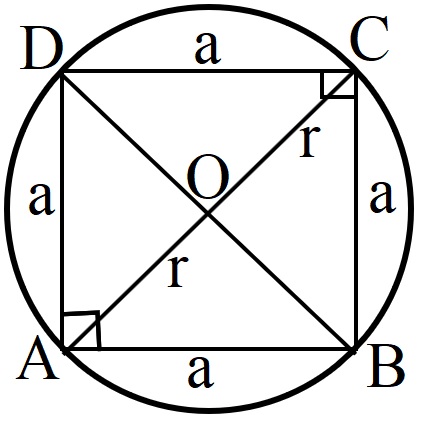
In $\triangle\text{ABC},\angle\text{B}=90^\circ$
$\text{AC}^2=\text{AB}^2+\text{BC}^2$
$\Rightarrow(2\text{r})^2 =\text{a}^2 +\text{a}^2$
$\Rightarrow4\text{r}^2=2\text{a}^2$
$\Rightarrow\text{a}^2=2\text{r}[\because \text{a}^2=\text{area of square}]$
View full question & answer→MCQ 311 Mark
Directions : In the following questions, a statement of assertion $(A)$ is followed by a statement of reason $(R)$. Mark the correct choice as:
Assertion : $(A)$ If the outer and inner diameter of a circular path is $10m$ and $6m$ respectively, then area of the path is $16\pi\text{ m}^2$
Reason : $(R)$ If $R$ and $r$ be the radius of outer and inner circular path respectively, then area of circular path $=\pi(\text{R}^2-\text{r}^2).$
- ✓
Both assertion $(A)$ and reason $(R)$ are true and reason $(R)$ is the correct explanation of assertion $(A)$.
- B
Both assertion $(A)$ and reason $(R)$ are true but reason $(R)$ is not the correct explanation of assertion $(A)$.
- C
Assertion $(A)$ is true but reason $(R)$ is false.
- D
Assertion $(A)$ is false but reason $(R)$ is true.
AnswerCorrect option: A. Both assertion $(A)$ and reason $(R)$ are true and reason $(R)$ is the correct explanation of assertion $(A)$.
View full question & answer→MCQ 321 Mark
Directions: In the following questions, a statement of assertion $(A)$ is followed by a statement of reason $(R)$. Mark the correct choice as:
Assertion: A wire is looped in the form of a circle of radius $28 \ cm$ .It is bent into a square. Then the area of the square is $1936 \ cm^2$
Reason: Angle described by a minute hand in $60$ minutes $=360^{\circ}$
- A
Both assertion $(A)$ and reason $(R)$ are true and reason $(R)$ is the correct explanation of assertion $(A).$
- B
Both assertion $(A)$ and reason $(R)$ are true but reason $(R)$ is not the correct explanation of assertion $(A).$
- C
Assertion $(A)$ is true but reason $(R)$ is false.
- ✓
Assertion $(A)$ is false but reason $(R)$ is true.
AnswerCorrect option: D. Assertion $(A)$ is false but reason $(R)$ is true.
We have, $2\pi\text{r}=\text{length of wire}$
$2\times\frac{22}{7}\times28=\text{length of wire}$
$\text{length of wire}=176\text{cm}$
Now, perimeter of square $\text{perimeter of square}=176\text{cm}$
$4\text{a}=176\text{cm}$
$\text{a}=44$
$\text{Area of square}= (44)^2 = 1936 \text{cm}^2$
View full question & answer→MCQ 331 Mark
Directions : In the following questions, a statement of assertion $(A)$ is followed by a statement of reason $(R).$ Mark the correct choice as:
Assertion : If the circumference of a circle is $176\ cm,$ then its radius is $28\ cm.$
Reason : Circumference $=2\pi\times\text{radious}$
- ✓
Both assertion $(A)$ and reason $(R)$ are true and reason $(R)$ is the correct explanation of assertion $(A)$.
- B
Both assertion $(A)$ and reason $(R)$ are true but reason $(R)$ is not the correct explanation of assertion $(A)$.
- C
Assertion $(A)$ is true but reason $(R)$ is false.
- D
Assertion $(A)$ is false but reason $(R)$ is true.
AnswerCorrect option: A. Both assertion $(A)$ and reason $(R)$ are true and reason $(R)$ is the correct explanation of assertion $(A)$.
$\text{C}=2\times\frac{22}{7}\times\text{r}=176$
$\Rightarrow\text{r}=\frac{176\times7}{2\times22}=28\text{ cm}$
View full question & answer→MCQ 341 Mark
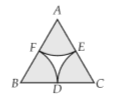
Statement A (Assertion) : In the given figure, if arcs are drawn by taking vertices $A$, $B$ and $C$ of an equilateral triangle of side $8 cm$, to intersect the sides $B C, C A$ and $A B$ at their respective mid-points $D, E$ and $F$, then area of the shaded region is $25.12 cm ^2$. (Use $\pi=3.14$ )
Statement R (Reason) : The area of a sector of a circle of radius $r$ with sector angle $\theta$ is $\frac{\theta}{180^{\circ}} \times \pi r^2$ sq. units. - A
Both assertion (A) and reason ( $R$ ) are true and reason $(R)$ is the correct explanation of assertion $(A)$.
- B
Both assertion (A) and reason ( $R$ ) are true and reason $(R)$ is not the correct explanation of assertion (A).
- ✓
Assertion $(A)$ is true but reason $(R)$ is false.
- D
Assertion (A) is false but reason $(R)$ is true.
AnswerCorrect option: C. Assertion $(A)$ is true but reason $(R)$ is false.
(c) : Given, $\triangle A B C$ is an equilateral triangle.
$\therefore \angle A=\angle B=\angle C=60^{\circ}$ and radius, $r=\frac{8}{2} cm =4 cm$
Area of sector AFEA $=\frac{\theta}{360^{\circ}} \times \pi r^2=\frac{60^{\circ}}{360^{\circ}} \times \pi(4)^2$
$
=\frac{8}{3} \pi cm ^2
$Since, area of all three sectors are equal.
$\therefore \quad$ Total area of shaded region $=3\left(\frac{8}{3} \pi\right)=25.12 cm ^2$
So, assertion and reason both are true but reason is not the correct explanation of assertion.
View full question & answer→MCQ 351 Mark
Statement A (Assertion) : In the figure, $C_1$ and $C_2$ are two circles with radii $7 cm$ and $5 cm$ respectively, then area of shaded portion is $24 \pi cm ^2$.

Statement R (Reason) : Area of the shaded region $=\pi\left(r_1^2+r_2^2\right)$ where $r_1$ and $r_2$ are the radii of outer and inner circle respectively. - A
Both assertion (A) and reason ( $R$ ) are true and reason $(R)$ is the correct explanation of assertion $(A)$.
- B
Both assertion (A) and reason ( $R$ ) are true and reason $(R)$ is not the correct explanation of assertion (A).
- ✓
Assertion $(A)$ is true but reason $(R)$ is false.
- D
Assertion (A) is false but reason $(R)$ is true.
AnswerCorrect option: C. Assertion $(A)$ is true but reason $(R)$ is false.
(c) : Area of circle $C_1=\pi(7)^2=49 \pi cm ^2$
Area of circle $C_2=\pi(5)^2=25 \pi cm ^2$
Area of shaded portion $=$ Area of circle $C_1-$ Area of circle $C_2=49 \pi-25 \pi=24 \pi cm ^2$.
So, assertion is true but reason is false.
View full question & answer→MCQ 361 Mark
Statement A (Assertion) : A sector is cut from a circle of radius $42 cm$. If the central angle of the sector is $150^{\circ}$, then the perimeter of the sector is $194 cm$.
Statement R (Reason) : Perimeter of sector $=2$ (radius) + Length of corresponding arc of sector.
- ✓
Both assertion (A) and reason ( $R$ ) are true and reason $(R)$ is the correct explanation of assertion $(A)$.
- B
Both assertion (A) and reason ( $R$ ) are true and reason $(R)$ is not the correct explanation of assertion (A).
- C
Assertion $(A)$ is true but reason $(R)$ is false.
- D
Assertion (A) is false but reason $(R)$ is true.
AnswerCorrect option: A. Both assertion (A) and reason ( $R$ ) are true and reason $(R)$ is the correct explanation of assertion $(A)$.
(a) : We have, radius of circle, $r=42 cm$
Sector angle, $\theta=150^{\circ}$
$\therefore \quad$ Perimeter of sector $=2 r+\frac{\theta}{360^{\circ}} \times 2 \pi r$
$
=2 \times 42+\frac{150^{\circ}}{360^{\circ}} \times 2 \times \frac{22}{7} \times 42=84+110=194 cm .
$
So, assertion and reason both are true and reason is the correct explanation of assertion.
View full question & answer→MCQ 371 Mark
Statement A (Assertion): The diameter of a wheel is $4.2 m$. It makes 75 revolutions in one minute. The distance covered by the wheel in one minute is $990 m$.
Statement R (Reason) : Distance travelled in one minute $=$ circumference $\times$ Number of revolutions in one minute.
- ✓
Both assertion (A) and reason ( $R$ ) are true and reason $(R)$ is the correct explanation of assertion $(A)$.
- B
Both assertion (A) and reason ( $R$ ) are true and reason $(R)$ is not the correct explanation of assertion (A).
- C
Assertion $(A)$ is true but reason $(R)$ is false.
- D
Assertion (A) is false but reason $(R)$ is true.
AnswerCorrect option: A. Both assertion (A) and reason ( $R$ ) are true and reason $(R)$ is the correct explanation of assertion $(A)$.
(a) : We have, diameter of wheel $=4.2 m$Circumference of circle $=$ one revolution
$
=\pi \times 4.2=\frac{22}{7} \times 4.2=13.2 m
$Distance covered in 75 revolutions $=(75 \times 13.2) m =990 m$
So, assertion and reason both are true and reason is the correct explanation of assertion.
View full question & answer→MCQ 381 Mark
Statement A (Assertion) : The sum of areas of a major sector and the corresponding minor sector of a circle is equal to the area of the circle.
Statement R (Reason) : Area of the major segment of a circle $=$ Area of circle + Area of minor segment.
- A
Both assertion (A) and reason ( $R$ ) are true and reason $(R)$ is the correct explanation of assertion $(A)$.
- B
Both assertion (A) and reason ( $R$ ) are true and reason $(R)$ is not the correct explanation of assertion (A).
- ✓
Assertion $(A)$ is true but reason $(R)$ is false.
- D
Assertion (A) is false but reason $(R)$ is true.
AnswerCorrect option: C. Assertion $(A)$ is true but reason $(R)$ is false.
View full question & answer→MCQ 391 Mark
Statement A (Assertion): In the circumferences of two circles are in the ratio $1: 3$, then the ratio of their areas is $1: 9$.
Statement R (Reason) : The area of a sector of a circle of radius $r$ with sector angle $\theta$ is $\frac{\theta}{180^{\circ}} \times \pi r^2$ sq. units.
- A
Both assertion (A) and reason ( $R$ ) are true and reason $(R)$ is the correct explanation of assertion $(A)$.
- ✓
Both assertion (A) and reason ( $R$ ) are true and reason $(R)$ is not the correct explanation of assertion (A).
- C
Assertion $(A)$ is true but reason $(R)$ is false.
- D
Assertion (A) is false but reason $(R)$ is true.
AnswerCorrect option: B. Both assertion (A) and reason ( $R$ ) are true and reason $(R)$ is not the correct explanation of assertion (A).
(b) : Let $r_1$ and $r_2$ be the radii of two circles.Then, ratio of their circumference $=\frac{2 \pi r_1}{2 \pi r_2}=\frac{1}{3}$
$
\Rightarrow \frac{r_1}{r_2}=\frac{1}{3} \Rightarrow \frac{r_1^2}{r_2^2}=\frac{1}{9}
$
Now, ratio of their areas $=\frac{\pi r_1^2}{\pi r_2^2}=\frac{r_1^2}{r_2^2}=\frac{1}{9}=1: 9$.
So, assertion and reason both are true but reason is not the correct explanation of assertion.
View full question & answer→MCQ 401 Mark
Statement A (Assertion): The area of a circle having circumference of $44 cm$ is $154 cm ^2$. Statement R (Reason) : The area of a sector of a circle of radius $r$ with central angle $x$ is $\frac{x}{360^{\circ}} \times 2 \pi r$. sq. units.
- A
Both assertion (A) and reason ( $R$ ) are true and reason $(R)$ is the correct explanation of assertion $(A)$.
- B
Both assertion (A) and reason ( $R$ ) are true and reason $(R)$ is not the correct explanation of assertion (A).
- ✓
Assertion $(A)$ is true but reason $(R)$ is false.
- D
Assertion (A) is false but reason $(R)$ is true.
AnswerCorrect option: C. Assertion $(A)$ is true but reason $(R)$ is false.
(c) : Let $r cm$ be the radius of the circle.Given, circumference of circle $=44 cm$
$
\therefore \quad 2 \pi r=44 \Rightarrow 2 \times \frac{22}{7} \times r=44 \Rightarrow r=7
$
$\therefore \quad$ Area of circle $=\pi r^2=\left(\frac{22}{7} \times 7 \times 7\right) cm ^2$
$
=154 cm ^2
$
So, assertion is true but reason is false.
View full question & answer→MCQ 411 Mark
Statement $A ($Assertion$):$ The perimeter of the sector with radius $42 \ cm$ and sector angle $90^{\circ}$ is $150 \ cm$.
Statement $R ($Reason$):$ The perimeter of a sector of a circle of radius $r$ with sector angle $\theta$ is $\frac{\theta}{360^{\circ}} \times 2 \pi r$.
- A
Both assertion $(A)$ and reason $(R)$ are true and reason $(R)$ is the correct explanation of assertion $(A)$.
- B
Both assertion $(A)$ and reason $(R)$ are true and reason $(R)$ is not the correct explanation of assertion $(A).$
- ✓
Assertion $(A)$ is true but reason $(R)$ is false.
- D
Assertion $(A)$ is false but reason $(R)$ is true.
AnswerCorrect option: C. Assertion $(A)$ is true but reason $(R)$ is false.
Here, $r =42 \ cm$ and $\theta=90^{\circ}$ Perimeter of sector $=2 r \ +$ length of arc of sector
$=2 r+\frac{\theta}{360^{\circ}} \times 2 \pi r$
$=2 \times 42+\frac{90^{\circ}}{360^{\circ}} \times 2 \times \frac{22}{7} \times 42$
$=84+66=150 \ cm$
So, assertion is correct and reason is not the correct explanation of assertion.
View full question & answer→MCQ 421 Mark
Statement A (Assertion) : The area of a circle of circumference $18 \pi$ units is $81 \pi$ sq. units. Statement R (Reason): The area of a circle is ' $r$ ' times its circumference, where $r=$ radius.
- A
Both assertion (A) and reason ( $R$ ) are true and reason $(R)$ is the correct explanation of assertion $(A)$.
- B
Both assertion (A) and reason ( $R$ ) are true and reason $(R)$ is not the correct explanation of assertion (A).
- ✓
Assertion $(A)$ is true but reason $(R)$ is false.
- D
Assertion (A) is false but reason $(R)$ is true.
AnswerCorrect option: C. Assertion $(A)$ is true but reason $(R)$ is false.
(c) : Let $r$ be the radius of circle.Now, circumference of circle $=18 \pi$
[Given]
$\Rightarrow 2 \pi r=18 \pi \Rightarrow r=9$ units
$\therefore \quad$ Area of circle $=\pi r^2=\pi(9)^2=81 \pi$ sq. units
Area of circle $=\pi r^2=(2 \pi r) \cdot \frac{r}{2}$
$\Rightarrow$ Area of circle is $\frac{r}{2}$ times its circumference.
View full question & answer→MCQ 431 Mark
Statement A (Assertion) : If the radius of a circle is $\frac{7}{\sqrt{\pi}} cm$, then the area of the circle is $49 cm ^2$.
Statement $R$ (Reason) : If $r$ is radius of a circle, then area of circle is $2 \pi r sq$. units.
- A
Both assertion (A) and reason ( $R$ ) are true and reason $(R)$ is the correct explanation of assertion $(A)$.
- B
Both assertion (A) and reason ( $R$ ) are true and reason $(R)$ is not the correct explanation of assertion (A).
- ✓
Assertion $(A)$ is true but reason $(R)$ is false.
- D
Assertion (A) is false but reason $(R)$ is true.
AnswerCorrect option: C. Assertion $(A)$ is true but reason $(R)$ is false.
(c) : Radius of the circle $(r)=\frac{7}{\sqrt{\pi}} cm$
$\therefore \quad$ Area of the circle $=\pi r^2=\pi\left(\frac{7}{\sqrt{\pi}}\right)^2=49 cm ^2$
So, assertion is true but reason is false.
View full question & answer→