Questions

5 Marks Questions

🎯

Test yourself on this topic

35 questions · timed · auto-graded

Question 15 Marks
The length of minute hand of a clock is 5cm. Find the area swept by the minute hand during the time period 6:05 AM and 6:40 AM.
Answer
We know that, in 60 min, minute hand revolving = 360°
In 1 min, minute hand revolving $=\frac{360^\circ}{60^\circ}$
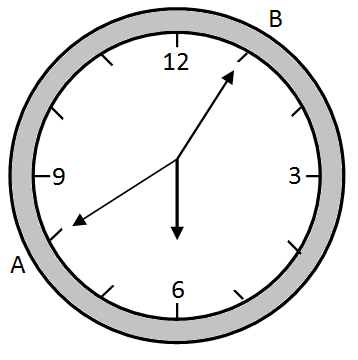
$\therefore$ In (6:05 AM to 6:40) = 35 min,
Minute hand revolving $=\frac{360^\circ}{60^\circ}\times35=6\times35$
Given that, length of minute hand (r) = 5cm
$\therefore$ Area of sector AOBA with angle $\angle\text{O}$
$=\frac{\pi\text{r}^2}{360^\circ}\times\angle\text{O}$
$=\frac{22}{7}\times\frac{(5)^2}{360^\circ}\times6\times35$
$=\frac{22}{7}\times\frac{5\times5}{360^\circ}\times6\times35$
$=\frac{22\times5\times5\times5}{60^\circ}=\frac{22\times5\times5}{12}$
$=\frac{11\times5\times5}{6}=\frac{275}{6}=45\frac{5}{6}\text{cm}^2 $
Hence, the required area swept by the minute land is $45\frac{5}{6}\text{cm}^2.$
View full question & answer
Question 25 Marks
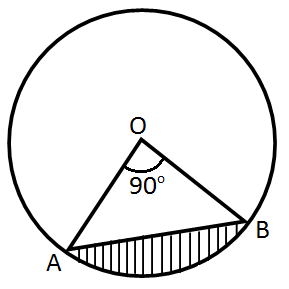
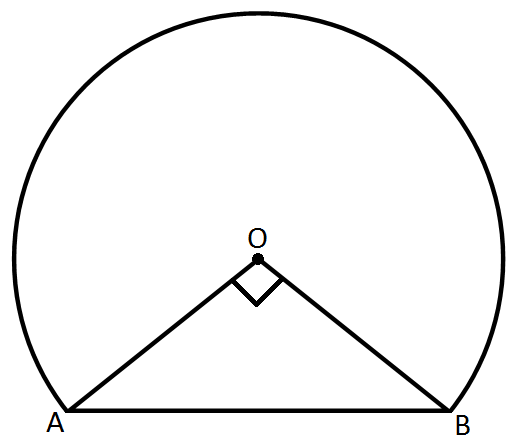
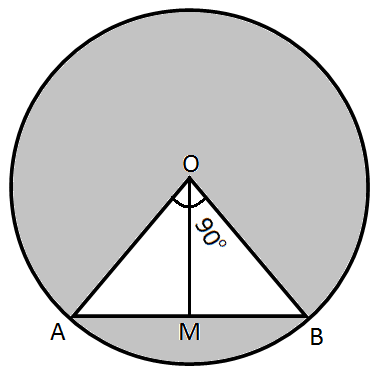
A chord of a circle of radius 20cm subtends an angle of 90° at the centre. Find the area of the corresponding major segment of the circle.$(\text{Use }\pi=3.14)$
Answer
Let AB be the chord of a circle of radius 10cm, with O as the centre of the circle.

Here, $\angle\text{AOB}=90^\circ$ and we have to find the
area of the major segment (which is shaded).
As $\angle\text{AOB}=90^\circ,$ therefore angle of the major
sector $=360^\circ-90^\circ=270^\circ$
So, area of the major sector
$=\frac{270}{360}\times\pi\times(10)^2\text{cm}^2$
$=\frac{3}{4}\times3.14\times100\text{cm}^2$
$=75\times3.14\text{cm}^2=235.5\text{cm}^2$
Now, to find the area of $\triangle\text{OAB},$
draw $\text{OM}\perp\text{AB}.$
So, $\text{AM}=\frac{1}{2}\text{AB}$ and $\angle\text{AOM}=\frac{1}{2}\times90^\circ=45^\circ$
Now, $\frac{\text{AM}}{\text{OA}}=\sin45^\circ=\frac{1}{\sqrt{2}}$
So, $\text{AM}=10\times\frac{1}{\sqrt{2}}\text{cm}$
Therefore, $\text{AB}=10\sqrt{2}\text{cm}$ and OM = OA
$\cos45^\circ=10\times\frac{1}{\sqrt{2}}\text{cm}=5\sqrt{2}\text{cm}$
So, area of $\triangle\text{OAB}=\frac{1}{2}\text{base}\times\text{height}$
$=\frac{1}{2}10\sqrt{2}\times5\sqrt{2}\text{cm}^2=50\text{cm}^2$
Therefore, the area of the required major
segment $ = 235.5\text{cm}^2 + 50\text{cm}^2 = 285.5\text{cm}^2$
Another method foe the area of $\triangle\text{OAB}$
As, $\angle\text{AOB}=90^\circ$
Therefore, area of $\triangle\text{OAB}=\frac{1}{2}.\text{OA}\times\text{OB}$
$=\frac{1}{2}10\times10\times\text{cm}^2=50\text{cm}^2$
View full question & answer
Question 35 Marks
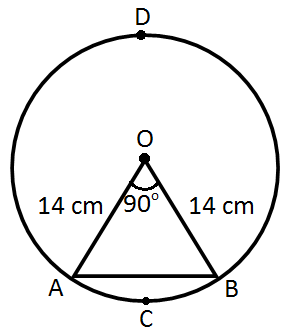
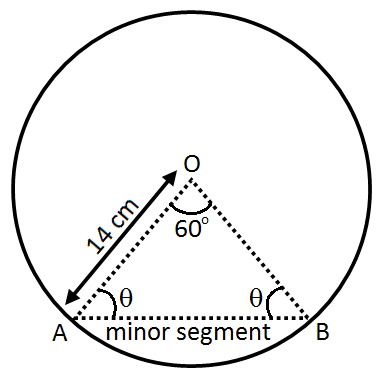
A chord of a circle of radius 14cm makes a right angle at the centre. Find the areas of the minor and major segments of the circle.
Answer
Radius of the circle (r) = 14cm
Angle at the centre $(\theta)=90^\circ$

AB is the chord
$\therefore$ Area of minor segment ACB
$=\Big(\frac{\pi\theta}{360^\circ}-\sin\frac{\theta}{2}\cos\frac{\theta}{2}\Big)\text{r}^2$
$=\Big(\frac{\pi\times90^\circ}{360^\circ}-\sin\frac{90^\circ}{2}\cos\frac{90^\circ}{2}\Big)(14)^2\text{cm}^2$
$=\Big(\frac{\pi}{4}-\sin45^\circ\cos45^\circ\Big)\times196\text{cm}^2$
$=196\Big(\frac{22}{7\times4}-\frac{1}{\sqrt{2}}\times\frac{1}{\sqrt{2}}\Big)\text{cm}^2$
$=\Big(\frac{22\times196}{28}-196\times\frac{1}{2}\Big)\text{cm}^2$
$=(154-98)=56\text{cm}^2$
Area of the circle $=\pi\text{r}^2=\frac{22}{7}\times(14)^2\text{cm}^2$
$=\frac{22}{7}\times14\times14=616\text{cm}^2$
$\therefore$ Area of major segment ADB = area of the circle - area of minor segment
$= 616 - 56 = 560cm^2$​​​​​​​
View full question & answer
Question 45 Marks
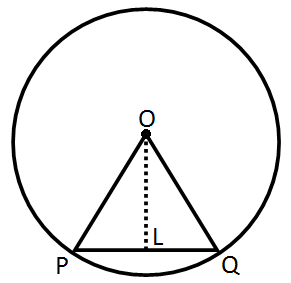
A chord PQ of length 12cm subtends an angle of 120° at the centre of a circle. Find the area of the minor segment cut off by the chord PQ.
Answer
We know that the area of minor segment of angle $\theta$ in a circle of radius r is, $\text{A}=\Big\{\frac{\pi\theta}{360^\circ}-\sin\frac{\theta}{2}\cos\frac{\theta}{2}\Big\}\text{r}^2$ It is given that the chord PQ divides the circle in two segments.
We have $\angle\text{POQ}=120$ and PQ = 12cm So, $\text{PL}=\frac{\text{PQ}}{2}\text{cm}$ $=\frac{12}{2}\text{cm}$ $= 6\text{cm}$ Since $\angle\text{POQ}=120,$ $\angle\text{POL}=\angle\text{QOL}$ $=60^\circ$ In $\triangle\text{OPQ},$ We have $\sin\theta=\frac{\text{PL}}{\text{OP}}$ $\sin60^\circ=\frac{6}{\text{OP}}$ $\frac{\sqrt{3}}{2}=\frac{6}{\text{OP}}$ $\text{OP}=\frac{12}{\sqrt{3}}$ Thus the radius of circle is $\text{OP}=4\sqrt{3}\text{cm}.$ Now using the value of radius r and angle $\theta$ we will find the area of minor segment $\text{A}=\Big\{\frac{120^\circ\pi}{360^\circ}-\sin\frac{120^\circ}{2}\cos\frac{120^\circ}{2}\Big\}\big(4\sqrt{3}\big)^2$ $=\Big\{\frac{\pi}{3}-\frac{\sqrt{3}}{2}\times\frac{1}{2}\Big\}\times48$ $=4\big\{4\pi-3\sqrt{3}\big\}\text{cm}^2$
View full question & answer
Question 55 Marks
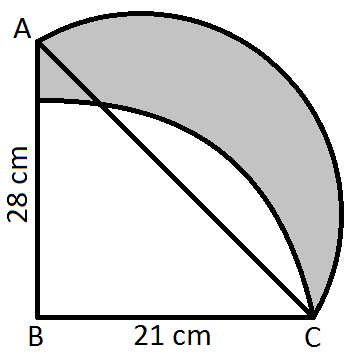
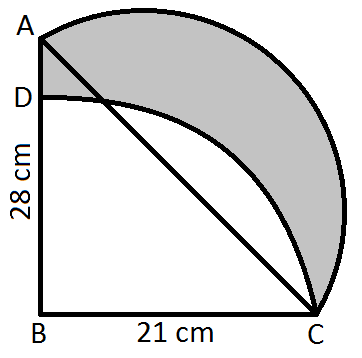
In the following figure, ABC is a right-angled triangle,$\angle\text{B}=90^\circ,$ AB = 28cm and BC = 21cm. With AC as diameter a semicircle is drawn and with BC as radius a quarter circle is drawn. Find the area of the shaded region correct to two decimal places.
Answer
In right $\triangle\text{ABC},$ AB = 28cm, BC = 21cm

$\therefore$ $AC^2 = AB^2 + BC^2$(Pythagoras theorem)
$= (28)^2+ (21)^2 = 784 + 441 = 1225 = (35)^2​​​​​​​$
$\therefore$ AC = 35cm
$\therefore$ Radius of quadrant BCD= 21cm and radius of semicircle on AC as diameter
$=\frac{35}{2}\text{cm}$ Area of
$\triangle\text{ABC}=\frac{1}{2}\text{ AB}\times\text{BC}=\frac{1}{2}\times28\times21\text{cm}^2=294\text{cm}^2$
Area of quadrant BCD $=\frac{1}{4}\pi\text{r}^2$
$=\frac{1}{4}\times\frac{22}{7}\times21\times21\text{cm}^2$
$=\frac{693}{2}=346.5\text{cm}^2$ and area of semicircle on AC as diameter
$=\frac{1}{2}\pi\text{R}^2=\frac{1}{2}\times\frac{22}{7}\times\frac{35}{2}\times\frac{35}{2}\text{cm}^2$
$=\frac{1925}{4}=481.25\text{cm}^2$
$\therefore$Area of shaded region = Area of
$\triangle\text{ABC}$ + area of semicircle - area of quadrant
$=294+481.25-346.50\text{cm}^2$
​​​​​​​ $=428.75\text{cm}^2$
View full question & answer
Question 65 Marks
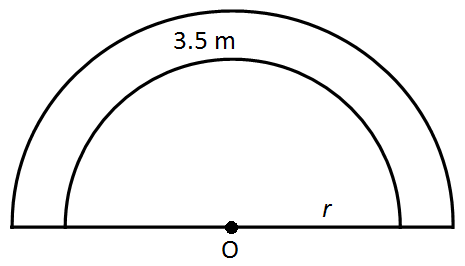
A path of width 3.5m runs around a semi­circular grassy plot whose perimeter is 72m. Find the area of the path. $\Big(\text{Use }\pi=\frac{22}{7}\Big)$
Answer
Perimeter of semicircle grassy plot = 72m

Let r be the radius of the plot
$\therefore\pi\text{r}+2\text{r}=72\Rightarrow\frac{22}{7}\text{r}+2\text{r}=72$
$\Rightarrow\frac{36}{7}\text{r}=72\Rightarrow\text{r}=\frac{72\times7}{36}=14\text{m}$
$\therefore$ Inner radius = 14m
and outer radius = 14+3.5 = 17.5 $=\frac{35}{2}\text{m}$
$\text{Now area of path}=\frac{1}{2}\pi\text{R}^2-\frac{1}{2}\pi\text{r}^2=\frac{1}{2}\pi$
$(\text{R}^2-\text{r}^2)$
$=\frac{1}{2}\times\frac{22}{7}\bigg[\Big(\frac{35}{2}\Big)^2-(14)^2\bigg]$
$=\frac{11}{7}\Big[\frac{1225}{4}-196\Big]\text{m}^2$
$=\frac{11}{7}\Big[\frac{1225-784}{4}\Big]$
$=\frac{11}{7}\times\frac{441}{4}\text{m}^2=\frac{693}{4}\text{m}^2$
$=173.25\text{m}^2$
View full question & answer
Question 75 Marks
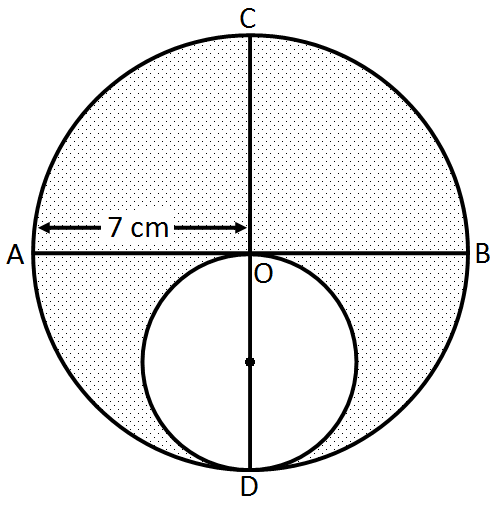
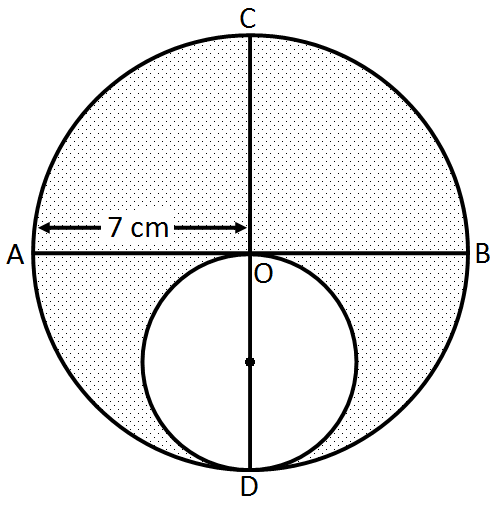
In the following figure, AB and CD are two diameters of a circle perpendicular to each other and OD is the diameter of the smaller circle. If OA = 7cm, find the area of the shaded region.
Answer
It is given that AB and CD are two diameters of a circle perpendicular to each other and OD is the diameter of small circle.

It is given that, OA = 7cm
So, radius r of small circle is
$=\frac{7}{2}\text{cm}$
$=3.5\text{cm}$
We know that the area A of circle of radius r is $\text{A}=\pi\text{r}^2$.
Substituting the value of r in above formula,
$\text{A}=\frac{22}{7}\times3.5\times3.5$
$=38.5\text{cm}^2$
Now, let the area of large circle be A'.
Using the value radius OA,
$\text{A}'=\frac{22}{7}\times7\times7$
$=154\text{cm}^2$
Hence,
Area of shaded rigion = Area of largion circle - Area of small circle
$= 154 - 38.5$
$= 115.5cm^2$​​​​​​​
View full question & answer
Question 85 Marks
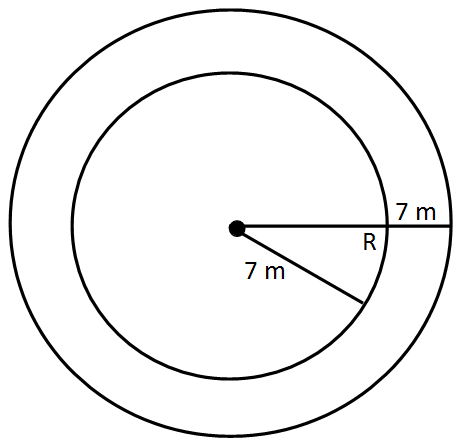
A road which is 7m wide surrounds a circular park whose circumference is 352m. Find the area of the road.
Answer
Width of the road = 7m
Circumference of the park = 352m Let r be the radius, then $2\pi\text{r}=352$ $\Rightarrow2\times\frac{22}{7}\text{r}=352\Rightarrow\text{r}=\frac{352\times7}{2\times22}$ ⇒ r = 56m Width of outer road = 7m $\therefore$ outer radius (R) = 56+7 = 63m $\therefore\text{Area of the road}=\pi\text{R}^2-\pi\text{r}^2$ $=\pi(\text{R}^2-\text{r}^2)=\frac{22}{7}(63^2-56^2)\text{m}^2$ $=\frac{22}{7}(63+56)(63-56)\text{m}^2$ $=\frac{22}{7}\times119\times7=2618\text{m}^2$
View full question & answer
Question 95 Marks
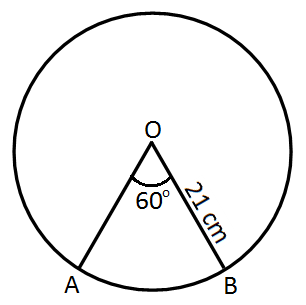
In a circle of radius 21cm, an arc subtends an angle of 60° at the centre. Find
  1. The length of the arc.
  2. Area of the sector formed by the arc. $\Big(\text{Use }\pi=\frac{22}{7}\Big)$
Answer
Radius of a circle (r) = 21cm Angle at the centre = 60°
  1. $\therefore$ Length of arc $\text{AB}=2\pi\text{r}\times\frac{\theta}{360^\circ}$
$=2\times\frac{22}{7}\times21\times\frac{60}{360}=22\text{cm}$
  1. Area of the sector $=\pi\text{r}^2\times\frac{\theta}{360^\circ}$
$=\frac{22}{7}\times21\times21\times\frac{60}{360}=231\text{cm}^2$
View full question & answer
Question 105 Marks
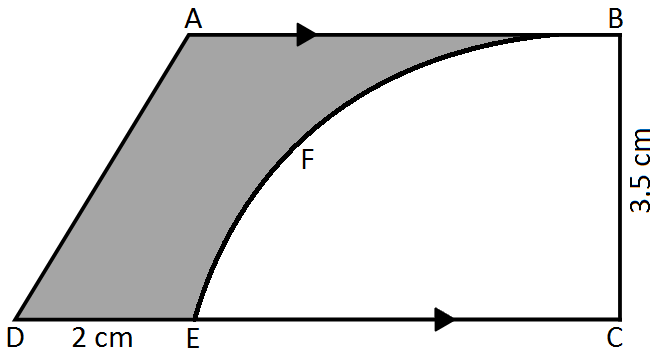
From a thin metallic piece, in the shape of a trapezium ABCD, in which $\text{AB} || \text{CD}$ and $\angle\text{BCD}=90^\circ,$ a quarter circle BEFC is removed (in the following figure). Given AB = BC = 3.5cm and DE = 2cm, calculate the area of the remaining piece of the metal sheet.
Answer
We have given a trapezium. We are asked to find the area of the shaded region. We can find the area of the remaining part that is area of the shaded region as shown below. Area of the shaded region = Area of the trapeziam - Area of the sector $\therefore$ Area of the shaded region $=\frac{1}{2}(\text{AB}+\text{CD})\times\text{BC}-\frac{\theta}{360}\pi\text{r}^2$ $\therefore$ Area of the shaded region $=\frac{1}{2}(3.5+\text{CD})\times3.5-\frac{90}{360}\pi(3.5)^2\dots(1)$ Now we find the value of CD ....(1) $\text{CD}=\text{CE}+\text{DE}$ $\therefore$ $\text{CD}=3.5+2$ ……(Since, CE is radius of the sector, therefore, CE = 3.5) Substituting the values of CD and $\pi=\frac{22}{7}$ in equation (1), $\therefore$ Area of the shaded region $=\frac{1}{2}(3.5+5.5)\times3.5-\frac{90}{360}\times\frac{22}{7}\times(3.5)^2$ $\therefore$ Area of the shaded region $=\frac{1}{2}(9)\times3.5-\frac{90}{360}\times\frac{22}{7}\times3.5\times3.5$ $\therefore$ Area of the shaded region $=\frac{31.5}{2}-\frac{1}{4}\times22\times0.5\times3.5$ $\therefore$ Area of the shaded region $=\frac{31.5}{2}-\frac{1}{2}\times11\times0.5\times3.5$ $\therefore$ Area of the shaded region $=\frac{31.5}{2}-\frac{19.25}{2}$ $\therefore$ Area of the shaded region $=\frac{12.25}{2}$ $\therefore$ Area of the shaded region $=6.125$Therefore, area of the remaining part is $=6.125\text{cm}^2$
View full question & answer
Question 115 Marks
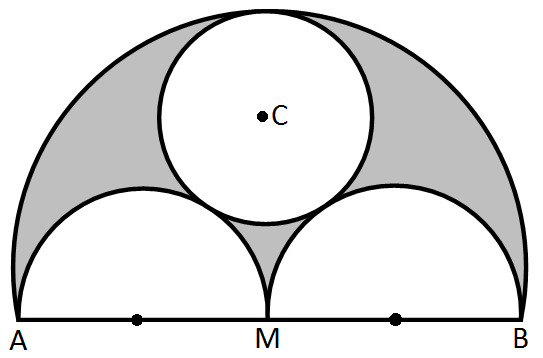
In the following figure, AB = 36cm and M is mid-point of AB. Semi-circles are drawn on AB, AMand MB as diameters. A circle with centre C touches all the three circles. Find the area of the shaded region.
Answer
We have given two semi-circles and one circle.
Area of the shaded region = area of semicircle with diameter AB - area of two semicircles with diameters AM and MB - area of circle ….(1)
Let us calculate the area of the semi-circle with AB as a diameter.
Area of semi-circle with AB as a diameter $=\frac{\pi\text{r}^2}{2}$
$\therefore$ Area of semi-circle with AB as a diameter $=\frac{\pi\big(\frac{36}{2}\big)^2}{2}$
$\therefore$ Area of semi-circle with AB as a diameter $=\frac{\pi\times18^2}{2}$
Now we will find the area of the semi-circle with AM as a diameter.
Area of semi-circle with AM as a diameter $=\frac{\pi\text{r}^2}{2}$
$\therefore$ Area of semi-circle with AM as a diameter $=\frac{\pi\big(\frac{18}{2}\big)^2}{2}$
$\therefore$ Area of semi-circle with AM as a diameter $=\frac{\pi\times9^2}{2}$
Area of the semi-circle with MB as a diameter is same as the area of the semi-circle with diameter with AM as a diameter.
Now we will find the area of the circle with centre C.
Area of circle $=\pi\times6^2$
Now we will substitute all these values in equation (1).
$\therefore$ Area of shaded region $=\frac{\pi\times18^2}{2}-\frac{\pi\times9^2}{2}-\frac{\pi\times9^2}{2}-36\pi$
$\therefore$ Area of shaded region $=\frac{\pi\times18^2}{2}-\pi\times9^2-36\pi$
$\therefore$ Area of shaded region $=\frac{\pi\times18^2}{2}-81\pi-36\pi$
$\therefore$ Area of shaded region $=\frac{\pi\times18^2}{2}-117\pi$
$\therefore$ Area of shaded region $=(162-117)\pi$
$\therefore$ Area of shaded region $=45\pi$
Therefore, area of shaded region is $45\pi\text{cm}^2.$
View full question & answer
Question 125 Marks
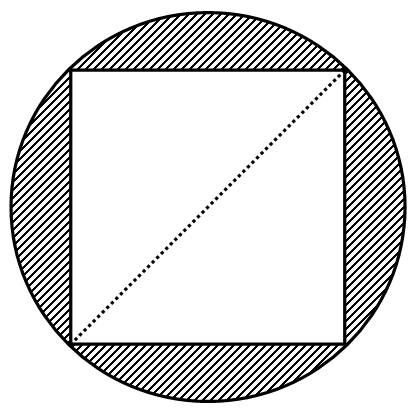
A square of diagonal 8cm is inscribed in a circle. Find the area Of the region lying outside the circle and inside the square.
 
Answer
Let the side of a square be a and the radius of circle be r.
Given that, length of diagonal of square = 8cm

$\Rightarrow\text{a}\sqrt{2}=8$
$\Rightarrow\text{a}=4\sqrt{2}\text{cm}$
Now, Diagonal of a square = Diameter of a circle
$\Rightarrow\text{Diameter of circle}=8$
$\Rightarrow\text{Radius of circle}=\text{r}=\frac{\text{Diameter}}{2}$
$\Rightarrow\text{r}=\frac{8}{2}=4\text{cm}$
$\therefore\text{Area of circle}=\pi\text{r}^2=\pi(4)^2$
$=16\pi\text{ cm}^2$
and area of square $=\text{a}^2=(4\sqrt{2})^2$
$=32\text{cm}^2$
So, the area of the shaded region = Area of circle - Area of square
$(16\pi-32)\text{cm}^2$
Hence, the required area of the shaded region is $(16\pi-32)\text{cm}^2$ .
View full question & answer
Question 135 Marks
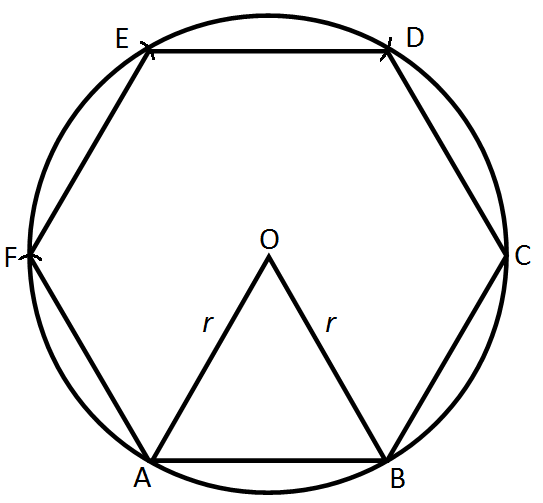
A regular hexagon is inscribed in a circle. If the area of hexagon is $24\sqrt{3}\text{cm}^2,$ find the area of the circle. $\big(\text{Use }\pi=3.14\big)$
Answer
A regular hexagon ABCDEF is inscribed in a circle Area of hexagon $=24\sqrt{3}\text{cm}^2$ Let r be the radius of circle $\therefore$ Side of regular hexagon = r Area of equilateral $\triangle\text{OAB}=\frac{\sqrt{3}}{4}\text{r}^2$ sq. unitsBut area of $\triangle\text{OAB}=\frac{1}{6}\times$ area of hexagon
$=\frac{24\sqrt{3}}{6}=4\sqrt{3}$ $\therefore\text{r}^2=\frac{4\sqrt{3}\times4}{\sqrt{3}}=16=(4)^2$ $\therefore\text{r}=4$ units Now area of circle = $\pi\text{r}^2=3.14\times(4)^2$ sq. units $=3.14\times16=50.24$ sq. units
View full question & answer
Question 145 Marks
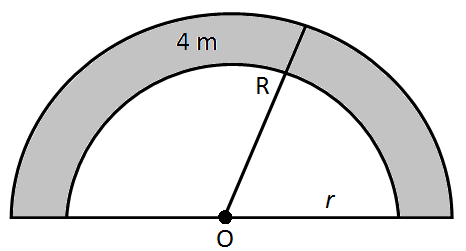
A path of 4m width runs round a semi­circular grassy plot whose circumference is 81 $\big(\frac{5}{7}\big)$m. Find:
  1. The area of the path.
  2. The cost of gravelling the path at the rate of ₹ 1.50 per square metre.
  3. The cost of turfing the plot at the rate of 45 paise per $m^2$​​​​​​​.
Answer
Width of path around the semicircular grassy plot = 4m
Circumference of the plot $= 81 \big(\frac{5}{7}\big)$m.
$=\big(\frac{572}{7}\big)\text{m}$
Let r be the radius of the plot, then
$\pi\text{r}=\frac{572}{7}\Rightarrow\frac{22}{7}\text{r}=\frac{572}{7}$
$(\text{Semicircumference}=\pi\text{r})$
$\Rightarrow\text{r}=\frac{572}{7}\times\frac{7}{22}=26$
$\therefore$ Radius of plot (r) = 26m
Width of the parh = 4m
Outer radius (R) = 26 + 4 = 30m

$\therefore\text{Area of path}=\frac{1}{2}\pi(\text{R}^2-\text{r}^2)$
$=\frac{1}{2}\times\frac{22}{7}(30^2-26^2)\text{m}$
$=\frac{11}{7}(30+26)(30-26)\text{m}^2$
$=\frac{11}{7}\times56\times4=352\text{m}^2$
Cost of Gravelling at the rate of 1.50 per $m^2$
$=₹352\times\frac{150}{100} =₹\frac{352\times3}{2}$
$=₹176\times3=₹528$
Area of the plot $=\frac{1}{2}\pi\text{r}^2$
$=\frac{1}{2}\times\frac{22}{7}\times(26)^2\text{m}^2$
$=\frac{11}{7}\times676=\frac{7436}{7}\text{m}^2$
Rate of turFing the plot = 45 paisa per $m^2$​​​​​​​
$\therefore\text{Total cost}=\text{Rs}.\frac{7436}{7}\times\frac{45}{100}$
= ₹ 478.02 = ₹ 478 (approx)
View full question & answer
Question 155 Marks
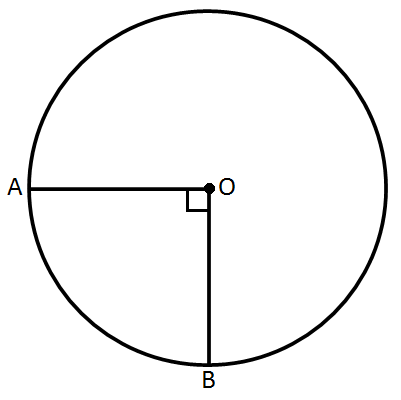
The radius of a circle with centre O is 5cm (see figure). Two radii OA and OB are drawn at right angles to each other. Find the areas of the segments made by the chord AB $(\text{Take }\pi=3.14).$
Answer

We know area of minor segment of the circle is $\text{A}=\Big\{\frac{\pi\theta}{360}-\sin\frac{\theta}{2}\cos\frac{\theta}{2}\Big\}\text{r}^2$
$\text{A}=\Big\{\frac{\pi90}{360}-\sin\frac{90}{2}\cos\frac{90}{2}\Big\}(5)^2$
$\text{A}=\Big\{\frac{\pi}{4}-\sin45\times\cos45\Big\}(5)^2$
$\text{A}=\Big\{\frac{\pi}{4}-\frac{1}{\sqrt{2}}\times\frac{1}{\sqrt{2}}\Big\}25$
$\text{A}=\Big\{\frac{\pi}{4}-\frac{1}{{2}}\Big\}25=7.125\text{cm}^2$
Area of the major segment = Area of the sector - area of minor segment
$=\pi(5)^2-7.125$
$=71.375\text{cm}^2$
View full question & answer
Question 165 Marks
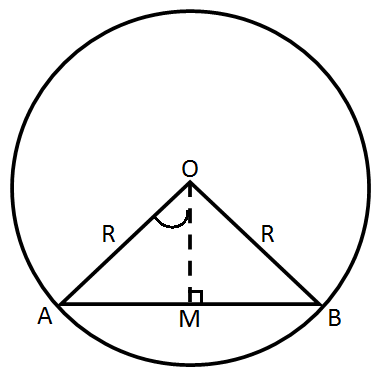
A chord of a circle subtends an angle of $\theta$ at the centre of the circle. The area of the minor segment cut off by the chord is one eighth of the area of the circle. Prove that
$8\sin\frac{\theta}{2}\cos\frac{\theta}{2}+\pi=\frac{\pi\theta}{45}.$
Answer

Let radius of circle = r
Area of circle $=\pi\text{r}^2$
AB is a chord, OA, OB are joined drop $\text{OM}\perp\text{AB}.$ This OM bisects AB as well as $\angle\text{AOB}.$
$\angle\text{AOM}=\angle\text{MOB}=\frac{1}{2}(0)=\frac{\theta}{2}$ $\text{AB}=2\text{AM}$
In $\triangle\text{AOM},\angle\text{AMO}=90^\circ$
$\sin\frac{\theta}{2}=\frac{\text{AM}}{\text{AO}}\Rightarrow\text{AM}=\text{R.}\sin\frac{\theta}{2}$ $\text{AB}=2\text{R}\sin\frac{\theta}{2}$
$\cos\frac{\theta}{2}=\frac{\text{OM}}{\text{AO}}\Rightarrow\text{OM}=\text{R}\cos\frac{\theta}{2}$
Area of segment cut off by AB = (area of sector) - (area of triangles)
$=\frac{\theta}{360}\times\pi\text{r}^2-\frac{1}{2}\times\text{AB}\times\text{OM}$
$=\text{R}^2\Big[\frac{\pi\theta}{360^\circ}-\frac{1}{2}.2\text{R}\sin\frac{\theta}{2}.\text{R}\cos\frac{\theta}{2}\Big]$
$=\text{R}^2\Big[\frac{\pi\theta}{360^\circ}-\sin\frac{\theta}{2}.\cos\frac{\theta}{2}\Big]$
Area of segment $=\frac{1}{8}$ (area of circle)
$\text{r}^2\Big[\frac{\pi\theta}{360^\circ}-\sin\frac{\theta}{2}.\cos\frac{\theta}{2}\Big]=\frac{1}{8}\pi\text{r}^2$
$\frac{8\pi\theta}{360^\circ}-8\sin\frac{\theta}{2}.\cos\frac{\theta}{2}=\pi$
$8\sin\frac{\theta}{2}.\cos\frac{\theta}{2}+\pi=\frac{\pi\theta}{45}$
View full question & answer
Question 175 Marks
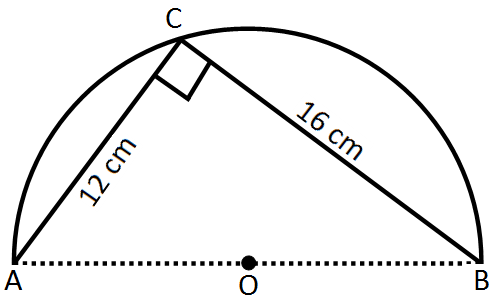
In the following figure, O is the centre of a circular arc and AOB is a straight line. Find the perimeter and the area of the shaded region correct to one decimal place. $\big(\text{Take }\pi=3.142\big)$
Answer
Let us find the perimeter of the shaded region.
$\therefore$ Perimeter $=\pi\times10+12+16$
$\therefore$ Perimeter = 3.142 × 10 + 28
$\therefore$ Perimeter = 31.42 + 28
$\therefore$ Perimeter = 59.42
Therefore, perimeter of the shaded region is. 59.4cm.
Now we will find the area of the shaded region can be calculated as shown below,
Area of the shaded region = Area of the semi-circle − area of the right angled triangle
First, we will find the length of AB as shown below,
$AB^2 = AC^2 + CB^2$​​​​​​​
$\therefore AB^2 = 12^2 + 16^2$
$\therefore AB^2 = 144 + 256$
$\therefore AB^2 = 400$
$\therefore AB = 20$
$\therefore$ Area of shaded region $=\frac{\pi\times10\times10}{2}-\frac{1}{2}\times12\times16$
$\therefore$ Area of shaded region $=\pi\times50-6\times16$
$\therefore$ Area of shaded region $\pi\times50-96$
Substituting $\pi=3.142$ we get,
$\therefore$ Area of shaded region $= 3.142 × 50 - 96$
$\therefore$ Area of shaded region $= 157.1 -96$
$\therefore$ Area of shaded region $= 61.1$
Therefore, area of the shaded region is $61.1cm^2.$
View full question & answer
Question 185 Marks
A chord 10cm long is drawn in a circle whose radius is $5\sqrt{2}\text{cm}.$ Find area of both the segments.
Answer
Given radius $=\text{r}=5\sqrt{2}\text{cm}$
$=\text{OA}=\text{OB}$
Length of chord AB = 10cm

In $\triangle\text{OAB},$
$\Rightarrow\text{OA}=\text{OB}$
$\Rightarrow5\sqrt{2}\text{cm}\text{ AB}=10\text{cm }$
$\Rightarrow\text{OA}^2+\text{OB}^2$
$\Rightarrow\big(5\sqrt{2}\big)^2+\big(5\sqrt{2}\big)^2$
$\Rightarrow50+50$
$\Rightarrow100=(\text{AB}^2)$
Pythagoras theom is satisfied OAB is right triangle
$\theta=$ angle subtended by chord $=\angle\text{AOB}=90^\circ$
Area of segment (minor) = shaded region
= area of sector - area of $\triangle\text{OAB}$
$=\frac{\theta}{360}\times\pi\text{r}^2-\frac{1}{2}\times\text{OA}\times\text{OB}$
$=\frac{90}{360}\times\frac{22}{7}\big(5\sqrt{2}\big)^2-\frac{1}{2}\times5\sqrt{2}\times5\sqrt{2}$
$=\frac{275}{7}-25=\frac{100}{7}\text{cm}^2$
Area of major segment = (area of circle) - (area of minor segment)
$=\pi\text{r}^2-\frac{100}{7}$
$=\frac{22}{7}\times\big(5\sqrt{2}\big)^2-\frac{100}{7}$
$=\frac{1100}{7}-\frac{100}{7}=\frac{1000}{7}\text{cm}^2$
View full question & answer
Question 195 Marks
In the following figure, ABC is an equilateral triangle of side 8cm. A, B and C are the centres of circular arcs of radius 4cm. Find the area of the shaded region correct up to 2 decimal places.$\big(\text{Take }\pi=3.142$ and $\sqrt{3}=1.732\big).$
Answer
In the figure, ABC is an equilateral triangle with 8cm as side with centres A, B and C,
circular arcs drawn of radius 4cm
Each side of $\triangle\text{ABC}$ = 8cm

$\therefore\text{Area}=\frac{\sqrt{3}}{4}\text{a}^2$
$=\frac{\sqrt{3}}{4}(8)^2=\frac{1.732\times64}{4}\text{cm}^2$
$=1.732\times16=27.712\text{cm}^2$
Angle of each sector $=60^\circ$
Area of 3 sector $3\times\pi\text{r}^2\times\frac{60^\circ}{360^\circ}$
$=3\times3.142\times4\times4\times\frac{1}{6}\text{cm}^2$
$=1.571\times16=25.136\text{cm}^2$
$\therefore$ Area of shaded portion
= Area of $\triangle\text{ABC}-$ areas of 3 sectors
$= 27.712 - 25.136 = 2.576cm^2$
$= 2.576cm^2$​​​​​​​
View full question & answer
Question 205 Marks
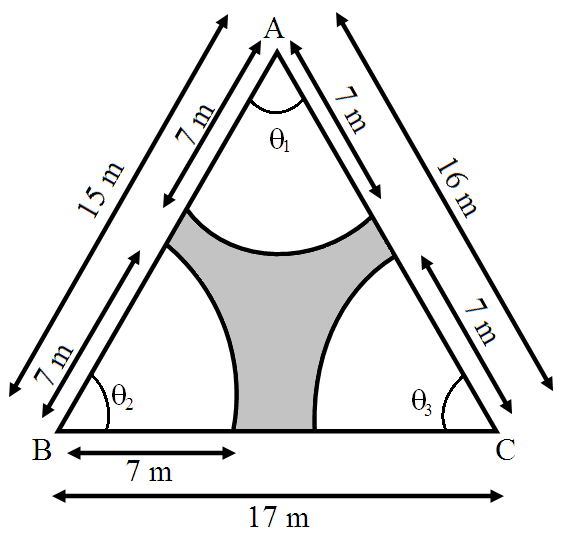
Side of a triangular field are 15m, 16m and 17m. With the three corners of the field a cow, a buffalo and tied separately with ropes of length 7m each to graze in field. Find the area of the field which cannot be grazed by three animals.
Answer

The area grazed by the cow, buffolo and the horse are in the form of sectors of the circle with radius 7m
Let the angle formed in the three sectors be $\theta_1,\theta_2,\theta_3$
Now the area of these sector will be
Area of sector with angle $\theta_1=\frac{\pi\theta_1(7)^2}{360}$
Area of sector with angle $\theta_2=\frac{\pi\theta_2(7)^2}{360}$
Area of sector with angle $\theta_3=\frac{\pi\theta_3(7)^2}{360}$
Area of the triangle ABC will be
$\text{S}=\frac{\text{a+b+c}}{2}=\frac{15+16+17}{2}=\frac{48}{2}=24$
$\text{Area}=\sqrt{\text{S}(\text{S}-\text{a})(\text{S}-\text{b})(\text{S}-\text{c})}$
$=\sqrt{24(24-15)(24-16)(24-17)}$
$=24\sqrt{21}\text{m}^2$
Area of the field not grazed by the animals = Area of the triangle ABC - Area of the thre sector.
$=24\sqrt{21}-\Big[\Big(\frac{\pi\theta_1(7)^2}{360}\Big)+\Big(\frac{\pi\theta_2(7)^2}{360}\Big)+\Big(\frac{\pi\theta_3(7)^2}{360}\Big)\Big]$
$=24\sqrt{21}-\Big(\frac{\pi\ (7)^2}{360}\Big)(\theta_1+\theta_2+\theta_3)$
$=24\sqrt{21}-\Big(\frac{\pi(7)^2}{360}\Big)(180)$ (Angle sum property)
$=\big(24\sqrt{21}-77\big)\text{m}^2$
View full question & answer
Question 215 Marks
A chord AB of a circle, of radius 14cm makes an angle of 60° at the centre of the circle. Find the area of the minor segment of the circle.$\Big(\text{Use }\pi=\frac{22}{7}\Big)$
Answer
We know that the area of minor segment of angle $\theta$ in a circle of radius r is,
$\text{A}=\Big\{\frac{\pi\theta}{360^\circ}-\sin\frac{\theta}{2}\cos\frac{\theta}{2}\Big\}\text{r}^2$
It is given that,
$\text{r}=14\text{cm}$
$\theta=60^\circ$
Substituting these values in above formula
$\text{A}=\Big\{\frac{3.14\times60^\circ}{360^\circ}-\sin\frac{60^\circ}{2}\cos\frac{60^\circ}{2}\Big\}\times14\times14$
$=\Big\{\frac{3.14}{6}-\sin30^\circ\cos30^\circ\Big\}\times196$
$=\frac{3.14\times196}{6}-\frac{1}{2}\times\frac{\sqrt{3}}{2}\times196$
$=102.573-84.868$
$\text{A}=17.70\text{cm}^2$
View full question & answer
Question 225 Marks
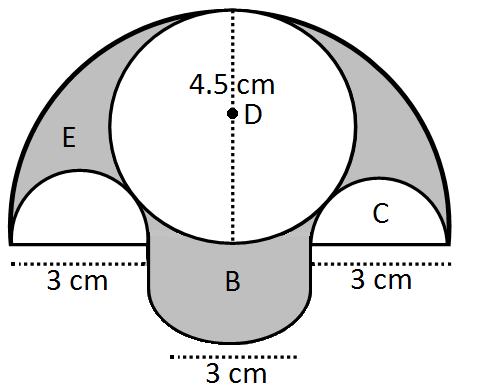
In the following figure, there are three semicircles, A, B and C having diameter 3cm each, and another semicircle E having a circle D with diameter 4.5cm are shown. Calculate:
The area of the shaded region.
The cost of painting the shaded region at the rate of 25 paise per $cm^2$​​​​​​​ , to the nearest rupee.
Answer
Area of the shaded region can be calculated as shown below,
Area of the shaded region = Area of the semi-circle with
diameter of 9cm - area of 2semicircles with radius 3cm - area of the circle with centre D + area of semi-circle with radius 3cm
$\therefore$ Area of the shaded region -
$= \frac{\pi\times4.5\times4.5}{2}-2\times\frac{\pi\times1.5\times1.5}{2}-\pi\times2.25\times2.25+\frac{\pi\times1.5\times1.5}{2}$
$\therefore$ Area of the shaded region $= \frac{\pi\times4.5\times4.5}{2}-2\times\frac{\pi\times1.5\times1.5}{2}-\pi\times2.25\times2.25$
$\therefore$ Area of the shaded region $=\frac{\pi}{2}(20.25-2.25)-\pi\times5.0625$
$\therefore$ Area of the shaded region $=\frac{\pi}{2}(18)-\pi\times5.0625$
$\therefore$ Area of the shaded region $=9\pi-\pi\times5.0625$
$\therefore$ Area of the shaded region $=\pi(9-5.0625)$
$\therefore$ Area of the shaded region $=3.9375\pi$
Substituting $\pi=\frac{22}{7}$ we get,
$\therefore$ Area of the shaded region $=3.9375\times\frac{22}{7}$
$\therefore$ Area of the shaded region $=12.375$
Therefore, area of the shaded region is $12.375cm^2.$
Now we will find the cost of painting the shaded region at the rate of 25 paise
per $cm^2.$
$\therefore \text{cost}=12.375\times25$
$\therefore\text{cost}=309.375$ paise
$\therefore\text{cost}=\text{Rs.} \ 3$
Therefore, cost of painting the shaded region to the nearest rupee is Rs 3.
View full question & answer
Question 235 Marks
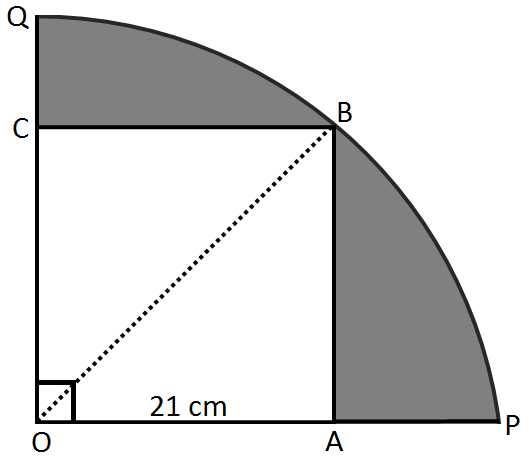
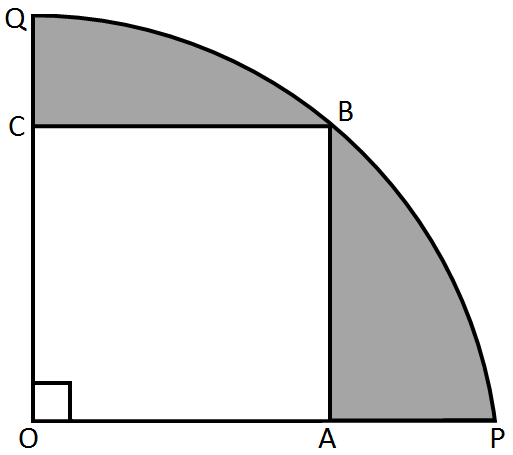
In the following figure a square OABC is inscribed in a quadrant OPBQ of a circle. If OA = 21cm, find the area of the shaded region.
Answer
In the figure, OPQ is a quadrant in which
OABC is a square OA = 21cm
Join OB,

$\therefore$ Diagonal OB $=\sqrt{2}\times\text{OA}$
$=\sqrt{2}\times21\text{cm}$
$=21\sqrt{2}\text{cm}$
Then radius of the quadrant $=21\sqrt{2}\text{cm}$
Now area od shadde region
= Area of quadrant - Area of square
$=\frac{1}{4}\pi\text{r}^2-(\text{OA})^2$
$=\frac{1}{4}\times\frac{22}7{}\times(21\sqrt{2})^2-(21)^2\text{cm}^2$
$=\frac{11}{14}\times441\times2-441=441\Big(\frac{22}{14}-1\Big)$
$=441\times\frac{8}{14}=252\text{cm}^2$
View full question & answer
Question 245 Marks
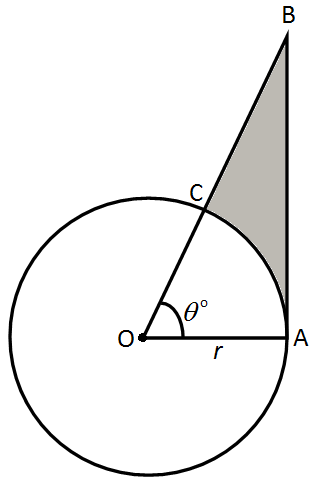
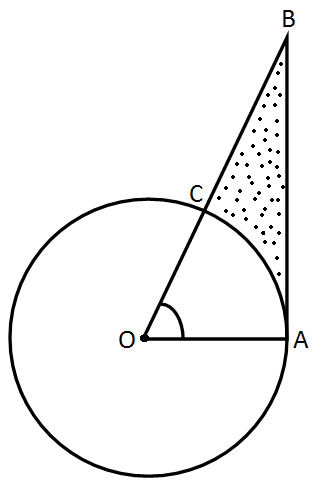
In the following figure, shows a sector of a circle, centre O, containing an angle $\theta^\circ.$ Prove that: Perimeter of the shaded region is $\Big(\tan\theta+\sec\theta+\frac{\pi\theta}{180}-1\Big)$
Answer
It is given that the radius of circle is r and the angle $\angle\text{AOC}=\theta^\circ$

In $\triangle\text{AOB},$
It is given that OA = r .
$\cos\theta=\frac{\text{OA}}{\text{OB}}$
$\text{OB}=\frac{\text{OA}}{\cos\theta}$
$\text{OB}=\text{r}\sec\theta$
$\tan\theta=\frac{\text{AB}}{\text{OA}}$
$\text{AB}=\text{OA}\tan\theta$
$\text{AB}=\text{r}\tan\theta$
We know that the arc length l of a sector of an angle $\theta$ in a circle of radius r is
$\text{l}=\frac{\theta}{360^\circ}2\pi\text{r}$
Perimeter of sector AOC = OC + OA + arc length AB
Now we substitute the value of OC, OA and l to find the perimeter of sector AOC,
Perimeter of sector $\text{AOC}=\text{r}+\text{r}+\frac{\theta}{360^\circ}\times2\pi\text{r}$
$=2\text{r}+\frac{\theta}{180^\circ}\times\pi\text{r}$
Perimeter of $\triangle\text{AOB}=\text{OB}+\text{OA}+\text{AB}$
$=\text{r}\sec\theta+\text{r}+\text{r}\tan\theta$
$=\text{r}(\sec\theta+\tan\theta+1)$
perimeter of shaded region ABC = perimeter of $\triangle\text{AOB }-$ Perimeter of sector AOC.
$=\text{r}(\sec\theta+\tan\theta+1)-2\text{r}-\frac{\theta}{180^\circ}\times\pi\text{r}$
$=\text{r}\Big(\sec\theta+\tan\theta-\frac{\pi\theta}{180^\circ}-1\Big)$
Hence, Perimeter of shadede region $\text{ABC}=\text{r}\Big(\sec\theta+\tan\theta-\frac{\pi\theta}{180^\circ}-1\Big)$
View full question & answer
Question 255 Marks
The outer circumference of a circular race-track is 528m. The track is every­where 14m wide. Calculate the cost of levelling the track at the rate of 50paise per square metre $\Big(\text{Use }\pi=\frac{22}{7}\Big).$
Answer
Let R and r be the radii of the outer and inner of track. Outer circumference of the race track = 528m

and width of track = 14m
$\therefore\text{Outer radius (R)}=\frac{\text{Circumference}}{2\pi}$
$=\frac{528\times7}{2\times22}\text{m}$ = 12 × 7 = 84m
$\therefore$ Inner radius (r) = 84 - 14 = 70m
$\therefore\text{Area of the track}=\pi\text{R}^2-\pi\text{r}^2=\pi(\text{R}^2-\text{r}^2)$
$=\frac{22}{7}(84^2-70^2)\text{m}^2$
$=\frac{22}{7}(84+70)(84-70)\text{m}^2$
$=\frac{22}{7}\times154\times14=6776\text{m}^2$
Rate of levelling the track = 0.50 per $m^2$
​​​​​​​$\therefore\text{Total cost on levelling}=₹\ 6776\times\frac{50}{100}$ = ₹ 3388
View full question & answer
Question 265 Marks
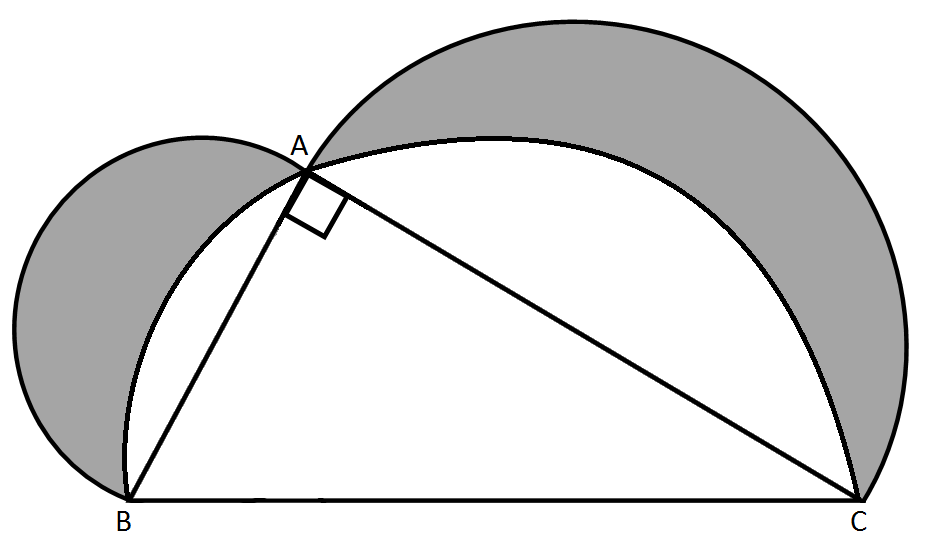
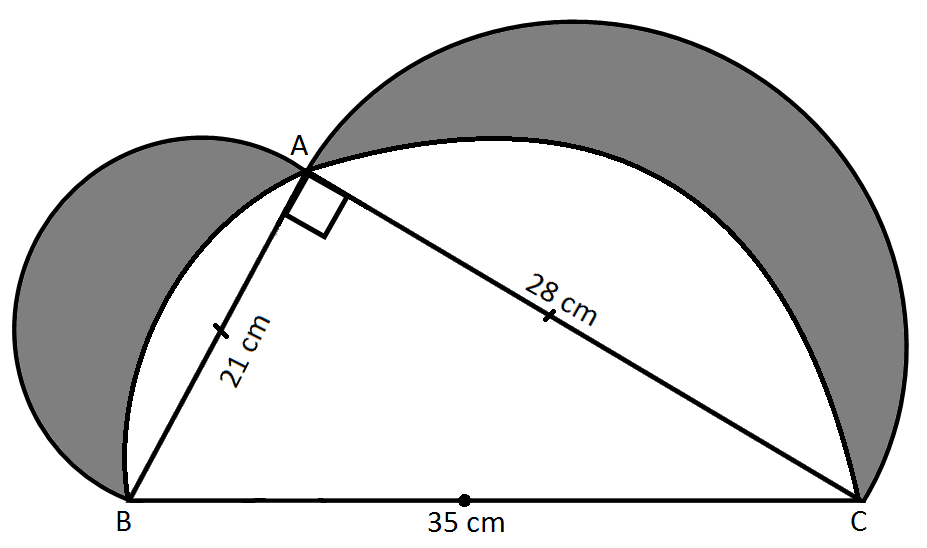
In the following figure, ABC is a right angled triangle in which $\angle\text{A}=90^\circ,$ AB = 21cm and AC = 28cm. Semi-circles are described on AB, BC and AC as diameters. Find the area of the shaded region.
Answer
In the figure, ABC is a right triangle in a semicircle $\angle\text{A}=90^\circ,$ AB = 21cm and AC = 28cm

Semicircles are drawn on BC and AC as diameters
In right $\triangle\text{ABC}$
$BC^2 = AB^2 + AC^2$ (Pythagoras Theorem)
$= 21^2 + 28^2$
$= 441 + 784 = 1225 = (35)^2$​​​​​​​
$\therefore$ BC = 35cm
Now radius of bigger semicircle (R) $=\frac{35}{2}\text{cm},$
of semicircle at $\text{AB}=\frac{21}{2}\text{cm}$ and of semicircle on $\text{AC}=\frac{28}{2}\text{cm}=14\text{cm}$
Now area of shaded portion
= Area of semicircle on AB as diameter + area of semicircle on AC as diameter + area of $\triangle\text{ABC}$ - area of
semicircle on BC as diameter
$=\frac{1}{2}\pi\Big(\frac{21}{2}\Big)^2+\frac{1}{2}\cdot\pi\Big(\frac{28}{2}\Big)^2+\frac{1}{2}\text{AB}\times\text{AC}-\frac{1}{2}\pi\Big(\frac{35}{2}\Big)^2$
$=\frac{\pi}{2}\bigg[\Big(\frac{21}{2}\Big)^2+\Big(\frac{28}{2}\Big)^2-\Big(\frac{35}{2}\Big)^2\bigg]+\frac{1}{2}\times21\times28$
$=\frac{\pi}{2}\Big[\frac{441}{4}+196-\frac{1225}{4}\Big]+294$
$=\frac{\pi}{2}\big[441+784-1225\big]+294$
$=\frac{\pi}{2}\times\big[1225-1225\big]+294$
$=\frac{\pi}{2}\times0+294=294\text{cm}^2$
View full question & answer
Question 275 Marks
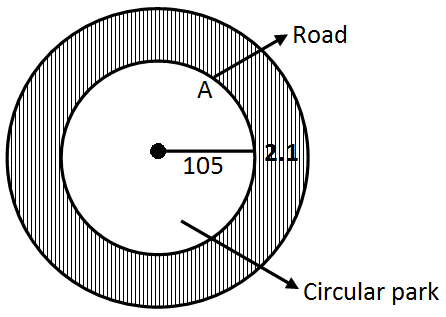
A circular park is surrounded by a rod 21m wide. If the radius of the park is 105m, find the area of the road.
Answer
Given that, a circular park is surrounded by a road.
Width of the road = 21m
Radius of the park ($r_1$​​​​​​​) = 105m

$\therefore$ Radius of whole circular portion (park + road),
$r_e = 105 + 21 = 126 m$
Now, area of road = Area of whole circular portion – Area of circular park
$=\pi\text{r}^2-\pi\text{r}^2\ [\therefore\text{area of circle}=\pi\text{r}^2]$
$=\pi\text{r}^2_\text{e}-\pi\text{r}^2_1$ $[\text{area of circle}=\pi\text{r}^2]$
$=\pi(\text{r}^2_\text{e}-\text{r}^2_1)$
$=\pi\big\{(126)^2-(105)^2\big\}$
$=\frac{22}{7}\times(126+105)(126-105)$
$=\frac{22}{7}\times231\times21$
$[\therefore(\text{a}^2-\text{b}^2)=(\text{a}-\text{b})(\text{a}+\text{b})]$
$=66\times231=15246\text{cm}^2$
Hence, the required area of the road is $15246cm^2​​​​​​​$​​​​​​​.
View full question & answer
Question 285 Marks
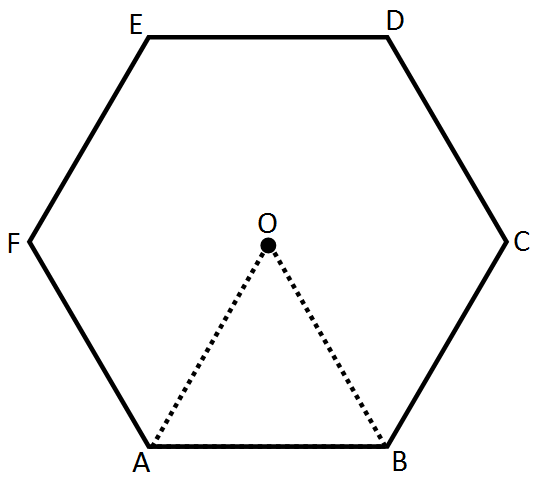
ABCDEF is a regular hexagon with centre O (in the following figure). If the area of triangle OAB is $9cm^2$, find the area of: (i) the hexagon and (ii) the circle in which the haxagon is incribed.
Answer
We know that a regular hexagon is made up of 6 equilateral triangles.
We have given area of the one of the triangles.
$\therefore$ Aera of the hexagon = 6× area of one equiteral triangle
$\therefore$ Area of the hexagon = 6×9
$\therefore$ Area of the hexagon = 54
We know that if a regular hexagon is inscribed in the circle, then the radius of the circle is same as the side of the regular hexagon.
We also know that a regular hexagon is made up of 6 equilateral triangles and we have area of one of the equilateral triangle.
$\therefore$ Area of the equilateral triangle =$\frac{\sqrt{3}}{4}\times\text{(side)}^2$
Substituting the value of the given equilateral triangle we get,
$\therefore9=\frac{\sqrt{3}}{4}\times\text{side}^2$
$\therefore\text{side}^2=\frac{9\times4}{\sqrt{3}}$
$\therefore\text{side}^2=\frac{36}{\sqrt{3}}$
Now we will find the area of the circle.
$\therefore$ Area of the circle = $\pi\text{r}^2$
Substituting the values we get,
$\therefore$ Area of the circle $=\frac{22}{7}\times\frac{36}{\sqrt{3}}$
Now we will substitute $\sqrt{3}=1.732$ we get,
$\therefore$ Area of the circle $=\frac{22}{7}\times\frac{36}{1.732}$
$\therefore$ Area of the circle $=\frac{792}{12.124}$
$\therefore$ Area of the circle = 65.324
Therefore, area of the hexagon and area of the circle are $54cm^2$ and
$65.324cm^2​​​​​​​$​​​​​​​ respectively.
View full question & answer
Question 295 Marks
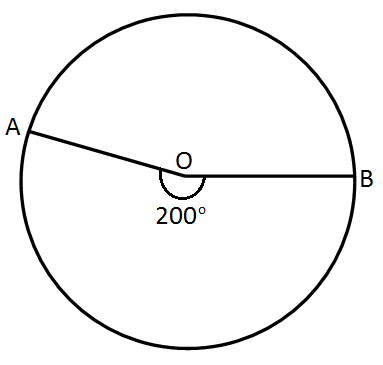
Area of a sector of central angle $200^\circ$ of a circle s $770cm^2$. Find the length of the corresponding are of this sector.
Answer
Let the radius of the sector AOBA be r.
Given that, Central angle of sector AOBA $=\theta=200^\circ$
and area of the sector $AOBA = 770cm^2$

We Know that, area of the sector
$=\frac{\pi\text{r}^2}{360^\circ}\times\theta$
$\therefore$ Area of the sector, $770=\frac{\pi\text{r}^2}{360^\circ}\times200$
$\Rightarrow\frac{77\times18}{\pi}=\text{r}^2$
$\Rightarrow\text{r}^2=\frac{77\times18}{22}\times7\Rightarrow\text{r}^2=9\times49$
$\Rightarrow\text{r}=3\times7$
$\therefore\text{r}=21\text{cm}$
So, radius of the sector AOBA = 21cm.
Now, the length of the corresponding arc of this sector = Central angle × Radius $\Big[\therefore\theta=\frac{\text{l}}{\text{r}}\Big]$
$=200\times21\times\frac{\pi}{180^\circ}$ $\Big[\therefore1^\circ=\frac{\pi}{180^\circ}\text{R}\Big]$
$=\frac{20}{18}\times21\times\frac{22}{7}$
$=\frac{220}{3}\text{cm}=73\frac{1}{3}\text{cm}$
Hence, the required length of the corresponding arc is $73\frac{1}{3}\text{cm}.$
View full question & answer
Question 305 Marks
Find the area of the minor segment of a circle of radius 14cm, when the angle of the corresponding sector is$ 60^\circ.$
Answer
Given that, radius of circle (r) = 14cm
and angle of the corresponding sector i.e.,
central angle $(\theta)=60^\circ$
Since, in $\triangle\text{AOB},\text{OA}=\text{OB}=\text{Radius of circle}$
i.e., $\triangle\text{AOB}$ is isosceles.

$\Rightarrow\angle\text{AOB}=\angle\text{OBA}=\theta$
Now, in $\triangle\text{OAB},$
$\angle\text{AOB}+\angle\text{OAB}+\angle\text{OBA}=180^\circ$
[since, sum of interior angles of any triangle is 180°]
$\Rightarrow60^\circ+\theta+\theta=180^\circ$ $[\text{given},\angle\text{AOB}=60^\circ]$
$\Rightarrow2\theta=120^\circ$
$\Rightarrow\theta=60^\circ$
i.e., $\angle\text{OAB}=\angle\text{OBA}=60^\circ=\angle\text{AOB}$
Since, all angles of $\triangle\text{AOB}$ are equal to $60^\circ$
i.e., $\triangle\text{AOB}$ is an equilateral triangle.
Also,OA = OB = AB = 14cm
So, Area of $\triangle\text{OAB}=\frac{\sqrt{3}}{4}(\text{side})^2$
$=\frac{\sqrt{3}}{4}\times(14)^2$
$\big[\because$ are of an equilateral triangle $=\frac{\sqrt{3}}{4}$ (side$^2$$\big]$
$=\frac{\sqrt{3}}{4}\times196=49\sqrt{3}\text{cm}^2$
and area of sector OBAO $=\frac{\pi\text{r}^2}{360^\circ}\times\theta$
$=\frac{22}{7}\times\frac{14\times14}{360}\times60^\circ$
$=\frac{22\times2\times14}{6}=\frac{22\times14}{3}=\frac{308}{3}\text{cm}^2$
$\therefore$ Area of minor segment = Area of sector
OBAO - Area of $\triangle\text{OAB}$
$=\Big(\frac{308}{3}-49\sqrt{3}\Big)\text{cm}^2$
Hence, the required area of the minor
segment is $\Big(\frac{308}{3}-49\sqrt{3}\Big)\text{cm}^2.$
View full question & answer
Question 315 Marks
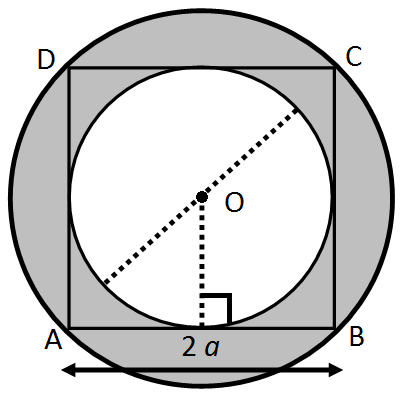
In the following figure, ABCD is a square of side 2a, Find the ratio between The circumferences. The areas of the in circle and the circum-circle of the square.
Answer
A square ABCD is inscribed a circle
The side of the square = 2a
and one circle is inscribed in the square ABCD
Now diameter of the outer circle is AC
$= \sqrt{2}. \text{side} = \sqrt{2}\times2\text{a}$
$=2\sqrt{2}\text{a}$
$\therefore \text{Radius}(\text{R}) =\frac{\text{AC}}{2}=\frac{2\sqrt{2\text{a}}}{2}=\sqrt{2}\text{a}$
and radius of the inner circle (r) = a
  1. $\therefore \ \frac{\text{circumference of outer circle}}{\text{circumference of inner circle}} = \frac{2\pi\text{R}}{2\pi\text{r}}$
$=\frac{\text{R}}{\text{r}}= \frac{\sqrt{2\text{a}}}{\text{a}}=\frac{\sqrt{2}}{1}$

$\therefore$ Ratio $=\sqrt{2}\ : 1$

or ratio in incircle and circumcircle $=1:\sqrt{2}$
  1. Now $\frac{\text{Area of nicirle}}{\text{Area of circumcircle}}= \frac{\pi\text{r}^2}{\pi\text{R}^2}$
$=\frac{\pi(\sqrt{2}\text{a})^2}{\pi(\text{a})^2}=\frac{\pi2\text{a}^2}{\pi\text{a}^2}=\frac{2}{1}$

$\therefore$ Ratio $=2:1$
View full question & answer
Question 325 Marks
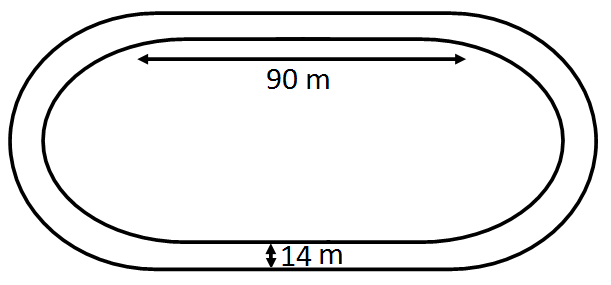
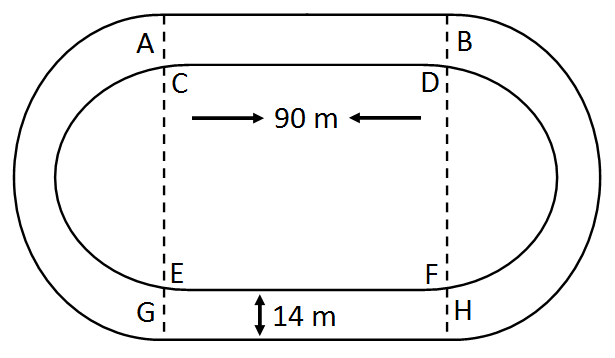
The inside perimeter of a running track (shown in the following figure) is 400m. The length of each of the straight portion is 90m and the ends are semi-circles. If the track is everywhere 14m wide. find the area of the track. Also find the length of the outer running track.
Answer
It is given that, length of each straight portion = 90m and width of track = 14m

We know that the circumference C of semicircle of radius be r is
$\text{C}=\pi\text{r}$
The inside perimeter of running track is the sum of twice the length of straight portion and circumferences of semicircles.
So, inside perimeter of running track = 400m
$2\text{l}+2\pi\text{r}=400\text{m}$
$\Rightarrow2\times90+2\times\frac{22}{7}\times\text{r}=400\text{m}$
$\Rightarrow\text{r}=\frac{220\times7}{2\times22}=35\text{m}$
Thus, radius of inner semicircle is 35m.
Now, radius of outer semicircle $r = 35 + 14 = 49m$
Area of running track = 2 × Area of rectangle + 2 × Area of outer semi circle - 2 × Area of inner semicircle $=2\times90\times14+2\times\frac{\pi(49)^2}{2}-2\times\frac{\pi(35)^2}{2}$
$=2520+\pi\times(49+35)(49-35)$
$=2520+\frac{22}{7}\times84\times14$
$=2520+3696=6216\text{m}^2$
Hence, the area of running track $= 6216m^2$ 
Now, length L of outer running track is
$\text{L}=2\times\text{l}+2\pi\text{r}$
$=2\times90+2\pi\times49$
$=180+2\times\frac{22}{7}\times49$
$=180+308=488\text{m}$
Hence, the length L of outer running track is 488m.
View full question & answer
Question 335 Marks
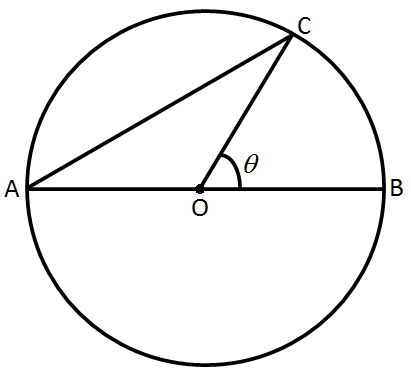
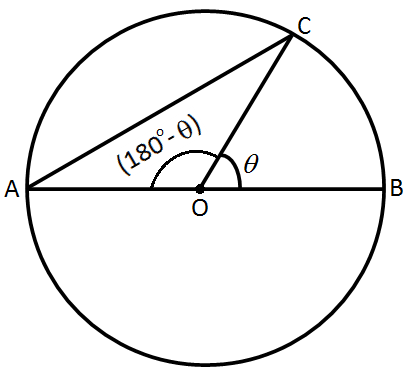
AB is the diameter of a circle, centre O, C is a point on the circumference such that $\angle\text{COB}=\theta.$ The area of the minor segment cut off by AC is equal to twice the area of the sector BOC. Prove that. $\sin\frac{\theta}{2}\cos\frac{\theta}{2}=\pi\Big(\frac{1}{2}-\frac{\theta}{120}\Big)$
Answer
In the figure $\angle\text{BOC}=\theta$
$\therefore\text{AOC}=180^\circ-\theta$ $(\because$ AB is diameter $)$
Let r be radius of the circle

Now area of sector $\text{BOC}=\pi\text{r}^2\times\frac{\theta}{360^\circ}$
$\therefore$ area of minor segment AC = 2 (area of sector BOC)
$=2\times\pi\text{r}^2\frac{\theta}{360^\circ}=\frac{2\pi\text{r}^2\theta}{360^\circ}\dots(\text{i})$
But area of segment
$=\Big(\frac{\pi(180^\circ-\theta)}{360^\circ}-\sin\frac{180^\circ-\theta}{2}\cos\frac{180^\circ-\theta}{2}\Big)\text{r}^2$
From (i) and (ii) $(\because\angle\text{AOC}=180^\circ-\theta)$
$\frac{2\pi\text{r}^2\theta}{360^\circ}=\text{r}^2$
$\Big(\frac{\pi(180^\circ-\theta)}{360^\circ}-\sin\frac{180^\circ-\theta}{2}\cos\frac{180^\circ-\theta}{2}\Big)$
$\Rightarrow\frac{2\pi\theta}{360^\circ}$
$=\bigg[\frac{\pi(180^\circ-\theta)}{360}-\sin\Big(90^\circ-\frac{\theta}{2}\Big)\cos\Big(90^\circ-\frac{\theta}{2}\Big)\bigg]$
$\Rightarrow\frac{2\pi\theta}{360^\circ}=\frac{\pi(180^\circ-\theta)}{360^\circ}-\cos\frac{\theta}{2}\sin\frac{\theta}{2}$
$\begin{Bmatrix}\sin(90^\circ-\theta)=\cos\theta\\\cos(90^\circ-\theta)=\sin\theta\end{Bmatrix}$
$\Rightarrow\sin\frac{\theta}{2}\cos\frac{\theta}{2}=\frac{\pi(180^\circ-\theta)}{360^\circ}-\frac{2\pi\theta}{360^\circ}$
$\Rightarrow\sin\frac{\theta}{2}\cos\frac{\theta}{2}=\pi\Big(\frac{180^\circ}{360^\circ}-\frac{\theta}{360^\circ}-\frac{2\theta}{360^\circ}\Big)$
$\Rightarrow\sin\frac{\theta}{2}\cos\frac{\theta}{2}=\pi\Big(\frac{1}{2}-\frac{3\theta}{360^\circ}\Big)=\pi\Big(\frac{1}{2}-\frac{\theta}{120}\Big)$
Hence $\sin\frac{\theta}{2}\cos\frac{\theta}{2}=\pi\Big(\frac{1}{2}-\frac{\theta}{120}\Big)$
View full question & answer
Question 345 Marks
In the following figure, shows the cross-section of railway tunnel. The radius OA of the circular part is 2m. If $\angle\text{AOB}=90^\circ,$ calculate
  1. The height of the tunnel
  2. The perimeter of the cross-section
  3. The area of the cross-section.
Answer
We have a cross section of a railway tunnel. $\triangle\text{OAB}$ is a right angled isosceles triangle, rightangled at O. let OM be perpendicular to AB.
  1. We have to find the height of the tunnel. We have,
$\text{OA}=2\text{m}$ Use Pythagoras theorem in $\triangle\text{OAB}$ to get,

$\text{AB}=\Big(\sqrt{2^2+2^2}\Big)\text{m}$

$=2\sqrt{2}\text{m}$

Let the height of the tunnel be h. So,

Area of $\triangle\text{OAB}=\frac{1}{2}(2)(2)$

$\frac{1}{2}\big(2\sqrt{2}\big)(\text{OM})=2$

Thus,

$\text{OM}=\sqrt{2}\text{m}$

Therefore,

$\text{h}=\Big(2+\sqrt{2}\Big)\text{m}$
  1. Perimeter of cross-section is,
= Major ar AB + AB

$=2(\pi)(2)\Big(\frac{3}{4}\Big)+2\sqrt{2}$

$=\Big(3\pi+2\sqrt{2}\Big)\text{m}$
  1. Area of cross section,
$=\frac{3}{4}$ (Area of circle) + Area of $\triangle\text{OAB}$

$=(\pi)(2)^2\Big(\frac{3}{4}\Big)+\frac{1}{2}(2)(2)$

$(3\pi+2)\text{m}^2$
View full question & answer
Question 355 Marks
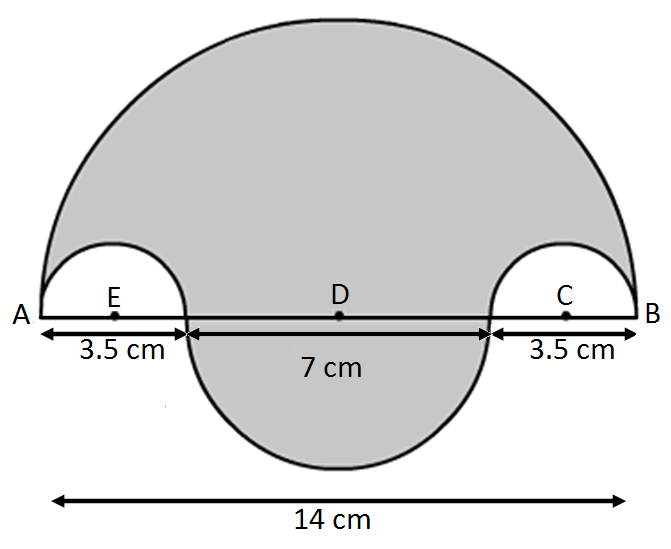
In the following figure, the boundary of the shaded region consists of four semi-circular arcs, the smallest two being equal. If the diameter of the largest is 14cm and of the smallest is 3.5cm, find,
  1. The length of the boundary.
  2. The area of the shaded region.
Answer
Diameter of the biggest semicircle = 14cm 14
$\therefore$ Radius (R) $=\frac{14}{2}=7\text{cm}$
Diameter of the small semicircle = 7cm 7
$\therefore$ Radius $(\text{r}_1)=\frac{7}{2}\text{cm}$
and diameter of each smaller circles = 3.5cm
$\therefore$ Radius $(\text{r}_2)=\frac{3.5}{2}=1.75\text{cm}$
  1. Length of the boundery = circumference of bigger semicircle + circumference of small semicircle + circumference of 2 smaller semicircles.
$=\pi\text{R}+\pi\text{r}_1+2\pi\text{r}_2$

$=\pi(\text{R}+\text{r}_1+2\text{r}_2)$

$=\frac{22}{7}\Big(7+3.5+2\times\frac{3.5}{2}\Big)$

$=\frac{22}{7}(7+3.5+3.5)=\frac{22}{7}\times14\text{cm}$

$=44\text{cm}$
  1. Area of shaded portion = area of bigger semicircle + area of small semicicrle - area of 2 smaller semicircles.
$=\frac{1}{2}\pi\text{R}^2+\frac{1}{2}\pi\text{r}_1^2-2\times\frac{1}{2}\pi\text{r}_2^2$

$=\frac{1}{2}\pi(\text{R}^2+\text{r}^2_1-2\text{r}^2_2)$

$=\frac{1}{2}\times\frac{22}{7}[7^2+(3.5)^2-2\times(1.75)^2]\text{cm}^2$

$=\frac{11}{7}[49+12.25-6.125]\text{cm}^2$

$=\frac{11}{7}\times55.125=86.625\text{cm}^2$
View full question & answer
5 Marks Questions - Maths STD 10 Questions - Vidyadip