Questions

Case study (4 Marks)

🎯

Test yourself on this topic

5 questions · timed · auto-graded

Question 14 Marks
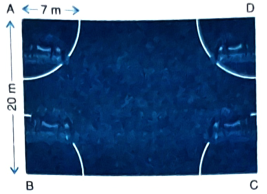
A slable owner has four horses. He usually tie these horses with 7 m long rope to pegs at each corner of a square shaped grass field of 20 m length, to graze in his farm. But tying with rope sometimes results in injuries to his horses, so he decided to build fence around the area so that each horse can graze.
Image
(i) Find the area of the square shaped grass field.
(ii) (a) Find the area of the total field in which these horses can graze.
OR
(b) If the length of the rope of each horse is increased from 7 m to 10 m , find the area grazed by one horse.
(Use $\pi=3.14$ )
(iii) What is area of the field that is left ungrazed, if the length of the rope of each horse is 7 cm ?
Answer
(i) The area of the square shaped grass field $=20 \times 20 m^2=400 m^2$
(ii) (a) Area of the field in which horses can graze $=4\left(\frac{1}{4} \times \frac{22}{7} \times 7 \times 7\right) m ^2=154 m^2$ OR
(b) Area grazed by one horse $=\left(\frac{1}{4} \times 3.14 \times 10^2\right) m ^2=78.5 m^2$
(iii) Area of the field that is left un-grazed $=(400-154) m ^2=246 m^2$.
View full question & answer
Question 24 Marks
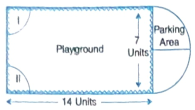
Gorerning council of a local public deoclopment authority of Dehradun decided to build an adrenturous playsround on the top of a hill, which will have adequale space for parking.
Image
After surcey, it was decided to build reclangular playground, with a semi-circular area allotted for parking at one end of the playground. The length and bread th of the reclangular playground are 14 units and 7 units, repectroely. There are two quadrants of radius 2 units on one side for special seats.
(i) What is the total perimeter of the parking area?
(ii) What is the total area of parking and the two quadrants?
(iii) What is the ratio of area of playground to the area of parking arca?
(iv) Find the cost of fencing the playground and parking area at the rate of ₹ 2 per unit.
Answer
(i) Total perimeter of parking area $=14+\frac{22}{7} \times \frac{7}{2}$ units $=25$ units
(ii) Total area of parking and two quadrants $=\frac{1}{2} \times \frac{22}{7} \times\left(\frac{7}{2}\right)^2+2\left(\frac{1}{4} \times \frac{22}{7} \times 2^2\right)$ sq. units $=25.53$ sq. units
(iii) Area of playground $=14 \times 7-2\left(\frac{1}{4} \times \frac{22}{7} \times 2^2\right)=\left(98-\frac{44}{7}\right)$ sq. units $=\frac{642}{7}$ sq. units
Area of parking $=\frac{1}{2} \times \frac{22}{7} \times\left(\frac{7}{2}\right)^2=\frac{77}{4}$ sq. units
Area of playground : Area of parking $=\frac{642}{7}: \frac{77}{4}=2568: 539$
(iv) Cost of fencing the playground and parking area $=$₹$\left(14+14+7+\frac{22}{7} \times \frac{7}{2}\right) \times 2=$₹ $92$
View full question & answer
Question 34 Marks
In an annual day function of a school, the organizers wanted to give a cash prize along with a memento to their best students. Each memento is made as shown in the figure and its base $A B C D$ is shown from the front side. The rate of silver plating is ₹ $20$ per $cm ^2$. Based on the above, answer the following questions:
(i) What is the area of the quadrant $O D C O$ ?
(ii) Find the area of $\triangle A O B$.
(iii) What is the total cost of silver plating the shaded part $A B C D$ ?
(iv) What is the length of arc $C D$ ?
Answer
(i) Area of quadrant $O D C O=\frac{1}{4}$ (Area of a circle of radius 7 cm )
$
=\frac{1}{4} \times \frac{22}{7} \times 7^2 cm^2=38.5 cm^2
$
(ii) Clearly, $\triangle O A N$ is isoseles right angled triangle.
$
\text { Area of } \triangle O A B=\frac{1}{2}(O A \times O B)=\frac{1}{2}(10 \times 10) cm^2=50 cm^2
$
(iii) Area of shaded part $A R C D=$ Ares of $\triangle O A B-$ Ares of quadrant ODCO
$
=(50-38.5) cm^2=11.5 cm^2
$
(iv) length of the are $C D=\frac{1}{4}$ (Circumference of the circle of radius 7 cm )
$
=\frac{1}{4} \times 2 \times \frac{22}{7} \times 7 cm=11 cm
$
View full question & answer
Question 44 Marks
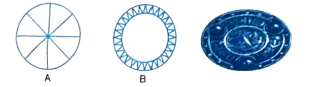
A brooch is a small piece of jewellery which has a pin at the back so that it can be fastened on a dress, blouse or coat. Designs of some brooches are shown below.
Image
posisn A: Brooch A is made with silver wire in the form of a circle with diameter 28 mm . The wire is also used for making 4 diameters which divide the circle into 8 equal parts.
Destst B: Brooch B is made of two colours, Gold and Silver. Outer part is made with Gold. The circumference of the silver part is 44 mm and the gold part is 3 mm wide coerywhere.
(i) In design A, the total length of the wire required is
(a) 180 mm $\qquad$ (b) 200 mm $\qquad$ (c) 250 mm $\qquad$ (d) 280 mm
(ii) In design $A$, the area of each sector of the brooch is
(a) $44 mm^2$ $\qquad$ (b) $52 mm^2$ $\qquad$ (c) $77 mm^2$ $\qquad$ (d) $68 mm^2$
(iii) In design B, the circumference of the outer part (golden) is
(a) 48.49 mm $\qquad$ (b) 82.2 mm $\qquad$ (c) 72.50 mm $\qquad$ (d) 62.86 mm
(iv) In design B, the difference of the areas of golden and silver parts is
(a) $18 \pi$ $\qquad$ (b) $44 \pi$ $\qquad$ (c) $51 \pi$ $\qquad$ (d) $64 \pi$
Answer
(i) (b): In design $A$, diameter of the circle is 28 mm .
Circumference of the circle $=\pi \times 28 mm=\frac{22}{7} \times 28 mm=88 mm$
Length of the wire used in 4 diameters $=4 \times 28 mm=112 mm$.
Total length of the wire required $=(112+88) mm =200 mm$
(ii) (c): Area of each sector $=\frac{1}{8}$ (Area of the circle) $=\left(\frac{1}{8} \times \frac{22}{7} \times 14^2\right) mm ^2=77 mm^2$
(iii) (d): Let $r mm$ be the radius of the silver part. Then,
$
2 \times \frac{22}{7} \times r=44 \Rightarrow r=7 mm
$
The radius of the Brooch $B$ is $(7+3) mm =10 mm$.
$\therefore \quad$ Circumference of the outer part $=2 \times \frac{22}{7} \times 10 mm=62.86 mm$
(iv) (c): Required difference $=\pi\left(10^2-7^2\right)=\pi(17)(3)=51 \pi mm^2$
View full question & answer
Question 54 Marks
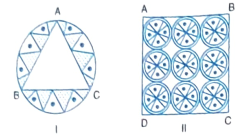
Pookalam is the flower bed or flower pattern designed during Onam in Kerala. It is similar as Rangoli in North India and Kolam in Tamil Nadu. During the festival of Onam, your school is planning to conduct a Pookalam competition. Your friend whose partner in competition, suggests two design given below:
Design I: This design is made with a circle of radius 32 cm having equilateral triangle $A B C$ in the middle as shown in Fig. 12.11.
Design II: This Pookalam is made with 9 circular designs each of radius 7 cm .
Image
(i) In design-1, the side of equilateral triangle is
(a) $12 \sqrt{3} cm$ $\qquad$ (b) $32 \sqrt{3} cm$ $\qquad$ (c) 48 cm $\qquad$ (d) 64 cm
(ii) In devign-1, the altitude of the equilaleral triangle is
(a) 8 cm $\qquad$ (b) 12 cm $\qquad$ (c) 48 cm $\qquad$ (d) 52 cm
(iii) In design-II, the area of square $A B C D$ is
(a) $1264 cm^2$ $\qquad$ (b) $1764 cm^2$ $\qquad$ (c) $1830 cm^2$ $\qquad$ (d) $1944 cm^2$
(iv) In desgn-II, the area of cach circular region is
(a) $124 cm^2$ $\qquad$ (b) $132 cm^2$ $\qquad$ (c) $144 cm^2$ $\qquad$ (d) $154 cm^2$
Answer

Image
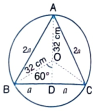
Let each side of the equilateral triangle be of length $2 a cm$ and let $O$ be the centre of the circle.
(i) Ans. (b): In $\triangle O D B$, we have
$
\begin{array}{l}
O B=32 cm, B D=a \text { and } \angle B O D=60^{\circ} \\
\sin 60^{\circ}=\frac{B D}{O B} \Rightarrow \frac{\sqrt{3}}{2}=\frac{a}{32} \Rightarrow a=16 \sqrt{3} \\
B C=2 a=32 \sqrt{3} cm
\end{array}
$
(ii) Ans. (c): In $\triangle O D B$, we have
$
\begin{array}{l}
\cos 60^{\circ}=\frac{O D}{O B} \Rightarrow \frac{1}{2}=\frac{O D}{32} \Rightarrow O D=16 cm \\
A D=A O+O D=(32+16) cm=48 cm \\
\left.A D=\frac{\sqrt{3}}{2} \text { (Side }\right)=\frac{\sqrt{3}}{2} \times 32 \sqrt{3} cm=48 cm
\end{array}
$
(iii) Ans. (b): It is evident from design-II that
$A B=3 \times$ Diameter of each circle $=3 \times 14 cm=42 cm$
$\therefore$ Area of square $A B C D=(42)^2 cm^2=1764 cm^2$
(iv) Ans. (d): Area of each circular region $=\frac{22}{7} \times 7^2 cm^2=154 cm^2$
View full question & answer
Case study (4 Marks) - Maths STD 10 Questions - Vidyadip