MCQ 11 Mark
The hour hand of a clock is $6\ cm$ long. The area swept by it between $11.20 \ am$ and $11.55\ am$ is:
- A
$2.75\ cm^2$
- ✓
$5.5\ cm^2$
- C
$11\ cm^2$
- D
$10\ cm^2$
AnswerCorrect option: B. $5.5\ cm^2$
Hour hand moves $\Big(\frac{1^\circ}{2}\Big)$ in one minute.
So, area,
$=\frac{1}{2}(\text{r}^2)\Big(\frac{\theta}{180}\pi\Big)$
$=\frac{1}{2}(36)\Big(\frac{35}{2(180)}\pi\Big)$
$=5.5\text{cm}^2$
So the answer is $(b)$
View full question & answer→MCQ 21 Mark
If the area of a square is same as the area of a circle, then the ratio of their perimeters, in terms of $\pi,$ is:
- A
$\pi:\sqrt{3}$
- ✓
$2:\sqrt{\pi}$
- C
$3:\pi$
- D
$\pi:\sqrt{2}$
AnswerCorrect option: B. $2:\sqrt{\pi}$
We have given that area of a circle of radius r is equal to the area of a square of side a.
$\therefore\pi\text{r}^2=\text{a}^2$
$\therefore\text{a}=\sqrt{\pi\text{r}}$
We have to find the ratio of the perimeters of circle and square.
$\therefore\frac{\text{Perimeter of circle}}{\text{Perimeter of square}}=\frac{2\pi\text{r}}{4\text{a}}\ \dots(1)$
Now we will substitute $\text{a}=\sqrt{\pi\text{r}}$ in equation (1).
$\frac{\text{Perimeter of circle}}{\text{Perimeter of square}}=\frac{2\pi\text{r}}{4\sqrt{\pi\text{r}}}$
$\therefore\frac{\text{Perimeter of circle}}{\text{Perimeter of square}}=\frac{\pi}{2\sqrt{\pi}}$
$\therefore\frac{\text{Perimeter of circle}}{\text{Perimeter of square}}=\frac{\sqrt{\pi}}{2}$
Therefore, ratio of their perimeters is $\sqrt{\pi}:2.$
Hence, the correct answer is (b).
View full question & answer→MCQ 31 Mark
The radius of a circle is 20cm. It is divided into four parts of equal area by drawing three concentric circles inside it. Then, the radius of the largest of three concentric circles drawn is:
- A
$10\sqrt{5}\text{cm}$
- ✓
$10\sqrt{3}\text{cm}$
- C
$10\sqrt{5}\text{cm}$
- D
$10\sqrt{2}\text{cm}$
AnswerCorrect option: B. $10\sqrt{3}\text{cm}$
The circle can be divided into four parts of equal area by drawing three concentric circles inside it as,
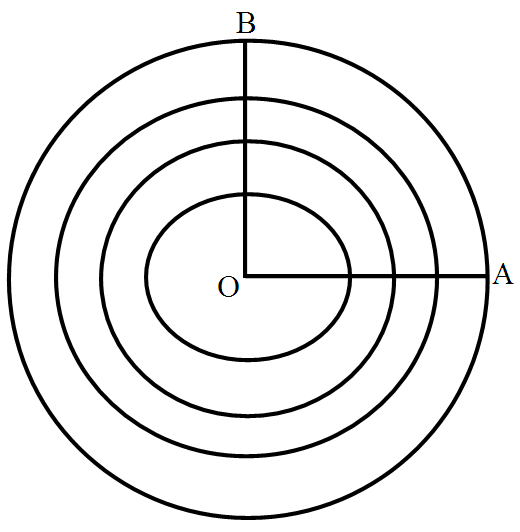
It is given that OB = 20cm. Let OA = x.
Since the circle is divided into four parts of equal area by the three concentric circles, we have,
Area of the fourth region $=\frac{1}{4}\times$ Area of the given circle
$\pi\times(20^2-\text{x}^2)=\frac{1}{4}\times\pi\times20^2$
$400-\text{x}^2=100$
$\text{x}=300$
$\text{x}=10\sqrt{3}\text{cm}$
Therefore, the correct answer is (b). View full question & answer→MCQ 41 Mark
The area of a circle whose area and circumference are numerically equal, is:
- A
$2\pi\text{sq. units}$
- ✓
$4\pi\text{sq. units}$
- C
$6\pi\text{sq. units}$
- D
$8\pi\text{sq. units}$
AnswerCorrect option: B. $4\pi\text{sq. units}$
We have given that circumference and area of a circle are numerically equal.
Let it be x.
Let r be the radius of the circle, therefore, circumference of the circle is $2\pi\text{r}$ and area of the circle will be $\pi\text{r}^2.$
Therefore, from the given condition we have,
$2\pi\text{ r}=\text{x}\ \dots(1)$
$\pi\text{ r}^2=\text{x}\ \dots(2)$
Therefore, from equation (1) get $\text{r}=\frac{\text{x}}{2\pi}$Now we will substitute this value in equation (2)
we get, $\pi\Big(\frac{\text{x}}{2\pi}\Big)^2=\text{x}$
Simplifying further we get,
$\pi\times\frac{\text{x}^2}{4\pi^2}=\text{x}$
Cancelling x we get,
$\pi\times\frac{\text{x}}{4\pi^2}=1$
Now we will cancel $\pi$
$\frac{\text{x}}{4\pi}=1\ \dots(3)$
Now we will multiply both sides of the equation (3) by $4\pi$ we get,
$\text{x}=4\pi$
Therefore, area of the circle is $4\pi\text{sq. units}.$
Hence, option (b) is correct.
View full question & answer→MCQ 51 Mark
If the radius of a circle is diminished by 10%, then its area is diminished by:
AnswerLet in first case radius of a circle = rThen area $=\pi\text{r}^2$
In second case, radius $=\frac{\text{r}\times(100-10)}{100}$
$=\frac{\text{r}\times90}{100}=\frac{9}{10}\text{r}$
Then area $=\pi\Big(\frac{9}{10\text{r}}\Big)^2=\frac{81}{100}\pi\text{r}^2$
Difference $=\pi\text{r}^2-\frac{81}{100}\pi\text{r}^2=\frac{100-81}{100}\pi\text{r}^2$
$=\frac{19}{100}\pi\text{r}^2$
$\therefore$ It is diminished by 19% (b)
View full question & answer→MCQ 61 Mark
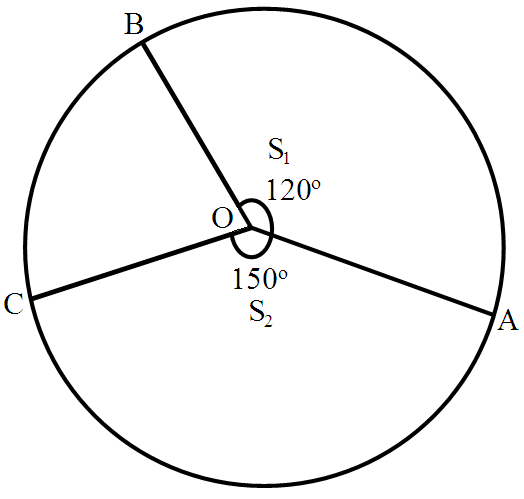
In the following figure, the ratio of the areas of two sectors $S_1$ and $S_2$ is:
- A
$5 : 2$
- B
$3 : 5$
- C
$5 : 3$
- ✓
$4 : 5$
AnswerCorrect option: D. $4 : 5$
Area of the sector, $\text{S}_1=\frac{\theta_1}{360}\times\pi\text{r}^2$
Area of the sector, $\text{S}_2=\frac{\theta_2}{360}\times\pi\text{r}^2$
Now we will take the ratio,
$\frac{\text{S}_1}{\text{S}_2}=\frac{\frac{\theta_1}{360}\times\pi\text{r}^2}{\frac{\theta_2}{360}\times\pi\text{r}^2}$
Now we will simplify the ratio as below,
$\frac{\text{S}_1}{\text{S}_2}=\frac{\theta_1}{\theta_2}$
Substituting the values we get,
$\frac{\text{S}_1}{\text{S}_2}=\frac{120}{150}$
$\therefore\frac{\text{S}_1}{\text{S}_2}=\frac{4}{5}$
Therefore, ratio of the areas of the two sectors is $4 : 5$
Hence, the correct answer is option $(d)$.
View full question & answer→MCQ 71 Mark
If the perimeter of a semi-circular protractor is 36cm, then its diameter is:
AnswerWe know that perimeter of a semi-circle of radius $\text{r}=\frac{1}{2}(2\pi\text{r})+2\text{r}\ \dots(1)$
We have given the perimeter of the semi-circle and we are asked to find the diameter of the semi-circle.
Therefore, substituting the perimeter of the semi-circle in equation (1) we get,
$36=\frac{1}{2}(2\pi\text{r})+2\text{r}$
Multiplying both sides of the equation by 2 we get,
$72=2\pi\text{r}+4\text{r}$
Substituting $\pi=\frac{22}{7}$we get,
$\therefore72=\frac{44}{7}\text{r}+4\text{r}$
Now we will multiply both sides of the equation by 7.
$504=44\text{r}+28\text{r}$
Adding like terms we get,
$\therefore504=72\text{r}$
Dividing both sides of the equation 72 we get, r = 7
Therefore, radius of the semi circle is 7cm.
Now we will find the diameter.
$\text{Diameter}=2\times\text{r}$
$\therefore\text{Diameter}=2\times7$
$\therefore\text{Diameter}=14$
Hence, diameter of the semi-circle is 14cm.
Therefore, the correct answer is (c).
View full question & answer→MCQ 81 Mark
If diameter of a circle is increased by 40%, then its area increase by:
AnswerLet the diameter of a circle in first case = 2r
Then radius = r
Area $=\pi\text{r}^2$
By increasing 40% of diameter or radius,
New radius $=\frac{\text{r}\times140}{100}=\frac{7\text{r}}{5}$
$\therefore$ New area $=\pi\Big(\frac{7\text{r}}{5}\Big)^2=\frac{49}{25}\pi\text{r}^2$
$\therefore$ Difference of areas $=\frac{49}{25}\pi\text{r}^2-\pi\text{r}^2$
$=\frac{24}{25}\pi\text{r}^2$
Percentage increase $=\frac{24\pi\text{r}^2}{25\pi\text{r}^2}\times100$
= 96% (a)
View full question & answer→MCQ 91 Mark
If the perimeter of a circle is equal to that of a square, then the ratio of their areas is :
- A
$13 : 22$
- ✓
$14 : 11$
- C
$22 : 13$
- D
$11 : 14$
AnswerCorrect option: B. $14 : 11$
Let side of square $= a$ units
$\therefore$ Area $= a^2$ sq. units
and perimeter $= 4a$ units
Now perimeter of circle $= 4a$ units
$\therefore$ Radius $=\frac{\text{Perimeter}}{2\pi}=\frac{4\text{a}}{2\pi}$
$=\frac{2\text{a}}{\pi}$
and area $=\pi\text{r}^2=\pi\Big(\frac{2\text{a}}{\pi}\Big)^2$
$=\frac{\pi\times4\text{a}^2}{\pi^2}=\frac{4\text{a}^2}{\pi}\text{sq. units}$
$=\frac{7\times4\text{a}^2}{22}=\frac{14}{11}\text{a}^2$
$\therefore$ Ratio in the areas of circle and square
$\frac{14}{11}\text{a}^2:\text{a}^2=14:11\text{(b)}$
View full question & answer→MCQ 101 Mark
If area of a circle inscribed in an equilateral triangle is $48\pi$ square units, then perimeter of the triangle is:
AnswerCorrect option: C. $72\text{ units}$
Area of a circle inscribed in an equilateral triangle $48\pi\text{ sq. units}$
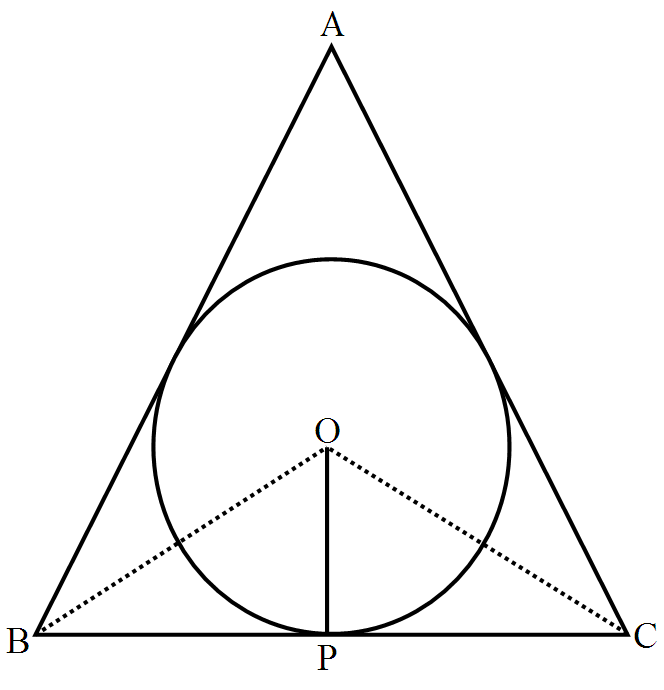
$\therefore$ Radius of the circle $=\sqrt{\frac{\text{Area}}{\pi}}=\sqrt{\frac{48\pi}{\pi}}$
$=\sqrt{48}\text{ units}=4\sqrt{3}\text{ units}$
$\therefore\text{OP}\perp\text{BC}$ and $\angle\text{B}=60^\circ$
$\therefore\angle\text{OAP}=30^\circ$
Now $\tan\theta=\frac{\text{OP}}{\text{BP}}\Rightarrow\tan30^\circ=\frac{4\sqrt{3}}{\text{BP}}$
$\Rightarrow\frac{1}{\sqrt{3}}=\frac{4\sqrt{3}}{\text{BP}}\Rightarrow\text{BP }4\sqrt{3}\times\sqrt{3}=12\text{ units}$
$\therefore$ BC = 2 × BP = 2 × 12 = 24 units.
$\therefore$ Perimeter of $\triangle\text{ABC}$ = 3 × side
= 3 × 24 =72 units (c) View full question & answer→MCQ 111 Mark
The ratio of the areas of a circle and an equilateral triangle whose diameter and a side are respectively equal, is:
- A
$\pi:\sqrt{2}$
- ✓
$\pi:\sqrt{3}$
- C
$\sqrt{3}:\pi$
- D
$\sqrt{2}:\pi$
AnswerCorrect option: B. $\pi:\sqrt{3}$
We are given that diameter and side of an equilateral triangle are equal.
Let d and a are the diameter and side of circle and equilateral triangle respectively.
$\therefore$ d = a
We know that area of the circle $=\pi\text{r}^2$
Now we will find the ratio of the areas of circle and equilateral triangle.
$\therefore\frac{\text{Area of circle}}{\text{Area of equilateral triangle}}=\frac{\pi\text{r}^2}{\frac{\sqrt{3}}{4}\text{a}^2}$
We know that radius is half of the diameter of the circle.
$\therefore\frac{\text{Area of circle}}{\text{Area of equilateral triangle}}=\frac{\pi\Big(\frac{\text{d}}{2}\Big)^2}{\frac{\sqrt{3}}{4}\text{a}^2}$
$\therefore\frac{\text{Area of circle}}{\text{Area of equilateral triangle}}=\frac{\pi\times\frac{\text{d}^2}{4}}{\frac{\sqrt{3}}{4}\text{a}^2}$
Now we will substitute d = a in the above equation,
$\frac{\text{Area of circle}}{\text{Area of equilateral triangle}}=\frac{\pi\times\frac{\text{a}^2}{4}}{\frac{\sqrt{3}}{4}\text{a}^2}$
$\frac{\text{Area of circle}}{\text{Area of equilateral triangle}}=\frac{\pi}{\sqrt{3}}$
Therefore, ratio of the areas of circle and equilateral triangle is $\pi:\sqrt{3}.$
Hence, the correct answer is option (b).
View full question & answer→MCQ 121 Mark
If the sum of the areas of two circles with radii $r_1$ and $r_2$ is equal to the area of a circle of radius $r,$ then :
- A
$\text{r}=\text{r}_1+\text{r}_2$
- ✓
$\text{r}^2_1+\text{r}^2_2=\text{r}^2$
- C
$\text{r}_1=\text{r}_2<\text{r}$
- D
$\text{r}^2_1+\text{r}^2_2<\text{r}^2$
AnswerCorrect option: B. $\text{r}^2_1+\text{r}^2_2=\text{r}^2$
According to the given condition,
Area of circle $=$ Area of first circle $+$ Area of second circle.
$\therefore\pi\text{r}^2=\pi\text{r}^2_1+\pi\text{r}^2_2$
$\Rightarrow\text{r}^2=\text{r}^2_1+\text{r}^2_2\text{(b)}$
View full question & answer→MCQ 131 Mark
In the following figure, the area of the shaded region is:
- ✓
$3\pi\text{ cm}^2$
- B
$6\pi\text{ cm}^2$
- C
$9\pi\text{ cm}^2$
- D
$7\pi\text{ cm}^2$
AnswerCorrect option: A. $3\pi\text{ cm}^2$
In the figure,$\angle\text{C}=\angle\text{B}=90^\circ$ and $\angle\text{D}=60^\circ,$
$\therefore\angle\text{A}+\angle\text{B}+\angle\text{C}+\angle\text{D}+=360^\circ$
$\angle\text{A}+90^\circ+90^\circ+60^\circ=360^\circ$
$\therefore\angle\text{A}=120^\circ$
Area of shaded region $=\frac{\theta}{360}\times\pi\text{r}^2$
$\therefore$ Area of shaded region $=\frac{120}{360}\times\pi\times3^2$
$\therefore$ Area of shaded region $=\frac{1}{3}\times\pi\times9$
$\therefore$ Area of shaded region $=3\pi$
Therefore, area of the shaded region is $3\pi\text{ cm}^2.$
Hence, the correct answer is option (a).
View full question & answer→MCQ 141 Mark
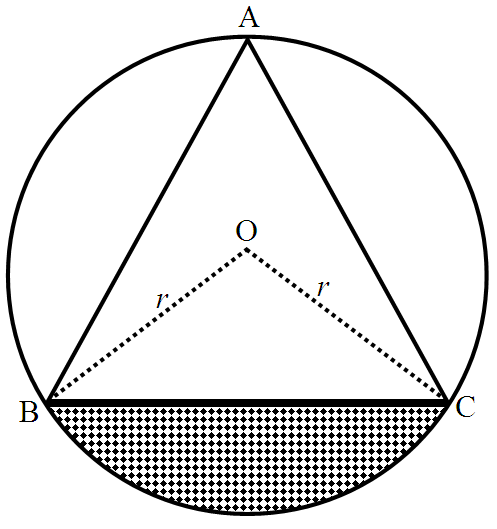
In the figure, if ABC is an equilateral triangle, then shaded area is equal to?
- ✓
$\Big(\frac{\pi}{3}-\frac{\sqrt{3}}{4}\Big)\text{r}^2$
- B
$\Big(\frac{\pi}{3}-\frac{\sqrt{3}}{2}\Big)\text{r}^2$
- C
$\Big(\frac{\pi}{3}+\frac{\sqrt{3}}{4}\Big)\text{r}^2$
- D
$\Big(\frac{\pi}{3}+\sqrt{3}\Big)\text{r}^2$
AnswerCorrect option: A. $\Big(\frac{\pi}{3}-\frac{\sqrt{3}}{4}\Big)\text{r}^2$
$\triangle\text{ABC}$ is an equilateral triangle inscribed in a circle with centre O and radius r
BO and CO are joined.
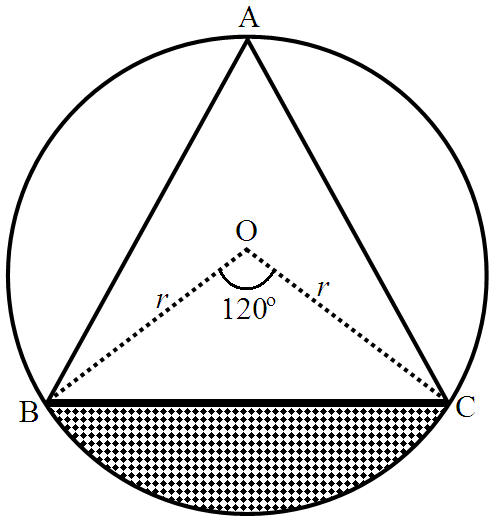
$\therefore\angle\text{BOC}=2\angle\text{BAC}=2\times60^\circ=120^\circ$
Area of shaded portion
$=\Big[\pi\frac{\theta}{360^\circ}-\sin\frac{\theta}{2}\cos\frac{\theta}{2}\Big]\text{r}^2$
$=\Big[\frac{\pi\times120^\circ}{360^\circ}-\sin60^\circ\cos60^\circ\Big]\text{r}^2$
$=\Big[\frac{\pi}{3}-\frac{\sqrt{3}}{2}\times\frac{1}{2}\Big]\text{r}^2=\Big[\frac{\pi}{3}-\frac{\sqrt{3}}{4}\Big]\text{r}^2$
Hence, the correct answer is (a). View full question & answer→MCQ 151 Mark
The area of the largest triangle that can be inscribed in a semi $-$ circle of radius $r$ is:
- A
$2r$
- ✓
$r^2$
- C
$r$
- D
$\sqrt{\text{r}}$
AnswerRadius of semicircule $= r$
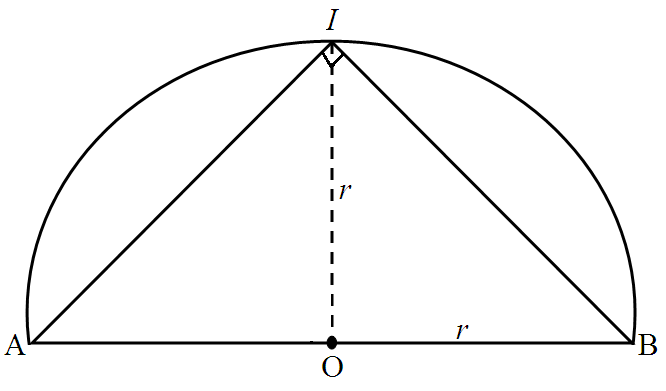
The base of the largest triangle.
$(b) = 2r$
and height $(h) = r$
$\therefore$ Area $=\frac{1}{2}\text{base}\times\text{height}$
$=\frac{1}{2}\times2\text{r}\times\text{r}=\text{r}^2\text{(b)}$ View full question & answer→MCQ 161 Mark
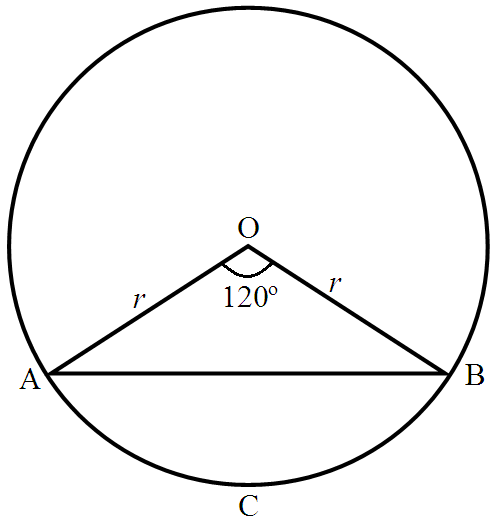
In the following figure, the area of segment ACB is:
- A
$\Big(\frac{\pi}{3}-\frac{\sqrt{3}}{2}\Big)\text{r}^2$
- B
$\Big(\frac{\pi}{3}+\frac{\sqrt{3}}{2}\Big)\text{r}^2$
- C
$\Big(\frac{\pi}{3}-\frac{\sqrt{2}}{3}\Big)\text{r}^2$
- ✓
$\text{None of these}$
AnswerCorrect option: D. $\text{None of these}$
We have to find area of segment ACB.Area of the ACB segment $=\Big(\frac{\pi\theta}{360}-\sin\frac{\theta}{2}\cos\frac{\theta}{2}\Big)\text{r}^2$
We know that $\theta=120^\circ.$
Substituting the values we get,
Area of the ACB segment $=\Big(\frac{\pi\times120}{360}-\sin60\cos60\Big)\text{r}^2$
$\therefore$ Area of the PAQ segment $=\Big(\frac{\pi}{3}-\sin60\cos60\Big)\text{r}^2$
Substituting $\sin60=\frac{\sqrt{3}}{2}$ and $\cos60=\frac{1}{2}$ we get,
Area of the ACB segment $=\Big(\frac{\pi}{3}-\frac{\sqrt{3}}{2}\times\frac{1}{2}\Big)\text{r}^2$
$\therefore$ Area of the ACB segment $=\Big(\frac{\pi}{3}-\frac{\sqrt{3}}{4}\Big)\text{r}^2$
Therefore, area of the segment ACB is $\Big(\frac{\pi}{3}-\frac{\sqrt{3}}{4}\Big)\text{r}^2$
Hence, the correct answer is option (d).
View full question & answer→MCQ 171 Mark
If the area of a sector of a circle bounded by an arc of length $5\pi\text{ cm}$ is equal to $20\pi\text{ cm}^2,$ then the radius of the circle:
AnswerLength of arc $=5\pi\text{ cm}$area of sector $20\pi\text{ cm}^2$
Let the angle at the centre be $\theta$
then, $2\pi\text{r}\times\frac{\theta}{360^\circ}=5\pi$
$\text{r}\times\frac{\theta}{360^\circ}=\frac{5\pi}{2\pi}=\frac{5}{2}\ \dots(\text{i})$
Area $=\pi\text{r}\frac{\theta}{360^\circ}$
$\therefore\pi\text{r}^2\frac{\theta}{360^\circ}=20\pi$
$\pi\text{r}.\text{r}\frac{\theta}{360^\circ}=20\pi$
$\pi\text{r}\times\frac{5}{2}=20\pi\Rightarrow\text{r}=\frac{20\pi\times2}{5\pi}$
$\Rightarrow\text{r}=8$
$\therefore$ Radius of the circle = 8cm (c)
View full question & answer→MCQ 181 Mark
Area of the largest triangle that can be inscribed in a semi-circle of radius r units is:
- ✓
$\text{r}^2\text{sq. units}$
- B
$\frac{1}{2}\text{r}^2\text{sq. units}$
- C
$2\text{r}^2\text{sq. units}$
- D
$\sqrt{2}\text{r}^2\text{sq. units}$
AnswerCorrect option: A. $\text{r}^2\text{sq. units}$
Take a point C on the circumference of the semi-circle and join it by the end points of diameter A and B.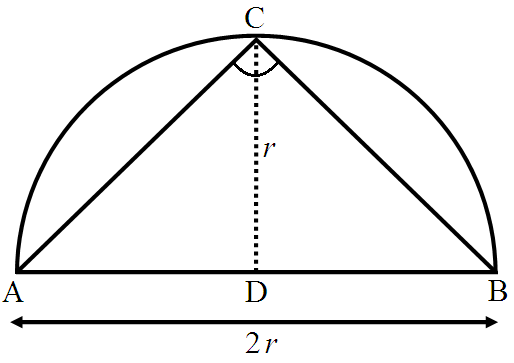
$\therefore\angle\text{C}=90^\circ$ [by property of circle]
[angle in a semi-circle are right angle]
So, $\triangle\text{ABC}$ is right angled triangle.
$\therefore$ Area of largest $\triangle\text{ABC}=\frac{1}{2}\times\text{AB}\times\text{CD}$
$=\frac{1}{2}\times2\text{r}\times\text{r}$
$\text{r}^2\text{sq. units}\ \text{(a)}$ View full question & answer→MCQ 191 Mark
The circumference of a circle is 100m. The side of a square inscribed in the circle is:
AnswerCorrect option: D. $\frac{100\sqrt{2}}{\pi}$
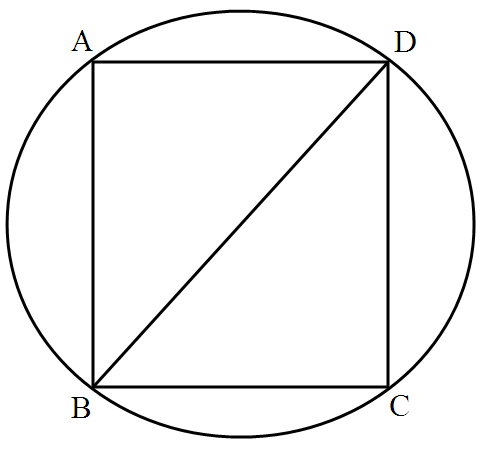
We have given the circumference of the circle that is 100cm. If d is the diameter of the circle, then
its circumference will be $\pi\text{d}.$
$\therefore\pi\text{d}=100$
$\therefore\text{d}=\frac{100}{\pi}$
We obtained diameter of the circle. Look at the figure, diameter of the circle is also the diagonal of the square ABCD.
We know that if we have diagonal of the circle we can calculate the side of the square, using the formula given below,
$\text{side=}\sqrt{2}\times\text{diagonal}$
Substituting the value of diagonal we get,
$\text{side}=\sqrt{2}\times\frac{100}{\pi}$
Therefore, side of the inscribed square is $\frac{100\sqrt{2}}{\pi}\text{cm}$
Hence, the correct answer is option (d). View full question & answer→MCQ 201 Mark
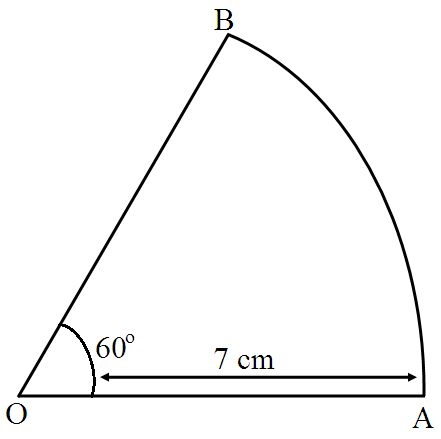
The perimeter of the sector OAB
shown in the following figure, is:
- ✓
$\frac{64}{3}\text{cm}$
- B
$26\text{cm}$
- C
$\frac{64}{5}\text{cm}$
- D
$19\text{cm}$
AnswerCorrect option: A. $\frac{64}{3}\text{cm}$
Radius of sector of 60° = 7cm
$\therefore$ perimeter = arc AB + 2r
$=2\pi\text{r}\times\frac{60}{360}+2\times7$
$=2\times\frac{22}{7}\times7\times\frac{1}{6}+14$
$=\frac{22}{3}+14=\frac{64}{3}\text{cm}\text{(a)}$
View full question & answer→MCQ 211 Mark
The area of the largest triangle that can be inscribed in a semi $-$ circle of radius $r,$ is:
- ✓
$r^2$
- B
$2r^2$
- C
$r^3$
- D
$2r^3$
AnswerThe largest triangle inscribed in a semi-circle of radius $r,$ can be $\triangle\text{ABC}$ as shown in the figure, whose base $= AB = 2r$
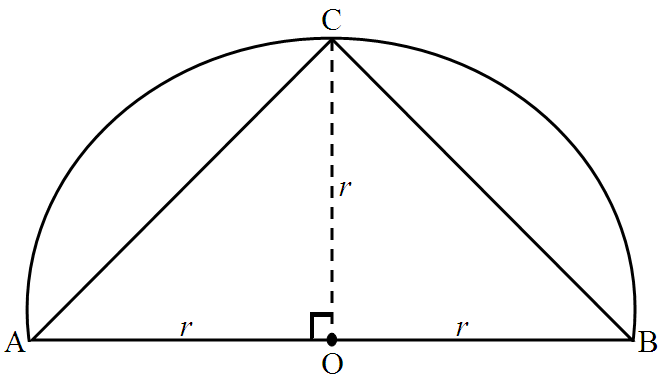
and altitude $OC = r$
Area of triangle $=\frac{1}{2}\text{base}\times\text{altitude}$
$=\frac{1}{2}\times2\text{r}\times\text{r}=\text{r}^2 (a)$ View full question & answer→MCQ 221 Mark
The area of a circle is $220\ cm^2$. The area of ta square inscribed in it is
- A
$49\ cm^2$
- B
$70\ cm^2$
- ✓
$140\ cm^2$
- D
$150\ cm^2$
AnswerCorrect option: C. $140\ cm^2$
Area of a circle $= 220\ cm^2$
$\therefore$ Radius $(r) =\sqrt{\frac{\text{A}}{\pi}}=\sqrt{\frac{220\times7}{22}}$
$=\sqrt{70}\text{ cm}$
Diagonal of square $=$ diameter of the circle
$=2\times\text{r}=2\times\sqrt{70}\text{ cm}$
$\therefore$ Area of square $= \Big(\frac{\text{Diagonal}}{\sqrt{2}}\Big)^2=\Big(\frac{2\sqrt{70}}{\sqrt{2}}\Big)^2$
$=\frac{4\times70}{2}=140\text{ cm}^2 \text{(c)}$
View full question & answer→MCQ 231 Mark
The ratio of the outer and inner perimeters of a circular path is 23 : 22. If the path is 5 metres wide, the diameter of the inner circle is:
AnswerRatio in the outer and inner perimeter of a circular path = 23 : 22
Width of path = 5m
Let R and r be the radii of outer and inner path then R- r = 5m ….(i)
and $\frac{2\pi\text{R}}{2\pi\text{r}}=\frac{23}{22}\Rightarrow\frac{\text{R}}{\text{r}}=\frac{23}{22}$
$\Rightarrow22\text{R}=23\text{r}\Rightarrow\text{R}=\frac{23}{22}\text{r}$
$\therefore$ From (i)
$\frac{23}{22}\text{r}-\text{r}=5\Rightarrow\text{r}\Big(\frac{23}{22}-1\Big)=5$
$\Rightarrow\text{r}\Big(\frac{1}{22}\Big)=5\Rightarrow\text{r}=5\times22=110\text{m}$
$\therefore$ Diameter of inner circle = 2r = 2 × 110
= 220m (c)
View full question & answer→MCQ 241 Mark
If he area of a sector of a circle is $\frac{7}{20}$ of the area of the circle, then the sector angle is equal to:
AnswerWe have given that area of the sector is $\frac{7}{20}$ of the area of the circle.Therefore, area of the sector $=\frac{7}{20}\text{x}$ area of the circle.
$\therefore\frac{\theta}{360}\times\pi\text{r}^2=\frac{7}{20}\times\pi\text{r}^2$
Now we will simplify the equation as below,
$\frac{\theta}{360}=\frac{7}{20}$
Now we will multiply both sides of the equation by 360,
$\therefore\theta=\frac{7}{20}\times360$
$\therefore\theta=126$
Therefore, sector angle is 126°.
Hence, the correct answer is option (d).
View full question & answer→MCQ 251 Mark
The area of incircle of an equilateral triangle is $154\ cm^2.$ The perimeter of the triangle is:
- A
$71.5\ cm$
- B
$71.7\ cm$
- C
$72.3\ cm$
- ✓
$72.7\ cm$
AnswerCorrect option: D. $72.7\ cm$
Area of incircle of equilateral triangle is $154\ cm^2$
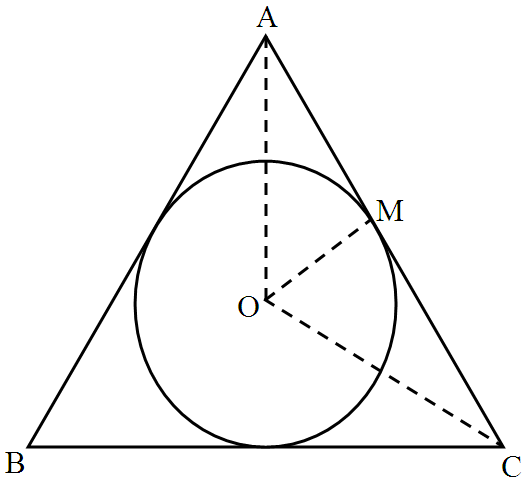
We have to find the perimeter of the triangle.
So we will use area to get,
Area of incircle $= 154$
$\pi\text{r}^2=154$
$\text{r}=\sqrt{\frac{154}{\pi}}\text{ cm}$
As triangle is equilateral so,
$\angle\text{OCM}=30^\circ$
So,
$\tan30^\circ=\frac{\text{r}}{\text{MC}}$
$\text{MC}=\sqrt{\frac{154(3)}{\pi}}\text{ cm}$
So,
$\text{AC}=2\text{(MC)}$
$=2\bigg(\sqrt{\frac{154(3)}{\pi}}\bigg)\text{ cm}$
Therefore perimeter of the triangle is,
$=3\text{(AC)}$
$=6\Big(\sqrt{\frac{462}{3.14}}\Big)$
$=72.7\text{ cm}$
Therefore the answer is $(d)$. View full question & answer→MCQ 261 Mark
If the difference between the circumference and radius of a circle is 37cm, then using $\pi=\frac{22}{7}$ the circumference (in cm) of the circle is:
AnswerWe know that circumference; C of the circle with radius r is equal to $2\pi\text{r}$
We have given difference between circumference and radius of the citcle that is 37cm,
$\therefore\text{C}-\text{r}=2\pi\text{r}-\text{r}$
$\therefore(2\pi-1)\text{r}=37$
Substituting we $\pi=\frac{22}{7}$ get,
$\therefore\Big(2\times\frac{22}{7}-1\Big)\text{r}=37$
$\therefore\Big(\frac{44-7}{7}\Big)\text{r}=37$
$\therefore\Big(\frac{37}{7}\Big)\text{r}=37$
Dividing both sides of the equation by $\frac{7}{37},$ we get, $\therefore\text{r}=7$
Threfore, circumference of the circle will be
$2\pi\text{r}=2\times\frac{22}{7}\times7$
$=44\text{cm}^2$
Hence, the correct choice is (b).
View full question & answer→MCQ 271 Mark
If the circumference of a circle increases from $4\pi$ to $8\pi,$ then its area is:
AnswerLet the circumference $\text{C}=4\pi$$\therefore2\pi\text{r}=4\pi$
$\therefore\text{r}=2$
Therefore, area of the circle when radius of the circle is 2 can be calculated as below,
$\pi\text{r}^2=\frac{22}{7}\times4\ \dots(1)$
Now when circumference is $\text{C}=8\pi,$ then the radius of the circle is calculated as below,
$\therefore2\pi\text{r}=8\pi$
$\therefore\text{r}=4$
Therefore, area of the circle when radius of the circle is 4 can be calculated
as below,
$\pi\text{r}^2=\frac{22}{7}\times16$
$\therefore\pi\text{r}^2=4\Big(\frac{22}{7}\times4\Big) \dots(2)$
Therefore, from equation (1) and (2) we can say that its area is quadrupled.
Hence, the correct answer is option (d).
View full question & answer→MCQ 281 Mark
The perimeter of a triangle is $30\ cm$ and the circumference of its incircle is $88\ cm$. The area of the triangle is:
- A
$70\ cm^2$
- B
$140\ cm^2$
- ✓
$210\ cm^2$
- D
$420\ cm^2$
AnswerCorrect option: C. $210\ cm^2$
We have to find the area of the given triangle.
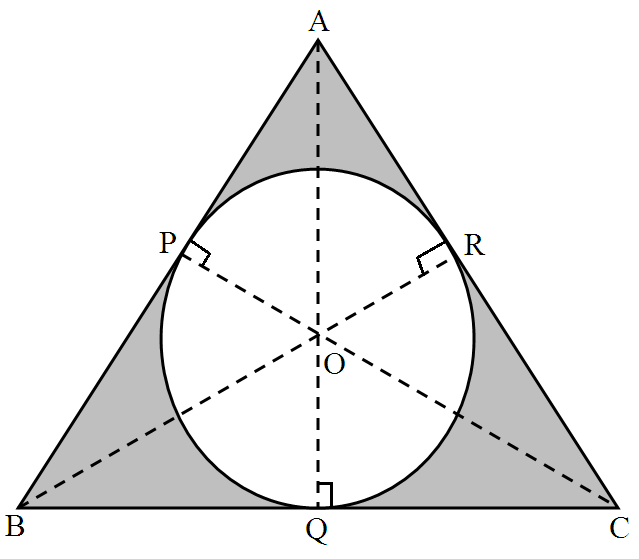
Perimeter of triangle is $30\ cm$.
Let the radius of the circle be $r$.
We have,
Circumference of incircle $= 88$
$2\pi\text{r}=88$
$\text{r}=14$
Therefore,
$\text{ar}(\triangle\text{ABC})=\text{ar}(\triangle\text{OAB})+\text{ar}(\triangle\text{OBC})+\text{ar}(\triangle\text{OAC})$
$=\frac{1}{2}\text{(r)}\text{(AB+BC+CA)}$
$=\frac{1}{2}(14)(30)\text{ cm}^2$
$=210\text{ cm}^2$
Therefore the answer is $(c).$ View full question & answer→MCQ 291 Mark
A wire can be bent in the form of a circle of radius $56\ cm$. If it is bent in the form fo a square, then its area will be:
- A
$3520\ cm^2$
- B
$6400\ cm^2$
- ✓
$7744\ cm^2$
- D
$8800\ cm^2$
AnswerCorrect option: C. $7744\ cm^2$
Radius of circular wire $(r) = 56\ cm$
Circumference $=2\pi\text{r}=2\times\frac{22}{7}\times56\text{ cm}=352\text{ cm}$
Now perimeter of square $= 352\ cm$
$\therefore$ side of square $=\frac{352}{4}=88\text{ cm}$
and area of square $=\text{(side)}^2=(88)^2$
$=7744\text{ cm}^2\ (\text{c})$
View full question & answer→MCQ 301 Mark
If the sum of the circumference of two circles with radii $r_1$ and $r_2$ is equal to the circumference of a circle of radius $r,$ then:
- ✓
$r = r_1 + r_2$
- B
$r_1 + r_2 > r$
- C
$r_1 + r_2 < r$
- D
AnswerCorrect option: A. $r = r_1 + r_2$
The radius of the two circles $ r_1$ and $r_2$
Now, according to the given condition
The circumference of the circle with radius $r =$ circumference of the circle with radius $r_1\ +$ circumference of the circle with radius $r_2$
$2\pi\text{r}=2\pi\text{r}_1+2\pi\text{r}_2$
$2\pi\text{r}=2\pi(\text{r}_1+\text{r}_2)$
$\text{r}=\text{r}_1+\text{r}_2$
Hence, the correct answer is option $(a).$
View full question & answer→MCQ 311 Mark
If the sum of the areas of two circles with radii $r_1$ and $r_2$ is equal to the area of a circle of radius $r,$ then $\text{r}^2_{1}+\text{r}^2_{1}$
- A
$ > r^2$
- ✓
$= r^2$
- C
$ < r^2$
- D
AnswerCorrect option: B. $= r^2$
Sum of area of two circles with radii $r_1$ and $r_2$
$=\pi\text{r}^2_{1}+\pi\text{r}^2_{2}=\pi(\text{r}^2_{1}+\text{r}^2_{2})$
and area of a circle with radius $\text{r}=\pi\text{r}^2$
$\therefore\pi(\text{r}^2_{1}+\text{r}^2_{2})=\pi\text{r}^2$
$\Rightarrow\text{r}^2_{1}+\text{r}^2_{2}=\text{r}^2\text{(b)}$
View full question & answer→MCQ 321 Mark
The area of a circular path of uniform width $h$ surrounding a circular region of radius $r$ is:
- A
$\pi(2\text{r}+\text{h})\text{r}$
- ✓
$\pi(2\text{r}+\text{h})\text{h}$
- C
$\pi(\text{h}+\text{r})\text{r}$
- D
$\pi(\text{h}+\text{r})\text{h}$
AnswerCorrect option: B. $\pi(2\text{r}+\text{h})\text{h}$
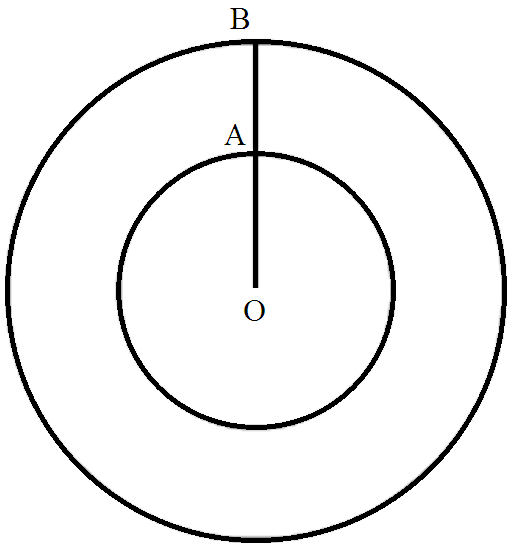
We have
$OA = r$
$AB = h$
Therefore, radius of the outer circle will be $r + h$
Now we will find the area between the two circles.
Area of the circular path $-$ area of the outer circle $-$ area of the inner cicrle.
$\therefore$ Area of the circular path $=\pi\Big[(\text{r}+\text{h})^2\Big]-\pi\text{r}^2$
$\therefore$ Area of the circular path $=\pi(\text{r}^2+2\text{rh}+\text{h}^2)-\pi\text{r}^2$
$\therefore$ Area of the circular path $=\pi(\text{r}^2+2\text{rh}+\text{h}^2-\text{r}^2)$
Cancelling $r^2$ we get,
Area of the circular path $=\pi(2\text{rh}+\text{h}^2)$
$\therefore$ Area of the circular path $=\pi(2\text{r}+\text{h})\text{h}.$
Hence, the correct answer is option $(b)$. View full question & answer→MCQ 331 Mark
If the area of a circle is equal to the sum of the areas of two circles of diameters 10cm and 24cm, then diameter of the large circle (in cm) is:
AnswerLet the diameter of the larger circle be dNow, Area of larger circle = Area of circle having diameter 10cm + Area of circle having diameter 24cm
$\Rightarrow\pi\Big(\frac{\text{d}}{2}\Big)^2=\pi\Big(\frac{10}{2}\Big)^2+\pi\Big(\frac{24}{2}\Big)^2$
$\Rightarrow\Big(\frac{\text{d}}{2}\Big)^2=(5)^2+(12)^2$
$\Rightarrow\Big(\frac{\text{d}}{2}\Big)^2=25+144$
$\Rightarrow\Big(\frac{\text{d}}{2}\Big)^2=13^2$
$\Rightarrow\frac{\text{d}}{2}=13$
$\Rightarrow\text{d}=26\text{cm}$
Hence, the correct answer is option (b).
View full question & answer→MCQ 341 Mark
In the following figure, the shaded area is:

- A
$50(\pi-2)\text{cm}^2$
- ✓
$25(\pi-2)\text{cm}^2$
- C
$25(\pi+2)\text{cm}^2$
- D
$5(\pi-2)\text{cm}^2$
AnswerCorrect option: B. $25(\pi-2)\text{cm}^2$
Area of the shaded region is-$=\Big[\frac{\pi\theta}{360}-\sin\frac{\theta}{2}\cos\frac{\theta}{2}\Big](\text{r})^2$
$=\Big(\frac{\pi}{4}-\frac{1}{2}\Big)(10) ^2$
$=25(\pi-2)\text{cm}^2$
So the answer is (b).
View full question & answer→MCQ 351 Mark
If AB is a chord of length $5\sqrt{3}\text{cm}$ of a circle with centre O and radius 5cm, then area of sector OAB is:
- A
$\frac{3\pi}{8}\text{cm}^2$
- B
$\frac{8\pi}{3}\text{cm}^2$
- C
$25\pi\text{ cm}^2$
- ✓
$\frac{25\pi}{3}\text{cm}^2$
AnswerCorrect option: D. $\frac{25\pi}{3}\text{cm}^2$
We have to find the area of the sector OAB.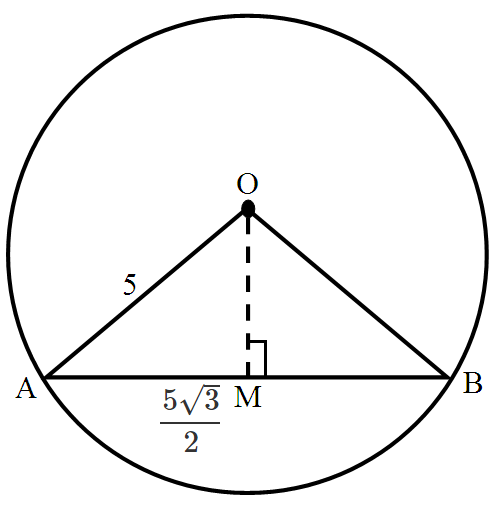
We have,
$\text{AM}=\frac{5\sqrt{3}}{2}$
So,
$\sin\angle\text{AOM}=\frac{5\sqrt{3}}{2(5)}$
Hence,
$\angle\text{AOM}=60^\circ$
Therefore area of the sector,
$=\frac{1}{2}\text{r}^2\theta$
$=\frac{1}{2}(25)\Big(\frac{2\pi}{3}\Big)$
$=\frac{25\pi}{3}\text{cm}^2$
So answer is (d). View full question & answer→MCQ 361 Mark
If the perimeter of a sector of a circle of radius $6.5\ cm$ is $29\ cm,$ then its area is:
- A
$58 \ cm^2$
- ✓
$52 \ cm^2$
- C
$25 \ cm^2$
- D
$56 \ cm^2$
AnswerCorrect option: B. $52 \ cm^2$
We know that perimeter of a sector of radius $\text{r}=2\text{r}+\frac{\theta}{360}\times2\pi\text{r}\ \dots(1)$
We have given perimeter of the sector and radius of the sector and we are asked to find the area of the sector.
For that we have to find the sector angle.
Therefore, substituting the corresponding values of perimeter and radius in equation $(1)$ we get,
$29=2\times6.5+\frac{\theta}{360}\times2\pi\times6.5\ \dots(2)$
We will simplify equation $(2)$ as shown below,
$29=2\times6.5\Big(1+\frac{\theta}{360}\times\pi\Big)$
Subtracting $1$ from both sides of the equation we get,
$\frac{29}{2\times6.5}-1=\frac{\theta}{360}\times\pi\ \dots(3)$
We know that area of the sector $=\frac{\theta}{360}\times\pi\text{r}^2$
From equation $(3),$ we get
Area of the sector $=\Big(\frac{29}{2\times6.5}-1\Big)\text{r}^2$
Substituting $r = 6.5$ we get,
Area of the sector $=\Big(\frac{29}{2\times6.5}-1\Big)6.5^2$
$\therefore$ Area of sector $=\Big(\frac{29\times6.5^2}{2\times6.5}-6.5^2\Big)$
$\therefore$ Area of sector $=\Big(\frac{29\times6.5}{2}-6.5^2\Big)$
$\therefore$ Area of sector $=\Big(\frac{188.5}{2}-42.25\Big)$
$\therefore$ Area of sector $= (94.25 - 42.25)$
$\therefore$ Area of sector $= 52$
Therefore, area of the sector is $52\ cm^2$.
Hence, the correct answer is option $(b).$
View full question & answer→MCQ 371 Mark
ABCD is a rectangle whose three vertices are B(4, 0), C(4, 3) and D(0, 3). The length of one of its diagonals is:
Answer$\text{BD}=\sqrt{(0-4)^2+(3-0)^2}$
$=\sqrt{4^2+3^3}$
$=\sqrt{25}$
$=5\text{ units}$
Hence, the correct answer is option (a).
View full question & answer→MCQ 381 Mark
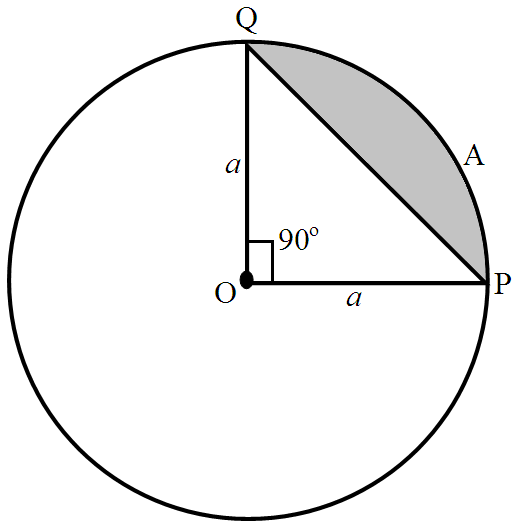
In the following figure, the area of the segment PAQ is:
- A
$\frac{\text{a}^2}{4}(\pi+2)$
- ✓
$\frac{\text{a}^2}{4}(\pi-2)$
- C
$\frac{\text{a}^2}{4}(\pi-1)$
- D
$\frac{\text{a}^2}{4}(\pi+1)$
AnswerCorrect option: B. $\frac{\text{a}^2}{4}(\pi-2)$
a is the radius of the circle arc PAQ subtends angle 90° at the centre$\therefore$ Area of segment PAQ
= Area of quadrant - area of $\triangle\text{OPQ}$
$=\frac{1}{4}\pi\text{a}^2-\frac{1}{2}\text{a}\times\text{a}=\frac{1}{4}\pi\text{a}^2-\frac{1}{2}\text{a}^2$
$=\frac{1}{4}\text{a}^2(\pi-2)=\frac{\text{a}^2}{4}(\pi-2)\text{(b)}$
View full question & answer→MCQ 391 Mark
A circular park has a path of uniform width around it. The difference betweenthe outer and inner circumferences of the circular path is 132m. Its width is:
AnswerLet R and r the radil of the outer and inner circles of the park, then $2\pi\text{R}-2\pi\text{r}=132$$\Rightarrow2\pi(\text{R - r})=132\Rightarrow\frac{2\times22}{7}(\text{R - r})=132$
$\Rightarrow\text{R - r}=\frac{132\times7}{2\times22}=21$
$\therefore$ Width of parth = 21m (b)
View full question & answer→MCQ 401 Mark
If the area of a sector of a circle is $\frac{5}{18}$ of the area of the circle, then the sector angle is equal to:
AnswerArea of sector of a circle $=\frac{5}{18}$ x area of circle.
Let $\theta$ be its angle at the centre and r be radius.
Then, $\pi\text{r}^2\times\frac{\theta}{360^\circ}=\frac{5}{18}\pi\text{r}^2$
$\frac{\theta}{360^\circ}=\frac{5}{18}\Rightarrow\theta=\frac{5}{18}\times360^\circ=100^\circ\text{(c)}$
View full question & answer→MCQ 411 Mark
If the perimeter of a circle is equal to that of a square, then the ratio of their areas is:
AnswerLet radius of circle be r and side of a square be a
According to the given condition,
Perimeter of a circle = Perimeter of a square
$\therefore2\pi\text{r}=4\text{a}\Rightarrow\text{a}=\frac{\pi\text{r}}{2}\dots(\text{i})$
Now, $\frac{\text{Area of circle}}{\text{Area of square}}=\frac{\pi\text{r}^2}{\text{a}^2}=\frac{\pi\text{r}^2}{\Big(\frac{\pi\text{r}}{2}\Big)^2}$
[From Eq. (i)]
$=\frac{\pi\text{r}^2}{\frac{\pi^2\text{r}^2}{4}}=\frac{4}{\pi}=\frac{4}{\frac{22}{7}}=\frac{28}{22}=\frac{14}{11}$
View full question & answer→MCQ 421 Mark
The area of the circle that can be inscribed in a square of side 10cm is:
- A
$40\pi\text{ cm}^2$
- B
$30\pi\text{ cm}^2$
- C
$100\pi\text{ cm}^2$
- ✓
$25\pi\text{ cm}^2$
AnswerCorrect option: D. $25\pi\text{ cm}^2$
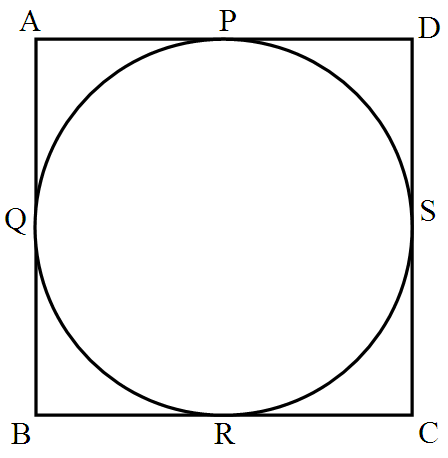
We know that ABCD is a square of length 10cm. A circle is inscribed in the square therefore, all the sides of the square are become tangents of the circle.
By, the tangent property, we have
AP = PD = 5
AQ = QB = 5
BR = RC = 5
CS = DS = 5
If we join PR then it will be the diameter of the circle of 10cm.
Therefore, radius of the circle = 5cm
$\therefore$ Area of the circle $=\pi\text{ r}^2$
$\therefore$ Area of the circle $=\pi\times5^2$
$\therefore$ Area of the circle $=25\pi$
Therefore, area of the circle is $25\pi\text{ cm}^2.$
Hence, the correct answer is option (d). View full question & answer→MCQ 431 Mark
If a chord of a circle of radius $28 \ cm$ makes an angle of $90^{\circ}$ at the centre, then the area of the major segment is :
- A
$392 \ cm^2$
- B
$1456 \ cm^2$
- C
$1848 \ cm^2$
- ✓
$2240 \ cm^2$
AnswerCorrect option: D. $2240 \ cm^2$
Area of major segment, $=$ Area of circle $-\Big[\frac{\pi\theta}{360}-\sin\frac{\theta}{2}\cos\frac{\theta}{2}\Big]\text{(r)}^2$
$=\pi(28)^2-\Big(\frac{\pi}{4}-\frac{1}{2}\Big)(28)^2$
$=784\pi-196(\pi-2)$
$=2240\text{ cm}^2$
So the answer is $(d)$
View full question & answer→MCQ 441 Mark
If the difference between the circumference and radius of a circle is $37\ cm,$ then its area is :
- ✓
$154 \ cm^2$
- B
$160 \ cm^2$
- C
$200 \ cm^2$
- D
$150 \ cm^2$
AnswerCorrect option: A. $154 \ cm^2$
Let $r$ be the radius of a circle then circum $-$ ference $=2\pi\text{r}$
$\therefore2\pi\text{ r}-\text{r}=37$
$\text{r}\Big(2\times\frac{22}{7}-1\Big)=37$
$\Rightarrow\text{r}\Big(\frac{44}{7}-7\Big)=37$
$\Rightarrow\text{r}\Big(\frac{37}{7}\Big)=37 $
$\Rightarrow\text{r}=\frac{37\times7}{37}=7\text{ cm}$
Now area of the circle $=\pi\text{r}^2$
$=\frac{22}{7}\times7\times7=154\text{ cm}^2\text{(a)}$
View full question & answer→MCQ 451 Mark
$\text{ABCD}$ is a square of side $4\ cm$. If $E$ is a point in the interior of the square such that $\triangle\text{CED}$ is equilateral, then area of $\triangle\text{ACE}$ is:
- A
$2\sqrt{3}-1\text{ cm}^2$
- ✓
$4\sqrt{3}-1\text{ cm}^2$
- C
$6\sqrt{3}-1\text{ cm}^2$
- D
$8\sqrt{3}-1\text{ cm}^2$
AnswerCorrect option: B. $4\sqrt{3}-1\text{ cm}^2$
Side of square $\text{ABCD} = 4\ cm$
and side of equilateral $\triangle\text{CED}=4\text{ cm}$
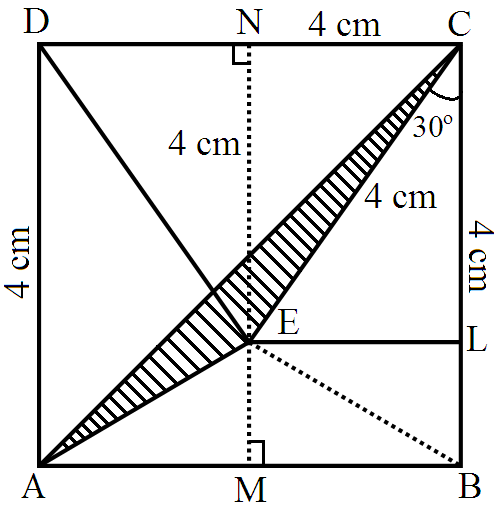
Area of square $=(\text { side })^2=4 \times 4=16 \ cm^2$
and area of $\triangle\text{CED}=\frac{\sqrt{3}}{4}\text{(side)}^2$
$=\frac{\sqrt{3}}{4}\times4\times4=4\sqrt{3}\text{ cm}^2$
Join $AE, AB$ and $AC$ and draw $\text{EL}\perp\text{BC},$
$\text{EM}\perp\text{AB}$ and $\text{EN}\perp\text{CD}$
Now area of $\triangle\text{ABC}$
$=\frac{1}{2}\text{AD}\times\text{BC}=\frac{1}{2}\times4\times4=8\text{ cm}^2$
In $\triangle\text{BEC},\text{EL}=\frac{4}{2}=2$
$\Big(\therefore\sin30^\circ=\frac{1}{2}\Big)$
$\therefore$ area $\triangle\text{BEC}=\frac{1}{2}\times\text{BC}\times\text{EL}$
$=\frac{1}{2}\times4\times2=4\text{cm}^2$
and in $\triangle\text{AEB}\perp\text{EM}=\text{MN}-\text{EN}$
$\big(4-2\sqrt{3}\big)\text{ cm}$
$\therefore$ area $\triangle\text{AEB}=\frac{1}{2}\text{AB}\times\text{EM}$
$=\frac{1}{2}\times4\big(4-2\sqrt{3}\big)$
$=4\big(2-\sqrt{3}\big)=8-4\sqrt{4}\text{ cm}^2$
$\therefore$ area $\triangle\text{AEC} =$ area $\triangle\text{ABC}-\big($area $\triangle\text{AEB}\ +$ area $\triangle\text{BEC}\big)$
$=8-\big(8-4\sqrt{3}+4\big)$
$=8-8-4+4\sqrt{3}$
$=4\sqrt{3}-4=4\big(\sqrt{3}-1\big)\text{ cm}^2\text{(b)}$ View full question & answer→MCQ 461 Mark
If the area of a sector of a circle bounded by an arc of length $5\pi\text{cm}$ is equal to $20\pi\text{cm}^2,$ then its radius is:
AnswerLet r be the radius, thenLength of the arc of sector of $\theta$ angle $=5\pi$
$\Rightarrow2\pi\text{r}\frac{\theta}{360^\circ}=5\pi$
$\therefore\text{r}\frac{\theta}{360^\circ}=\frac{5}{2}\ \dots\text{(i)}$
and area of sector of $\theta$ angle $=20\pi\text{cm}^2$
$\therefore\pi\text{r}^2\frac{\theta}{360^\circ}=20\pi$
$\text{r}^2\frac{\theta}{360^\circ}=20$
$\Rightarrow\text{r}.\text{r}\frac{\theta}{360^\circ}=20\Rightarrow\text{r}\times\frac{5}{2}=20$
$\Rightarrow\text{r}=\frac{20\times2}{5}=8$
$\therefore$ Radius = 8cm (c)
View full question & answer→MCQ 471 Mark
If the circumference of a circle and the perimeter of a square are equal, then:
- A
Area of the circle = Area of the square.
- B
Area of the circle < Area of the square.
- ✓
Area of the circle > Area of the square.
- D
Nothing definite can be said.
AnswerCorrect option: C. Area of the circle > Area of the square.
According to the given condition, Circumference of a circle = Perimeter of square $2\pi\text{r}=4\text{a}$
[where, r and a are radius of circle and side of square respectively]
$\Rightarrow\frac{22}{7}\text{r}=2\text{a}\Rightarrow11\text{r}=7\text{a}$
$\Rightarrow\text{a}=\frac{11}{7}\text{r}\Rightarrow\text{r}=\frac{7\text{a}}{11}\dots(\text{i})$
Now, area of circle, $\text{A}_1=\pi\text{r}^2$
$=\pi\Big(\frac{7\text{a}}{11}\Big)^2=\frac{22}{7}\times\frac{49\text{a}^2}{121}$ [From Eq. (i)]
$=\frac{14\text{a}^2}{11}\dots(\text{ii})$
and area of square, $\text{A}_2=\text{(a)}^2\dots(\text{iii})$
from Eqs.(ii) and (iii), $\text{A}_1=\frac{14}{11}\text{A}_2$
$\therefore\text{A}_1>\text{A}_2$
Hence, Area of the circle > Area of the square. (c)
View full question & answer→MCQ 481 Mark
If a wire is bent into the shape of a square, then the area of the square is $81\ cm^2$.When wire is bent into a semi-circular shape, then the area of the semi $-$ circle will be:
- A
$22 \ cm^2$
- B
$44 \ cm^2$
- ✓
$77 \ cm^2$
- D
$154 \ cm^2$
AnswerCorrect option: C. $77 \ cm^2$
We have given that a wire is bent in the form of square of side a $cm$ such that the area of the square is. $81\ cm^2$
If we bent the same wire in the form of a semicircle with radius $r \ cm,$ the perimeter of the wire will not change.
$\therefore$ perimeter of the square $=$ perimeter of semi circle
$4\text{a}=\frac{1}{2}(2\pi\text{r})+2\text{r} \dots(1)$
We know that area of the square $= 81\ cm^2$
$\therefore\text{a}^2=81$
$\therefore\text{a}=9$
Now we will substitute the value of a in the equation $(1),$
$4\times9=\frac{1}{2}(2\pi\text{r})+2\text{r}$
$\therefore36=\frac{1}{2}(2\pi\text{r})+2\text{r}$
$\therefore36=(\pi\text{r})+2\text{r}$
$\therefore36=\text{r}(\pi+2)$
Now we will substitute $\pi=\frac{22}{7}$
$\therefore36=\text{r}\big(\frac{22}{7}+2\big)$
$\therefore=\text{r}\Big(\frac{22+14}{7}\Big)$
$\therefore36=\text{r}\Big(\frac{36}{7}\Big)$
Multiplying both sides of the equation by $7$ we get, $36 \times 7 = r \times 36$
Now we will divide both sides of the equation by $36$ we get,$ r = 7$
Therefore, radius of the semi circle is $7\ cm.$
Now we will find the area of the semicircle.
Area of the semicircle $=\frac{1}{2}\times\pi\text{r}^2$
$=\frac{1}{2}\times\pi\times7^2$
$=\frac{1}{2}\times\frac{22}{7}\times7^2$
$=11\times7$
$=7$
Therefore, area of the semicircle is $77\ cm^2$
Hence the correct answer is option $(c)$.
View full question & answer→MCQ 491 Mark
The area of a sector whose perimeter is four times its radius r units, is:
- A
$\frac{\text{r}^2}{4}\text{sq. units}$
- B
$2\text{r}^2\text{sq. units}$
- ✓
$\text{r}^2\text{sq. units}$
- D
$\frac{\text{r}^2}{2}\text{sq. units}$
AnswerCorrect option: C. $\text{r}^2\text{sq. units}$
Radius of sector = rPerimeter = 4r
and length of arc = 4r – 2r = 2r
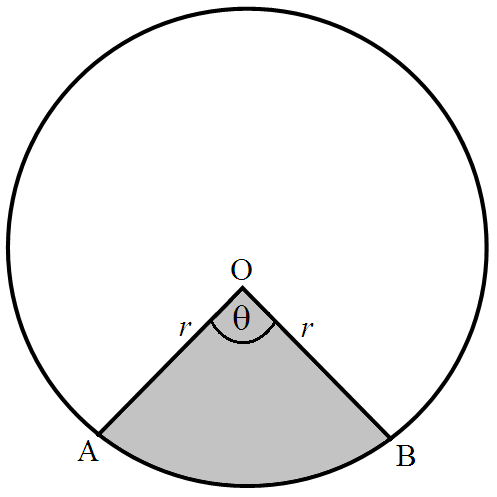
$\therefore$ Let angle at the centre $=\theta$
Then, $2\pi\text{r}=\frac{\theta}{360^\circ}=2\text{r}$
$\Rightarrow\pi=\frac{\theta}{360^\circ}=1\ \dots\text{(i)}$
Now area $\pi\text{r}^2\times\frac{\theta}{360^\circ}=\text{r}^2\Big(\pi\times\frac{\theta}{360^\circ}\Big)$
$=\text{r}^2\times1$ [From (i)]
$=\text{r}^2\text{(c)}$ View full question & answer→MCQ 501 Mark
The area of the incircle of an equilateral triangle of side $42\ cm$ is :
- A
$22 \sqrt{3} \ cm^2$
- B
$231 \ cm^2$
- ✓
$462 \ cm^2$
- D
$924 \ cm^2$
AnswerCorrect option: C. $462 \ cm^2$
Side of an equilateral triangle $(a) = 42\ cm$
Radius of inscribed circle $=\frac{1}{3}\times\text{altitude}$
$=\frac{1}{3}\times\frac{\sqrt{3}}{2}\text{side}$
$=\frac{\sqrt{3}}{6}\times42=7\sqrt{3}$
$\therefore$ Area of the incircle = $\pi\text{r}^2$
$=\frac{22}{7}\times\big(7\sqrt{3}\big)^2\text{ cm}^2$
$=\frac{22}{7}\times7\times7\times3\text{ cm}^2=462\text{ cm}^2\text{(c)}$
View full question & answer→