Questions

2 Marks Questions

Take a timed test

18 questions · self-marked practice — reveal the answer and mark yourself.

Question 12 Marks
In the given figure, $P A$ and $P B$ are tangents to the circle from an external point $P . C D$ is another tangent touching the circle at $Q$. If $P A=12 cm$, $Q C=Q D=3 cm$, then find $P C+P D$.
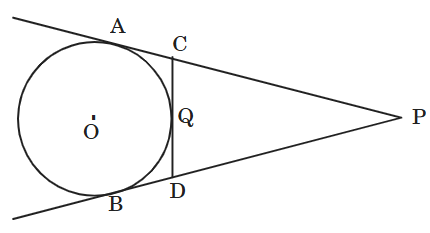
Image
Answer
Given: $P A$ and $P B$ are tangents to the circle from an external point $P$.
$C D$ is a tangent touching the circle at $Q$
$
P A=12 cm
$
To find: $P C+P D$
We know that the lengths of tangents to a circle from same point are equal.
So, Similarly, $C A=C Q=3 cm$
And $D B=D Q=3 cm$
Now, $P C=P A-C A=12-3=9 cm$
And $P D=P B-D B=12-3=9 cm$
$\therefore P C+P D=9+9=18 cm$
Hence, $P C+P D=18 cm$
View full question & answer
Question 22 Marks
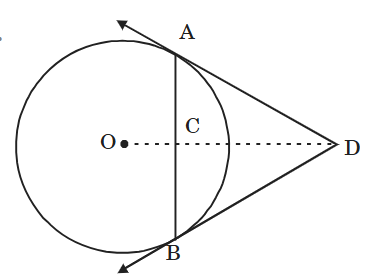
Prove that the tangents drawn at the end points of a chord of a circle make equal angles with the chord.
Answer

Image
Let $A B$ be chord of circle with centre $O$.
Let $A D$ and $B D$ be the tangents at $A$ and $B$.
$O D$ meets $A B$ at $C$.
To Prove $\angle D A C=\angle D B C$
Line segment joining the centre to external point bisects the angle between two tangents.
$\angle D A C=\angle D B C\quad \quad \ldots \ldots(i)$
In $\triangle D C A$ and $\triangle D C B$
$D A=D B$ [Tangents from an external points are equal]
$
\begin{array}{ll}
\angle A D C=\angle B D C & {[\text { From (i) }]} \\
D C=D C & {[\text { Common }]} \\
\triangle D C A \cong \triangle D C B & {[\text { By SAS }]} \\
\Rightarrow \angle D A C=\angle D B C & {[\text { By C.P.C.T }]}
\end{array}
$
Hence proved.
View full question & answer
Question 32 Marks
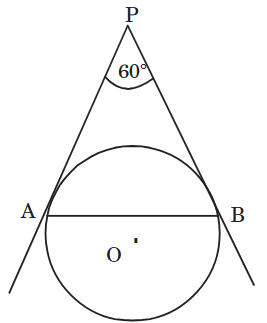
In Fig., $A P$ and $B P$ are tangents to a circle with centre $O$, such that $A P=5 \ cm$ and $\angle A P B=60^{\circ}$. Find the length of chord $A B$
Image
Answer
Two tangents $A P$ and $B P$ are drawn to the circle with centre $O$ from an external point $P$.
Tangents drawn from an external point to a circle are equal in length, so $P A=P B$
Now, in $\triangle P A B$, sides $P A$ and $P B$ are of the same length
i.e. $\triangle P A B$ is an isosceles triangle such that
$P A=P B$ amd $\angle P A B=\angle P B A=x\ \ ($ Let suppose $)$
Given that $\angle A P B=60^{\circ}$, we can find $\angle P A B$ and $\angle P B A$.
We know that the sum of angles of a triangle is $180^{\circ}$.
In $\triangle P A B$,
$\angle P A B+\angle P B A+\angle A P B=180^{\circ}$
$\Rightarrow x+x+60^{\circ}=180^{\circ}$
$\Rightarrow 2 x=120^{\circ}$
$\Rightarrow x=60^{\circ}$
Thus, $\angle P A B=\angle P B A=60^{\circ}$
From this we conclude that is an equilateral triangle with $A P=B P=A B$
Now we know that $A P=5 \ cm$
$\therefore A B=A P=5 \ cm$
Hence, the length of the chord $A B$ is $5 \ cm $.
View full question & answer
Question 42 Marks
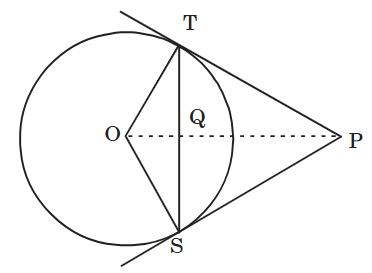
In the given figure, from an external point $P,$ two tangents $P T$ and $P S$ are drawn to a circle with centre $O$ and radius $r$. If $O P=2 r,$ show that $\angle O T S=\angle O S T=30^{\circ}$
Image
Answer
Given $O P=2 \tau, \angle O T P=90^{\circ} $
$($radius drawn at the point of contact is perpendicular to the tangent$)$
Now, In $\triangle O T P, \sin \angle O P T$
$=\frac{O T}{O P}=\frac{T}{2 T}=\frac{1}{2}$
$\Rightarrow \sin \angle O P T=\sin 30^{\circ}$
$\Rightarrow \angle O P T=30^{\circ}$
Sum of angles of a triangle is equal to $180^{\circ}$
Therefore, $\angle O P T+\angle T O P+\angle T P O=180^{\circ}$
$90^{\circ}+30^{\circ}+\angle T O P=180^{\circ}$
$120^{\circ}+\angle T O P=180^{\circ}$
$\angle T O P=60^{\circ}$
So, $\triangle O T P$ is a right angled triangle
Similarly, $\triangle O S P$ is a right angled triangle and $\angle S O P=60^{\circ}$
Hence, $\angle T O S=\angle T O P+\angle S O P$
$=60^{\circ}+60^{\circ}=120^{\circ}$
In $\triangle O T S, \angle T O S+\angle O T S+\triangle O S T=60^{\circ}$
$\angle O T S+\angle O S T+120^{\circ}=180^{\circ}$
$\angle O T S+\angle O S T=60^{\circ}$
$\therefore O T=O S\ \ \ ($ Radii of the same circle$)$
$\therefore \angle O T S=\angle O S T=30^{\circ}$
Hence proved.
View full question & answer
Question 52 Marks
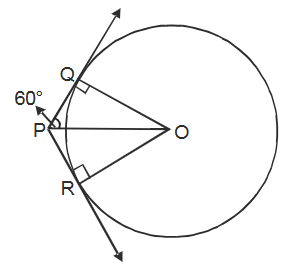
If from an external point $P$ of a circle with center $O$, two tangents $P Q$ and $P R$ are drawn such that $\angle Q P R=120^{\circ}$, prove that $2 P Q=P O$
Answer
Let us draw the circle with extent point $P$ and two tangents $P Q$ and $P R$.
Image
we know that the radius is perpendicular to the tangent at the point of contact.
$\angle O Q P=90^{\circ}$
We also know that the tangents drawn to a circle from an external point are equally inclined joining the centre to that point.
$\angle Q P O=60^{\circ}$
Now, in $\triangle Q P O$
$\cos 60^{\circ}=\frac{P Q}{P O}$
$\frac{1}{2}=\frac{P Q}{P O}$
$2 P Q=P O$
Hence proved.
View full question & answer
Question 62 Marks
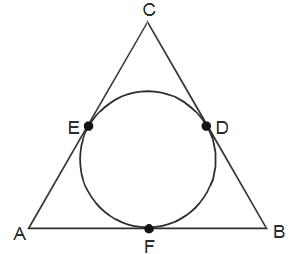
The incircle of an isosceles triangle $A B C$, in which $A B=A C$, touches the sides $B C, C A$ and AB at $D, E$ and $F$ respectively. Prove that $B D=D C$.
Answer
Consider the isosceles triangle $A B C$ where $A B=A C$
Image
Tangents from an external point on the circle are equal in length.
$\Rightarrow B D=B F\quad \quad \ldots \ldots(i)$
Also, $C D=C E\quad \quad \ldots \ldots(ii)$
Since $A B=A C$ and $A F=A E\quad \quad \ldots \ldots(iii)$
$
\Rightarrow B F=C E
$
Using equations (i), (ii) and (iii)
$
B D=D C
$
Hence proved.
View full question & answer
Question 72 Marks
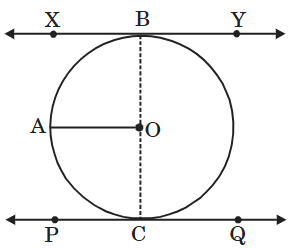
Prove that the line segment joining the points of contact of two parallel tangents of a circle passes through its centre.
Answer
Image
Let $X B Y$ and $P C Q$ be two parallel tangents to a circle with centre $O$
Construction: Join $O B$ and $O C$.
Now, $XB \| AO$
$\angle X B O+\angle A O B=180^{\circ} \ ($sum of adjacent interior angles is $180^{\circ} )$
Now, $\angle X B O=90^{\circ} \ ($A tangent to a circle is perpendicular to the radius through the point of contact$)$
$90^{\circ}+\angle A O B=180^{\circ} \ ($Co  $0 - $ interior angles$)$
$\angle A O B=180^{\circ}-90^{\circ}=180^{\circ}$
Similarly, $\angle A O C=90^{\circ}$
$\angle A O B+\angle A O C=90^{\circ}+90^{\circ}=180^{\circ}$
Hence, $B O C$ is a straight line passing through $O$.
Thus, the line segment joining the points of contact of two parallel tangents of a circle passes through its centre Hence proved.
View full question & answer
Question 82 Marks
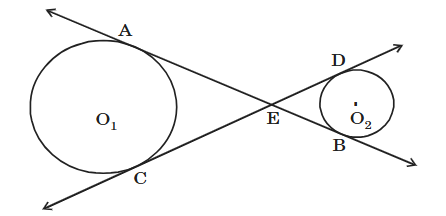
In Figure, common tangents $A B$ and $C D$ to the two circles with centres $O_1$ and $O_2$ intersect at $E$. Prove that $A B=C D$.
Image
Answer
Tangents from an external point to a circle is equal in length.
$\Rightarrow EA=EC$ and  $EB=ED$
Add the two equations
$\Rightarrow EA+EB=EC+ED$
$\Rightarrow AB=CD$
Hence proved.
View full question & answer
Question 92 Marks
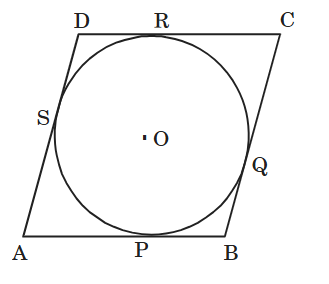
Prove that the parallelogram circumscribing a circle is a rhombus.
Answer
Let $\ce{ABCD}$ is the parallelogram circumscribing a circle with centre $O$.
Image
To Prove: $\ce{ABCD}$ is a rhombus.
In parallelogram $\ce{ABCD}$,
$A S=A P ($tangents drawn to a circle from an exterior point$)$
$B Q=B P ($tangents drawn to a circle from an exterior point$)$
$C Q=C R ($tangents drawn to a circle from an exterior point$)$
$D S=D R ($tangents drawn to a circle from an exterior point$)$
Thus,
$A S+B Q+C Q+D S=A P+B P+C R+D R$
$(A S+D S)+(B Q+C Q)=(A P+B P)+(C R+D R)$
$\therefore A D+B C=A B+C D$
$\because A D=B C $ and $ A B=C D ($Opposite sides of parallelogram$)$
$\therefore 2 B C=2 A B$
$\Rightarrow B C=A B$
$\therefore A B=B C=D C=A D$
$\therefore \ce{ABCD}$ is a rhombus.
Hence proved.
View full question & answer
Question 102 Marks
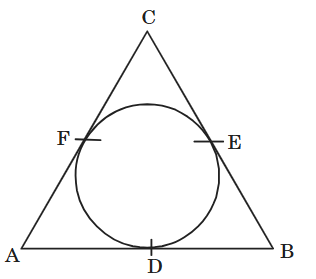
In Fig., a circle inscribed in triangle $\text{ABC}$ touches its sides $A B, B C$ and $A C$ at points $D, E$ and $F$ respectively. If $AB =12 \ cm, BC =8 \ cm$ and $AC =10 \ cm$, then find the lengths of $A D, B E$ and $C F$.
Image
Answer
Lengths of sides of the triangle are given as If $A B=12 \ cm, B C=8 \ cm$ and $A C=10 \ cm$
Assume $A D=A F=p \ cm, B D=B E=q$ and $C E=C F=r \ cm $
$($Tangents drawn from an external point to the circle are equal$)$
$2(p+q+r)=A B+B C+A C=30 \ cm$
$\Rightarrow(p+q+r)=15 \ cm$
$\Rightarrow A B=A D+D B=p+q=12 \ cm$
$\therefore r=C F=15-12=3 \ cm$
$\Rightarrow A C=A F+F C=p+r=10 \ cm$
$\therefore q=B E=15-10=5 \ cm$
$\Rightarrow B C=B E+E C=q+r=8 \ cm$
$\therefore p=A D=15-8=7 \ cm$
Thus $A D=7 \ cm, B E=5 \ cm$ and $C F=3 \ cm$
 
View full question & answer
Question 112 Marks
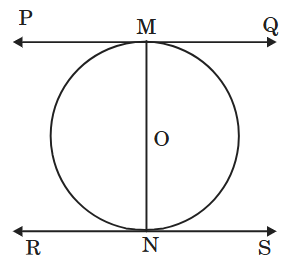
Prove that the tangents drawn at the ends of a diameter of a circle are parallel.
Answer
Let $M N$ be a diameter of a given circle, $P Q$ and $R S$ be the tangents drawn to the circle at points $M$ and $N$ respectively.
Image
Since, we know that the tangent at a a point to a circle is perpendicular to the radius through the point of contact.
$\therefore M N \perp P Q $  and $ M N \perp R S$
$\Rightarrow \angle P M N=90^{\circ} $ and $ \angle M N S=90^{\circ}$
$\Rightarrow \angle P M N=\angle M N S$
Now, since $\angle P M N$ and $\angle M N S$ are pair of alternate angles for the pair of lines $P Q$ and $R S$.
$\therefore P Q \| R S$
Hence proved.
View full question & answer
Question 122 Marks
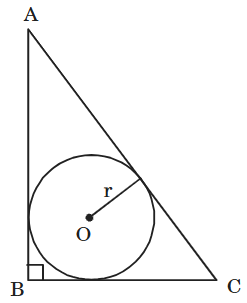
In Figure, a right triangle $\text{ABC}$, circumscribes a circle of radius $r$. If $A B$ and $B C$ are of lengths $8 \ cm$ and $6 \ cm$ respectively, find the value of $r$.
Image
Answer
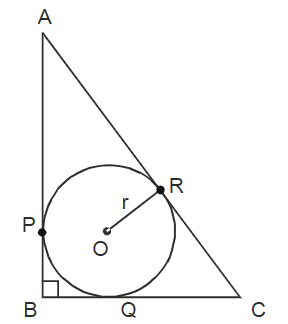
Let us suppose that the circle touches the triangle $\text{ABC}, $ on sides $AB, BC$ and $AC$ at $P, Q$ and $R$ respectively.
Image
Now, we know that, tangents drawn from an external point to a circle are equal in length.
$\therefore A P=A R, B P=B Q$ and $C Q=C R . $
$\text{BPOQ}$ is a square as every angle measures $90^{\circ}$
We have, $A R=A P$
$\Rightarrow A R=A B-B P$
$=(8-r)$
Similarly, $C R=C Q$
$\Rightarrow C R=C B-B Q$
Now, $A C=A R+C R$
$=(8-r+6-r)=(14-2 r)$
By Pythagoras theorem,
$A C^2=A B^2+B C^2$
$\Rightarrow(14-2 r)^2=8^2+6^2$
$\Rightarrow(14-2 r)^2=10^2$
$\Rightarrow(14-2 r)=10$
$\Rightarrow 2 r=4$
$\Rightarrow r=2$
Therefore, the radius of the circle is $2 \ cm$ .
View full question & answer
Question 132 Marks
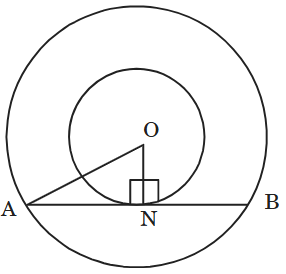
Two concentric circles are of radii $7 \ cm$ and $r \ cm$ respectively, where $r>7$. A chord of the larger circle of length $48 \ cm,$ touches the smaller circle. Find the value of $r$.
Answer
Given that the radius of the smaller circle is $7 \ cm$ and the radius of the bigger circle is $r \ cm$.
Let $A B,$ be the chord of the bigger circle which touches the smaller circle.
Here, $A B=48 \ cm$ Join $O A$ and drop a perpendicular from $O$ on chord $A B$ meeting at point $N$.
Image
We know that, perpendicular from the centre of the circle on a chord bisects the chord.
$\therefore ON \cong A B$ and
$A N=N B=\frac{A B}{2}=\frac{48}{2}=24 \ cm$
Now, in $\triangle ONA, O N=7 \ cm, O A=r \ cm$ and $A N=24 \ cm$
Applying Pythagoras theorem in $\triangle ONA,$
$O A^2=O N^2+N A^2$
$r^2=(7)^2+(24)^2$
$r^2=49+576$
$r^2=625$
$T=\sqrt{625}=25$
Therefore, the radius $(r)$ of the bigger circle is $25 \ cm$ .
View full question & answer
Question 142 Marks
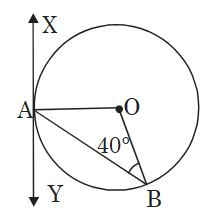
In Figure $, \text{XAY}$ is a tangent to the circle centered at $O$. If $\angle A B O=40^{\circ}, $ then find $m \angle B A Y$ and $m \angle AOB$.
Image
Answer
$AO$ and $OB$ is radius hence $AO = OB$
$\rightarrow \angle OAB=\angle OBA=40^{\circ}$
$($hence equal side have equal angle$)$
Now, In $\triangle AOB$,
$\rightarrow \angle OAB+\angle OBA+\angle AOB=180^{\circ}$
$($sum of all three angle of triangle is $180^{\circ})$
$\rightarrow 40^{\circ}+40^{\circ}+\angle AOB=180^{\circ}$
$\rightarrow 80^{\circ}+\angle AOB=180^{\circ}$
$\rightarrow \angle AOB=180^{\circ}-80^{\circ}$
Hence, $\angle AOB =100^{\circ}$
Now value of $?\ \text{BAY},$
$AO \perp XA$,
then $\angle OAY =90^{\circ}$
$\rightarrow \angle BAY =\angle OAY -\angle OAB$
$\rightarrow \angle BAY =90^{\circ}-40^{\circ}$
$\rightarrow \angle BAY =50^{\circ}$
View full question & answer
Question 152 Marks
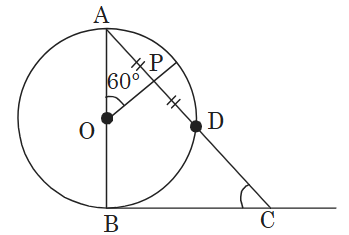
In Figure $,AB$ is diameter of a circle centered at $O. B C$ is tangent to the circle at $B$. If $O P$ bisects the chord $A D$ and $\angle A O P=60^{\circ}$, then find $m \angle C$.
Image
Answer
In Quadrilateral $\text{OBCP},$
$\angle PD=90^{\circ} (OP \text { bisects } AD)$
$\angle OBC=90^{\circ} $
$($Line Drawn to the circle is perpendicular to the radius through point of contact$)$
In straight line $\text{AOB},$
$\angle AOP+\angle POB=180^{\circ}$
$($Angle in a straight line is $180^{\circ} )$
$60^{\circ}+\angle BOP=180^{\circ}$
$\angle BOP=120^{\circ}$
So, $\angle OPD =90^{\circ}, \angle OBC =90^{\circ}, \angle BOP =120^{\circ}$
Now,
$\angle OPD+\angle OBC+\angle BOP+\angle BCD=360^{\circ} $
$ ($Angle sum property of Quadrilateral$)$
$90^{\circ}+90^{\circ}+120^{\circ}+\angle BCD=360^{\circ}$
$300^{\circ}+\angle BCD=360^{\circ}$
$\angle BCD=60^{\circ}$
Therefore, $\angle BCD$ that is, $\angle C$ is $60^{\circ}$
View full question & answer
Question 162 Marks
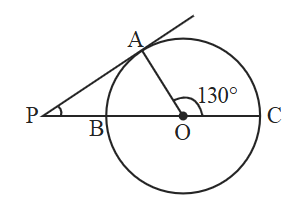
In the given figure $,PA$ is a tangent to the circle drawn from the external point $P$ and $\text{PBC}$ is the secant to the circle with $BC$ as diameter.If $\angle AOC =130^{\circ},$ then find the measure of $\angle APB$, where $O$ is the centre of the circle.
Image
Answer
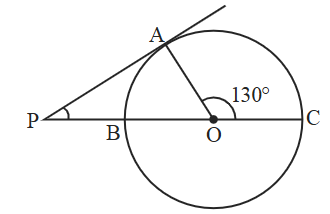
Consider the following figurHere $, \angle AOC +\angle AOP =180^{\circ} \ ($Linear pair$)$
Image
$130^{\circ}+\angle AOP =180^{\circ}$
$\angle AQP =50^{\circ}$
Now, In $\triangle A O P$,
$\angle OAP =90^{\circ} \ldots. \ ($angle subtended by tangent on circle$)$
According to angle sum property of a triangle,
$\angle AOP+\angle OAP+\angle APO=180^{\circ}$
$50^{\circ}+90^{\circ}+\angle APO=180^{\circ}$
$140^{\circ}+\angle APO=180^{\circ}$
Or $ \angle APB=40^{\circ}$
 
View full question & answer
Question 172 Marks
The distance between two tangents parallel to each other of a circle is 13 cm . Find the radius of the circle.
Answer
Given the distance between two tangents parallel to each other to a circle is 13 cm .
Two parallel tangents to a circle are found when the line joining the point of contact are diameter.
$
\therefore d=13 cm
$
Since, $r=\frac{ d }{2}=\frac{13}{2}=6.5 cm$
Hence, radius of circle is 6.5 cm .
View full question & answer
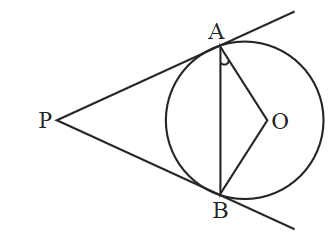
Question 182 Marks
PA and PB are tangents drawn to the circle with centre O as shown in the figure. Prove that $\angle APB =2 \angle OAB$.
Image
Answer
Given : A circle with centre $O$, an external point $P$ and two tangents PA and PB to the circle, where $A$ and $B$ are points of contact
To Prove : $\angle APB =2 \angle OAB$
Proof: PA = PB
[Tangents from an ext. pt. are equal]
$\Rightarrow \triangle APB$ is isosceles triangle
$
\begin{aligned}
\Rightarrow \quad \angle PAE & =\angle FBA \\
& =\frac{1}{2}\left(180^{\circ}-\angle APB\right) \\
& =\frac{1}{2}\left(180^{\circ}-\theta\right) \\
& =90^{\circ}-\frac{\theta}{2}
\end{aligned}
$
But $\angle OAF =90^{\circ}$
[ $\because$ Radius is $\perp$ to the tangent]
$
\begin{aligned}
\therefore \quad \angle OAR & =\angle OAF-\angle PAB \\
& =90^{\circ}-\left(90^{\circ}-\frac{1}{2} \theta\right) \\
& =\frac{1}{2} \theta=\frac{1}{2} \angle APB
\end{aligned}
$
Hence, $\angle APB =2 \angle OAB$. Proved.
View full question & answer
2 Marks Questions - Maths STD 10 Questions - Vidyadip