Questions

M.C.Q (1 Marks)

🎯

Test yourself on this topic

37 questions · timed · auto-graded

MCQ 11 Mark
A chord of a circle of radius $10 \ cm$ subtends a right angle at its centre. The length of the chord $($in $cm )$ is
  • $5 \sqrt{2}$
  • B
    $10 \sqrt{2}$
  • C
    $\frac{5}{\sqrt{2}}$
  • D
    $10 \sqrt{3}$
Answer
Correct option: A.
$5 \sqrt{2}$
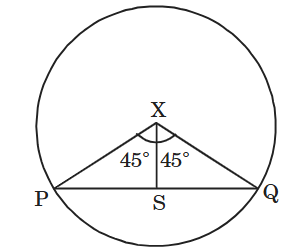
The figure represents the circle of radius $10 \ cm$ with the chord that subtends right angle at the centre.
Image
Consider $\triangle P X S$
$\cos 45^{\circ}=\frac{XS}{PX}$
$\Rightarrow \cos 45^{\circ}=\frac{X S}{10}$
$\Rightarrow \frac{1}{\sqrt{2}}=\frac{X S}{10}$
$\Rightarrow X S=\frac{10}{\sqrt{2}}=5 \sqrt{2} \ cm$
Thus the correct answer is $(a).$
View full question & answer
MCQ 21 Mark
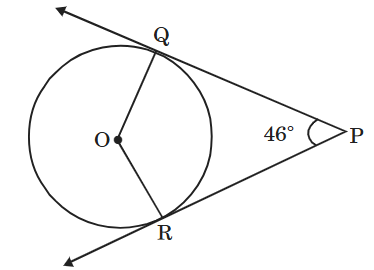
In figure, $P Q$ and $P R$ are two tangents to a circle with centre $O$. If $\angle P Q R=46^{\circ},$ then $\angle Q O R$ equals:
Image
  • A
    $67^{\circ}$
  • $134^{\circ}$
  • C
    $44^{\circ}$
  • D
    $46^{\circ}$
Answer
Correct option: B.
$134^{\circ}$
Given: $\angle Q P R=46^{\circ}$
$P Q$ and $P R$ are tangents.
Therefore, the radius drawn to these tangents will be perpendicular to the tangents.
So, we have $O Q \perp P Q$ and $O R \perp R P$.
$\angle O Q P=\angle O R P=90^{\circ}$
So, in quadrilateral $P Q O R$, we have
$\angle O Q P+\angle Q P R+\angle P R O+\angle R O Q=360^{\circ}$
$($Angle sum property$)$
$\Rightarrow 90^{\circ}+46^{\circ}+90^{\circ}+\angle R O Q=360^{\circ}$
$=\angle R O Q=360^{\circ}-226^{\circ}=134^{\circ}$
 
View full question & answer
MCQ 31 Mark
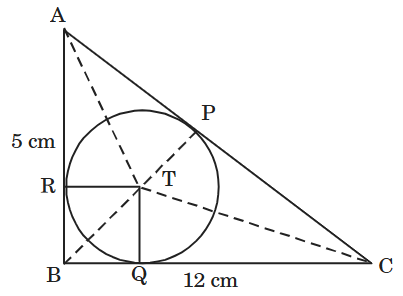
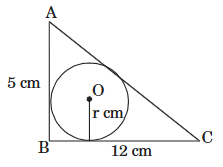
In a right triangle $\text{ABC}$, right $-$ angled at $B, BC =12 \ cm$ and $AB =5 \ cm$. The radius of the circle inscribed in the triangle $($in $\ cm )$ is
  • A
    $4$
  • B
    $3$
  • $2$
  • D
    $1$
Answer
Correct option: C.
$2$
Consider the triangle $\text{ABC},$ right angled at $B$ where $AB =5 \ cm$ and $BC =12 \ cm$.
$T$ is the centre of the circle and $T P, T R$ and $T Q$ are the radii of the inscribed circle.
Image
$\text{ABC}$ is a right angle triangle with an inscribed circle centered at $T$.
Let $r$ be the radius of the circle, so $T Q=T R=T P$
$A B, B C$ and $A C$ are tangents to the circle at $R, Q$ and $P$.
Using Pythagor as theorem in $\triangle A B C$
$A C^2=A B^2+B C^2$
$\Rightarrow A C^2=5^2+12^2$
$\Rightarrow A C^2=25+144$
$\Rightarrow A C^2=169$
$\Rightarrow A C=\sqrt{169}=13 \ cm$
Area of $\triangle ABC =\frac{1}{2} \times AB \times BC$
$\Rightarrow$ Area of $\triangle ABC =\frac{1}{2} \times 5 \times 12=30 \ cm^2$
Also, Area of $\triangle A B C=$ Area $\triangle T A B+$ Area $\triangle T B C+$ Area $\triangle T C A$
$\Rightarrow 30=\frac{1}{2} \times TR \times AB+\frac{1}{2} \times TQ \times BC+\frac{1}{2} \times TP \times AC$
$\Rightarrow 30=\frac{1}{2} \times r \times AB+\frac{1}{2} \times r \times BC+\frac{1}{2} \times r \times AC\ ( T P, T R$ and $T Q$ are the radii of the circle$)$
$\Rightarrow 30=\frac{1}{2} \times r(AB+BC+AC)$
Substitute the value for the length of the sides
$\Rightarrow 30=\frac{1}{2} \times r (5+12+13)$
$\Rightarrow 30=\frac{1}{2} \times r \times 30$
$\Rightarrow T=\frac{30 \times 2}{30}=2 \ cm$
View full question & answer
MCQ 41 Mark
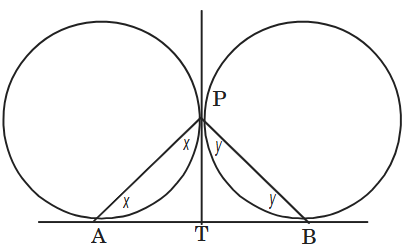
Two circles touch each other externally at $\text{P.AB}$ is a common tangent to the circles touching them at $A$ and $B$. The value of $\angle \text{APB}$ is
  • $30^{\circ}$
  • B
    $45^{\circ}$
  • C
    $60^{\circ}$
  • D
    $90^{\circ}$
Answer
Correct option: A.
$30^{\circ}$
The diagram is represented as follows:
Image
In $\triangle \text{TAP}$
$\text{TA = TP} ($Tangents from an external point are equal$)$
So $\angle \text{TAP}=\angle \text{TPA}=x ($Corresponding angles are equal$)$
In $\triangle \text{TBP}$
$\text{TB = TP} ($Tangents from an external point are equal$)$
So $\angle \text{TBP}=\angle \text{TPB}=y ($Corresponding angles are equal$)$
In $\triangle \text{PAB,} \angle \text{PAB}+\angle \text{PBA}+\angle \text{APB} ($Sum of angles of a triangle$)$
$\Rightarrow x+y+x+y=180^{\circ}$
$\Rightarrow 2 x+2 y=180^{\circ}$
$\Rightarrow 2(x+y)=180^{\circ}$
$\Rightarrow x+y=\frac{180^{\circ}}{2}$
Therefore, $\angle \text{APB}=x+y=90^{\circ}$
The correct answer is $(d).$
View full question & answer
MCQ 51 Mark
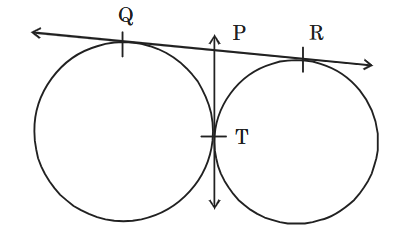
In figure, $\text{QR}$ is a common tangent to the given circles, touching externally at the point $T$. The tangent at $T$ meets $\text{QR}$ at $P$. If $\text{QP} =3.8$, then the length of $\text{QR} ($in $cm )$ is :
Image
  • A
    $3.8$
  • $7.6$
  • C
    $5.7$
  • D
    $1.9$
Answer
Correct option: B.
$7.6$
It is known that the length of the tangents drawn from an external point to a circle is equal.
$\text{QP =PT}=3.8 \ cm \ldots \ldots(i)$
$\text{PR =PT}=3.8 \ cm \ldots \ldots(ii)$
From equations $(i)$ and $(ii),$ we get:
$\text{QP=PR}=3.8 \ cm$
Now,
$\text{QR=Q P+PR}$
$=3.8 \ cm+3.8 \ cm=7.6 \ cm$
View full question & answer
MCQ 61 Mark
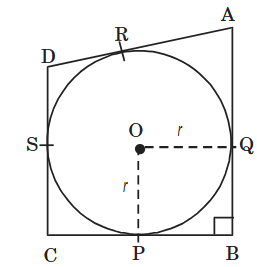
In Fig. $2,$ a circle with centre $O$ is inseribed in a quadrilateral $\text{ABCD}$ such that, it touches the sides $B C, A B, A D$ and $C D$ at points $P, Q, R$ and $S$ respectively, If $A B=29 \ cm, A D=23 \ cm, \angle B=90^{\circ}$ and $D S=5 \ cm$, then the radius of the circle $($in $\ cm )$ is:
Image
  • $11$
  • B
    $18$
  • C
    $6$
  • D
    $15$
Answer
Correct option: A.
$11$
Here it is given that $A B, B C, C D$ and $A D$ are tangents to the circle with centre $O$ and touch the circle at $Q, P, S$ and $R$ respectively.
And also,
$B A=29 \ cm, A D=23 \ cm, \angle B=90^{\circ} $ and $ D S=5 \ cm$
We know that the lengths of the tangents drawn from an external point to a circle are equal.
$D S=D R=5 \ cm$
$A R=A D-D R$
$=23-5=18 \ cm \ \ A D=23 \ cm)$
$\Rightarrow A Q=A R=18 \ cm$
$\therefore Q B=A B-A Q$
$=29-18=11 \ cm\ \ (A B=29 \ cm)$
And, $Q B=B P=11 \ cm$
$\angle P B Q=90^{\circ} \ \ [$Given$]$
We know that, angle between the tangent and the radius at the point of contact is a right angle.
Thus, $\angle O P B=90^{\circ}$ and $\angle O Q B=90^{\circ}$
Now, In quadrilateral $\text{OPBQ}$,
$\angle P B Q+\angle O P B+\angle O Q B+\angle P O Q=360^{\circ}$
$[$Angle sum property of a quadrilateral$]$
$\Rightarrow 90^{\circ}+90^{\circ}+90^{\circ}=\angle P O Q=360^{\circ}$
$\Rightarrow 270^{\circ}+\angle P O Q=360^{\circ}$
$\Rightarrow \angle P O Q=360^{\circ}-270^{\circ}$
$\Rightarrow \angle P O Q=90^{\circ}$
Here all sides of $\text{OPBQ}$ are equal and all angles are
$\therefore O P B Q$ is a square.
$\therefore O Q=Q B=B P=P O=r=11 \ cm$
Thus the radius of the circle is $" 11 \ cm "$
View full question & answer
MCQ 71 Mark
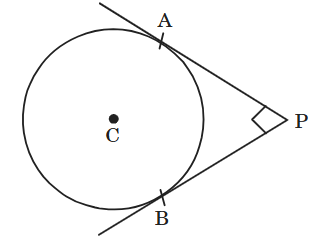
In Fig. $P A$ and $P B$ are two tangents drawn from an external point $P$ to a circle with centre $C$ and radius $4 \ cm$ . If $P A \perp P B,$ then the length of each tangent is:
Image
  • A
    $3 \ cm$
  • $4 \ cm$
  • C
    $5 \ cm$
  • D
    $6 \ cm$
Answer
Correct option: B.
$4 \ cm$
Image
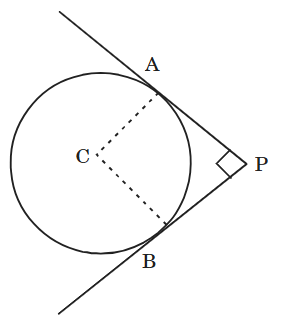
It is given that $A P \perp P B$ and radius of the circle is $4 \ cm$
Construction : Join $C A$ and $C B$.
It is known fact that the tangent at any point of a circle is perpendicular to the radius through the point of contact.
$\therefore A C \perp A P$ and $B C \perp P B$
$\Rightarrow \angle C A P=\angle C B P=90^{\circ}$
Also, In quadrilateral $\text{ACBP},$
$\angle C A P+\angle A P B+\angle P B C+\angle B C A=360^{\circ}$
$($Angle sum property$)$
$\Rightarrow 90^{\circ}+90^{\circ}+90^{\circ}+\angle B C A=360^{\circ}$
$\Rightarrow 270^{\circ}+\angle B C A=360^{\circ}$
$\Rightarrow \angle B C A=360^{\circ}-270^{\circ}$
$\Rightarrow \angle B C A=90^{\circ}$
And also, $A C=C B$
$($Radius of the circle$)$
Here all sides of $\text{APBC}$ are equal and all angles are $90^{\circ}$
$\therefore \text{APBC}$ is a square.
$\therefore A C=C B=B P=P A=4 \ cm$
Thus the length of each tangent is $" 4 \ cm "$
View full question & answer
MCQ 81 Mark
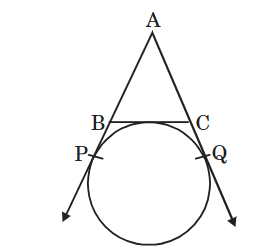
In Figure $ 1, A P, A Q$ and $B C$ are tangents to the circle. If $AB =5, BC =4$ and $AC =6 \ cm,$ then the length of $AP$ (in $\ cm )$ is
Image
  • $7.5$
  • B
    $15$
  • C
    $10$
  • D
    $9$
Answer
Correct option: A.
$7.5$
Let us suppose that the tangent $B C$ touches the circle at point $O$.
Now, we know that, tangents drawn from an exterior point to a circle are equal in length.
$\therefore B P=B O \ [$ From external point  $B]$
$C Q=C O\  [$ From external point $ C]$
$A P=A Q\  [$ From external point $ A]$
Now, In $\triangle A B C$,
$A B+B C+A C=5 \ cm+4 \ cm+6 \ cm$
$\Rightarrow A B+(B O+C O)+A C=15 \ cm$
$\Rightarrow(A B+B P)+(C Q+A C)=15 \ cm$
$[\because B P=B O$  and $C Q=C O]$
$\Rightarrow A P+A Q=15 \ cm$
$\Rightarrow 2 A P=15 \ cm$
$\Rightarrow A P=7.5 \ cm \quad[\because A P=A Q]$
$\Rightarrow A P$
Therefore, length of the tangent $A P$ is $7.5 \ cm .$
View full question & answer
MCQ 91 Mark
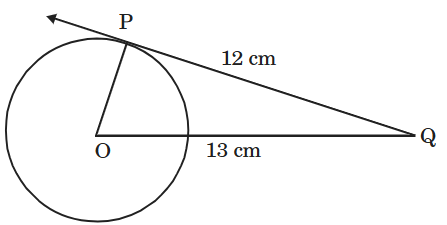
From a point $Q, 13 \ cm$ away from the centre of a circle, the length of tangent $PQ$ to the circle is $12 \ cm.$ The radius of the circle $($ in  $cm )$ is
  • A
    $25$
  • B
    $\sqrt{313}$
  • $5$
  • D
    $1$
Answer
Correct option: C.
$5$
Image
We know that, tangent at a point is perpendicular to the radius through that point.Therefore, $OP$ is perpendicular to $PQ$.
In right triangle $\text{OPQ}$, Using pythagoras theorem, we have
$\ce{OQ^2=O P^2 + P Q^2}$
$\Rightarrow(13)^2=OP^2+(12)^2$
$\Rightarrow OP^2=169-144$
$\Rightarrow OP^2=25 \Rightarrow O P=5$
Therefore, the length of the radius of the circle, $O P$ is $5 \ cm .$
The correct option is $(c).$
View full question & answer
MCQ 101 Mark
The radii of two circles are $4 \ cm$ and $3 \ cm$ respectively. The diameter of the circle having area equal to the sum of the areas of the two circles $($in $cm)$ is
  • A
    $5$
  • B
    $7$
  • $10$
  • D
    $14$
Answer
Correct option: C.
$10$
Let $r_1$ and $r_2$ denote the radii of two circles and $R$ be the radius of the bigger circle.
$\therefore r_1=4 \ cm$ and $r_1=3 \ cm$
According to the question,
Sum of the areas of two smaller circles $=$ Area of the bigger circle
$\pi r_1{ }^2+\pi r_2{ }^2=\pi R^2$
Substituting the values of $r_1$ and $r_2$ in the above equation.
$\Rightarrow \pi(4)^2+\pi(3)^2=\pi R^2$
$\Rightarrow(4)^2+(3)^2=R^2$
$\Rightarrow 16+9=R^2$
$\Rightarrow R^2=6+9$
$\Rightarrow R^2=25$
$\Rightarrow R=\sqrt{25}$
$\Rightarrow R=5$
Diameter $=2 \times$ Radius
Therefore, the required diameter of the circle is
Hence, the correct option is $(c).$
View full question & answer
MCQ 111 Mark
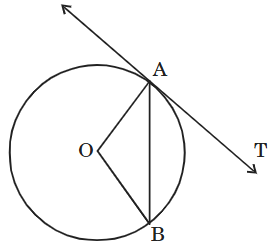
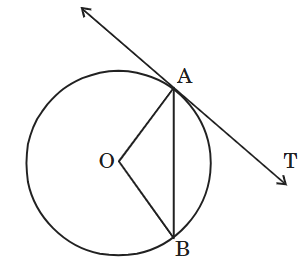
In the given figure, $O$ is the centre of a circle, $A B$ is a chord and $A T$ is the tangent at $A$. If $\angle AOB = 110^{\circ}$, then $\angle BAT$ is equal to
Image
  • A
    $100^{\circ}$
  • B
    $40^{\circ}$
  • $50^{\circ}$
  • D
    $90^{\circ}$
Answer
Correct option: C.
$50^{\circ}$
Consider the given diagram
Image
Here, in $\triangle A O B, \angle A O B=100^{\circ}, $
$O A=O B=$ Radius of the circle
$\Rightarrow \triangle A O B$ is an isosceles triangle.
$\therefore \angle O B A=\angle O A B=x$
In $\triangle A O B$ apply angle sum property.
$\therefore \angle A O B+\angle O B A+\angle O A B=180^{\circ}$
$\Rightarrow 100^{\circ}+x+x=180^{\circ} $
$\Rightarrow 100^{\circ}+2 x=180^{\circ}$
$\Rightarrow 2 x=180^{\circ}-100^{\circ}$
$ \Rightarrow 2 x=80^{\circ}$
$\Rightarrow x=40^{\circ}$
$\therefore \angle O B A=\angle O A B=40^{\circ}$
Clearly $\angle O A T=90^{\circ} \ ($as tangents are perpendicular to the radius at the point of contact.$)$
From the diagram,
$\angle O A T=\angle O A B+\angle B A T$
$\Rightarrow 90^{\circ}=40^{\circ}+\angle B A T$
$\Rightarrow \angle B A T=90^{\circ}-40^{\circ}$
$=50^{\circ}$
View full question & answer
MCQ 121 Mark
The diameter of a car wheel is $42 \ cm$ . The number of complete revolutions it will make in moving $132 \ km$ is
  • A
    $10^4$
  • $10^5$
  • C
    $10^6$
  • D
    $10^3$
Answer
Correct option: B.
$10^5$
Diameter of wheel $=42 \ cm$
Radius of the wheel $=\frac{42}{2}=21 \ cm$
Distance in  $1$  revolution
$=$ Circumference of the wheel $=2 \pi r$
$=2 \times \frac{22}{7} \times 3$
$=132 \ cm$
Number of revolutions
Total distance covered by wheel 
Distance covered in $1$ revolution
$=\frac{13200000}{132}$
$=100000$
$=10^5$
View full question & answer
MCQ 131 Mark
Points $A (-1, y)$ and $B (5,7)$ lie on a circle with centre $O (2,-3 y)$. The values of $y$ are
  • A
    $1,-7$
  • $-1,7$
  • C
    2,7
  • D
    $-2,-7$
Answer
Correct option: B.
$-1,7$
(b)
As point A and B lie on the circle and O is the centre.
AO and BO will be the radii of the circle.

View full question & answer
MCQ 141 Mark
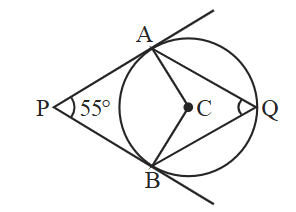
In the given figure, PA and PB are tangents from external point P to a circle with centre C and Q is any point on the circle. Then the measure of $\angle AQB$ is
Image
  • $621 / 2^{\circ}$
  • B
    $125^{\circ}$
  • C
    $55^{\circ}$
  • D
    $90^{\circ}$
Answer
Correct option: A.
$621 / 2^{\circ}$
(a)
Angle at the remaining part of the circle is half the angle subtended by the arc at the centre.
View full question & answer
MCQ 151 Mark
The circumferences of two circles are in the ratio $4: 5$. What is the ratio of their radii?
  • A
    $16: 25$
  • B
    $25: 16$
  • C
    $2: \sqrt{5}$
  • $4: 5$
Answer
Correct option: D.
$4: 5$
(d)
Circumference of a circle
$
\begin{aligned}
& =2 \pi r \\
\frac{2 \pi R_1}{2 \pi R_2} & =\frac{4}{5} \\
\frac{R_1}{R_2} & =\frac{4}{5} \\
R_1: R_2 & =4: 5
\end{aligned}
$
View full question & answer
MCQ 161 Mark
A statement of Assertion (A) is followed by a statement of Reason (R). Choose the correct option :
Assertion (A) : A tangent to a circle is perpendicular to the radius through the point of contact.
Reason (R): The lengths of tangents drawn from an external point to a circle are equal.
  • A
    Both Assertion (A) and Reason (R) are true and Reason (R) gives the correct explanation of Assertion (A).
  • Both Assertion (A) and Reason (R) are true but Reason (R) does not give the correct explanation of Assertion (A).
  • C
    Assertion (A) is true but Reason (R) is false.
  • D
    Assertion (A) is false but Reason (R) is true.
Answer
Correct option: B.
Both Assertion (A) and Reason (R) are true but Reason (R) does not give the correct explanation of Assertion (A).
(b)
Both Assertion and reason are correct but reason does not give the correct explanation of assertion.
View full question & answer
MCQ 171 Mark
The length of the tangent from an external point A to a circle, of radius 3 cm , is 4 cm . The distance of A from the centre of the circle is :
  • A
    7 cm
  • 5 cm
  • C
    $\sqrt{7} cm$
  • D
    25 cm
Answer
Correct option: B.
5 cm
(b)
Given that $AB =4 cm, OB =3 cm$
To find OA
Applying Pythagoras theorem to triangle OAB
$
\begin{aligned}
OB^2+AB^2 & =OA^2 \\
3^2+4^2 & =OA \\
OA^2 & =25 \\
OA & =5 cm
\end{aligned}
$
View full question & answer
MCQ 181 Mark
How many tangents can be drawn to a circle from a point on it?
  • One
  • B
    Two
  • C
    Infinite
  • D
    Zero
Answer
Correct option: A.
One
(a)
If a point lies on the circle, only one tangent can be drawn from this point and it is perpendicular to the radius of the circle.
View full question & answer
MCQ 191 Mark
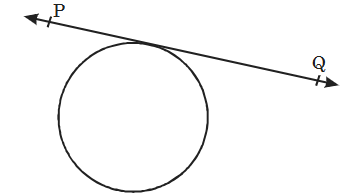
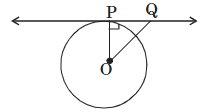
In the given circle in Figure, number of tangents parallel to tangent PQ is
Image
  • A
    $0$
  • B
    many
  • C
    2
  • 1
Answer
Correct option: D.
1
(d)
1
View full question & answer
MCQ 201 Mark
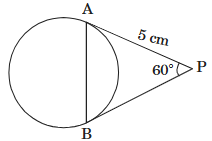
In the given figure, $\text{PA}$ and $\text{PB}$ are tangents to the given circle such that $\text{PA} =5 \ cm$ and $\angle \text{APB} =60^{\circ}$. The length of chord $\text{AB}$ is
Image
  • A
    $5 \sqrt{2} \ cm$
  • $5 \ cm$
  • C
    $5 \sqrt{3} \ cm$
  • D
    $7.5 \ cm$
Answer
Correct option: B.
$5 \ cm$
$\because \text{PA = PB}\ [$Tangent from external point $]$
$\therefore \angle \text{PBA} =\angle \text{PAB} = x ^{\circ} \text { (say) }$
In $\triangle \text{APB} ,$
$\angle \text{APB + PBA} +\angle \text{BAP} =180^{\circ}$
$\Rightarrow 60^{\circ}+ x ^{\circ}+ x ^{\circ}=180^{\circ}$
$\Rightarrow 2 x ^{\circ}=180^{\circ}-60^{\circ}$
$\Rightarrow 2 x ^{\circ}=120^{\circ}$
$\Rightarrow x =\frac{120}{2}=60^{\circ}$
$\therefore \triangle \text{APB}$ is equilateral triangle
$\therefore \text{AB = AP = PB} =5 \ cm$
View full question & answer
MCQ 211 Mark
In a right triangle $A B C$, right $-$ angled at $B$, $BC =12 \ cm$ and $AB =5 \ cm$. The radius of the circle inscribed in the triangle is
  • A
    $1 \ cm$
  • $2 \ cm$
  • C
    $3 \ cm$
  • D
    $4 \ cm$
Answer
Correct option: B.
$2 \ cm$
In right $\triangle A B C$, we have
$ AC =\sqrt{( AB )^2+( BC )^2}$
$=\sqrt{(5)^2+(12)^2}$
$=\sqrt{25+144}=\sqrt{169}=13 \ cm$
$\text { or }(\triangle ABC )=\frac{1}{2} \times(\text { perimeter of } \triangle ABC ) \times r$
$\Rightarrow \frac{1}{2} \times 5 \times 12=\frac{1}{2} \times(5+12+13) \times r$
$\Rightarrow r =\frac{60}{30}=2 \ cm$
Image
View full question & answer
MCQ 221 Mark
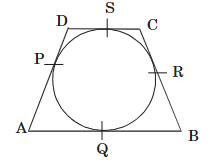
In the given figure, quadrilateral $\text{ABCD}$ is circumscribed, touching the circle at $\text{P, Q, R}$ and S . If $AP =5 \ cm, BC =7 \ cm$ and $CS =3 \ cm$. Then, the length $AB =$ ?
Image
  • $9 \ cm$
  • B
    $10 \ cm$
  • C
    $12 \ cm$
  • D
    $8 \ cm$
Answer
Correct option: A.
$9 \ cm$
Since the length of tangents drawn from an external point to a circle are equal,
We have $\ce{AQ = AP}=5 \ cm$
$\ce{CR=CS=}3 \ cm$ and $\ce{BR=(BC-CR)}$
$=7-3=4 \ cm$
$\ce{BQ=BR}=4 \ cm$
$\therefore \ce{AB=(AQ+BQ)}=5+4=9 \ cm$
View full question & answer
MCQ 231 Mark
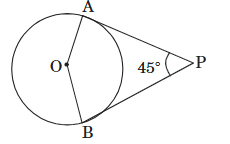
To draw a pair of tangents to a circle, which are inclined to each other at an angle of $45^{\circ}$, We have to draw tangents at the end points of those two radii, the angle between which is
  • A
    $105^{\circ}$
  • $135^{\circ}$
  • C
    $140^{\circ}$
  • D
    $145^{\circ}$
Answer
Correct option: B.
$135^{\circ}$
(b)
Let PA and PB be the desired tangents to a circle with centre $O$ from an exterior point $P$.
Image
The, $\angle APB =45^{\circ}$
BOAP must be a cyclic quadrilateral.
$
\begin{aligned}
\therefore & \angle AOB+\angle APB=180^{\circ} \Rightarrow \angle AOB=180^{\circ}-45^{\circ} \\
& =135^{\circ}
\end{aligned}
$
So, the angle between the two radii must be $135^{\circ}$
View full question & answer
MCQ 241 Mark
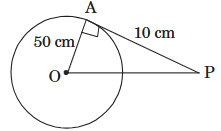
The length of the tangent from an external point $P$ to a circle of radius 5 cm is 10 cm . The distance of the point from the centre of the circle is.
  • A
    8 cm
  • B
    $\sqrt{104} cm$
  • C
    12 cm
  • $\sqrt{125} cm$
Answer
Correct option: D.
$\sqrt{125} cm$
(d)
In right angled $\triangle OAP$,
By pythagoras theorem
Image
$\begin{aligned} OP & =\sqrt{( OA )^2+( AP )^2} \\ & =\sqrt{(5)^2+(10)^2} \\ & =\sqrt{25+100}=\sqrt{125} cm\end{aligned}$
View full question & answer
MCQ 251 Mark
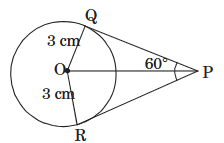
If two tangents inclined at an angle of $60^{\circ}$ are drawn to a circle of radius $3 \ cm$ then the length of each tangent is
  • A
    $3 \ cm$
  • B
    $\frac{3 \sqrt{3}}{2} \ cm$
  • $3 \sqrt{3} \ cm$
  • D
    $6 \ cm$
Answer
Correct option: C.
$3 \sqrt{3} \ cm$
Let $P Q$ and $P R$ be tangents to a circle with centre $O$ rom a point $P$ such that $\angle Q P R=60^{\circ}$
Then $\angle QPO =\angle RPO $
$=\frac{1}{2} \angle QPR =30^{\circ}$
Image
$[\because$ tangents from an external point are equally inclined to the line joining the point and the centre.$]$
In right $\triangle OPQ$, we have,
$\tan \ (\angle OPQ)=\frac{OQ}{PQ} $
$\Rightarrow \tan 30^{\circ}=\frac{3}{PQ}$
$\Rightarrow \frac{1}{\sqrt{3}}=\frac{3}{PQ} $
$\Rightarrow PQ=3 \sqrt{3} \ cm$
Now, $PR = PQ $
$=3 \sqrt{3} \ cm$.
View full question & answer
MCQ 261 Mark
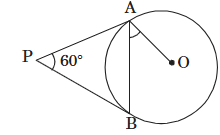
In the given figure, $PA$ and $PB$ are two tangents to the circle with centre $O$. If $\angle APB =60^{\circ}$ then $\angle OAB$ is
Image
  • A
    $15^{\circ}$
  • $30^{\circ}$
  • C
    $60^{\circ}$
  • D
    $90^{\circ}$
Answer
Correct option: B.
$30^{\circ}$
$\because \angle APB =2 \angle OAB \text { (By theorem) }$
$\therefore 60^{\circ}=2 \angle OAB$
$\Rightarrow \angle OAB $
$=\frac{60^{\circ}}{2}$
$=30^{\circ}$
View full question & answer
MCQ 271 Mark
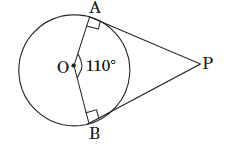
If $PA$ and $PB$ are two tangents to a circle with centre $O$ such that $\angle A O B=110^{\circ}$ then $\angle APB$ is equal to
Image
  • A
    $55^{\circ}$
  • B
    $60^{\circ}$
  • $70^{\circ}$
  • D
    $90^{\circ}$
Answer
Correct option: C.
$70^{\circ}$
$\because \square OAPB$ is a cyclic quadrilateral
$\therefore \angle AOB+\angle APB=180^{\circ} ($Opposite angle of a cyclic quadrilateral$)$
$\Rightarrow 110^{\circ}+\angle APB=180^{\circ}$
$\angle APB=180^{\circ}-110^{\circ}$
$=70^{\circ}$
View full question & answer
MCQ 281 Mark
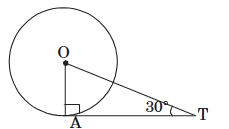
In the given figure, $AT$ is a tangent to the circle with centre $O$ such that $O T=4 \ cm$ and $\angle O T A=$ $30^{\circ}$. Then, $AT$ = ?
Image
  • A
    $4 \ cm$
  • B
    $2 \ cm$
  • $2 \sqrt{3} \ cm$
  • D
    $4 \sqrt{3} \ cm$
Answer
Correct option: C.
$2 \sqrt{3} \ cm$
In right $\triangle OAT ($having right angle at $A ),$ we have
$\cos (\angle OTA)=\frac{AT}{OT} $
$\Rightarrow \cos 30^{\circ}=\frac{AT}{4}$
$\Rightarrow AT=4 \times \cos 30^{\circ}$
$=4 \times \frac{\sqrt{3}}{2}$
$=2 \sqrt{3} \ cm$
View full question & answer
MCQ 291 Mark
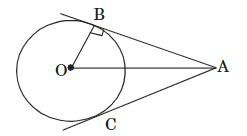
In a given figure, $AB$ and $AC$ are tangents to a circle with centre $O$ and radius $8 \ cm .$ If $OA =17 \ cm ,$ then the length of $AC ($in $cm )$ is
Image
  • A
    $9$
  • $15$
  • C
    $\sqrt{353}$
  • D
    $25$
Answer
Correct option: B.
$15$
$\triangle OBA$ us a right angled triangle.
$\therefore AB=\sqrt{(OA)^2-(OB)^2}$
$=\sqrt{(17)^2-(8)^2}$
$=\sqrt{289-64}$
$=\sqrt{225}$
$=15$
$\therefore AB=AC$
$(\because \text { tangents from an external point are equal) }$
$\therefore AC=15 \ cm$
View full question & answer
MCQ 301 Mark
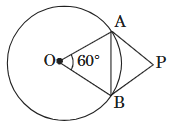
If a chord $A B$ subtends an angle of $60^{\circ}$ at the centre of a circle, then the angle between the tangents to the circle drawn from $A$ and $B$ is
  • A
    $30^{\circ}$
  • B
    $60^{\circ}$
  • C
    $90^{\circ}$
  • $120^{\circ}$
Answer
Correct option: D.
$120^{\circ}$
$\because \square \ce{OAPB}$ is a cyclic quadrilateral
Image
$\therefore \angle AOB+\angle APB=180^{\circ}$
$\Rightarrow \angle APB=180^{\circ}-60^{\circ}$
$=120^{\circ}$
View full question & answer
MCQ 311 Mark
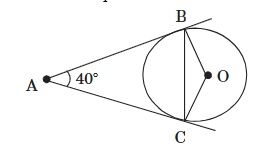
In the gives figure, $AB$ and $AC$ are tangents to the circle with centre $O$ such that $\angle BAC =40^{\circ}$ Then $\angle BOC$ is equal to
Image
  • A
    $80^{\circ}$
  • $140^{\circ}$
  • C
    $120^{\circ}$
  • D
    $100^{\circ}$
Answer
Correct option: B.
$140^{\circ}$
$\because \angle OBA=OCA=90^{\circ}$
$[\because$ Tangent at any point is perpendicular to the radius through the point of contact$]$
$\therefore \angle ABO+\angle BOC+\angle OCA+\angle CAB=360^{\circ}$
$\Rightarrow 90^{\circ}+\angle BOC+90^{\circ}+40^{\circ}=360^{\circ}$
$\Rightarrow \angle BOC=360^{\circ}-220^{\circ}=140^{\circ}$
View full question & answer
MCQ 321 Mark
$PQ$ is a tangent to a circle with centre $O$ at the point $P .$ If $\triangle OPQ$ is an isosceles triangle, then $\angle O Q P$ is equal to
  • A
    $30^{\circ}$
  • $45^{\circ}$
  • C
    $60^{\circ}$
  • D
    $90^{\circ}$
Answer
Correct option: B.
$45^{\circ}$
We have $OP \perp PQ$, i.e $\angle OPQ =90^{\circ}$
$\because \triangle OPQ$ is isosceles
Image
$OP=PQ$
$\therefore \angle OQP=\angle POQ=45^{\circ} [\because$ In a triangle, angle opposite equal sides are equal$]$
View full question & answer
MCQ 331 Mark
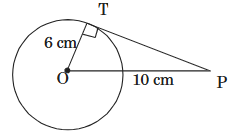
In the given figure, $PT$ is a tangent to the circle with centre $O$ . If $OT =6 \ cm$ and $OP =10 \ cm$, then the length of tangent $PT$ is
Image
  • $8 \ cm$
  • B
    $10 \ cm$
  • C
    $12 \ cm$
  • D
    $16 \ cm$
Answer
Correct option: A.
$8 \ cm$
In right $\triangle \text{OTP}$
By pythagoras theorem,
$\ce{(OP)^2=(OT)^2 + (PT)^2}$
$\Rightarrow PT=\sqrt{(10)^2-(6)^2}$
$=\sqrt{100-36}$
$=\sqrt{64}$
$=8 \ cm$
View full question & answer
MCQ 341 Mark
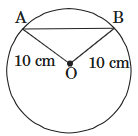
Two chord of a circle of radius $10 \ cm$ subtends a right angle at its centre. The length of the chord $($in $cm )$ is
  • A
    $\frac{5}{\sqrt{2}}$
  • B
    $5 \sqrt{2}$
  • $10 \sqrt{2}$
  • D
    $10 \sqrt{3}$
Answer
Correct option: C.
$10 \sqrt{2}$
Length of the chord
Image
$AB=\sqrt{(10)^2+(10)^2}$
$=\sqrt{100+100}$
$=\sqrt{200}$
$=\sqrt{100 \times 2}$
$=10 \sqrt{2} \ cm$
View full question & answer
MCQ 351 Mark
Which of the following pairs of lines in a circle cannot be parallel?
  • A
    two chords
  • B
    a chord and a tangents
  • C
    two tangents
  • two diameters.
Answer
Correct option: D.
two diameters.
(d)
Two diameters in a circle cannot be parallel.
View full question & answer
MCQ 361 Mark
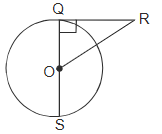
In a given figure, $R Q$ is a tangent to the circle with centre $O$. If $S Q=6 \ cm$ and $Q R=4 \ cm$, then $OR$ is equal to
Image
  • A
    $2.5 \ cm$
  • B
    $3 \ cm$
  • $5 \ cm$
  • D
    $8 \ cm$
Answer
Correct option: C.
$5 \ cm$
$\because$ We know that tangent at any point is perpendicular to the radius through the point of contact.
$\therefore \angle OQR=90^{\circ}$
and $OS = OQ =3 \ cm ($radius of circle$)$
In $\triangle OQR$
By Pythagoras theorem,
$(OR)^2=(OQ)^2+(QR)^2$
$\Rightarrow OR=\sqrt{9+16}$
$=\sqrt{25}$
$=5 \ cm$
View full question & answer
MCQ 371 Mark
The number of tangents that can be drawn from an external point to a circle is
  • A
    1
  • 2
  • C
    3
  • D
    4
Answer
Correct option: B.
2
(b)
  There are only 2 tangents that can be drawn from an external point to a circle
Image
View full question & answer
M.C.Q (1 Marks) - Maths STD 10 Questions - Vidyadip