Questions

Case study (4 Marks)

🎯

Test yourself on this topic

13 questions · timed · auto-graded

Question 14 Marks
Drones are used by military for surveillance purposes. These days, drones are also used by individual entrepreneurs, SMEs and large companies to accomplish various other tasks.
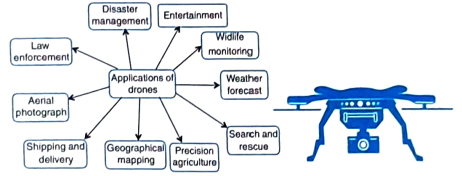
Image
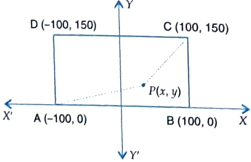
Adrone is flying over a rectangular field with vertices at $A(-100,0), B(100,0), C(100,150)$ and $D(-100,150)$. The drone captures an image at a location $(x, y)$.
(i) Find the dimensions of the rectangular field.
(ii) Find the distance between points A and C .
(iii) (a) If a drone captures the image of an object $P(x, y)$ on the rectangular field, find the relation between $x$ and $y$ such that $P A=P C$.
OR
(b) If a drone captures the image of an object at a point $Q$ whose $x$ coordinate is 0 and it is equidistant from points $A$ and $D$, find the coordinates of $Q$.
Answer
Image
(i) We find that
$
\begin{array}{l}
A B=\sqrt{(100-(-100))^2+(0-0)^2}=\sqrt{200^2}=200 \\
B C=\sqrt{(100-100)^2+(150-0)^2}=\sqrt{150^2}=150
\end{array}
$
So, dimensions of the rectangular field are : Length $=200$, Breadth $=150$.
(ii) $A C=\sqrt{(100-(-100))^2+(150-0)^2}=\sqrt{40000+22500}=\sqrt{62500}=250$
$\begin{array}{l}\text { (iii) (a) } P A=P C \Rightarrow P A^2=P C^2 \Rightarrow\left(x+100^2\right)+(y-0)^2=(x-100)^2+(y-150)^2 \\ \Rightarrow \quad 400 x+300 y=22500 \Rightarrow 4 x+3 y=225\end{array}$
OR
(b) Let the coordinates of $Q$ be $(0, y)$. Then,
$
\begin{array}{ll}
& Q A=Q D \\
\Rightarrow & Q A^2=Q D^2 \\
\Rightarrow & (0-100)^2+(y-0)^2=(0+100)^2+(y-150)^2 \\
\Rightarrow & 100^2+y^2=100^2+y^2-300 y+22500 \Rightarrow 300 y=22500 \Rightarrow y=75
\end{array}
$
Hence, the ordinate of $D$ is 75 .
View full question & answer
Question 24 Marks
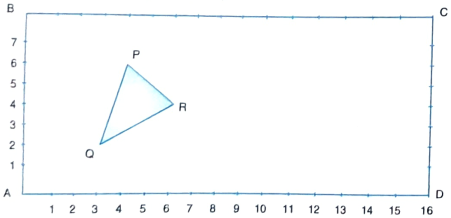
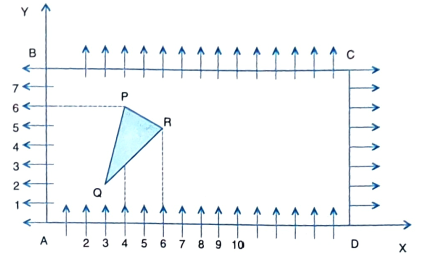
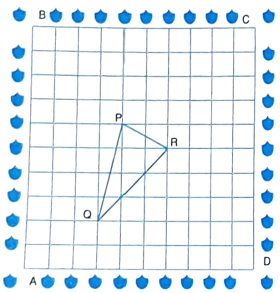
A garden is in the shape of a square. The gardener grew saplings of Ashoka tree on the boundary of the garden at the distance of 1 m from each other. He wants to decorate the garden with rose plants. He chose a triangular region inside the garden to grow rose plants. In the above situation, the gardener took help from the students of class 10. They made a chart for it which looks like the Fig.
Image
(i) If $A$ is taken as origin, what are the coordinates of the vertices of $\triangle P Q R$ ?
(ii) (a) Find the distances $P Q$ and $Q R$.
OR
(b) Find the coordinates of the point which divides the line segment joining points $P$ and $R$ in the ratio 2:1 internally.
(iii) Find out if $\triangle P Q R$ is an isoscales triangle.
Answer
(i) The coordinates of vertices $P, Q$ and $R$ are $P(4,6), Q(3,2)$ and $R(6,5)$ respectively.
(ii) (a) $P Q=\sqrt{(4-3)^2+(6-2)^2}=\sqrt{17}$ and
$
Q R=\sqrt{(6-3)^2+(5-2)^2}=3 \sqrt{2}
$
OR
(b) The coordinates of point dividing $P R$ in the ratio $2: 1$ are:
$
\left(\frac{2 \times 6+1 \times 4}{2+1}, \frac{2 \times 5+1 \times 6}{2+1}\right)=\left(\frac{16}{3}, \frac{16}{3}\right)
$
(iii) We find that $P Q=\sqrt{17}, Q R=3 \sqrt{2}$ and $P R=\sqrt{(6-4)^2+(5-6)^2}=\sqrt{17}$
$\therefore \quad P Q=P R$. So, $\triangle P Q R$ is an isoscales triangle.
View full question & answer
Question 34 Marks
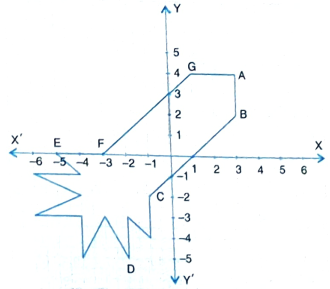
Ryan, from a very young age, was fascinated by the twinkling of stars and the vastness of space. He always dreamt of becoming an astronaut one day. So, he started to sketch his own rocket designs on the graph sheet. One such design is given below:
Image
(i) Find the mid-point of the segment joining $F$ and $G$.
(ii) (a) What is the distance between the points $A$ and $C$ ?
OR
(b) Find the coordinates of the point which divides the line segment joining the points $A$ and $B$ in the ratio 1:3 internally.
(iii) What are the coordinates of the moint D?
Answer
(i) The coordinates of $F$ and $G$ are $(-3,0)$ and $(1,4)$ respectively.
So, the coordinates of the mid-point of segment $F G$ are $\left(\frac{-3+1}{2}, \frac{0+4}{2}\right)=(-1,2)$.
(ii) (a) The coordinates of $A$ and $C$ are $A(3,4)$ and $C(-1,-2)$ respectively.
$
\therefore \quad A C=\sqrt{(3+1)^2+(4+2)^2}=\sqrt{16+36}=\sqrt{52}=2 \sqrt{13}
$
OR
(b) The coordinates of $A$ and $B$ are $(3,4)$ and $(3,2)$ respectively. So, the coordinates of the point which divides the line segment $A B$ in the ratio 1:3 are $\left(\frac{1 \times 3+3 \times 3}{1+3}, \frac{1 \times 2+3 \times 4}{1+3}\right)=\left(3, \frac{7}{2}\right)$
(iii) The coordinates of point $D$ are $(-2,-5)$.
View full question & answer
Question 44 Marks
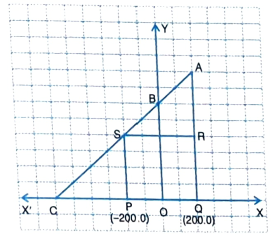
Jagdish has a field which is in the shape of a right angled triangle $A Q C$. He wants to leave a space in the form of a square $P Q R S$ inside the field for growing wheat and the remaining for growing vegetables (as shown in the Fig. 6.10). In the field, there is a pole marked as $O$.
Image
(i) Taking $O$ as origin, coordinates of $P$ are $(-200,0)$ and $Q$ are $(200,0) . P Q R S$ being a square, what are the coordinates of $R$ and $S$ ?
(ii) What is the area of square $P Q R S$ ?
(iii) What is the length of diagonal $P R$ in square $P Q R S$ ?
(iv) If $S$ divides $C \Lambda$ in the ratio $k: 1$, what is the value of $k$, where point $\Lambda$ is $(200,800)$ ?
Answer
(i) Given that PQRS is a square.
$
P Q=O R=R S=P S \Rightarrow 400=Q R=P S
$
So, the coordinates of $R$ and $S$ are $(200,400)$ and $(-200,400)$ respectively.
(ii) Area of square $P Q R S=(P Q)^2=400^2$ sq. units $=160000$ sq. units.
(iii) length of diagonal $P R$ is given by
$
P R=\sqrt{\{200-(-200)\}^2+(400)^2}=\sqrt{160000+160000}=400 \sqrt{2} \text { units }
$
(iv) Let the coordinates of $C$ be $(x, 0)$. Given that $S$ divides $C \wedge$ in the ratio $k: 1$. So, the coordinates of $S$ are $\left(\frac{200 k+x}{k+1}, \frac{800 k+0}{k+1}\right)$. But, the coordinates of $S$ are $(-200,400)$.
$
\begin{array}{l}
\therefore \frac{200 k+x}{k+1}=-200 \text { and } \frac{800 k}{k+1}=400 \\
\Rightarrow \quad 200 k+x=-200 k-200 \text { and } 800 k=400 k+400 \Rightarrow k=1 \text { and } x=-600
\end{array}
$
View full question & answer
Question 54 Marks
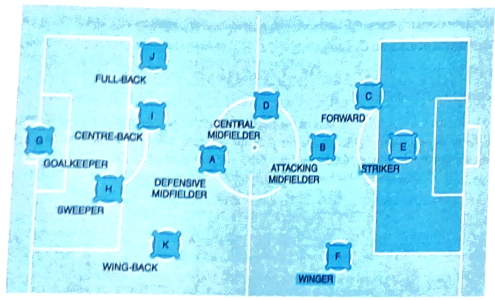
Tharunya was thrilled to know that the football tournament is fixed with a monthly time frame from 20th July to 20th August 2023 and for the first time in the FIFA Women's World Cup's history, two mations host in 10 venues. Her father fell that the game can be belter understood if the position of players is represented as points on a coordinate plane.
Image
(i) At an inslance, the mid fielders and forward formed a parallelogram. Find the position of the central mid fielder (D) if the position of other players who formed the parallelogram are: $A(1,2), B(4,3)$ and $C(6,6)$.
(ii) Check if the Goal keeper $G(-3,5)$, Sweeper $H(3,1)$ and Wing-back $K(0,3)$ fall on a same straight line.
(iii) Check if the Full-back $J(5,-3)$ and centre-back I $(-4,6)$ are equidistant from forward $C(0,1)$ and if $C$ is the mid-point of IJ.
(iv) If Defensive mid fielder $\Lambda(1,4)$, Altacking mid fielder $B(2,-3)$ and Striker $E(a, b)$ lie on the same straight line and B is equidistant from $\triangle$ and $E$, find the position of $E$.
Answer
(i) Let the coordinates of $D$ be $(x, y)$. Given that $A B C D$ is a parallelogram and diagonals of a parallelogram bisect each other.
$
\begin{array}{ll}
& \left(\frac{1+6}{2}, \frac{2+6}{2}\right)=\left(\frac{4+x}{2}, \frac{3+y}{2}\right) \Rightarrow\left(\frac{7}{2}, 4\right)=\left(\frac{4+x}{2}, \frac{3+y}{2}\right) \\
\Rightarrow & \frac{4+x}{2}=\frac{7}{2}, 4=\frac{3+y}{2} \Rightarrow 4+x=7,8=3+y \Rightarrow x=3, y=5
\end{array}
$
Hence, the central mid fielder is at $D(3,5)$.
(ii) The coordinates of the mid-point of GH are $\left(\frac{-3+3}{2}, \frac{5+1}{2}\right)$ i.e. ( 0,3 ), which are the coordinates of $K$. This means that the Wing-back $K$ is at the middle of Goal keeper $G(-3,5)$ and Sweeper $H(3,1)$. Therefore, Goal keeper, Sweeper and Wing-back fall on the same straight line.
(iii) We find that $C I=\sqrt{(5-0)^2+(-3-1)^2}=\sqrt{41}$ and $C I=\sqrt{(0+4)^2+(1-6)^2}=\sqrt{41}$
$
\therefore \quad C I=C J
$
$\Rightarrow \quad$ Forward $C$ is equidistant from Full-back and Centre-back.
The coordinates of the mid-point of $I J$ are $\left(\frac{5-4}{2}, \frac{-3+6}{2}\right)=\left(\frac{1}{2}, \frac{3}{2}\right)$ and the coordinates of $C(0,1)$.
Therefore, $C$ is not the mid-point of $I J$.
(iv) Given that attacking mid fielder $B(2,-3)$ is the mid-point of $A(1,4)$ and $E(a, b)$.
$
\therefore \quad(2,-3)=\left(\frac{1+a}{2}, \frac{4+b}{2}\right) \Rightarrow \frac{1+a}{2}=2, \frac{4+b}{2}=-3, \Rightarrow a=3, b=-10
$
Hence, the striker is at $E(3,-10)$.
View full question & answer
Question 64 Marks
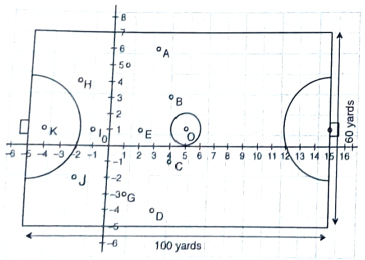
A hockey field is the playing surface for the game of hockey. Historically, the game was played on natural turf (grass) but nowadays it is predominantly played on an artificial turf. It is rectangular in shape - 100 yards by 60 yards. Goals consist of two upright posts placed equidistant from the centre of the backline, joined at the top by a horizontal crossbar. The inner edges of the posts must be 3.66 metres ( 4 yards) apart, and the lower edge of the crossbar must be 2.14 metres ( 7 feet) above the ground. Each team plays with 11 players on the field during the game including the goalie. Positions you might play include:
Forward: As shown by players A, B, C and D; Midfielders: As shown by players E, F and G.
Fullbacks: As shown by players H, I and J; Goalie: As shown by player K.
Using the picture of a hockey field below, answer the following questions:
Image
(i) The coordinates of the centroid of $\triangle E H J$ are
(a) $(-2 / 3,1)$ $\qquad$ (b) $(1,-2 / 3)$
(c) $(2 / 3,1)$ $\qquad$  (d) $(-2 / 3,-1)$
(ii) If a player $P$ needs to be at equal distances from $A$ and $G$, such that $A, P$ and $G$ are in straight line, then position of $P$ will be given by
(a) $(-3 / 2,2)$ $\qquad$ (b) $(2,-3 / 2)$
(c) $(2,3 / 2)$ $\qquad$  (d) $(-2,-3)$
(iii) The point on $x$ axis equidistance from $I$ and $E$ is
(a) $(1 / 2,0)$ $\qquad$  (b) $(0,-1 / 2)$
(c) $(-1 / 2,0)$ $\qquad$ (d) $(0,1 / 2)$
(iv) What are the coordinates of the position of a player $Q$ such that his distance from $K$ is twice his distance from $E$ and $K, Q$ and $E$ are collinear?
(a) $(1,0)$ $\qquad$  (b) $(0,1)$
(c) $(-2,1)$ $\qquad$ (d) $(-1,0)$
Answer
(i) (a): The coordinates of $E, H$ and $J$ are $(2,1),(-2,4)$ and $(-2,-2)$. So, the coordinates of the centroid of $\Delta E H J$ are $\left(\frac{2-2-2}{3}, \frac{1+4-2}{3}\right)$ i.e. $\left(-\frac{2}{3}, 1\right)$.
(ii) (c): The coordinates of $A$ and $G$ are $(3,6)$ and $(1,-3)$ respectively. The mid-point of $A G$ is equidistant from $A$ and $G$. The coordinates of the mid-point are $\left(\frac{3+1}{2}, \frac{6-3}{2}\right)=\left(2, \frac{3}{2}\right)$.
(iii) (a): Let $P(x, 0)$ be a point on $x$-axis equidistant from $I(-1,1)$ and $E(2,1)$. Then,
$
P I=P E \Rightarrow P I^2=P E^2 \Rightarrow(x+1)^2+(0-1)^2=(x+2)^2+(0-1)^2 \Rightarrow 2 x+1=-4 x+4 \Rightarrow 6 x=3 \Rightarrow x=\frac{1}{2}
$
Hence, $P\left(\frac{1}{2}, 0\right)$ is the required point.
(iv) (b): The coordinates of $K$ and $E$ are $(-4,1$ and $(2,1)$ respectively. Clearly, $Q$ divides $K E$ in the ratio $2: 1$. So, the coordinates of $Q$ are $\left(\frac{2 \times 2+1 \times-4}{2+1}, \frac{2 \times 1+1 \times 1}{2+1}\right)$ i.e. $(0,1)$.
View full question & answer
Question 74 Marks
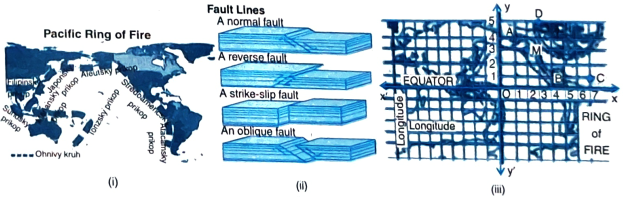
The pacific Ring of Fire is a major area in the basin of the Pacific Ocean where many carthquakes and volcanic eruptions occur. In a large horseshoe shape, it is associated with a nearly continuous series of oceanic trenches volcanic arcs, and volcanic belts and plate movements.
Image
Large faults within the Earth's crust result from the action of plate tectonic forces, with the largest forming the boundaries between the plates. Energy release associated with rapid movement on active faults is the case of most earthquakes. Positions of some countries in the Pacific ring of fire is shown in the square grid given above. Based on the given information, answer the following questions:
(i) The distance between the point country $A$ and country B is
(a) 4 units $\qquad$ (b) 5 units
(c) 6 units $\qquad$ (d) 7 units
(ii) Find a relation between $x$ and $y$ such that the point $(x, y)$ is equidistant from the country $C$ and country D
(a) $x-y=2$ $\qquad$ (b) $x+y=2$
(c) $2 x-y=0$ $\qquad$ (d) $2 x+y=2$
(iii) The fault line $3 x+y-9=0$ divides the line joining the country $P(1,3)$ and country $Q(2,7)$ internally in the ratio
(a) $3: 4$ $\qquad$ (b) $3: 2$
(c) $2: 3$ $\qquad$ (d) $4: 3$
(iv) The distance of the country $M$ from the $x$-axis is
(a) 1 units $\qquad$ (b) 2 units
(c) 3 units $\qquad$ (d) 5 units
Answer
(i) (b): The coordinates of country $A$ and country $B$ are $(1,4)$ and $(4,0)$ respectively. So, the distance $A B$ is given by
$
A B=\sqrt{(1-4)^2+(4-0)^2}=5 \text { units }
$
(ii) (a): The coordinates of country $C$ and country $D$ are $(7,1)$ and $(3,5)$ respectively if $P(x, y)$ is equidistant from C and $D$. Then,
$
C P=C D \Rightarrow C P^2=C D^2 \Rightarrow(x-7)^2+(y-1)^2=(x-3)^2+(y-5)^2 \Rightarrow 8 x-8 y=16 \Rightarrow x-y=2
$
(iii) (a): Suppose the fault line $3 x+y-9=0$ divides the country $P(1,3)$ and $Q(2,7)$ internally in the ratio $\lambda: 1$. Then, the coordinates of the point of division are $\left(\frac{2 \lambda+1}{\lambda+1}, \frac{7 \lambda+3}{\lambda+1}\right)$. This point lies on $3 x+y-9=0$.
$
\therefore \quad 3\left(\frac{2 \lambda+1}{\lambda+1}\right)+\left(\frac{7 \lambda+3}{\lambda+1}\right)-9=0 \Rightarrow 6 \lambda+3+7 \lambda+3-9 \lambda-9=0 \Rightarrow 4 \lambda=3 \Rightarrow \lambda=\frac{3}{4}
$
Hence, required ratio is $3: 4$.
(iv) (c): The coordinates of $M$ are (2,3). So, it is at a distance of 3 units from $x$-axis.
View full question & answer
Question 84 Marks
Answer
(i) (a): The coordinates of $P, Q$ and $R$ are $(4,6),(3,2)$ and $(6,4)$ respectively with reference to $A D$ and $A B$ as the coordinate axes.
(ii) (c): Taking $C B$ and $C D$ as the coordinate axes, the coordinates of $P, Q$, and $R$ are $(12,2),(13,6)$ and $(10,4)$ respectively.
(iii) (d): It is evident from Fig. 6.7 that the coordinates of $Q$ are $(13,6)$
(iv) (a): Area of $\triangle P Q R=\frac{1}{2}|4(2-4)+3(4-6)+6(6-2)|=\frac{1}{2}|10|=5$ sq. units
View full question & answer
Question 94 Marks
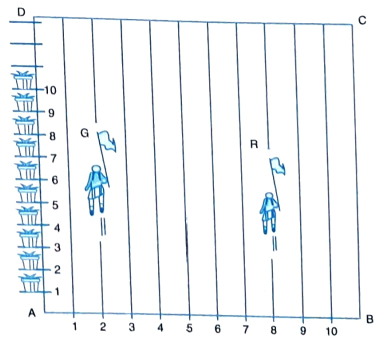
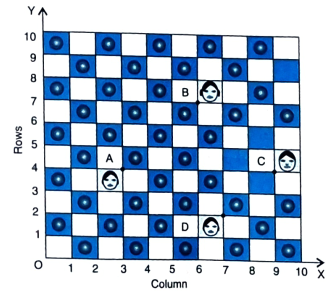
In order to conduct sports day activities in your school, lines have been drawn with chalk powder at a distance of 1 m each in a rectangular shaped ground $A B C D .100$ flower pots have been placed at a distance of 1 m from each other along $A D$, as shown in the following figure. Niharika runs $\left(\frac{1}{4}\right)^{\text {th }}$ the distance $A D$ on the 2 nd line and posts a green Flag. Prect runs $\left(\frac{1}{5}\right)^{\text {th }}$ distance $A D$ on the eight line and posts a red flag. Taking $A$ as the origin $A B$ along $x$-axis and $A D$ along $y$-axis, answer the following questions.
Image
(i) The coordinates of the green flag are
(a) $(2,25)$ $\qquad$ (b) $(2,0.25)$ $\qquad$ (c) $(25,2)$ $\qquad$ (d) $(0,-25)$
(ii) The coordinates of the red flag are
(a) $(8,0)$ $\qquad$ (b) $(20,8)$ $\qquad$ (c) $(8,20)$ $\qquad$ (d) $(8,0.2)$
(iii) The distance between the two flags is
(a) $\sqrt{45} m$ $\qquad$ (b) $\sqrt{11} m$ $\qquad$ (c) $\sqrt{61} m$ $\qquad$ (d) $\sqrt{51} m$
(iv) If Rachmi has to post a blue flag exactly half way betucen the line segment joining the two flags, where should she post her flag?
(a) $(5,22.5)$ $\qquad$ (b) $(10,22)$ $\qquad$ (c) $(2,8.5)$ $\qquad$ (d) $(2.5,20)$
Answer
(i) (a): The green flag is posted on second line at a distance of 25 metres from $A B$. So, the coordinates of the point where the green flag is posted are $(2,25)$.
(ii) (c): Preet posts red flag on $8^{\text {th }}$ line at a distance of 20 metres from $A B$. So, the coordinates of the point where red flag is put are $(8,20)$.
(iii) (c): The coordinates of $G$ and $R$ are $(2,25)$ and $(8,20)$ respectively.
$
G R=\sqrt{(2-8)^2+(25-20)^2}=\sqrt{36+25}=\sqrt{61} m
$
(iv) (a): The coordinates of the mid-point of $G R$ are $\left(\frac{2+8}{2}, \frac{25+20}{2}\right)=(5,22.5)$.
View full question & answer
Question 104 Marks
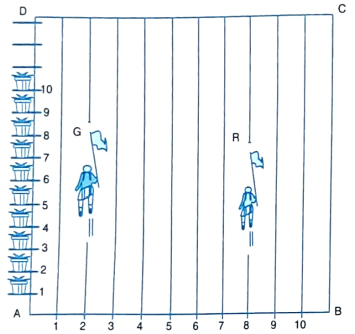
A City school is organizing annual sports event in a rectangular shaped ground $A B C D$. The tracks are being marked with a gap of 1 m each in the form of straight lines. 120 flower pots are placed with a distance of 1 m each along $A D$. Shruti runs $1 / 3^{\text {rd }}$ of the distance in the second line along $A D$ and post her flag. Saanvi runs $1 / 5^{\text {th }}$ of the distance $A D$ in the eighth line and posts her flag.
Image
(i) The distance between the two flags is
(a) $2 \sqrt{73}$ $\qquad$ (b) $3 \sqrt{73}$ $\qquad$ (c) $\sqrt{273}$ $\qquad$ (d) $\sqrt{73}$
(ii) If Reena has to post the flag exactly halfway between the line segment joining the two flags, the coordinates where she should post her flag are
(a) $(2,40)$ $\qquad$ (b) $(2,30)$ $\qquad$ (c) $(5,32)$ $\qquad$ (d) $(10,64)$
(iii) The coordinates where Shruti posts her flag are
(a) $(2,40)$ $\qquad$ (b) $(40,2)$ $\qquad$ (c) $(2,30)$ $\qquad$ d) $(3,40)$
(iv) The coordinates where Saanvi posts her flag are
(a) $(3,40)$ $\qquad$ (b) $(24,8)$ $\qquad$ (c) $(5,32)$ $\qquad$ (d) $(8,24)$
Answer
(i) (a) (ii) (c) (iii) (a) (iv) (d) 
View full question & answer
Question 114 Marks
Four persons John, Saurabh, Salim and Ratan are sitting in a courtyard at points $A, B, C$ and $D$ respectively as shown in Fig. 6.19. The Courtyard has been divided into small squares by drawing equality spaced horizontal and vertical lines. Taking $O X$ and $O Y$ as the coordinate axes, answer the following questions:
Image
(i) The coordinates of points $A$ are
(a) $(4,3)$ $\qquad$ $\qquad$ (b) $(3,4)$ $\qquad$ (c) $(3,3)$ $\qquad$ (d) $(4,4)$
(ii) By joining $A$ to $B, B$ to $C, C$ to $D$ and $D$ to $A$, the figure formed is not a
(a) rhombus $\qquad$ (b) square $\qquad$ (c) parallelogram $\qquad$ (d) trapezium
(iii) The distance between the mid-points of $A C$ and $B D$ is
(a) 2 $\qquad$ (b) 3 $\qquad$ (c) 0 $\qquad$ (d) 1
(iv) Area of $\triangle A B C$ is
(a) 18 sq. units $\qquad$ (b) 9 sq. units $\qquad$ (c) 12 sq. units $\qquad$ (d) 16 sq. units
Answer
(i) (a) (ii) (c) (iii) (c) (iv) (b)
View full question & answer
Question 124 Marks
Class $X$ students of a secondary school in Krish Nagar have been allotted a rectangular plot of land for gardening activity. Saplings of Gulmohar are planted on the boundary at a distance of 1 m from each other. There is a triangular grassy lawn in the plot as shown in the Fig. 6.18. The students are to sow seeds of flowering plants on the remaining area of the plot. Considering $A$ as origin, $A D$ along $x$-axis and $A B$ along $y$-axis answer questions:
Image
(i) What are the coordinates of $A$ ?
(a) $(0,1)$ $\qquad$ $\qquad$ (b) $(1,0)$ $\qquad$ (c) $(0,0)$ $\qquad$ (d) $(-1,-1)$
(ii) What are the coordinates of $P$ ?
(a) $(4,6)$ $\qquad$ (b) $(6,4)$ $\qquad$ (c) $(4,5)$ $\qquad$ (d) $(5,4)$
(iii) What are the coordinates of $R$ ?
(a) $(6,5)$ $\qquad$ (b) $(5,6)$ $\qquad$ (c) $(6,0)$ $\qquad$ (d) $(7,4)$
(iv) What are the coordinates of $D$ ?
(a) $(16,0)$ $\qquad$ (b) $(0,0)$ $\qquad$ (c) $(0,16)$ $\qquad$ (d) $(16,1)$
Answer
(i) (c) (ii) (a) (iii) (a) (iv) (a)
View full question & answer
Question 134 Marks
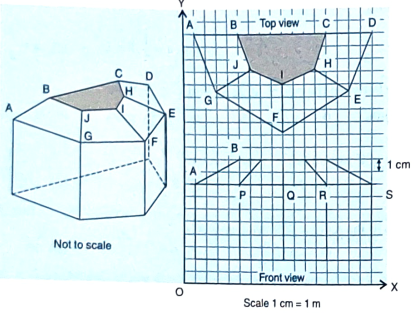
Figure shows the plans for a sun room. It will be built onto the wall of a house. The four walls of the sun room are square clear glass panels. The roof is made of four trapezium shape clear glass panels of same size and one tinted glass panel in half a regular octagon shape.
Image
(i) In the top view, find the mid-point of the segment joining the points $J(6,17)$ and $I(9,16)$.
(a) $(33 / 2,15 / 2)$ $\qquad$ (b) $(3 / 2,1 / 2)$
(c) $(15 / 2,33 / 2)$ $\qquad$ (d) $(1 / 2,3 / 2)$
(ii) In the top view, the distance of the point $P$ from the $y$-axis is
(a) 5 $\qquad$ (b) 15 $\qquad$ (c) 19 $\qquad$ (d) 25
(iii) In the front view, the distance between the point $A$ and $S$ is
(a) 4 $\qquad$ (b) 8 $\qquad$ (c) 16 $\qquad$ (d) 20
(iv) In the front view, find the co-ordinates of the point which divides the line segment joining the points $A$ and $B$ in the ratio $1: 3$ internally.
(a) $(8.5,2.0)$ $\qquad$ (b) $(2.0,9.5)$
(c) $(3.0,7.5)$ $\qquad$ (d) $(2.0,8.5)$
Answer
(i) (c) (ii) (a) (iii) (c) (iv) (d)
View full question & answer