Question 12 Marks
If the distances of $P ( x , y )$ from $A (5,1)$ and $B (-1,5)$ are equal, then prove that $3 x =2 y $
AnswerGiven, $P A=P B$
Using distance formula,
$\Rightarrow \sqrt{(x-5)^2+(y-1)^2}$
$=\sqrt{(x+1)^2+(y-5)^2}$
Squaring both sides
$\Rightarrow(x-5)^2+(y-1)^2$
$=(x+1)^2+(y-5)^2$
$\Rightarrow x^2-10 x+25+y^2-2 y+1$
$=x^2+2 x+1+y^2-10 y+25$
$\Rightarrow-10 x-2 y=2 x-10 y$
Dividing both sides by $4$
$\Rightarrow 3 x=2 y$
Hence proved.
View full question & answer→Question 22 Marks
A line intersects the $y-$axis and $x-$axis at the points $P$ and $Q$ respectively. If $(2,-5)$ is the mid$-$point of $PQ$, then find the coordinates of $P$ and $Q$.
AnswerGiven, $P(0, y)$
$Q(x, 0)$
Midpoint of $P Q=(2,-5)$
Using midpoint formula,
$\left(\frac{x+0}{2}, \frac{0+y}{2}\right)=(2,-5)$
$\Rightarrow\left(\frac{x}{2}, \frac{y}{2}\right)=(2,-5)$
On comparing the $x$ and $y$ coordinates of both the sides.
$\Rightarrow \frac{x}{2}=2 \text { and } \frac{y}{2}=-5$
$\Rightarrow x=4, y=-10$
Therefore, coordinates of $P$ and $Q$ are $(0,-10)$ and $(4,0)$ respectively.
View full question & answer→Question 32 Marks
Prove that the points $(3,0),(6,4)$ and $(-1,3)$ are the vertices of a right angled isosceles triangle.
AnswerLet the coordinates for point $A(3,0)$, coordinates for point $B(6,4)$ and the coordinates for point $C(-1,3)$.
Using Distance formula,
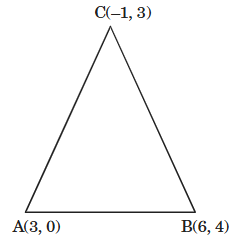
$AB=\sqrt{\left(x_2-x_1\right)^2+\left(y_2-y_1\right)^2}$
$AB=\sqrt{(6-3)^2+(4-0)^2}=\sqrt{25}=5$
Similarly,
$BC=\sqrt{(-1-6)^2+(3-4)^2}=\sqrt{50}$
$AC=\sqrt{(-1-3)^2+(3-0)^2}=\sqrt{25}=5$
So, two sides are equal.
Hence, $A C=A B$.
Now, apply the Pythagoras theorem on the given triangle.
If $A B^2+A C^2=B C^2$
then it is right angled isosceles triangle because it already has two equal sides.
So, $ B C^2=(\sqrt{50})^2=50$ and $ A B^2=5^2=25,$
$A C^2=5^2=25$
$A B^2+A C^2$
$=25+25$
$=50=B C^2$
Hence, the given triangle is right angled isosceles triangle. View full question & answer→Question 42 Marks
Let $P$ and $Q$ be the points of trisection of the line segment joining the points $A (2,-2)$ and $B (-7,4)$ such that $P$ is nearer to $A$ . Find the coordinates of $P$ and $Q$.
Answer$P$ land $Q$ are the points of trisection. Hence, $A P=P Q=Q B$

Thus, $P$ divides $A B$ internally in the ratio $1: 2$ and $Q$ divides $A B$ internally in the ratio $2: 1$.
Using section formula, coordinates of $P$ are,
$P=\left(\frac{1(-7)+2(2)}{1+2}, \frac{1(4)+2(-2)}{1+2}\right)$
$=\left(\frac{-7+4}{3}, \frac{4-4}{3}\right)$
$P=\left(\frac{-3}{3}, 0\right)=(-1,0)$
$P=(-1,0)$
Similarly, coordinates of $Q$ are,
$Q=\left(\frac{2(-7)+1(2)}{2+1}, \frac{2(4)+1(-2)}{2+1}\right)$
$=\left(\frac{-14+2}{3}, \frac{8-2}{3}\right)$
$Q=\left(\frac{-12}{3}, \frac{6}{3}\right)=(-4,2)$
$Q=(-4,2)$ View full question & answer→Question 52 Marks
The $x-$ coordinate of a point $P$ is twice its $y$ coordinate. If $P$ is equidistant from $Q(2,-5)$ and $R(-3,6),$ find the coordinates of $P$.
AnswerLet the $y-$ coordinate of the point be $a$.
Then according to the question, $x-$ coordinate will be $2 a$.
So, the coordinates of the point $P$ are $(2 a, a)$.
Since, the point $P(2 a, a)$ is equidistant from $Q(2,-5)$ and $R(-3,6)$.
So we can use distance formula such that,
$\sqrt{(2 a-2)^2+(a-(-5))^2}$
$=\sqrt{(2 a-(-3))^2+(a-6)^2}$
$\Rightarrow \sqrt{(2 a-2)^2+(a+5)^2}$
$=\sqrt{(2 a+3)^2+(a-6)^2}$
$\Rightarrow \sqrt{4 a^2+4-8 a+a^2+25+10 a}$
$ =\sqrt{4 a^2+9+12 a+a^2+36-12 a}$
$\Rightarrow \sqrt{5 a^2+2 a+29}$
$=\sqrt{5 a^2+45}$
Squaring both sides,
$\Rightarrow 5 a^2+2 a+29=5 a^2+45$
$\Rightarrow 5 a^2+2 a-5 a^2=45-29$
$\Rightarrow 2 a=16$
$\Rightarrow a=8$
Since $\alpha=8$, then $x-$ coordinate is $2 \alpha$
i.e. $2 \times 8=16$.
Hence, the coordinates of the point $P$ are $(16,8)$.
View full question & answer→Question 62 Marks
Find the relation between $x$ and $y$ if the points $A( x , y ), B(-5,7)$ and $C(-4,5)$ are collinear.
AnswerIf $A, B, C$ are collinear then area of $\triangle A B C=0$ Area of the triangle with coordinates
$( x_1, y_1 ),$ $\left(x_2, y_2\right),\left(x_3, y_3\right)$ is given by $-$
$\frac{1}{2}\left|x_1\left(y_2-y_3\right)+x_2\left(y_3-y_1\right)+x_3\left(y_1-y_2\right)\right|$
Now, if $A, B, C$ are collinear, then
$\triangle A B C=0$
$\Rightarrow \frac{1}{2}|x(7-5)-5(5-y)-4(y-7)|=0$
$\Rightarrow \frac{1}{2}|2 x-25+5 y-4 y+28|=0$
$\Rightarrow \frac{1}{2}|2 x+y+3|=0$
$\Rightarrow 2 x+y+3=0 $
$\Rightarrow 2 x+y=-3$
Hence, the relation between $x$ and $y$ is $2 x+y=3$.
View full question & answer→Question 72 Marks
Find the ratio in which $y-$ axis divides the line segment joining the points $A (5,-6)$ and $B (-1,-4)$. Also find the coordinates of the point of division.
AnswerLet $(0, a)$ be a point on the $y-$ axis dividing the line segment $A B$ in the ratio $k: 1$.
We make use of section formula to get
$(0, a)=\left(\frac{-k+5}{k+1}, \frac{-4 k-6}{k+1}\right)$
Comparing the $x$ and $y$ coordinate on both the sides.
$\Rightarrow \frac{-k+5}{k+1}=0, \frac{-4 k-6}{k+1}=a$
Solving each one independently,
$\Rightarrow \frac{-k+5}{k+1}=0$
$\Rightarrow-k+5=0$
$\Rightarrow k=5$
and
$\Rightarrow \frac{-4 k-6}{k+1}=a$
Substituting $k=5$
$\Rightarrow \frac{-4 \times 5-6}{5+1}=a$
$\Rightarrow a=\frac{-26}{6}$
$\Rightarrow a=\frac{-13}{3}$
Thus, the $y-$ axis divide the line segment in the ratio $5: 1$.
Hence, the coordinates of point of division are $\left(0, \frac{-13}{3}\right)$.
View full question & answer→Question 82 Marks
The points $A(4,7), B(p, 3)$ and $C(7,3)$ are the vertices of a right triangle, right$-$angled at $B.$ Find the value of $p$.
Answer$A(4,7), B(p, 3)$ and $C(7,3) ($Given$)$
The coordinate of $A(4,7)$ and $B(p, 3)$
so, $x_2=p$, $x_1=4, y_2=3$ and $y_1=7$
$A B=\sqrt{\left(x_2-x_1\right)^2+\left(y_2-y_1\right)^2}$
$A B=\sqrt{(p-4)^2+(3-7)^2}$
$A B=\sqrt{p^2-8 p+16+16}$
On squaring both sides.
$A B^2=p^2-8 p+32$
Similarly,
$B C=\sqrt{(p-7)^2+(3-3)^2}$
$B C=\sqrt{p^2+49-14 p}$
On squaring both the sides.
$B C^2=p^2+49-14 p$
And $A C=\sqrt{(4-7)^2+(7-3)^2}$
$A C=\sqrt{9+16}$
On squaring both the sides.
$A C^2=25$
$A B C$ is a right angled triangle.
By Pythagoras theorem, $A B^2+B C=A C^2$
Putting the value of $A B, B C$ and $A C$ in Pythagoras theorem
$p^2-8 p+32+p^2+49-14 p=25$
$\Rightarrow 2 p^2-22 p+81=25$
$\Rightarrow 2 p^2-22 p+56=0$
$\Rightarrow p^2-11 p+28=0$
$\Rightarrow p^2-7 p-4 p+28=0$
$\Rightarrow p(p-7)-4(p-7)=0$
$\Rightarrow(p-4)(p-7)=0$
$\Rightarrow p=4,7$
Here, if $p=7$ point $B$ and $C$ will coincide.
$A, B$ and $C$ are given vertices of a triangle, therefore, $p \neq 7$
Hence, $p=4$
View full question & answer→Question 92 Marks
Find the ratio in which the point $P\left(\frac{3}{4}, \frac{5}{12}\right)$ divides the line segment joining the points $A\left(\frac{1}{2}, \frac{3}{2}\right)$ and $B (2,-5)$.
AnswerLet $P$ divides the line segment joining the points $A$ and $B$ in the ratio $m: n$.

$A \left(x_1, y_1\right) P (x, y) B \left(x_2, y_2\right)$
Then the coordinates of point $P$ is given by the section formula,
$P=\left(\frac{m x_2+n x_1}{m+n}, \frac{m y_2+n y_1}{m+n}\right)$
Where $\left(x_1, y_1\right)$ and $\left(x_2, y_2\right)$ are the coordinates of the points joined to make the line segment.
Here $P=\left(\frac{3}{4}, \frac{5}{12}\right)$.
Let $\left(x_1, y_1\right)=\left(\frac{1}{2}, \frac{3}{2}\right)$ and $\left(x_2, y_2\right)=(2,-5)$
Using the section formula we get,
$\left(\frac{3}{4}, \frac{5}{12}\right)=\left(\frac{2 m+\frac{1}{2} n}{m+n}, \frac{-5 m+\frac{3}{2} n}{m+n}\right)$
Comparing the $x$ and $y$ coordinates of both the sides.
$\Rightarrow \frac{3}{4}=\frac{2 m+\frac{1}{2} n}{m+n}$ and $\frac{5}{12}=\frac{-5 m+\frac{3}{2} n}{m+n}$
Using $\frac{3}{4}=\frac{2 m+\frac{1}{2} n}{m+n}$ we get,
$3(m+n)=4\left(2 m+\frac{1}{2} n\right)$
$\Rightarrow 3 m+3 n=8 m+2 n$
$\Rightarrow 3 n-2 n=8 m-3 m$
$\Rightarrow n=5 m$
Hence, $P$ divides the given line segment in the ratio $1: 5.$ View full question & answer→Question 102 Marks
If $A(5, 2),B(2,-2)$ and $C(-2, t )$ and are the vertices of a right angled triangle with $\angle B=90^{\circ}$, then find the value of $t$.
AnswerGiven $A(5,2), B(2,-2)$ and $C(-2, t)$ as the vertices of a right angled triangle with with $\angle B =90^{\circ}$
Distance between the two points is given by the
formula $\sqrt{\left(x_2-x_1\right)^2+\left(y_2-y_1\right)^2}$
$\Rightarrow$ Distance $A B=\sqrt{(2-5)^2+(-2-2)^2}$
$=\sqrt{9+16}=\sqrt{25}$
$\Rightarrow A B=5$
Now, Distance $B C=\sqrt{(-2-2)^2+(t+2)^2}$
$\qquad=\sqrt{16+t^2+4+4 t}$
$\Rightarrow B C=\sqrt{t^2+4 t+20}$
Distance $C A=\sqrt{(5+2)^2+(2-t)^2}$
$=\sqrt{49+4+t^2-4 t}$
$\Rightarrow C A=\sqrt{t^2-4 t+53}$
Using Pythagoras theorem we get,
$(A C)^2=(A B)^2+(B C)^2$
$\Rightarrow t^2-4 t+53=25+t^2+4 t+20$
$\Rightarrow-8 t=45-53$
$\Rightarrow-8 t=-8$
$\Rightarrow t=1$
Hence, the value of $t$ is $1.$
View full question & answer→Question 112 Marks
Find the value of $k$, if the point $P(2,4)$ is equidistant from the points $A (5, k )$ and $( k , 7)$
AnswerSince $P$ is equidistant from points $A$ and $B$,
$\therefore P A=P B$
$\Rightarrow \sqrt{(5-2)^2+(k-4)^2}=\sqrt{(k-2)^2+(7-4)^2}$
$\Rightarrow \sqrt{9+(k-4)^2}=\sqrt{(k-2)^2+9}$
On squaring both sides.
$\Rightarrow 9+(k-4)^2=(k-2)^2+9$
$\Rightarrow(k-4)^2=(k-2)^2$
$\Rightarrow k^2+16-8 k=k^2+4-4 k$
$\Rightarrow 16-8 k=4-4 k$
$\Rightarrow 4 k=12$
$\Rightarrow k=3$
Therefore, the value of $k$ is $3 .$
View full question & answer→Question 122 Marks
Find that value$(s)$ of $x$ for which the distance between the points $P ( x , 4)$ and $Q (9,10)$ is $10$ units.
AnswerGiven that, the distance between the points $P(x, 4)$ and $Q(9,10)$ is $10$ units.
Using the distance formula.
$D=\sqrt{\left(x_2-x_1\right)^2+\left(y_2-y_1\right)^2}$
The distance between the point $P$ and $Q$ is given by:
$P Q=\sqrt{\left(x_2-x_1\right)^2+\left(y_2-y_1\right)^2}$
Given, $P Q=10$
$10=\sqrt{(9-x)^2+(10-4)^2}$
$10=\sqrt{(9-x)^2+(6)^2}$
$10=\sqrt{(9-x)^2+36}$
On squaring both the sides.
$(10)^2=\left(\sqrt{(9-x)^2+36}\right)^2$
$\Rightarrow 100=(9-x)^2+36$
$\Rightarrow 100=81+x^2-18 x+36$
$\Rightarrow 100=x^2-18 x-117$
$\Rightarrow x^2-18 x+117-100=0$
$\Rightarrow x^2-18 x+17=0$
$\Rightarrow x(x-17)-1(x-17)=0$
$\Rightarrow(x-17)(x-1)=10$
$\Rightarrow(x-17)=0 \text { or }(x-1)=0$
$\Rightarrow x=17 \text { or } x=1$
Therefore, the coordinates of the point $P$ could be $( 17,4)$ or $(1,4)$.
View full question & answer→Question 132 Marks
A line intersects $y -$axis and $x -$axis at point $P$ and $Q,$ respectively. If $R(2,5)$ is the mid$-$point of line segment $PQ ,$ then find the coordinates of $P$ and $Q.$
AnswerLet the co$-$ordinates of $P$ be $( x , y )$ and $Q$ be $\left( x _2, y _2\right)$
Midpoint of $PQ =(2,5)$
By midpoint formula,
$X=\frac{x_1+x_2}{2} $ and $ y=\frac{y_1+y_2}{2}$
$ 2=\frac{x_1+x_2}{2}$ and $ 5=\frac{y_1+y_2}{2}$
$\therefore x_1+x_2=4 $ and $ y_1+y_2=10$
Since line $P Q$ intersects the $y-$axis at $P$
So,
$x_1=0$
$y_2=0$
Similarly,
$\therefore x_2=4$ and $y_1=10$
The co$-$ordinates of $P$ are $(0,10)$ and $Q$ are $(4,0)$.
View full question & answer→Question 142 Marks
If the points $A(2,3), B(-5,6), C(6,7)$ and $D(p, 4)$ are the vertices of a parallelogram $\text{ABCD},$ find the value of $p$.
AnswerPoints $A (2,3), B (-5,6), C (6,7)$ and $D ( p , 4)$ are vertices of a parallelogram $\text{ABCD}$.
Diagonals of the parallelogram bisector each other.
The mid $-$ point of line joining $\left( x _1, y _1\right)$ and $\left( x _2, y _2\right)$ is $\left[\frac{\left( x _1+ x _2\right)}{2}, \frac{\left( y _1+ y _2\right)}{2}\right]$
Let's assume that $AC$ and $BD$ intersect each other at $O $.
Using the formula, we get
$.O=\left[\frac{(2+6)}{2}, \frac{(3+7)}{2}\right] \text { \{as mid point of } AC\}$
$O=[4,5]$
$O=\left[\frac{(-5+p)}{2}, \frac{(6+4)}{2}\right]$
$O=\left[\frac{(-5+p)}{2}, 5\right]$
Since $ (1) =(2)$,
$(4,5)=\left[\frac{(-5+p)}{2}, 5\right]$
Comparing, we get
$4 =\frac{(-5+p)}{2}$
$(-5+p) =8$
$p =8+5$
$p =13$
So, the value of $p$ will be $13$ .
View full question & answer→Question 152 Marks
Find the coordinates of the point which divides the join of $A(-1,7)$ and $B(4,-3)$ in the ratio $2: 3$.
AnswerWe know that, the coordinates of the point dividing the line segment joining the points $\left( x _1, y _1\right.$ ) and ( $x _2, y _2$ ) in the ratio m:n is given by
$
\left(\frac{m_1 x_2+m_2 x_1}{m_1+m_2}, \frac{m_1 y_2+m_2 y_1}{m_1+m_2}\right)
$
Given
$\begin{aligned}\left( x _1, y _1\right) & =(-1,7) \\ \left( x _2, y _2\right) & =(4,-3) \\ \left( m _1, m_2\right) & =2: 3\end{aligned}$
Coordinates of point of intersection of line egment is$
\begin{aligned}
\left.\frac{(2)(4)+(3)(-1)}{2+3}, \frac{(2)(-3)+(3)(7)}{2+3}\right) & =\left(\frac{5}{5}, \frac{15}{5}\right) \\
& =(1,3)
\end{aligned}
$
View full question & answer→Question 162 Marks
The point $R$ divides the line segment $A B$, where $A(-4,0)$ and $B(0,6)$ such that $A R=\frac{3}{4} A B$. Find the coordinates of $R$.
AnswerGiven, $AR =\frac{3}{4} AB$
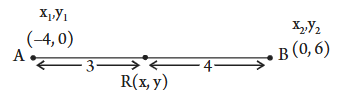
$\frac{ AR }{ AB }=\frac{3}{4}$
$
\begin{aligned}
R(x, y) & =\left(\frac{mx_2-nx_1}{m+n}, \frac{my_2-ny_1}{m+n}\right) \\
& =\left(\frac{3 \times 0-4 \times-4}{3+4}, \frac{3 \times 6-4 \times 0}{3+4}\right) \\
& =\left(\frac{16}{7}, \frac{18}{7}\right)
\end{aligned}
$
$\therefore$ Required coordinate of point $R =\left(\frac{16}{7}, \frac{18}{7}\right)$ View full question & answer→