Question 13 Marks
The area of a triangle is $5$ sq units. Two of its vertices are $(2,1)$ and $(3,-2)$. If the third vertex is $\left(\frac{7}{2}, y\right)$, find the value of $y$.
AnswerWe know that area of triangle can be calculated using the formula
$A=\frac{1}{2}\left|x_1\left(y_2-y_3\right)+x_2\left(y_3-y_1\right)+x_3\left(y_1-y_2\right)\right|$
Here, $x_1=2, y_1=1, x_2=3, y_2=-2, x_3=\frac{7}{2}, y_3=y$
$\therefore 5=\frac{1}{2}\left|2(-2-y)+3(y-1)+\frac{7}{2}(1-(-2))\right|$
$\Rightarrow 5=\frac{1}{2}\left|-4-2 y+3 y-3+\frac{21}{2}\right|$
$\Rightarrow 10=\left|\frac{-14+21}{2}+y\right| \Rightarrow 10=\left|\frac{7}{2}+y\right|$
$\Rightarrow 10=\frac{7}{2}+y \text { or }-10=\frac{7}{2}+y$
$\Rightarrow 10-\frac{7}{2}=y \text { or }-10-\frac{7}{2}=y$
$y=\frac{13}{2} \text { or } y=\frac{-27}{2}$
Hence, the value of $y$ can be $\frac{13}{2}$ or $\frac{-27}{2}$.
View full question & answer→Question 23 Marks
Show that $\triangle A B C$, whereA $(-2,0), B (2,0), C (0,2)$ and $\triangle P Q R$ where $(-4,0), Q(4,0) R(4,0)$ are similar triangles.
AnswerTo prove that $\triangle A B C$ and $\triangle P Q R$ are similar triangles we need to find prove that the ratios of the lengths of their corresponding sides are equal.
We know that distance $d$ between two points is given by
$d=\sqrt{\left(x_2-x_1\right)^2+\left(y_2-y_1\right)^2}$
In $\triangle A B C$
$A B=\sqrt{(2-(-2))^2+(0-0)^2}=4$
$B C=\sqrt{(0-2)^2+(2-0)^2}=2 \sqrt{2}$
$C A=\sqrt{(0-(-2))^2+(2-0)^2}=2 \sqrt{2}$
In $\triangle P Q R$
$P Q=\sqrt{(4-(-4))^2+(0-0)^2}=8$
$Q R=\sqrt{(0-4)^2+(4-0)^2}=4 \sqrt{2}$
$P R=\sqrt{(0+4)^2+(4-0)^2}=4 \sqrt{2}$
Now, the ratios of the corresponding sides will be
$\Rightarrow \frac{A B}{P Q}=\frac{4}{8}=\frac{1}{2} $
$\Rightarrow \frac{B C}{Q R}=\frac{2 \sqrt{2}}{4 \sqrt{2}}=\frac{1}{2}$
$\Rightarrow \frac{C A}{P R}=\frac{2 \sqrt{2}}{4 \sqrt{2}}=\frac{1}{2}$
We can see that the ratios of the corresponding sides of the triangles $A B C$ and $P Q R$ are same.
Therefore, $\triangle A B C$ and $\triangle P Q R$ are similar triangles.
Hence proved.
View full question & answer→Question 33 Marks
In what ratio does the point $\left(\frac{24}{11}, y\right)$ divide the line segment joining the points $P (2,-2)$ and $Q(3,7)$ ? Also find the value of $y$
AnswerSection Formula $\left(\frac{m x_2+n x_1}{m+n}, \frac{m y_2+n y_1}{m+n}\right)$
Let the given point divide line segment in ratio $x: 1$
Using section formula and point $\left(\frac{24}{11}, y\right)$
$\left(\frac{24}{11}, y\right)=\left(\frac{m x_2+n x_1}{m+n}, \frac{m y_2+n y_1}{m+n}\right)$
Comparing the $x$ and $y$ coordinate.
$\frac{24}{11}=\frac{3 x+2}{x+1}, y=\frac{7 x-2}{x+1}$
For $\frac{24}{11}=\frac{3 x+2}{x+1}$
$24(x+1)=33 x+22$
$\Rightarrow 24 x+24=33 x+22$
$\Rightarrow 2=9 x$
Now, for $y=\frac{7 x-2}{x+1}$
$y(x+1)=7 x-2$
$\Rightarrow x y+y=7 x-2$
Put $x=\frac{2}{9}$
$\Rightarrow \frac{2}{9} y+y=7 \times \frac{2}{9}-2$
$\Rightarrow \frac{2}{9} y+y=\frac{14}{9}-2$
$\Rightarrow \frac{11}{9} y=\frac{-4}{9}$
$\Rightarrow y=\frac{-4}{11}$
Therefore, the point $\left(\frac{24}{11}, \frac{-4}{11}\right)$ divides the line $PQ$ in ratio $2: 9$.
View full question & answer→Question 43 Marks
In the given figure, $\text{ABC}$ is a triangle coordinates of whose vertex $A$ are $(0,-1) D$ and E respectively are the mid $-$ points of the sides $A B$ and $A C$ and their coordinates are $(1,0)$ and $(0,1)$ respectively. If $F$ is the mid $-$ point of $B C$, find the areas of $\triangle A B C$ and $\triangle D E F$.
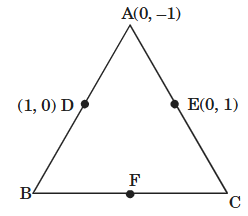
AnswerLet the coordinates of $B$ and $C$ be $\left(x_2, y_2\right)$ and $\left(x_3, y_3\right)$.
Since, $D$ is the mid $-$ point of $A B$. So,
$(1,0)=\left(\frac{x_2+0}{2}, \frac{y_2-1}{2}\right)$
$a \Rightarrow 1=\frac{x_2+0}{2}$ and $ 0=\frac{y_2-1}{2}$
$\Rightarrow 1=\frac{x_2}{2} $ and $ 0=\frac{y_2-1}{2}$
$\Rightarrow x_2=2 $ and $y_2=1$
Thus, the coordinates of $B$ are $(2,1)$.
Similarly, $E$ is the mid $-$ point of $A C$. So,
$(0,1)=\left(\frac{x_3+0}{2}, \frac{y_3-1}{2}\right)$
$\Rightarrow 0=\frac{x_3+0}{2}$ and $1=\frac{y_3-1}{2}$
$\Rightarrow 0=\frac{x_3}{2}$ and $1=\frac{y_3-1}{2} $
$\Rightarrow x_3=0$ and $y_3=3$
Thus, the coordinates of $C$ are $(0,3)$.
We know that $F$ is the mid $-$ point of $B C$.
So, its coordinates are
$\left(\frac{2+0}{2}, \frac{1+3}{2}\right)=(1,2)$
Now we know that the area of the triangle is given by $-$
$=\frac{1}{2}\left|x_1\left(y_2-y_3\right)+x_2\left(y_3-y_1\right)+x_3\left(y_1-y_2\right)\right|$
So, area of $\triangle A B C$ is
$=\frac{1}{2}|0(1-3)+2(3+1)+0(-1-1)|$
$=\frac{1}{2} \times 8=4$ square unit
Area of the is $\triangle D E F$
$=\frac{1}{2}|1(1-2)+0(2-0)+1(0-1)|$
$=\frac{1}{2} \times|-2|=\frac{1}{2} \times 2=1$ square unit
Hence, the area of $\triangle A B C$ is $4$ and the area of $\triangle D E F$ is $1$ square unit.
View full question & answer→Question 53 Marks
If the point $P(x, y)$ is equidistant from the points $A ( a + b , a - b )$ and $B ( a - b , a + b )$ Prove that $bx = ay$
AnswerAccording to the question, point $P$ is equidistant from the points $A$ and point $B$.
Hence, $P A=P B$
Using the distance formula, distance
$=\sqrt{\left(x_1-x_2\right)^2+\left(y_1-y_2\right)^2}$
$=\sqrt{(x-(a+b))^2+(y-(b-a))^2}=\sqrt{(x-(a-b))^2+(y-(a+b))^2}$
$=x^2+(a+b)^2-2 x(a+b)+y^2+(b-a)^2-2 y(b-a)$
$=x^2+(a-b)^2-2 x(a-b)+y^2+(a+b)^2-2 y(a+b)$
$=-2 x(a+b)-2 y(b-a)=-2 x(a-b)-2 y(a+b)$
$=-2 x(a+b)+2 x(a-b)=-2 y(a+b)+2 y(b-a)$
$=2 x(-a-b+a-b)=2 y(-a-b+b-a)$
$=x(-2 b)=y(-2 a)$
$=-2 b x=-2 a y$
$b x=a y$
Hence proved.
View full question & answer→Question 63 Marks
Find the area of the triangle $\text{ABC}$ with $(1,-4)$ and mid $-$ points of sides through $A$ being $(2,-1)$ and. $(0,-1)$
Answer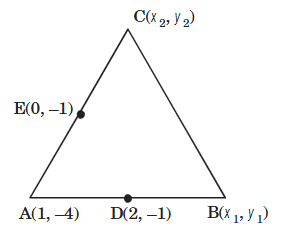
Given coordinates of point and mid $-$ points of sides through $A$ being $(2,-1)$ and $(0,-1)$.
Let co $-$ ordinate of the point $B$ and $C$ be $\left(x_1, y_1\right)$ and $\left(x_2, y_2\right)$ respectively.
Also, let point $D$ and $E$ be the mid points of sides $A B$ and $A C$ respectively.
The mid $-$ point formula is given as:
$(x, y)=\left(\frac{x_1+x_2}{2}, \frac{y_1+y_2}{2}\right)$
Since $D$ is the mid-point of $A B$ we get,
$2=\frac{1+x_1}{2}$ and $-1=\frac{-4+y_1}{2}$
$\Rightarrow 4=1+x_1$ and $-2=-4+y_1$
$\Rightarrow x_1=3$ and $ y_1=2$
The coordinates of point $B$ are $(3,2)$.
Now since $E$ is the mid $-$ point of $A C$ we get,
$0=\frac{1+x_2}{2} $ and $-1=\frac{-4+y_2}{2}$
$\Rightarrow 0=1+x_2$ and $-2=-4+y_2$
$\Rightarrow x_2=-1$ and $ y_2=2$
The coordinates of point $C$ are $(-1,2)$.
Area of the triangle $\text{ABC}$ having vertices $( x_1, y_1 ), \left(x_2, y_2\right)$ and $\left(x_3, y_3\right)$ is given by the formula,
$\text { Area }=\frac{1}{2}\left[x_1\left(y_2-y_3\right)+x_2\left(y_3-y_1\right)+x_3\left(y_1-y_2\right)\right]$
$\Rightarrow$ Area of the $ \Delta ABC=\frac{1}{2}\left[ 1(2-2)+3(2+4) -1(-4-2) \right]$
$=\frac{1}{2}[0+18-1(-6)]$
$=\frac{1}{2}(18+6)=\frac{1}{2} \times 24=12$
Hence, the area of the triangle $\text{ABC}$ is $12 \text{ unit }^2$. View full question & answer→Question 73 Marks
Find the ratio in which the line segment joining the points $A (3,-3)$ and $B (-2,7)$ is divided by $x-$axis. Also find the coordinates of the point of division.
AnswerLet the $x-$axis divide the line segment $A B$ at $K(x, 0)$ in the ratio $m: 1$
Let the coordinates of $A$ be $\left(x_1, y_1\right)$ and that of $B$ be $\left(x_2, y_2\right)$
By section formula coordinates of $K$ are
$\left(\frac{m x_2+x_1}{m+1}, \frac{m y_2+y_1}{m+1}\right) \ldots \ldots(1)$
$(x, 0)=\left(\frac{m x_2+x_1}{m+1}, \frac{m y_2+y_1}{m+1}\right)$
Comparing the $y$ coordinates on both the sides.
$\frac{m y_2+y_1}{m+1}=0$
Substitute the values of $y_1$ and $y_3$
$\frac{m \cdot 7-3}{m+1}=0$
$7 m-3=0$
$m=\frac{3}{7}$
Therefore the $x-$axis divides the line segment $A B$
in the ratio $\frac{3}{7}: 1=3: 7$
Substituting the value of $m$ in $(i),$
Coordinates of $K=\left(\frac{\frac{3}{7} \cdot(-2)+3}{\frac{3}{7}+1}, 0\right)$
Coordinates of $K=\left(\frac{-\frac{6}{7}+3}{\frac{3}{7}+1}, 0\right)$
Coordinates of $K=\left(\frac{\frac{21-6}{7}}{\frac{3+7}{7}}, 0\right)$
Coordinates of $K=\left(\frac{\frac{15}{7}}{\frac{10}{7}}, 0\right)$
Coordinates of $K=\left(\frac{3}{2}, 0\right)$
View full question & answer→Question 83 Marks
If the points $A(-2,1), B(a, b)$ and $C(4,-1)$ are collinear and $a-b=1$, find the values of $a$ and $b$.
AnswerThe given points are $A(-2,1), B(a, b)$ and $C(4,-1)$ Since the given points are collinear, the area of the triangle $A B C$ is zero.
Area of $\triangle A B C=0$
$\Rightarrow \frac{1}{2}\left[x_1\left(y_2-y_3\right)+x_2\left(y_3-y_1\right)+x_3\left(y_1-y_2\right)\right]=0$
Here $x_1=-2, y_1=1, x_2=a, y_2=b$ and $x_2=4$, $y_i=-1$
$\frac{1}{2}[-2(b+1)+a(-1-1)+4(1-b)]=0$
$-2 b-2-2 a+4-4 b=0$
$2 a+6 b=2$
Divide above equation by $2 ,$
$a+3 b=1 \ldots \ldots(1)$
Given:
$a-b=1 \ldots \ldots(2)$
Subtracting equation $(1)$ from $(2)$
$4 b=0$
$b=0$
Subtracting $b=0$ in $(2).$
$\alpha-0=1$
$\alpha=1$
Thus, the values of $\alpha$ and $b$ are $1$ and $0$ respectively.
View full question & answer→Question 93 Marks
If the point $P (k-1,2)$ is equidistant from the points $A (3, k)$ and $B (k, 5)$, find the values of $k$.
AnswerDistance between two points
$=\sqrt{\left(x_2-x_1\right)^2+\left(y_2-y_1\right)^2}$
Distance between $A(3, k)$ and $P(k-1,2)$
$=\sqrt{(k-1-3)^2+(2-k)^2}$
$A P=\sqrt{(k-4)^2+(2-k)^2}$
Apply the identity $(A-B)^2=A^2-2 A B+B^3$
$A P=\sqrt{k^2-8 k+16+4-4 k+k^2}$
$A P=\sqrt{2 k^2-12 k+20}$
Distance between $B(k, 5)$ and $P(k-1,2)$
$=\sqrt{(k-1-k)^2+(2-5)^2}$
$B P =\sqrt{(-1)^2+(-3)^2}$
$B P =\sqrt{1+9}$
$B P =\sqrt{10}$
Since $P$ is equidistant from $A$ and $B, A P=B P$
$\sqrt{2 k^2-12 k+20}=\sqrt{10}$
Squaring both sides, we get
$2 k^2-12 k+20=10$
Write the equation in the form $a x^2+b x+c=0$
$2 k^2-12 k+10=0$
$k^2-6 k+5=0$
Split the middle term
$k^2-5 k-k+5=0$
$k(k-5)-1(k-5)=0$
$(k-5)(k-1)=0$
Set each factor to zero
$k=5 \text { or } k=1$
The values of $k$ are $1,5$.
View full question & answer→Question 103 Marks
If the point $A (0,2)$ is equidistant from the points $B(3, p)$ and $C(p, 5)$, find $p$. Also find the length of $AB .$
AnswerThe given points are $A(0,2), B(3, p)$ and $C(p, 5)$. It is given that $A$ is equidistant from $B$ and $C$.
$\therefore A B=A C$
Squaring both the sides
$A B^2=A C^2$
$(3-0)^2+(p-2)^2=(p-0)^2+(5-2)^2$
$9+p^2+4-4 p=p^2+9$
$4-4 p=0$
$4 p=4$
$p=1$
Thus, the value of $p$ is $1 .$
Length of $A B=\sqrt{(3-0)^2+( p -2)^2}$
Substituting the value of $p$.
$=\sqrt{(3-0)^2+(1-2)^2}=\sqrt{9+1}$
$=\sqrt{10} \text { units }$
View full question & answer→Question 113 Marks
Find the coordinates of a point $P$, which lies on the line segment joining the points $A (-2,-2)$ and $B (2,-4)$ such that $AP =\frac{3}{7} AB$
AnswerLet the coordinates of point $P$ be $(x, y)$ Now, it is given that,
$A P=\frac{3}{7} A B$
$\Rightarrow AP=\frac{3}{7}(AP+PB)$
$\Rightarrow 7 AP=3(AP+PB)$
$\Rightarrow 7 AP-3 AP=3 PB$
$\Rightarrow 4 AP=3 PB$
$\Rightarrow \frac{AP}{PB}=\frac{3}{4}$
$\therefore$ The point $P$ divides the line segment $A B$ in the ratio $3:4.$
Therefore, using section formula,

$P=\left(\frac{m x_2+n x_1}{m+n}, \frac{m y_2+n y_1}{m+n}\right)$
$(x, y)=\left(\frac{3(2)+4(-2)}{3+4}, \frac{3(-4)+4(-2)}{3+4}\right)$
Comparing $x$ and $y$ coordinates on both the sides.
$\Rightarrow x=\frac{3 \times 2+4 \times(-2)}{7}$
$\Rightarrow x=\frac{6-8}{7}$
$\Rightarrow x=\frac{-2}{7}$
And,
$\Rightarrow y=\frac{3 \times(-4)+4 \times(-2)}{7}$
$\Rightarrow y=\frac{-12-8}{7}$
$\Rightarrow y=\frac{-20}{7}$
Therefore, the coordinates of $P(x, y)=\left(\frac{-2}{7}, \frac{-20}{7}\right)$ View full question & answer→Question 123 Marks
Prove that the points $(7,10),(-2,5)$ and $(3,-4)$ are the vertices of an isosceles right triangle.
AnswerLet the points be $A(7,10), B(-2,5)$ and $C(3,-4)$ Using distance formula,
$AB=\sqrt{(7+2)^2+(10-5)^2}=\sqrt{81+25}=\sqrt{106}$
$BC=\sqrt{(-2-3)^2+(5+4)^2}=\sqrt{25+81}=\sqrt{106}$
$CA=\sqrt{(7-3)^2+(10+4)^2}=\sqrt{16+196}=\sqrt{212}$
Here, $A B=B C$
$\Rightarrow \triangle A B C$ is an isosceles triangle.
Also, $A B^2+B C^2$
$=106+106$
$=212$
$=A C^2$
$\therefore \triangle A B C$ is also a right angled triangle.
Hence, The points $(7,10),(-2,5)$ and $(3,-4)$ are the vertices of an isosceles right angled triangle.
View full question & answer→Question 133 Marks
Find the ratio in which the $y-$axis divides the line segment joining the points $(-4,-6)$ and $(10,12)$ Also find the coordinates of the point of division.
AnswerLet us assume a point such that that the line joining the points $(-4,-6)$ and $(10,12)$ in the ratio $k: 1$
Let this point on the $y$ axis be $(0, y)$
Now using the section formula
$P=\left(\frac{m x_2+n x_1}{m+n}, \frac{m y_2+n y_1}{m+n}\right)$
$(0, y)=\left(\frac{10 k-4}{k+1}, \frac{12 k+(-6)}{k+1}\right)$
On comparing the $x$ coordinate of both the sides.
$\Rightarrow \frac{10 k+(-4)}{k+1}=0$
$\Rightarrow 10 k-4=0$
$\Rightarrow k=\frac{4}{10}=\frac{2}{5}$
and, $y=\frac{12 k-6}{k+1}$
Substituting the value of $k$,
$y=\frac{12 \times \frac{2}{5}-6}{\frac{2}{5}+1}$
$\Rightarrow y=-\frac{6}{7}$
Hence, the $y$ axis is dividing the line in the ratio
$2: 5$ at point $\left(0,-\frac{6}{7}\right)$
View full question & answer→Question 143 Marks
If the points $A ( x , y ), B (3,6)$ and $C (-3,4)$ are collinear, show that $x -3 y +15=0$.
AnswerIf the points $A(x, y), B(3,6)$ and $C(-3,4)$ are collinear, then they all are points lying on a straight line.
Hence, the area of the triangle formed with these three points $A, B$ and $C$ will be zero.
For $\triangle A B C$,
$\left(x_1, y_1\right) \equiv(x, y),\left(x_2, y_2\right) \equiv(3,6)$ and $\left(x_3, y_3\right) \equiv(-3,4)$
Substituting the values, we have
Area of $ \triangle ABC=\frac{1}{2}\left[ x_1\left(y_2-y_3\right)+x_2\left(y_3-y_1\right)+x_3\left(y_1-y_2\right) \right]=0$
$\frac{1}{2}[x(6-4)+3(4-y)-3(y-6)]=0$
$\frac{1}{2}[6 x-4 x+12-3 y-3 y+18]=0$
$\frac{1}{2} \times 2[x-3 y+15]=0$
$x-3 y+15=10$
Hence, proved.
View full question & answer→Question 153 Marks
Find the area of the quadrilateral $\text{ABCD}$ whose vertices are $A (-3,-1), B (-2,-4), C (4,-1)$ and $D (3,4)$.
Answer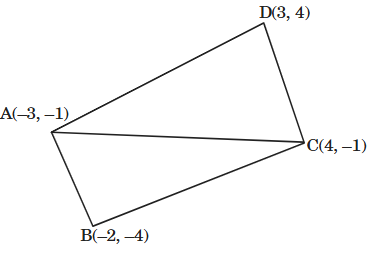
The vertices of quadrilateral are $A(-3,-1)$, $B(-2,-4), C(4,-1)$ and $D(3,4)$.
Let us join $A C$ to split the quadrilateral $\text{ABCD}$ into two triangles $\text{ABC}$ and $\text{ADC}$.
Therefore,
Area of quadrilateral $\text{ABCD}=$ Area of $\triangle A B C+$ Area of $\triangle A D C$.
Area of a triangle is given by
Area of $\Delta=\frac{1}{2}\left[\begin{array}{l}x_1\left(y_2-y_3\right)+x_2\left(y_3-y_1\right)+ \\ x_3\left(y_1-y_2\right)\end{array}\right]$
For $\triangle A B C,\left(x_1, y_1\right)=(-3,-1),\left(x_2, y_2\right)=(-2,-4)$ and $\left(x_3, y_3\right)=(4,-1)$
Substituting the values, we have
$ \text { Area of } \Delta ABC=\frac{1}{2}\left[\begin{array}{l} \left.x_1\left(y_2-y_3\right)+x_2\left(y_3-y_1\right)+\right] \\ x_3\left(y_1-y_2\right)\end{array}\right]$
$=\frac{1}{2}[-3(-4+1)-2(-1+1)+4(-1+4)]$
$=\frac{1}{2}[9-0+12]=\frac{1}{2} \times 21$
$=\frac{21}{2}$
Similarly, For $\triangle A D C,\left(x_1, y_1\right) \equiv(-3,-1),\left(x_2, y_2\right) \equiv(3,4)$ and $\left(x_3, y_3\right)=(4,-1)$
Substituting the values, we have
$\text { Area of } \triangle ADC=\frac{1}{2}\left[\begin{array}{l} x_1\left(y_2-y_3\right)+x_2\left(y_3-y_1\right)+ \\
x_3\left(y_1-y_2\right) \end{array}\right] $
$=\frac{1}{2}[-3(4+1)+3(-1+1)+4(-1-4)]$
$=\frac{1}{2}[-3(4+1)+3(-1+1)+4(-1-4)]$
$=\frac{1}{2} \times-35=-\frac{35}{2}$
However, area can't be negative,
Area of $\triangle ADC =\frac{1}{2}|-35|=\frac{1}{2} \times 35=\frac{35}{2}$
Therefore, Area of quadrilateral $\text{ABCD}=$ Area of $\triangle A B C+$ Area of $\triangle A D C$.
$=\frac{21}{2}+\frac{35}{2}=\frac{56}{2}=28$ square units
Therefore, Area of quadrilateral $\text{ABCD}$ is $28$ sq. units. View full question & answer→Question 163 Marks
If two vertices of an equilateral triangle are $(3,0)$ and $( 6,0 ),$ find the third vertex.
AnswerLet the equilateral triangle be $A B C$ and its vertices be $A(3,0), B(6,0)$ and $C(x, y)$
Now as we know that length of each sides of an equilateral triangle are same,
$A B=B C=A C$
$\Rightarrow AB^2=BC^2=AC^2$
Now let's take, $A B^2=B C^2$
$\Rightarrow(6-3)^2+(0-0)^2=(x-6)^2+(y-0)^2$
$\Rightarrow(3)^2=36+x^2-12 x+y^2$
$\Rightarrow\left(x^2-12 x+y^2+27\right)=0$
Now, $A B^2=A C^2$
$\Rightarrow(6-3)^2+(0-0)^2=(x-3)^2+(y-0)^2$
$\Rightarrow(3)^2=9+x^2-6 x+y^2$
$\Rightarrow x^2-6 x+y^2=0$
Subtract equation $(2)$ from equation $(1),$
$\Rightarrow\left(x^2-12 x+y^2+27\right)-\left(x^2-6 x+y^2\right)=0$
$\Rightarrow-6 x+27=0$
$\Rightarrow-6 x=-27$
$\Rightarrow x=\frac{9}{2}$
Substituting this value in equation $(2)$
$\Rightarrow\left(\frac{9}{2}\right)^2-6 \times\left(\frac{9}{2}\right)+y^2=0$
$\Rightarrow \frac{81}{4}-27+y^2=0$
$\Rightarrow y^2=\frac{108-81}{4}$
$\Rightarrow y^2=\frac{27}{4}$
$\Rightarrow y= \pm \frac{3 \sqrt{3}}{2}$
Hence the third vertex could be
$C\left(\frac{9}{2}, \frac{3 \sqrt{3}}{2}\right)$
$\text { or } C\left(\frac{9}{2},-\frac{3 \sqrt{3}}{2}\right)$
View full question & answer→Question 173 Marks
Find the value of $k$, if the points $P(5,4), Q(7, k)$ and $R(9,-2)$ are collinear.
AnswerSince the points $P(5,4), Q(7, k)$ and $R(9,-2)$ are collinear.
Then area of $\triangle PQR=0$
Area of the triangle with coordinates $\left(x_1, y_1\right)$, $\left(x_2, y_2\right),\left(x_3, y_3\right)$ is given by$-$
$\frac{1}{2}\left|x_1\left(y_2-y_3\right)+x_2\left(y_3-y_1\right)+x_3\left(y_1-y_2\right)\right|=0$
$\Rightarrow \frac{1}{2}|5(k-(-2))+7(-2-4)+9(4-k)|=0$
$\Rightarrow \frac{1}{2}|5(k+2)-42+9(4-k)|=0$
$\Rightarrow|5 k+10-42+36-9 k|=0$
$\Rightarrow|4 k+4|=0 $
$\Rightarrow-4 k+4=0 $
$\Rightarrow-4 k=-4$
$\Rightarrow k=1$
Hence the value of $k=1$.
View full question & answer→Question 183 Marks
If $(3,3),(6, y),(x, 7)$ and $(5,6)$ are the vertices of a parallelogram taken in order, find the values of $x$ and $y$
Answer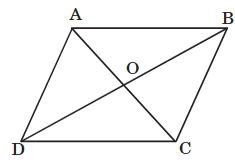
Let $A, B, C$ and $D$ be the vertices of the parallelogram.
Therefore, the coordinates of the vertices are $A(3,3), B(6, y), C(x, 7)$ and $D(5,6)$.
We know that the diagonals of a parallelogram bisect each other.
Therefore, the coordinates of the midpoint of $A C$ are the same as the coordinates of the midpoint of $B D$,
i.e. $\left(\frac{3+x}{2}, \frac{3+7}{2}\right)=\left(\frac{6+5}{2}, \frac{y+6}{2}\right)$
$\Rightarrow\left(\frac{3+x}{2}, \frac{10}{2}\right)=\left(\frac{11}{2}, \frac{y+6}{2}\right)$
Comparing the $x$ and $y$ coordinates on both the sides.
$\frac{3+x}{2}=\frac{11}{2}$ and $\frac{10}{2}=\frac{y+6}{2}$
$\Rightarrow 3+x=11$ and $y+6=10$
$\Rightarrow x=8$ and $y=4$
Therefore, the values of $x$ and $y$ are $8$ and $4$ respectively. View full question & answer→Question 193 Marks
Find the ratio in which the line segment joining the points $A (6,3)$ and $B (-2,-5)$ is divided by x -axis.
AnswerLet the line joining points $A(6,3)$ and $B (-2,-5)$ be divided by point $P ( x , 0)$ in the ratio $k : 1$.
$
\begin{aligned}
y & =\frac{ky_2+y_1}{k+1} \\
0 & =\frac{k \times(-5)+3}{k+1} \\
0 & =-5 k+3 \\
k & =\frac{3}{5}
\end{aligned}
$
Thus, the required ratio is $3: 5$
View full question & answer→Question 203 Marks
Find the area of triangle $\text{ABC}$ with $A (1,-4)$ and the mid$-$points of sides through $A$ being $(2,-1)$ and $(0,-1)$.
AnswerLet the co$-$ordinates of points $B$ and $C$ of the $\triangle \text{ABC}$ be $\left(a_1, b_1\right)$ and $\left(a_2, b_2\right)$ respectively.
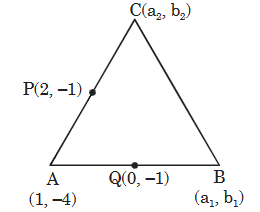
$' Q\ '$ is the midpoint of $A B$.
Using midpoint formula, we have :
$(0,-1) =\left(\frac{a_1+1}{2}, \frac{b_1-4}{2}\right)$
$\Rightarrow \frac{a_1+1}{2} =0$ and $\frac{b_1-4}{2}=-1$
$\Rightarrow a_1=-1$ and $b_1=2$
Therefore, the co$-$ordinates of $B$ are $(-1,2)$
$' P\ '$ is midpoint of $AC$
Now $(2,-1)=\left(\frac{a_2+1}{2}, \frac{b_2-4}{2}\right)$
$\Rightarrow \frac{a_2+1}{2}=2$ and $\frac{b_2-4}{2}=-1$
$\Rightarrow a_2=3$ and $b_2=2$
Therefore the co$-$ordinates of $C$ are $(3,2)$.
Thus the vertices of $\triangle \text{ABC}$ are $A (1,-4), B (-1,2)$ and $C (3,2)$.
Now, Area of $\triangle \text{ABC}$
$=\frac{1}{2}\left[x_1\left(y_2-y_3\right)+x_2\left(y_3-y_1\right)+x_3\left(y_1-y_2\right)\right]$
$=\frac{1}{2}[1(2-2)+(-1)(2+4)+3(-4-2)]$
$=\frac{1}{2}(-6-18)$
$=\frac{1}{2}(-24)=-12 \text { sq. unit }$
Since area can not be negative
Therefore, Area of $\triangle \text{ABC}=12 \text{sq. unit.}$ View full question & answer→Question 213 Marks
If the mid$-$point of the line segment joining the points $A(3,4)$ and $B(k, 6)$ is $P(x, y)$ and $x+y-10=0$, find the value of $k$.
Answer$A(3,4)$
$B(R, 6)$
$P(x, y)$
$P$ is mid point of $A B$
$x+y=10$
$\Rightarrow x=10-y$
$\text { Mid-point formula }=\frac{x_1+x_2}{2}, \frac{y_1+y_2}{2}$
$x=\frac{3+R}{2}, y=\frac{4+6}{2}$
$\Rightarrow 10-y=\frac{3+R}{2}, y=\frac{10}{2}$
$\Rightarrow \text { Putting } y=5$
$\Rightarrow y=5$
$\Rightarrow 10-5=\frac{3+R}{2}$
$\Rightarrow 5 \times 2=3+R$
$\Rightarrow R=10-3$
$\Rightarrow R=7$
View full question & answer→Question 223 Marks
If $A(-2,1), B(a, 0), C(4, b)$ and $D(1,2)$ are the vertices of a parallelogram $\text{ABCD},$ find the values of $a$ and $b$. Hence find the lengths of its sides. $A( x_1, y_1)$
Answer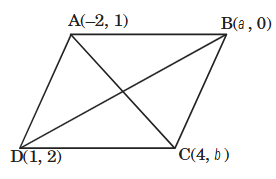
The diagonals of a parallelogram bisect each other.
So coordinates of midpoint of $A C=$ Coordinates of midpoint of $B D$
Coordinates of midpoint of a line segment joining the points $A\left(x_1, y_1\right)$
and $B\left(x_2, y_2\right)=\left(\frac{x_1+x_2}{2}\right),\left(\frac{y_1+y_2}{2}\right)$
Therefore, $\left(\frac{-2+4}{2}, \frac{1+b}{2}\right)=\left(\frac{a+1}{2}, \frac{0+2}{2}\right)$
$\left(\frac{2}{2}, \frac{1+b}{2}\right)=\left(\frac{a+1}{2}, \frac{2}{2}\right)$
$\left(1, \frac{1+b}{2}\right)=\left(\frac{a+1}{2}, 1\right)$
Comparing $x$ and $y$ coordinates of both the sides.
$\Rightarrow \frac{a+1}{2}=1$ and $ \frac{1+b}{2}=1$
$\Rightarrow a+1=2$ and $1+b=2$
$\Rightarrow a=2-1$ and $b=2-1$
$\Rightarrow a =1$ and $b =1$
So the coordinates are $A(-2,1), B(1,0), C(4,1) , D (1,2)$
Length of any side having coordinates ( $x_1, y_1$ ) and $\left(x_2, y_2\right)$ is given by $\sqrt{\left(x_2-x_1\right)^2+\left(y_2-y_1\right)^2}$ So the length of side $A B=\sqrt{(1-(-2))^2+(0-1)^2}$
Length of side $AB =\sqrt{(1+2)^2+(-1)^2}$
Length of side $A B=\sqrt{3^2+1}$
Length of side $A B=\sqrt{9+1}$
Length of side $A B=\sqrt{10}$
Since $\text{ABCD}$ is a parallelogram, opposite sides are equal.
$AB=CD=\sqrt{10}$
Length of side $B C=\sqrt{(4-1)^2+(1-0)^2}$
Length of side $B C=\sqrt{3^2+1^2}$
Length of side $B C=\sqrt{9+1}$
Length of side $B C=\sqrt{10}$ Since $\text{ABCD}$ is a parallelogram, opposite sides are equal.
$BC=AD=\sqrt{10}$
Therefore, the length of the sides of the parallelogram are
$A B=B C=C D=D A=\sqrt{10} \text { units }$ View full question & answer→Question 233 Marks
Krishna has an apple orchard which has a $10 m \times$ 10 m sized kitchen garden attached to it. She divides it into a $10 \times 10$ grid and puts soil and manure into it. She grows a lemon plant at A, a coriander plant at B , an onion plant at C and a tomato plant at D. Her husband Ram praised her kitchen garden and points out that on joining A , B, C, D they may form a parallelogram. Look at the below figure carefully and answer the following questions:
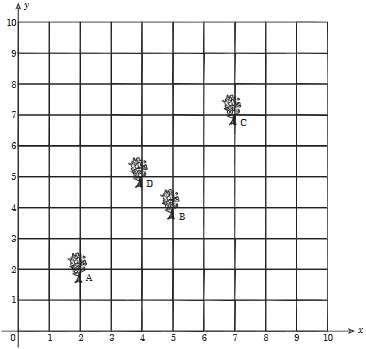
(i) Write the coordinates of the points $A , B , C$ and D , using the $10 \times 10$ grid as coordinate axes.
(ii) Find whether ABCD is a parallelogram or not. Answer(i) A is $(2,2)$
$B$ is $(5,4)$
C is $(7,7)$
D is $(4,5)$
(ii) Distance formula
$
\begin{aligned}
& =\sqrt{\left(x_1-x_2\right)^2+\left(y_1-y_2\right)^2} \\
AB & =\sqrt{(2-5)^2+(2-4)^2} \\
& =\sqrt{(-3)^2+(-2)^2}=\sqrt{9+4} \\
AB & =\sqrt{13} \\
BC & =\sqrt{(5-7)^2+(4-7)^2} \\
& =\sqrt{(-2)^2+(-3)^2}=\sqrt{4+9} \\
BC & =\sqrt{13} \\
CD & =\sqrt{(7-4)^2+(7-5)^2} \\
& =\sqrt{(3)^2+(2)^2}=\sqrt{9+4} \\
CD & =\sqrt{13}
\end{aligned}
$
$
\begin{aligned}
AD & =\sqrt{(2-4)^2+(2-5)^2} \\
& =\sqrt{(-2)^2+(-3)^2} \\
& =\sqrt{4+9} \\
AD & =\sqrt{13}
\end{aligned}
$
We see that $AB = CD$ and $BC = AD$. In a quadrilateral if opposite sides are euqal, then it is a parallelogram.
$\therefore ABCD$ is a parallelogram
View full question & answer→Question 243 Marks
Find the value of $p$ for which the points $(-5,1)$, $(1, p)$ and $( 4,-2 )$ are collinear.
AnswerThree points are collinear if area of triangle $=0$
$\Rightarrow \frac{1}{2}\left[x_1\left(y_2-y_3\right)+x_2\left(y_3-y_1\right)+x_3\left(y_1-y_2\right)\right]=0$
$-5(p+2)+1(-2-1)+4(1-p)=0$
$\Rightarrow-5 p-10-3+4-4 p=0$
$\Rightarrow-9 p-9=0$
$\Rightarrow-9 p=9 $
$\Rightarrow p=-\frac{9}{9}=-1$
View full question & answer→Question 253 Marks
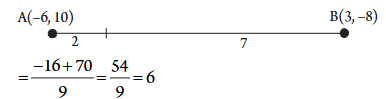
In what ratio does the point $P(-4, y)$ divide the line segment joining the points $A (-6,10)$ and $B (3,-8)$ ? Hence find the value of $y$.
AnswerLet the point $P$ divide the line segment $A B$ into $m : n$ Using section formula

$\therefore-4=\frac{3 \times m+(-6) \times n}{m+n}$
$\Rightarrow-4(m+n)=3 m-6 n$
$\Rightarrow-4 m-4 n=3 m-6 n$
$\Rightarrow-4 m-3 m=-6 n+4 n$
$\Rightarrow-7 m=-2 n$
$\Rightarrow \frac{m}{n}=\frac{2}{7}$
$m: n=2: 7$
Using section formula,
$y=\frac{2 \times-8+7 \times 10}{2+7}$
View full question & answer→