Questions

5 Marks Questions

🎯

Test yourself on this topic

8 questions · timed · auto-graded

Question 15 Marks
If $a \neq b \neq 0$, prove that the points $\left(a, a^2\right),\left(b, b^2\right)$, $(0,0)$ will not be collinear.
Answer
We know that three points are collinear if the area of the triangle formed by them is zero.
The area of triangle can be calculated using the formula
$A=\frac{1}{2}\left|x_1\left(y_2-y_3\right)+x_2\left(y_3-y_1\right)+x_3\left(y_1-y_2\right)\right|$
Here, $x_1=a, y_1=a^2, x_2=b, y_2=b^2, x_3=0, y_3=0$
$A=\frac{1}{2}\left|a\left(b^2-0\right)+b\left(0-a^2\right)+0\left(a^2-b^2\right)\right|$
$A=\frac{1}{2}\left|a b^2-a^2 b\right|$
According to the question $a \neq b \neq 0$
$\therefore A=\frac{1}{2}\left|a b^2-a^2 b\right| \neq 0$
Hence, the points $\left(a, a^2\right),\left(b, b^2\right),(0,0)$ are non collinear.
Hence proved.
View full question & answer
Question 25 Marks
If the points $A(k+1,2 k), B(3 k, 2 k+3)$ and $C(5 k-1,5 k)$ are collinear, then find the value of $k$.
Answer
Given points are collinear so area of triangle formed must be zero.
$\Rightarrow \frac{1}{2}\left|x_1\left(y_2-y_3\right)+x_2\left(y_3-y_1\right)+x_3\left(y_1-y_2\right)\right|=0$
Given;
$\begin{array}{l}\Rightarrow x_1=k+1, y_1=2 k ; \\\Rightarrow x_2=3 k, y_2=2 k+3; \\\Rightarrow x_3=5 k-1, y_3=5 k ; \\\Rightarrow \frac{1}{2}\left|\begin{array}{l}(k+1)\{(2 k+3)-(5 k)\}+(3 k)\{5 k-2 k\} \\+(5 k-1)\{(2 k)-(2 k+3)\}\end{array}\right|=0\end{array}$
$\begin{array}{l}\Rightarrow(k+1)\{-3 k+3\}+(3 k)\{3 k\}+(5 k-1)\{-3\}=0 \\\Rightarrow-3 k^2+3 k-3 k+3+9 k^2-15 k+3=0 \\\Rightarrow 6 k^2-15 k+6=0\end{array}$
Dividing the above equation by 3
$\begin{array}{l}\Rightarrow 2 k^2-5 k+2=0 \\\Rightarrow 2 k^2-4 k-k+2=0 \\\Rightarrow 2 k(k-2)-1(k-2)=0 \\\Rightarrow(k-2)(2 k-1)=0 \\\Rightarrow k-2=0 \text { and } 2 k-1=0 \\\Rightarrow k=2 \text { and } k=\frac{1}{2}\end{array}$
Therefore, the values of $k=\frac{1}{2}$ and $2$
View full question & answer
Question 35 Marks
Answer
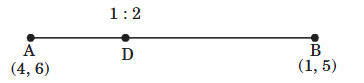
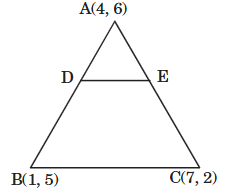
Given $\frac{A D}{A B}=\frac{A E}{A C}=\frac{1}{3}$
$\begin{array}{l}\frac{A D}{A B}=\frac{1}{3} \text { and } \frac{A E}{A C}=\frac{1}{3} \\\frac{AD}{AB}=\frac{1}{3} \\\Rightarrow 3 AD=AD+DB \Rightarrow 3 AD-AD=DB \\\Rightarrow 2 AD=BD \Rightarrow \frac{AD}{BD}=\frac{1}{2}\end{array}$
Thus point $D$ divides line AB in ratio 1:2
Image
Using section formula, Coordinates of $D$
$\left(\frac{m_1 x_2+m_2 x_1}{m_1+m_2}, \frac{m_1 y_2+m_2 y_1}{m_1+m_2}\right)$
Putting values in the given above formula
$\begin{array}{l}m_1=1, m_2=2 \\x_1=4, x_2=1 \\y_1=6, y_2=5\end{array}$
Point $D=\left(\frac{m_1 x_2+m_2 x_1}{m_1+m_2}, \frac{m_1 y_2+m_2 y_1}{m_1+m_2}\right)$
$=\left(\frac{1 \times 1+2 \times 4}{1+2}, \frac{1 \times 5+2 \times 6}{1+2}\right)=\left(\frac{1+8}{3}, \frac{5+12}{3}\right)$
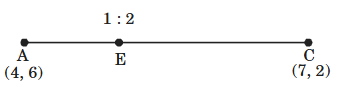
$\begin{array}{l}\text{Point D}=\left(\frac{9}{3}, \frac{17}{3}\right) \\\frac{AE}{AC}=\frac{1}{3} \\\Rightarrow 3 AE=AE+CE \Rightarrow 3 AE-AE=CE \\\Rightarrow 2 AE=CE \Rightarrow \frac{AE}{CE}=\frac{1}{2}\end{array}$
Thus point $E$ divides line $A C$ in ratio $1: 2$
Image
Using section formula, Coordinates of $E$
$\left(\frac{m_1 x_2+m_2 x_1}{m_1+m_2}, \frac{m_1 y_2+m_2 y_1}{m_1+m_2}\right)$
Putting values in the given above formula
$\begin{array}{l}m_1=1, m_2=2 \\x_1=4, x_2=7 \\y_1=6, y_2=2 \\\text { Point } E=\left(\frac{m_1 x_2+m_2 x_1}{m_1+m_2}, \frac{m_1 y_2+m_2 y_1}{m_1+m_2}\right) \\=\left(\frac{1 \times 7+2 \times 4}{1+2}, \frac{1 \times 2+2 \times 6}{1+2}\right)=\left(\frac{7+8}{3}, \frac{2+12}{3}\right) \\=\left(\frac{15}{3}, \frac{14}{3}\right)\end{array}$
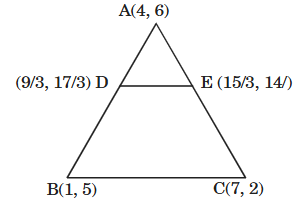
Now, Finding area of $\triangle A B C$ and $\triangle A D E$
Image
Area of $\triangle A B C$
$=\frac{1}{2}\left[x_1\left(y_2-y_3\right)+x_2\left(y_3-y_1\right)+x_3\left(y_1-y_2\right)\right]$
Given,
$\begin{array}{c}x_1=4, x_2=1 \\x_3=7, y_1=6 \\y_2=5, y_3=2\end{array}$
$\begin{array}{l}=\frac{1}{2}\left[x_1\left(y_2-y_3\right)+x_2\left(y_3-y_1\right)+x_3\left(y_1-y_2\right)\right] \\=\frac{1}{2}[4(5-2)+1(2-6)+7(6-5)] \\=\frac{1}{2}[4(3)+1(-4)+7(1)] \\=\frac{1}{2}[12-4+7] \\=\frac{15}{2} \text { sq.units }\end{array}$
Area of $\triangle A D E$
$=\frac{1}{2}\left[x_1\left(y_2-y_3\right)+x_2\left(y_3-y_1\right)+x_3\left(y_1-y_2\right)\right]$
Given,
$\begin{array}{l}x_1=4, x_2=\frac{9}{3} \\x_3=\frac{15}{3}, y_1=6 \\y_2=\frac{17}{3}, y_3=\frac{14}{3} \\=\frac{1}{2}\left[4\left(\frac{17}{3}-\frac{14}{3}\right)+\frac{9}{3}\left(\frac{14}{3}-6\right)+\frac{15}{3}\left(6-\frac{17}{3}\right)\right] \\
=\frac{1}{2}\left[4(1)+3\left(\frac{-4}{3}\right)+5\left(\frac{1}{3}\right)\right] \\=\frac{1}{2} \times \frac{5}{3}=\frac{5}{6} \text { sq units }\end{array}$
Therefore,
$\frac{\operatorname{ar}(\triangle ADE)}{\operatorname{ar}(\triangle ABC)}=\frac{\frac{5}{6}}{\frac{15}{2}}=\frac{5}{6} \times\frac{2}{15}=\frac{1}{9}$
Hence, ratio is $1: 9$.
View full question & answer
Question 45 Marks
Find the values of so that the area of the triangle with vertices $(1,-1),(-4,2 k)$ and $(-k,-5)$ is $24$ square units.
Answer
Area of a triangle with coordinates $\left(x_1, y_1\right)$, $\left(x_2, y_2\right),\left(x_3, y_3\right)$ is given by-
$=\frac{1}{2}\left|x_1\left(y_2-y_3\right)+x_2\left(y_3-y_1\right)+x_3\left(y_1-y_2\right)\right|$
Putting in the coordinates,
$\begin{array}{l}x_1=1, x_2=-4, x_3=-k, y_1=-1, y_2=2 k, y_3=-5 \\\Rightarrow \frac{1}{2}[1(2 k+5)-4(-5+1)-k(-1-2 k)]=24 \\\Rightarrow \frac{1}{2}\left[2 k+5+16+k+2 k^2\right]=24 \\\Rightarrow \frac{1}{2}\left[2 k^2+3 k+21\right]=24 \Rightarrow 2 k^2+3 k+21=48 \\\Rightarrow 2 k^2+3 k-27=0 \\\Rightarrow 2 k^2-6 k+9 k-27=0 \Rightarrow 2 k(k-3)+9(k-3)=0 \\\Rightarrow(k-3)(2 k+9)=0 \Rightarrow k-3=0 \text { and } 2 k+9=0 \\\Rightarrow k=3 \text { and } k=\frac{-9}{2}\end{array}$
View full question & answer
Question 55 Marks
If $A(-4,8), B(-3,-4), C(0,-5)$ and $D(5,6)$ are the vertices of a quadrilateral $A B C D$, find its area.
Answer
In this quadrilateral $A B C D$, we have 2 triangles i.e. $\triangle A B C$ and $\triangle A C D$
Area of a triangle
$\begin{array}{l}=\frac{1}{2}\left\{x_1\left(y_2-y_3\right)+x_2\left(y_3-y_1\right)+x_3\left(y_1-y_2\right)\right\} \\\Rightarrow \text { Area of } \triangle ABC=\frac{1}{2}\left\{\begin{array}{l}-4(-4-(-5))-3(-5-8) +0(8-(-4))\end{array}\right\}\end{array}$
Now,
$\begin{array}{l}\Rightarrow \text { Area of } \triangle ABC=\frac{1}{2}\left\{\begin{array}{l}-4(-4-(-5))-3(-5-8) +0(8-(-4))\end{array}\right\} \\=\frac{1}{2}\{-4(-4+5)-3(-13)+0\} \\=\frac{1}{2}\{-4+39\}=\frac{35}{2}=17.5\end{array}$
Area of $\triangle ABC =17.5$ units $^2$
Now,
$\begin{array}{l}\text { Area of } \triangle ACD=\frac{1}{2}\{-4(-5-6)+0(6-8)+5(8-(-5))\} \\=\frac{1}{2}\{-4(-11)+0+5(8+5)\} \\=\frac{1}{2}\{44+5(13)\}=\frac{1}{2}\{44+65\} \\=\frac{109}{2}=54.5\end{array}$
Area of $\triangle ACD =54.5$ units $^2$
Now area of quadrilateral $A B C D$ will be sum of area of $\triangle A B C$ and $\triangle A C D$.
Therefore Area of quadrilateral $A B C D=17.5+$ $54.5=72$ sq. units
Hence, answer is 72 sq. units.
View full question & answer
Question 65 Marks
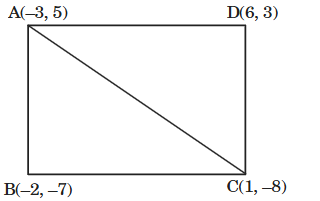
If $A(-3,5), B(-2,-7), C(1,-8)$ and $D(6,3)$ are the vertices of a quadrilateral $A B C D$, find its area.
View full question & answer
Question 75 Marks
Find the ratio in which the point $P(x, 2)$ divides the line segment joining the points $A(12,5)$ and $B(4,-3)$. Also find the value of $x$.
Answer
Let us assume the point $P$ divides the line segment joining the points $A(12,5)$ and $B(4,-3)$ in the ratio $r: 1$
Using section formula $\left(\frac{m x_2+x_1}{m+1}, \frac{m y_2+y_1}{m+1}\right)$
Then the coordinates of $P$ are, $\left(\frac{4 r+12}{r+1}, \frac{-3 r+5}{r+1}\right)$
Given, the coordinates of $P$ are $(x, 2)$
$\begin{array}{l}\therefore(x, 2)=\left(\frac{4 r+12}{r+1}, \frac{-3 r+5}{r+1}\right) \\\therefore \frac{4 r+12}{r+1}=x \text { and } \frac{-3 r+5}{r+1}=2\end{array}$
Now, $\frac{-3 r+5}{r+1}=2$
$\begin{array}{l}\Rightarrow-3 r+5=2(r+1) \\\Rightarrow 5 r=3 \Rightarrow r=\frac{3}{5}\end{array}$
Substitute $r=\frac{3}{5}$ in $\frac{4 r+12}{r+1}=x$, we get
$\begin{array}{l}\Rightarrow x=\frac{4\left(\frac{3}{5}\right)+12}{\frac{3}{5}+1} \\\Rightarrow x=\frac{\frac{12}{5}+12}{\frac{3}{5}+1} \\\Rightarrow x=\frac{\frac{72}{5}}{\frac{8}{5}} \Rightarrow x=\frac{72}{8} \\\Rightarrow x=9\end{array}$
Hence, the value of $x$ is 9 and the point $P(x, 2)$ divides the line segment joining the points $A(12,5)$ and $B(4,-3)$ in the ratio $\frac{3}{5}: 1=3: 5$
View full question & answer
Question 85 Marks
The three vertices of a parallelogram $A B C D$ are $A(3,-4), B(-1,-3)$ and $C(-6,2)$. Find the coordinates of vertex $D$ and find the area of parallelogram $A B C D$.
Answer
The three vertices are $A(3,-4), B(-1,-3)$ and $C(-6,2)$.
Let the coordinates of the vertex $D$ be $(x, y)$.
In a parallelogram, the diagonals bisect each other.
Hence, Mid point of $A C=$ Mid point of $B D$
$\begin{array}{l}\Rightarrow\left(\frac{3+(-6)}{2}, \frac{-4+2}{2}\right)=\left(\frac{-1+x_2}{2}, \frac{-3+y_2}{2}\right) \\\Rightarrow\left(\frac{-3}{2}, \frac{-2}{2}\right)=\left(\frac{-1+x_2}{2}, \frac{-3+y_2}{2}\right) \\\Rightarrow-3=-1+x_2,-2=-3+y_2 \\\Rightarrow x=-2, y=1 .\end{array}$
Hence, the coordinates of the fourth vertex $D$ is $(-2,1)$.
Now, for the area of $A B C D=$ area of triangle $A B C$ + area of triangle $A C D$
$=2 \times$ area of triangle $A B C$
The area of a triangle with vertices $\left(x_1, y_1\right),\left(x_2, y_2\right)$ and $\left(x_3, y_3\right)$ is
$\frac{1}{2}\left[x_1\left(y_2-y_3\right)+x_2\left(y_3-y_1\right)+x_3\left(y_1-y_2\right)\right]$
Now substituting the values,
$\begin{array}{l}\text {Area} =\frac{1}{2}|[3(-3-2)+(-1)(2-(-4))+(-6)(-4-(-3))]| \\=\frac{1}{2}|[-15-6+6]| \\=\frac{|-15|}{2} \text { square units }\end{array}$
Hence area of parallelogram $2 \times \frac{15}{2}=15$ square units.
View full question & answer
5 Marks Questions - Maths STD 10 Questions - Vidyadip