Questions

3 Marks Question

Take a timed test

7 questions · self-marked practice — reveal the answer and mark yourself.

Question 13 Marks
Find the point on the x-axis which is equidistant from $(2, -5)$ and $(-2, 9).$
Answer
We know that a point on the x-axis is of the form $(x, 0)$. So, let the point $P(x, 0)$ be equidistant from $A(2, –5)$ and $B(–2, 9)$. Then
$PA = PB$
$\Rightarrow PA^2 = PB^{2}$
$\Rightarrow (2 - x)^2 + (-5 - 0)^2= (-2 - x)^2 + (9 - 0)^2$
$\Rightarrow 4 + x^2 - 4x + 25 = 4 + x^2 + 4x + 81$
$\Rightarrow - 4x + 25 = 4x + 81$
$\Rightarrow 8x = -56$
$\Rightarrow \;x = \frac{{ - 56}}{8} = - 7$
Hence, the required point is (-7, 0)
Check:
$PA = \sqrt {{{\{ 2 - ( - 7)\} }^2} + {{( - 5 - 0)}^2}}$
$= \sqrt {81 + 25} = \sqrt {106}$
$PB = \sqrt {{{\{ - 2 - ( - 7)\} }^2} + {{(9 - 0)}^2}}$
$= \sqrt {25 - 81} = \sqrt {106}$
$\because$
$PA = PB$
$\therefore$ Our solution is checked.

View full question & answer
Question 23 Marks
Name the type of quadrilateral formed, if any, by the points (4, 5), (7, 6), (4, 3), (1, 2), and give a reason for your answer.
Answer
(4, 5), (7, 6), (4, 3), (1, 2)
Let A $\rightarrow$ (4, 5), B $\rightarrow$ (7, 6), C $\rightarrow$ (4, 3) and D $\rightarrow$ (1, 2)
Then, $AB = \sqrt {{{(7 - 4)}^2} + {{(6 - 5)}^2}}$
$= \sqrt {{{(3)}^2} + {{(1)}^2}} = \sqrt {9 + 1} = \sqrt {10}$
$BC = \sqrt {{{(4 - 7)}^2} + {{(3 - 6)}^2}}$
$\sqrt {{{( - 3)}^2} + {{( - 3)}^2}} = \sqrt {9 + 9} = \sqrt {18} = 3\sqrt 2$
$CD = \sqrt {{{(1 - 4)}^2} + {{(2 - 3)}^2}}$
$= \sqrt {{{( - 3)}^2} + {{( - 1)}^2}} = \sqrt {9 + 1} = \sqrt {10}$
$DA = \sqrt {{{(4 - 1)}^2} + {{(5 - 2)}^2}}$
$= \sqrt {9 + 9} = \sqrt {18} = 3\sqrt 2$
$AC = \sqrt {{{(4 - 4)}^2} + {{(3 - 5)}^2}} = 2$
$BD = \sqrt {{{(1 - 7)}^2} + {{(2 - 6)}^2}}$
$= \sqrt {36 + 16} = \sqrt {52}$
We see that
AB = CD, opposite sides are equal
BC = DA
and AC $\ne$ BD ..... Diagonals are unequal
Hence, the quadrilateral ABCD is a parallelogram.
View full question & answer
Question 33 Marks
Name the type of quadrilateral formed, if any, by the points $(-3, 5), (3, 1), (0, 3), (-1, -4)$, and give a reason for your answer.
Answer


The points of trisection means that the points which divide the line into three equal parts. From the figure, it is clear that C, and D are these two points. Let $C (x_1, y_1)$ and $D (x_2, y_2)$ are the points of trisection of the line segment joining the given points i.e., $BC = CD = DA$
Let $BC = CD = DA = k$, Point C divides $BC$ and $CA$ as: $BC = kCA = CD + DA = k + k = 2k$
Hence the ratio between BC and CA is: $\frac{B C}{C A}=\frac{k}{2 k}=\frac{1}{2}$
Therefore, point C divides BA internally in the ratio 1:2 then by section formula we have that if a point P(x, y) divides two points $P (x_1, y_1)$ and $Q (x_2, y_2)$ in the ratio m:n then, the point $(x, y)$ is given by $(\mathrm{x}, \mathrm{y})=\left(\frac{\mathrm{mx}_{2}+\mathrm{nx}_{1}}{\mathrm{m}+\mathrm{n}}, \frac{\mathrm{my}_{2}+\mathrm{ny}_{1}}{\mathrm{m}+\mathrm{n}}\right)$
Therefore C(x, y) divides B(–2, –3) and A(4,–1) in the ratio 1:2, then
$C(x, y)=\left(\frac{(1 \times 4)+(2 \times-2)}{1+2}, \frac{(1 \times-1)+(2 \times-3)}{1+2}\right)$
$C(x, y)=\left(\frac{4-4}{1+2}, \frac{-1-6}{1+2}\right)$
$C(x, y)=\left(0, \frac{-7}{3}\right)$
Point D divides the BD and $DA$ as:$DA = kBD = BC + CD = k + k = 2k$
Hence the ratio between BD and DA is: $\frac{B D}{D A}=\frac{2 k}{k}=\frac{2}{1}$
The point D divides the line BA in the ratio 2:1
So now applying section formula again we get,
$D(x, y)=\left(\frac{(2 \times 4)+(1 \times-2)}{2+1}, \frac{(2 \times-1)+(1 \times-3)}{2+1}\right)$
$D(x, y)=\left(\frac{8-2}{3}, \frac{-2-3}{3}\right)$
$D(x, y)=\left(\frac{6}{3}, \frac{-5}{3}\right)$
$D(x, y)=\left(2, \frac{-5}{3}\right)$
View full question & answer
Question 43 Marks
Name the type of quadrilateral formed, if any, by the points (-1, -2), (1, 0), (-1, 2), (-3, 0), and give a reason for your answer.
Answer
(-1, -2), (1, 0), (-1, 2), (-3, 0)
Let A $\rightarrow$ (-1, -2), B $\rightarrow$ (1, 0)
C $\rightarrow$ (-1, 2) and D $\rightarrow$ (-3, 0)
Then,
$AB = \sqrt {[1 - {{( - 1)}]^2} + {{[0 - ( - 2)]}^2}}$
$= \sqrt {{{(2)}^2} + {{(2)}^2}} = \sqrt {4 + 4} = \sqrt 8 = 2\sqrt 2$
$BC = \sqrt {{{( - 1 - 1)}^2} + {{(2 - 0)}^2}}$
$ = \sqrt {{{( - 2)}^2} + {{(2)}^2}} = \sqrt {4 + 4} = \sqrt 8 = 2\sqrt 2$
$CD = \sqrt {[ (- 3) - {{( - 1)}]^2} + {{(0 - 2)}^2}}$
$= \sqrt {{{( - 2)}^2} + {{( - 2)}^2}} = \sqrt {4 + 4} = \sqrt 8 = 2\sqrt 2$
$DA = \sqrt {{{[( - 1) - ( - 3)]}^2} + {{( - 2 - 0)}^2}}$
$= \sqrt {{{( 2)}^2} + {{( - 2)}^2}} = \sqrt {4 + 4} = \sqrt 8 = 2\sqrt 2$
$AC = \sqrt {[( - 1) - {{( - 1)}]^2} + {{[( 2) - ( - 2)]}^2}} = 4$
$BD = \sqrt {[( - 3) - {{( 1)}]^2} + {{(0 - 0)}^2}} = 4$
Since AB = BC = CD = DA (i.e., all the four sides of the quadrilateral ABCD are equal) and AC = BD (i.e. diagonals of the quadrilateral ABCD are equal). Therefore, ABCD is a square.
View full question & answer
Question 53 Marks
Show that the points A (1, 7), B (4, 2), C (-1, -1) and D (-4, 4) are the vertices of a square.
Answer
Let A(1, 7), B(4, 2), C(-1, -1) and D(-4, 4) be the given points. One way of showing that ABCD is a square is to use the property that all its sides should be equal both its diagonals should also be equal. Now,
$A B = \sqrt { ( 1 - 4 ) ^ { 2 } + ( 7 - 2 ) ^ { 2 } } = \sqrt { 9 + 25 } = \sqrt { 34 }$
$B C = \sqrt { ( 4 + 1 ) ^ { 2 } + ( 2 + 1 ) ^ { 2 } } = \sqrt { 25 + 9 } = \sqrt { 34 }$
$C D = \sqrt { ( - 1 + 4 ) ^ { 2 } + ( - 1 - 4 ) ^ { 2 } } = \sqrt { 9 + 25 } = \sqrt { 34 }$
$D A = \sqrt { ( 1 + 4 ) ^ { 2 } + ( 7 - 4 ) ^ { 2 } } = \sqrt { 25 + 9 } = \sqrt { 34 }$
$A C = \sqrt { ( 1 + 1 ) ^ { 2 } + ( 7 + 1 ) ^ { 2 } } = \sqrt { 4 + 64 } = \sqrt { 68 }$
$B D = \sqrt { ( 4 + 4 ) ^ { 2 } + ( 2 - 4 ) ^ { 2 } } = \sqrt { 64 + 4 } = \sqrt { 68 }$
Since, AB = BC = CD = DA and AC = BD, all the four sides of the quadrilateral ABCD are equal and its diagonals AC and BD are also equal. Therefore, ABCD is a square.
View full question & answer
Question 63 Marks
Do the points $(3, 2), (–2, –3)$ and $(2, 3)$ form a triangle? If so, name the type of triangle formed.
Answer
Let us apply the distance formula to find the distances PQ, QR and PR, where
P$\leftrightarrow$(3, 2),
Q$\leftrightarrow$(–2, –3) and
R$\leftrightarrow$(2, 3)
are the given points. We have
$\mathrm{PQ}=\sqrt{(3+2)^{2}+(2+3)^{2}}=\sqrt{5^{2}+5^{2}}=\sqrt{50}=7.07(\text { approx. })$
$\mathrm{QR}=\sqrt{(-2-2)^{2}+(-3-3)^{2}}=\sqrt{(-4)^{2}+(-6)^{2}}=\sqrt{52}=7.21(\text { approx. })$
$\mathrm{PR}=\sqrt{(3-2)^{2}+(2-3)^{2}}=\sqrt{1^{2}+(-1)^{2}}=\sqrt{2}=1.41(\text { approx. })$
Since the sum of any two of these distances is greater than the third distance, therefore, the points $P, Q$ and R form a triangle.
Also, $PQ^2 + PR^2 = QR^2 $, by the converse of Pythagoras theorem, we have $\angle P = 90^\circ$ Therefore, PQR is a right triangle.
View full question & answer
Question 73 Marks
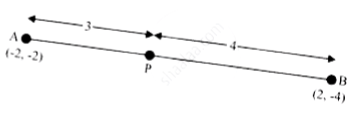
If $A$ and $B$ are $(-2,-2)$ and $(2,-4)$ respectively, find the coordinate of $P$ such that $A P=\frac{3}{7} A B$ and $P$ lies on the line segment $A B$.
Answer

Image
The coordinates of point A and B are $(-2,-2)$ and $(2$, $-4)$ respectively.Since $A P=\frac{3}{7} A B$
Therefore, AP : PB = 3 : 4
Point P divides the line segment AB in the ratio 3 : 4.
Coordinates of $P =$
$\begin{array}{l}\left(\frac{3 \times 2+4 \times(-2)}{3+4}, \frac{3 \times(-4)+4 \times(-2)}{3+4}\right) \\
=\left(\frac{6-8}{7}, \frac{-12-8}{7}\right) \\
=\left(-\frac{2}{7},-\frac{20}{7}\right)\end{array}$
View full question & answer