MCQ 11 Mark
The disrtance of point P(2, 3) from the X-axis is:
AnswerWe know that, if (x, y) is any point on the cartesian piane in first quadrant.
Then, x = Perpendicular distance from Y-axis
and y = Perpendicular distance from X-axis
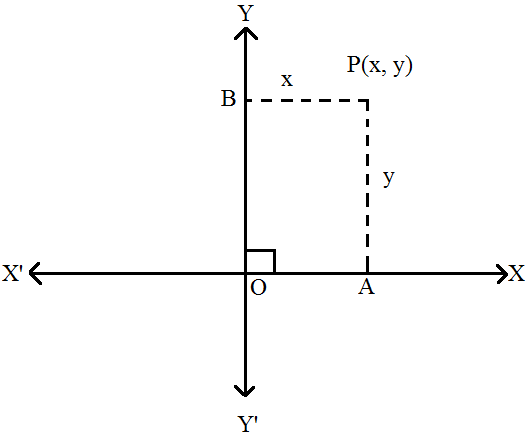
Distance of the point P(2, 3) from the X-axis = Ordinate of a point P(2, 3) = 3.
View full question & answer→MCQ 21 Mark
$\text{AOBC}$ is a rectangle whose three vertices are vertices $A(0, 3), O(0, 0)$ and $B(5, 0)$. The length of its diagonal is:
AnswerCorrect option: C. $\sqrt{34}$
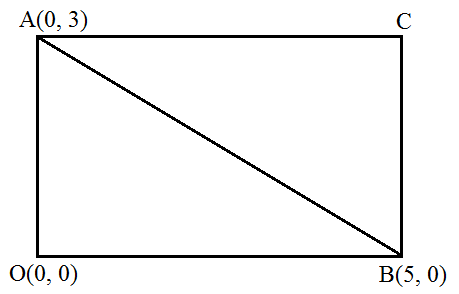
Now, length of the diagonal $A B=$ Distance between the points $A(0,3)$ and $B(5,0)$
Distance between the point $\left( x _1, y _1\right)$ and $\left( x _2, y _2\right)$
$d=\sqrt{\left(x_2-x_1\right)^2+\left(y_2-y_1\right)^2}$
Here, $x _1=0, y _1=3$ and $x _2=5, y _2=0$
Distance between the points $A(0,3)$ and $B(5,0)$
$AB=\sqrt{(5-0)^2+(0-3)^2}$
$AB=\sqrt{25+9}$
$AB=\sqrt{34}$
Hence, the required length of its diagonal is $\sqrt{34}$. View full question & answer→MCQ 31 Mark
If the points $A(1, 2), O(0, 0)$ and $C(a, b)$ are collinear, then:
- A
$a = b$
- B
$a = 2b$
- ✓
$2a = b$
- D
$a = -b$
AnswerCorrect option: C. $2a = b$
Let the given points are $A=\left(x_1, y_1\right)=(1,2), B=\left(x_2, y_2\right)=(0,0)$ and $C=\left(x_3, y_3\right)=(a, b)$.
$\because\text{Area of } \triangle\text{ABC }\triangle=\frac{1}{2}[\text{x}_1(\text{y}_2-\text{y}_3)+\text{x}_2(\text{y}_3-\text{y}_1)+\text{x}_3(\text{y}_1-\text{y}_2)]$
$\therefore\triangle=\frac{1}{2}[1(0 - \text{b})+0(\text{b}-2)+\text{a}(2 -0)]$
$\triangle=\frac{1}{2}(\text{-b} + 0 +2\text{a})$
$\triangle=\frac{1}{2}(2\text{a}-\text{b})$
Since, the points $A(1, 2), B(0, 0)$ and $C(a, b)$ are collinear, then area of $\triangle\text{ABC}$ should be equal to zero.
$\text{i.e.,}\text{ area of }\triangle\text{ ABC}=0$
$\Rightarrow\frac{1}{2}(2\text{a} - \text{b})=0 $
$\Rightarrow2\text{a}-\text{b}=0$
$\Rightarrow2\text{a}=\text{b}$
Hence, the required relation is $2a = b.$
View full question & answer→MCQ 41 Mark
If $\text{P}\Big(\frac{1}{2}, 4\Big)$ is the mid$-$point of the line segment joining the points $Q(-6, 5)$ and $ R(-2, 3)$, then the value of a is:
AnswerGiven that, $\text{P}\Big(\frac{1}{2}, 4\Big)$ is the mid$-$point of the line segment the point $Q(-6, 5)$ and $R(-2, 3)$, which shows in the figure given below:
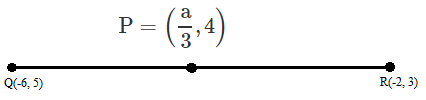
$\therefore\text{Mid-point of QR} = \text{P}\Big(\frac{-6-2}{2},\frac{5+3}{2}\Big) $
$\text{QR}=\text{P}(-4, 4)$
$\left[\right.$ Since, mid$-$point of line segment having points $\left(x_1, y_1\right)$ and $\left.\left(x_2, y_2\right)=\left(\frac{x_1+x_2}{2}, \frac{y_1+y_2}{2}\right)\right]$
But mid$-$point $\text{P}\Big(\frac{\text{a}}{3},4\Big)$ is given
$\therefore\Big(\frac{\text{a}}{3},4\Big)=(-4, 4)$
On comparing the coordinates, we get
$\frac{\text{a}}{3}=-4$
$\therefore\text{a}=-12$
Hence, the required value of a is $-12.$
View full question & answer→MCQ 51 Mark
A line intersects the y-axis and X-axis at the points P and Q, respectively. If (2, – 5) is the mid-point of PQ, then the coordinates of P and Q are, respectively:
AnswerLet the coordinates of P and 0 (0, y) and (x, 0), respectively.So, the mid-point of P(0, y) and Q(x, 0) is $\text{M}=\Big(\frac{0 + \text{x}}{2},\frac{\text{y + 0}}{2}\Big)$
$\Big[\because$ mid-point of a line segment having $=\Big(\frac{\text{x}_1+\text{x}_2}{2},\frac{\text{y}_1+\text{y}_2}{2}\Big)\Big]$
But it is given that, mid-point of PQ is (-2, -5)
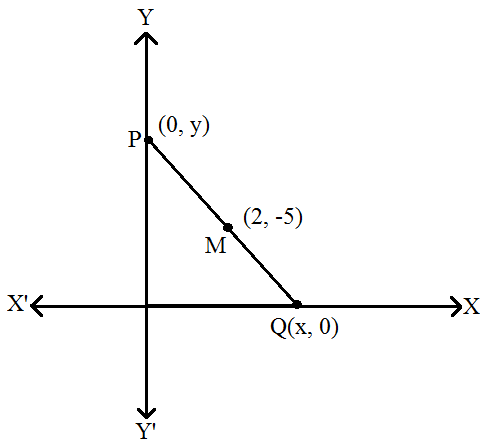
$\therefore2=\frac{\text{x+0}}{2}$
and $-5=\frac{\text{y}+0}{2}$
$\Rightarrow4=\text{x}\text{ and }-10= \text{y}$
$\Rightarrow\text{x}=4\text{ and } \text{y}=-10$
So, the coordinates of P and Q are (0, 10) and (4, 0). View full question & answer→MCQ 61 Mark
The ares of a triangle with vertices $A(3, 0)$ and $B(7, 0)$ and $C(8, 4)$ is
AnswerArea of $\triangle\text{ABC}$ whose Vertices $\text{A}\equiv(\text{x}_1,\text{ y}_1),\text{B}\equiv(\text{x}_2,\text{ y}_2)$ and $\text{C}\equiv(\text{x}_3,\text{ y}_3)$ are given by
$\begin{vmatrix}\frac{1}{2}[\text{x}_1(\text{y}_2-\text{y}_3)+\text{x}_2(\text{y}_3-\text{y}_1)+\text{x}_3(\text{y}_1-\text{y}_2)] \end{vmatrix}$
Here, $x_1=3, y_1=0, y_2=0, x_3=8$ and $y_3=4$
$=\begin{vmatrix}\frac{1}{2}[3(0-4)+7(4-0)+8(0-0)] \end{vmatrix}$
$=\begin{vmatrix} \frac{1}{2}(-12+28+0)\end{vmatrix}$
$=\begin{vmatrix}\frac{1}{2}(16) \end{vmatrix}$
$=8$
Hence, the required area of $\text{AABC}$ is $8.$
View full question & answer→MCQ 71 Mark
The distance between the points $A(0, 6)$ and $B(0, -2)$ is:
AnswerV distance between the points $\left( x _1, y _1\right)$ and $\left( x _2, y _2\right)$,
$d=\sqrt{\left(x_2-x_1\right)^2+\left(y_2-y_1\right)^2}$
Here, $x_1=0, y_1=6$ and $x_2=0, y_2=-2$
Distance between $A(0, 6)$ and $B(0, -2),$
$\text{AB}=\sqrt{(0-0)^2+(-2-6)^2}$
$\text{AB}=\sqrt{0+(-8)^2}$
$\text{AB}=\sqrt{8^2}$
$\text{AB}=8$
View full question & answer→MCQ 81 Mark
If the distance between the points (4, p) and (1, 0) is 5, then the value of p is:
AnswerCorrect option: B. $\pm4$
According to the question, the distance between the points (4, p) and (1, 0) = 5$\sqrt{(1 - 4)^2 + (0 - \text{p})^2}=5$
$\Big[\because\text{distance between the points }(\text{x}_1,\text{ y}_1 )\text{ and }(\text{x}_2,\text{ y}_2)\text{ d}=\sqrt{(\text{x}_2-\text{x}_1)^2+(\text{y}_2-\text{y}_1)^2}\Big]$
$\sqrt{(-3)^2+\text{p}^2}=5$
$\sqrt{9 + \text{p}^2}=5$
On squaring both the sides, we get
$9 + \text{p}^2=25$
$\text{p}^2=16$
$\text{p}^2=\pm4$
Hence, the required value of p is $\pm4.$
View full question & answer→MCQ 91 Mark
The area of a triangle with vertices $(a, b + c), (b, c + a)$ and $(c, a + b)$ is:
- A
$(a+b+c)^2$
- ✓
$0$
- C
$a + b + c$
- D
$abc$
AnswerLet the vertices of a triangle are,
$\text{A}\equiv(\text{x}_1,\text{ y}_1)\equiv(\text{a, b + c})\equiv\text{A}\equiv(\text{x}_2,\text{ y}_2)\equiv(\text{b, c + a})$
$\text{ and }\equiv\text{A}\equiv(\text{x}_3, \text{y}_3)\equiv(\text{c, a +b})$
$\because\text{Area of }\triangle\text{ABC}=\triangle$
$\triangle=\frac{1}{2}[\text{x}_1(\text{y}_2-\text{y}_3)+\text{x}_2(\text{y}_3-\text{y}_1)+\text{x}_3(\text{y}_1-\text{y}_2)]$
$\therefore\triangle=\frac{1}{2}[\text{a}(\text{c + a - a - b})+\text{b}(\text{a + b - b - c})+\text{c}(\text{b + c - c - a})]$
$\triangle=\frac{1}{2}[\text{a}(\text{c - b})+\text{b}(\text{a - c}) + \text{c}(\text{b - a})]$
$\triangle=\frac{1}{2}=(\text{ac - ab + ab - bc + bc - ac})$
$\triangle=\frac{1}{2}(0)=0$
Hence, the required area of triangle is $0.$
View full question & answer→MCQ 101 Mark
The perpendicular bisector of the line segment joining the points $A(1, 5)$ and $8(4, 6)$ cuts the y-axis at:
- ✓
$(0, 13)$
- B
$(0, -13)$
- C
$(0, 12)$
- D
$(13, 0)$
AnswerCorrect option: A. $(0, 13)$
Firstly, we plot the points of the line segment on the paper and join them.
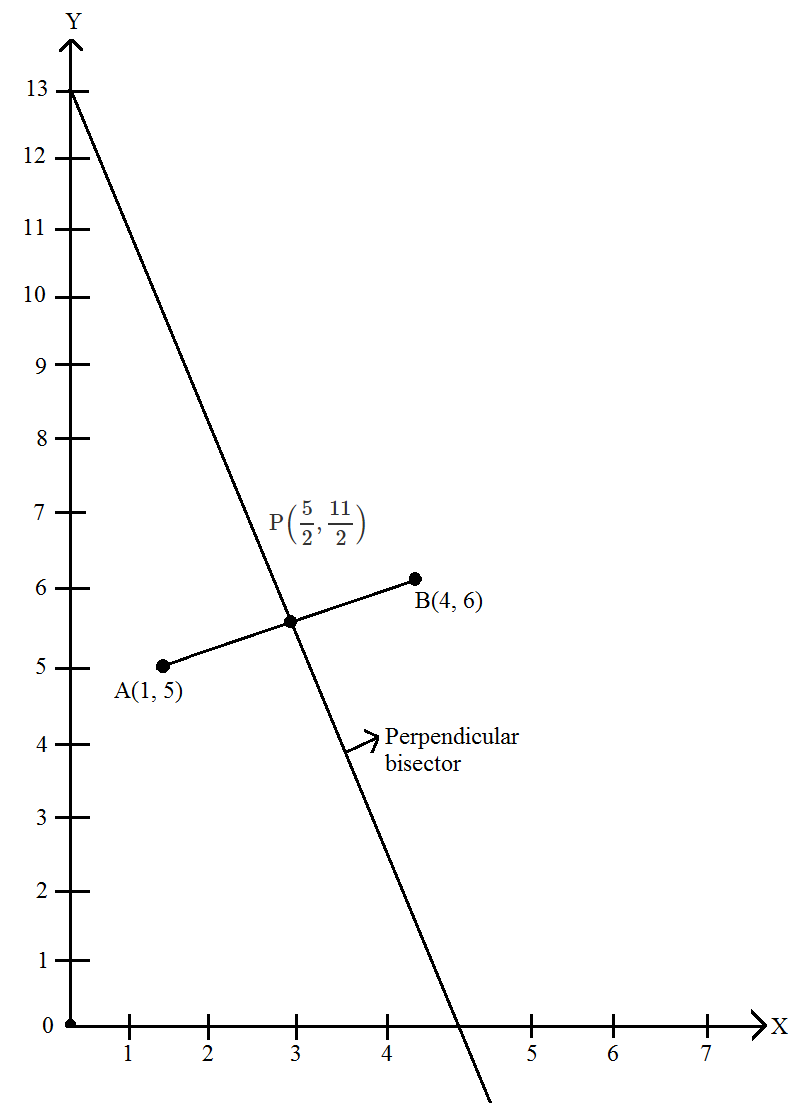
We know that, the perpendicular bisector of the line segment $AB$ bisect the segment $AB$, i.e., perpendicular bisector of line segment $AB$ passes through the mid$-$point of $AB.$
$\therefore\text{Mid-point of AB}=\Big(\frac{1+4}{2},\frac{5+6}{2}\Big)$
$\Rightarrow\text{P}=\Big(\frac{5}{2},\frac{11}{2}\Big)$
$\left[\right.$ Since, mid-point of any line segment which passes throught the points $\left(x_1, y_1\right)$ and $\left.\left(x_2, y_2\right)=\left(\frac{x_1+x_2}{2}, \frac{y_1+y_2}{2}\right)\right]$
Now, we draw a straight line on paper passes through the mid$-$point $P$ . We see that the perpendicular bisector cuts the $Y-$axis at the point $(0,13)$. Hence, the required point is $(0,13)$.
Alternate Answer
We know that, the equation of line which passes through the points $\left(x_1, y_1\right)$ and $\left(x_2, y_2\right)$ is, $\left( y - y _1\right)=\frac{ y _2- y _1}{ x _2- x _1}\left( x - x _1\right) \ldots (i)$
Here, $x _1=1, y _1=5$ and $x _2=4, y _2=6$
So, the equation of line segment joining the points $A(1, 5)$ and $B(4, 6)$ is,
$(\text{y}-5)=\frac{6-5}{4-1}(\text{x}-1)$
$\Rightarrow(\text{y}-5)=\frac{1}{3}(\text{x}-1)$
$\Rightarrow3\text{y}-15=\text{x}-1$
$\Rightarrow3\text{x}=\text{x}-14$
$\Rightarrow\text{y}=\frac{1}{3}\text{x}-\frac{14}{3}\ ......(\text{ii})$
$\therefore$ Slope of the line segment, $\text{m}_1=\frac{1}{3}$
If two lines are perpendicular to each other, then relation between its slopes is
$m_1 \times m_2=-1$
Where, $m _1=$ Slope of line $1$
and = Slope of line $2$
Also, we know that the perpendicular bisector of the line segment is perpendicular on the line segment.
Let slope of line segment is $m _2$.
From Eq. $(iii),$
$m_1 \times m_2=\frac{1}{3} \cdot m_2=-1$
$\Rightarrow m_2=-3$
Also we know that the perpendicular bisector is passes through the mid-point of line segment.
$\therefore \text { Mid-point of line segment }=\left(\frac{1+4}{2}, \frac{5+6}{2}\right)=\left(\frac{5}{2}, \frac{11}{2}\right)$
Equation of perpendicular bisector, which has slope $(-3)$ and passes through the point $\left(\frac{5}{2}, \frac{11}{2}\right)$ is,
$\left(y-\frac{11}{2}\right)=(-30)\left(x-\frac{5}{2}\right)$
[Since, equation od line passes through the point $\left(x_1, y_1\right)$ and having slope $m\left(y-y_1\right)=m\left(x-x_1\right)$ ]
$\Rightarrow(2 y-11)=-3(2 x-5)$
$\Rightarrow 2 y-11=-6 x+15$
$\Rightarrow 6 x+2 y=26$
$\Rightarrow 3 x+y=13$
If the perpendicular bisector cuts the $y$-axis, then put $x=0$ in Eq. $(iv),$
$3 \times 0+y=13$
$\Rightarrow y=13$
So, the required point is $(0,13)$. View full question & answer→MCQ 111 Mark
The point which divides the line segment joining the points $(7, – 6)$ and $(3, 4)$ in ratio $1 : 2$ internally lies in the:
- A
$I$ quadrant.
- B
$II$ quadrant.
- C
$III$ quadrant.
- ✓
$IV$ quadrant.
AnswerCorrect option: D. $IV$ quadrant.
If $P ( x , y )$ divides the line segment joining $A \left( x _1, y _2\right)$ and $B \left( x _2, y_2\right)$ internally in the ratio m : n then
$\text{x}=\frac{1(3)+2(7)}{1+2},\text{y}=\frac{1(4)+2(-6)}{1+2} [$by section formula$]$
$\Rightarrow\text{x}=\frac{3+14}{3},\text{y}=\frac{-4+12}{3}$
$\Rightarrow\text{x}=\frac{17}{3},\text{y}=-\frac{8}{3}$
So, $\big(\text{x},\text{ y})=\Big(\frac{17}{3},-\frac{8}{3}\Big) $ lies in $IV$ quadrant.
$[$Since, in $IV$ quadrant, $x-$coordinate is positive and $y-$coordinate is negative$]$
View full question & answer→MCQ 121 Mark
The fourth vertex $D$ of a parallelogram $\text{ABCD}$ whose three vertices are $A(-2, 3), B(6, 7)$ and $C(8, 3)$ is:
- A
$(0, 1)$
- ✓
$(0, -1)$
- C
$(-1, 0)$
- D
$(1, 0)$
AnswerCorrect option: B. $(0, -1)$
Let the fourth vertex of parallelogram, $\text{D}\equiv(\text{x}_4,\text{ y}_4)$ and $L, M$ be the middle points of $AC$ and $BD$, respectively,
Then, $\text{L}\equiv\Big(\frac{-2+8}{2},\frac{3+3}{2}\Big)\equiv(3, 3)$
$\Big[$ Since, mid-point of any line segment which passes throught the points $(x_1, y_1)$ and $(x_2, y_2)$ $=\Big(\frac{\text{x}_1+\text{x}_2}{2},\frac{\text{y}_1+\text{y}_2}{2}\Big)\Big]$
and $\text{M}=\Big(\frac{6+\text{x}_4}{2},\frac{7+\text{y}_4}{2}\Big)$
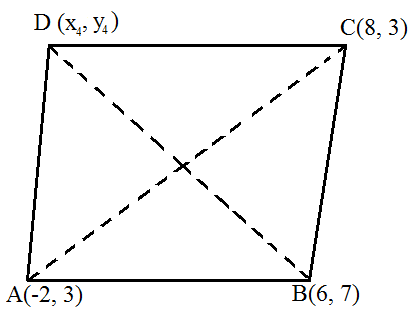
Since, $\text{ABCD}$ is a parallelogram, therefore diagonals $AC$ and $BD$ will bisect each other.
Hence, $L$ and $M$ are the same points.
$\therefore3=\frac{6+\text{x}_4}{2}\text{ and }3=\frac{7+\text{y}_4}{2}$
$\Rightarrow6=6+\text{x}_4\text{ and }6=7+\text{y}_{4}$
$\Rightarrow\text{x}_{4}=0\text{ and }\text{y}_{4}$
$\therefore\text{x}_{4}\text{ and }\text{y}_{4}=-1$
Hence, the fourth vertex of parallelogram is $D (x_4, y_4) = D(0, -1).$
View full question & answer→MCQ 131 Mark
If a circle drawn with origin as the centre passes through $\Big(\frac{13}{2}, 0\Big),$ then the point which does not lie in the interior of the circle is :
AnswerCorrect option: D. $\Big(-6,\frac{5}{2}\Big)$
It is given that , centre of circle in $(0, 0)$ and passes throught the point $\Big(\frac{13}{2},0\Big)$Radius of circle $=$ Distance between $(0 , 0)$ and $\Big(\frac{13}{2},0\Big)$
$=\sqrt{\Big(\frac{13}{2},0\Big)^2+(0 - 0)^2}$
$=\sqrt{\Big(\frac{13}{2}\Big)^2}$
$=\frac{13}{2}=6.5$
A point lie outside on or inside the circles of the distance of it from the centre of the circle is greater than equal to or less than redius of the circle.
Now, to get the correct option we have to check the option one by one.
- Distance between $(0, 0)$ and $\Big(\frac{-3}{4},1\Big)$
$=\sqrt{\Big(\frac{-3}{4},0\Big)^2+(1 - 0)^2}$
$=\sqrt{\frac{9}{16}+1}$
$=\sqrt{\frac{25}{16}}=\frac{5}{4}$
$=1.25<6.5$
So, the point $\Big(\frac{-3}{4},1\Big)$ lies interior to the circle.
- Distance between $(0, 0)$ and $2,\frac{7}{3}$
$=\sqrt{(2-0)^2+{\Big(\frac{7}{3}-0\Big)^2}{}}$
$=\sqrt{4+\frac{49}{9}}{}$
$=\sqrt\frac{{36+49}}{9}$
$=\sqrt{\frac{85}{9}}=\frac{9.22}{3}$
$=3.1<6.5$
So, the point $\Big(2,\frac{7}{3}\Big)$ lies inside the circle.
- Distance between $(0, 0)$ and $\Big(5,\frac{-1}{2}\Big)$
$=\sqrt{(5-0)^2+\Big(-\frac{1}{2}-0\Big)^2}$
$=\sqrt{25+\frac{1}{4}}$
$=\sqrt{\frac{101}{4}}$
$=\frac{10.04}{2}$
$=5.02<6.5$
So, the point $\Big(5,\frac{-1}{2}\Big)$ lise inside the circle.
- Distance between $(0, 0)$ and $\Big(-6,\frac{5}{2}\Big)$
$=\sqrt{(-6-0)^2+\Big(\frac{5}{2}\Big)^2}$
$=\sqrt{36+\frac{5}{2}}$
$=\sqrt{\frac{144+25}{4}}$
$=\sqrt\frac{169}{4}$
$=\frac{13}{2}$
$=-6.5$
So, the point $\Big(-6,\frac{5}{2}\Big)$ lis an circle
i.e, does not lie interior to the circle. View full question & answer→MCQ 141 Mark
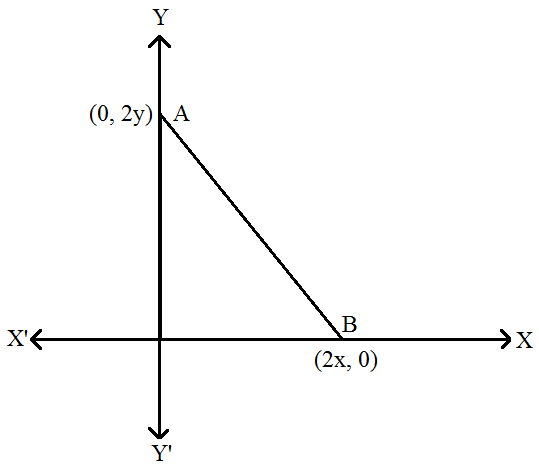
The coordinates of the point which is equidistant from the three vertices of the $\triangle\text{AOB}$ as shown in the figure is:
- ✓
$(\text{x, y})$
- B
$(\text{y, x})$
- C
$\Big(\frac{\text{x}}{2},\frac{\text{y}}{2}\Big)$
- D
$\Big(\frac{\text{y}}{2},\frac{\text{x}}{2}\Big)$
AnswerCorrect option: A. $(\text{x, y})$
Let the coordinate of the point which is equidistant from the three vertices $0(0,0), A(0,2 y)$ and $B (2 x , 0)$ is $P ( h , k )$.
Then, $PO = PA = PB$
$\Rightarrow(P O)^2=(P A)^2=(P B)^2$
By distance formula, $\left[\sqrt{(h-0)^2+(k-0)^2}\right]^2=\left[\sqrt{(h-0)^2+(k-2 y)^2}\right]^2=\left[\sqrt{(h-2 x)^2+(k-0)^2}\right]^2$
$\Rightarrow h^2+k^2=h^2+(k-2 y)^2=(h-2 x)^2+k^2 \ldots \ldots . . .( (ii))$
Taking first two equations, we get
$h^2+k^2=h^2+(k-2 y)^2$
$k^2=k^2+4 y^2-4 y k$
$4 y(y-k)=0$
$y=k[\because y \neq 0]$
Taking first and third equations, we get
$h^2+h^2=(h-2 x)^2+k^2$
$h^2=h^2+4 x^2-4 x h$
$4 x(x-h)=0$
$x=h[\because x \neq 0]$
$\therefore$ Required points $=(h, k)=(x, y)$
View full question & answer→MCQ 151 Mark
If the point $P(2, 1)$ lies on the line segment joining points $A(4, 2)$ and $B(8, 4)$, then:
- A
$\text{AP}=\frac{1}{3}\text{AB}$
- B
$\text{AP}=\text{PB}$
- C
$\text{PB}=\frac{1}{3}\text{AB}$
- ✓
$\text{AP}=\frac{1}{2}\text{AB}$
AnswerCorrect option: D. $\text{AP}=\frac{1}{2}\text{AB}$
Given that, the point $P(2, 1)$ lies on the line segment joining the points $A(4, 2)$ and $B(8, 4)$, which shows in the figure below:

Now, distance between $A(4, 2)$ and $(2, 1),$
$\text{AP}=\sqrt{(2-4)^2+(1-2)^2}$
$\left[\therefore\right.$ distance between two points $\left( x _1, y _1\right)$ and $\left.\left( x _2, y _2\right), d =\sqrt{\left( x _2- x _1\right)^2+\left( y _2- y _1\right)^2}\right]$
$\text{AP}=\sqrt{(-2)^2+(-1)^2}$
$\text{AP}=\sqrt{4+1}$
$\text{AP}=\sqrt{5}$
Distance between $A(4, 2)$ and $B(8, 4),$
$\text{AB}=\sqrt{(8-4)^2+(4-2)^2}$
$\text{AB}=\sqrt{(4)^2+(2)^2}$
$\text{AB}=\sqrt{16+4}$
$\text{AB}=\sqrt{20}$
$\text{AB}=2\sqrt{5}$
Distance between $B(8, 4)$ and $P(2, 1),$
$\text{BP}=\sqrt{(8-2)^2+(4-1)^2}$
$\text{BP}=\sqrt{(6)^2+(3)^2}$
$\text{BP}=\sqrt{36+9}$
$\text{BP}=\sqrt{45}$
$\text{BP}=3\sqrt{5}$
$\therefore\text{AB}=2\sqrt{5}=2\text{AP}$
$\text{AP}=\frac{\text{AB}}{2}$
Hence, required condition is $\text{AP}=\frac{\text{AB}}{2}.$
View full question & answer→MCQ 161 Mark
The distance between the points $P(-6, 8)$ from the origin is:
- A
$8$
- B
$2\sqrt{7}$
- ✓
$10$
- D
$6$
Answer$\therefore$ Distance between the points $\left( x _1, y _2\right)$ and $\left( x _2, y _2\right)$
$d=\sqrt{\left(x_2-x_1\right)^2+\left(y_2-y_1\right)^2}$
Here, $x_1=-6, y_1=8$ and $x_2=0, y_2=0$
$\therefore$ Distance between $P(-6, 8)$ and origin i.e., $O(0, 0)$
$\text{PO}=\sqrt{[0-(-6)]^2+(0-8)^2}$
$\text{PO}=\sqrt{(6)^2+(-8)^2}$
$\text{PO}=\sqrt{36+64}$
$\text{PO}=\sqrt{100}$
$\text{PO}=10$
View full question & answer→MCQ 171 Mark
The points $(-4, 0), (4, 0), (0, 3)$ are the vertices of a:
AnswerLet $A(- 4, 0), B(4, 0), C(0, 3)$ are the given vertices.
Now, distance between $A (-4, 0)$ and $B (4, 0),$
$\text{AB}=\sqrt{[4-(-4)^2+(0-0)^2}$
$\Big[\ \therefore$ distance between two points $\left( x _1, y _1\right)$ and $\left( x _2, y _2\right)$, $\text{d}=\sqrt{(\text{x}_2-\text{x}_1)^2+(\text{y}_2-\text{y}_1)^2}\Big]$
$\text{AB}=\sqrt{(4+4)^2}=\sqrt{8^2}=8$
Distance between B(4, 0) and C(0, 3),
$\text{BC}=\sqrt{(0-4)^2+(3-0)^2}=\sqrt{16+9}$
$\text{BC}=\sqrt{25}=5$
Distance between B(-4, 0) and C(0, 3),
$\text{AC}=\sqrt{[0-(-4)^2]+(3-0)^2}=\sqrt{16+9}$
$$$\text{AC}=\sqrt{25}=5$
$\because\text{BC}=\text{AC}$
Hence, $\triangle\text{ABC}$ is an isosceles triangle because an isosceles triangle has two sides equal.
View full question & answer→MCQ 181 Mark
The distance between the points $(0,5)$ and $(-5, 0)$ is:
- A
$5$
- ✓
$5\sqrt{2}$
- C
$2\sqrt{5}$
- D
$10$
AnswerCorrect option: B. $5\sqrt{2}$
Distance between the points $( x _1, y _1)$ and $( x _2, y _2)$
$\text{d}=\sqrt{(\text{x}_2-\text{x}_1)^2+(\text{y}_2-\text{y}_1)^2}$
Here, $x_1=0, y_1=5$ and $x_2=-5, y_2=0$
Distance between the point $(0, 5)$ and $(-5, 0)$
$\text{d}=\sqrt{(-5-0)^2+(0-5)^2}$
$\text{d}=\sqrt{25+25}$
$\text{d}=\sqrt{50}$
$\text{d}=5\sqrt{2}$
View full question & answer→MCQ 191 Mark
The perimeter of a triangle with vertices $(0, 4), (0, 0)$ and $(3, 0)$ is:
- A
$5$
- ✓
$12$
- C
$11$
- D
$7+\sqrt{5}$
AnswerWe further, adding all the distance of a triangle to get the oerimeter of a triangle. We point the vertices of a triangle i. e., $(0, 4), (0, 0)$ and $(3, 0)$ on the paper shown as given below:
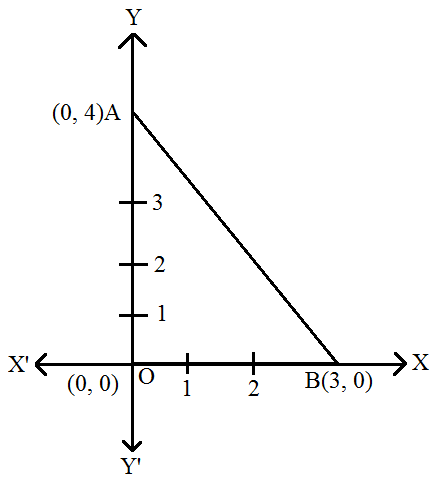
Now, perimeter of $\triangle\text{AOB} =$ Sum of the length of all its sides $= d(AO) + d(OB) + d(AB)$
$\therefore$ Distance between the points $\left( x _1, y _1\right)$ and $\left( x _2, y _2\right)$,
$\text{d}=\sqrt{(\text{x}_2-\text{x}_1)^2+(\text{y}_2-\text{y}_1)^2}$
$d =$ Distance between $A(0, 4)$ and $O(0, 0) +$ Distance between $O(0, 0)$ and $B(3, 0) +$ Distance between $A(0, 4)$ and $B(3, 0)$
$\text{d}\sqrt{(0-0)^2+(0-4)^2}+\sqrt{(3-0)^2+(0-0)^2}+\sqrt{(3-0)^2+(0-4)^2}$
$\text{d}=\sqrt{0+16}+\sqrt{9+0}+\sqrt{(3)^2+(4)^2}$
$\text{d}=4+3+\sqrt{9+16}$
$\text{d}=7+\sqrt{25}$
$\text{d}=7+5$
$\text{d}=12$
Hence, the required perimeter of triangle is $12.$
View full question & answer→MCQ 201 Mark
The point which lies on the perpendicular bisector of the line segment joining the points $A(-2, – 5)$ and $B(2, 5)$ is:
- ✓
$(0, 0)$
- B
$(0, 2)$
- C
$(2, 0)$
- D
$(-2, 0)$
AnswerCorrect option: A. $(0, 0)$
We know that, the perpendicular bisector of the any line segment divides the jjpe segment into two equal parts i.e., the perpendicular bisector of the line segment always passes through the mid$-$point of the line segment. Mid$-$point of the line segment joining the points $A (-2, -5)$ and $S(2, 5)$
$=\Big(\frac{-2+2}{2},\frac{-5+5}{2}\Big)=(0,0)$
$\Big[$ Since, mid-point of any line segment which passes throught the points $( x _1, y _1)$ and $( x _2, y _2)$ $=\Big(\frac{\text{x}_1+\text{x}_2}{2},\frac{\text{y}_1+\text{y}_2}{2}\Big)\Big]$
Hence, $(0, 0)$ is the required point lies on the perpendicular bisector of the lines segment.
View full question & answer→