Questions

2 Marks Questions

🎯

Test yourself on this topic

13 questions · timed · auto-graded

Question 12 Marks
$\sin ( A + B )=1\ \&\ \sin (A- B )=\frac{1}{2}$,$0 \leq A + B =90^{\circ}\ \&\ A> B$, then find $A\ \&\ B$.
Answer
Given $\operatorname{Sin}(A+B)=1$
$\Rightarrow \sin (A+B)=\sin 90^{\circ} \quad\left(\because \sin 90^{\circ}=1\right)$
$\Rightarrow A+B=90^{\circ} \ldots \ldots .(i)$
Also $\sin (A-B)=\frac{1}{2}$
$\Rightarrow \sin (A-B)=\sin 30^{\circ} \quad\left(\because \sin 30^{\circ}=\frac{1}{2}\right)$
$\Rightarrow A-B=30^{\circ} \ldots \ldots(ii)$
Adding Eqn. $(i)$ and $(ii)$
$\Rightarrow 2 A=120^{\circ}$
Divide above equation by $2,$
$\Rightarrow A=60^{\circ}$
Substituting value of $A$ in Eqn. $(i),$
we have $\Rightarrow B=30^{\circ}$
Hence, $A=60^{\circ}$ and $B=30^{\circ}$.
View full question & answer
Question 22 Marks
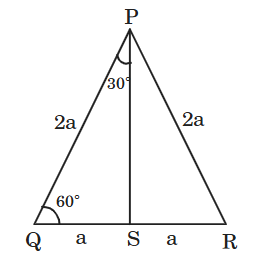
Find $\operatorname{cosec} 30^{\circ}  \cos 60^{\circ}$ geometrically.
Answer

Image

Make an equilateral $\triangle PQR$
$\angle P=\angle Q=\angle R=60^{\circ}$
Draw a perpendicular $PS$ from $P$ to the side $QR$
As, a perpendicular bisector divides the equilateral triangle into two congruent triangles,
So, $\triangle P Q S \cong \triangle P R S \ ($by $\text{RHS}$ congruency criterion$)$
$\therefore Q S=R S \ (\text{CPCT})$
Here length of each side is $2 a$
$\Rightarrow Q S=R S=a$
In $, \triangle P Q S$
$\operatorname{cosec} 30^{\circ}=\frac{\text { hypotenuse }}{\text { perpendicular }}=\frac{P Q}{Q S}$
$\Rightarrow \operatorname{cosec} 30^{\circ}=\frac{2 a}{a}=2$
$\text { And, } \cos 60^{\circ}=\frac{\text { base }}{\text { hypotenuse }}=\frac{Q S}{P Q}$
$\Rightarrow \cos 60^{\circ}=\frac{a}{2 a}=\frac{1}{2}$
Hence, $\operatorname{cosec} 30^{\circ}=2$ and $\cos 60^{\circ}=\frac{1}{2}$.
View full question & answer
Question 32 Marks
Take $A =60$ and $B =30$. Write the value of $\cos A$, $\cos B$ and $\cos (A+B)$. Is $\cos (A+B)=\cos A+\cos B$ ?
Answer
Here, It is given that $A=60$ and $B=30$
$
\therefore \cos A=\cos 60^{\circ}=\frac{1}{2}
$
and $\cos B =\cos 30^{\circ}=\frac{\sqrt{3}}{2}$
$\Rightarrow \cos A +\cos B =\cos 60^{\circ}+\cos 30^{\circ}=\frac{1}{2}+\frac{\sqrt{3}}{2}$
$
=\frac{1+\sqrt{3}}{2}
$
And
$
\cos (A+B)=\cos (60+30)=\cos 90=0
$
From (i) and (ii)
$
\cos A=\frac{1}{2}, \cos B=\frac{\sqrt{3}}{2}, \cos (A+B)=0
$
and $\cos (A+B) \neq \cos A+\cos B$
View full question & answer
Question 42 Marks
Prove the following identity: $\frac{\sin ^4 \theta+\cos ^4 \theta}{1-2 \sin ^2 \theta \cos ^2 \theta}=1$
Answer
$\frac{\sin ^4 \theta+\cos ^4 \theta}{1-2 \sin ^2 \theta \cos ^2 \theta}=1$
Taking the $\ce{LHS}$ and using the identity $\sin ^2 A+ \cos ^2 A=1$ we have,
$=\frac{\sin ^4 \theta+\cos ^4 \theta}{1-2 \sin ^2 \theta \cos ^2 \theta}$
$=\frac{\sin ^4 \theta+\cos ^4 \theta}{\sin ^2 \theta+\cos ^2 \theta-\sin ^2 \theta \cos ^2 \theta-\sin ^2 \theta \cos ^2 \theta}$
$=\frac{\sin ^4 \theta+\cos ^4 \theta}{\sin ^4 \theta+\cos ^4 \theta}$
$=1$
Hence proved.
View full question & answer
Question 52 Marks
$\left[\frac{1-\tan A}{1-\cot A}\right]^2=\tan ^2 A ; \angle A$ is acute
Answer
To prove $\left[\frac{1-\tan A}{1-\cot A}\right]^2=\tan ^2 A$,
Using the left hand side of the equation,
$
\left[\frac{1-\tan A}{1-\cot A}\right]^2
$
Since, $\tan A=\frac{\sin A}{\cos A}$
$\Rightarrow\left[\frac{1-\frac{\sin A}{\cos A}}{1-\frac{\cos A}{\sin A}}\right]^2$
$\Rightarrow\left[\frac{\frac{\cos A-\sin A}{\cos A}}{\frac{\sin A-\cos A }{\sin A }}\right]^2$
$\Rightarrow\left[\frac{\cos A -\sin A }{\sin A -\cos A } \cdot \frac{\sin A }{\cos A }\right]^2 \Rightarrow\left[-\frac{\sin A }{\cos A }\right]^2=\tan ^2 A$
Since LHS = RHS,
Hence proved, $\left[\frac{1-\tan A }{1-\cot A }\right]^2=\tan ^2 A$
View full question & answer
Question 62 Marks
If $\sin \theta-\cos \theta=\frac{1}{2}$ then find the value of $\sin \theta+\cos \theta$.
Answer
It is given that, $\sin \theta-\cos \theta=\frac{1}{2}$
On squaring both the sides,
$(\sin \theta-\cos \theta)^2=\frac{1}{4}$
$\sin ^2 \theta+\cos ^2 \theta-2 \sin \theta \cos \theta=\frac{1}{4}$
$\text { Since, } \sin ^2 \theta+\cos ^2 \theta=1$
$1-2 \sin \theta \cos \theta=\frac{1}{4}$
$2 \sin \theta \cos \theta=1-\frac{1}{4}=\frac{3}{4}$
$\sin \theta \cos \theta=\frac{3}{8}$
$\sin \theta+\cos \theta$
$\Rightarrow \sin \theta+\cos \theta=\sqrt{(\sin \theta-\cos \theta)^2+4 \sin \theta \cos \theta}$
$\Rightarrow \sin \theta+\cos \theta=\sqrt{1-2 \sin \theta \cos \theta+4 \times \frac{3}{8}}$
$\Rightarrow \sin \theta+\cos \theta=\sqrt{1-2 \times \frac{3}{8}+4 \times \frac{3}{8}}$
$\Rightarrow \sin \theta+\cos \theta=\sqrt{1-\frac{3}{4}+\frac{3}{2}}$
$\Rightarrow \sin \theta+\cos \theta=\frac{\sqrt{7}}{2}($ Given $)$
View full question & answer
Question 72 Marks
If $\sqrt{3} \sin \theta-\cos \theta=0$ and $0^{\circ}<\theta<90^{\circ}$, find the value of $\theta$.
Answer
We have,
$\sqrt{3} \sin \theta-\cos \theta=0$
Dividing above equation by $2 ,$ we get,
$\left(\frac{\sqrt{3}}{2}\right) \sin \theta-\left(\frac{1}{2}\right) \cos \theta=0$
Since, $\cos 30^{\circ}=\frac{\sqrt{3}}{2}$ and $\sin 30^{\circ}=\frac{1}{2}$, using this in equation $1 ,$ we get,
$\cos \left(30^{\circ}\right) \sin (\theta)-\sin \left(30^{\circ}\right) \cos (\theta)=0$
We know that, $\sin (A-B)=\sin A \cos B-\cos A \sin B$, using this in equation $2$
$\Rightarrow \sin \left(\theta-30^{\circ}\right)=\sin (n \pi)$
$\Rightarrow \theta-30^{\circ}=n \pi$
$\Rightarrow \theta=n \pi+30^{\circ}$
$\Rightarrow \theta=n \pi+\frac{\pi}{6}$
The value of $\theta$ is $n \pi+\frac{\pi}{6}$
View full question & answer
Question 82 Marks
If $\sqrt{3} \tan \theta=3 \sin \theta$, find the value of $\sin ^2 \theta-\cos ^2 \theta$.
Answer

$
\sqrt{3} \tan \theta=3 \sin \theta
$
(Given) Putting $\tan \theta=\frac{\sin \theta}{\cos \theta}$ in given equation,
$
\sqrt{3} \times \frac{\sin \theta}{\cos \theta}=3 \sin \theta
$
On solving,
$
\Rightarrow \cos \theta=\frac{1}{\sqrt{3}}
$
Squaring both the sides,
$
\cos ^2 \theta=\frac{1}{3}\quad \quad \ldots \ldots(i)
$
Using the Trigonometric identity,
$
\sin ^2 \theta=1-\cos ^2 \theta\quad \quad \ldots \ldots(ii)
$
On Substitute the value of $\cos ^2 \theta$ from equation
(ii) in (i),
$
\sin ^2 \theta=1-\frac{1}{3}=\frac{2}{3}\quad \quad \ldots \ldots(iii)
$
On putting the value of $\sin ^2 \theta$ and $\cos ^2 \theta$
$
\sin ^2 \theta-\cos ^2 \theta=\frac{2}{3}-\frac{1}{3}=\frac{1}{3}
$
Hence, the value of $\sin ^2 \theta-\cos ^2 \theta$ is $\frac{1}{3}$.
View full question & answer
Question 92 Marks
If $A, B$ and $C$ are interior angles of $\triangle A B C$, then show that $\tan \left(\frac{\angle A+\angle B}{2}\right)=\cot \frac{\angle C}{2}$
Answer
The sum of all the interior angles of a triangle is $180^{\circ}$.
So,
$\Rightarrow \angle A+\angle B+\angle C=180^{\circ}$
$\Rightarrow \angle A+\angle B=180^{\circ}-\angle C$
Divide both the sides by $2 ,$
$\frac{\angle A+\angle B}{2}=90^{\circ}-\frac{\angle C}{2}$
Applying $\tan$ to both the sides of the equation
$\tan \left(\frac{\angle A+\angle B}{2}\right)=\tan \left(90^{\circ}-\frac{\angle C}{2}\right)$
Also, $\tan \left(90^{\circ}-\theta\right)=\cot \theta^{\circ}$
$\Rightarrow \tan \left(\frac{\angle A+\angle B}{2}\right)=\cot \frac{\angle C}{2}$
Hence proved.
View full question & answer
Question 102 Marks
Show that $\tan ^4 \theta+\tan ^2 \theta=\sec ^4 \theta-\sec ^2 \theta$
Answer
$\tan ^4 \theta+\tan ^2 \theta=\sec ^4 \theta-\sec ^2 \theta$
$\text{L.H.S.}$
$\Rightarrow\left(\tan ^2 \theta\right)^2+\tan ^2 \theta$
$\Rightarrow\left(\sec ^2 \theta-1\right)^2-1+\sec ^2 \theta \left[\because \tan ^2 \theta=-1+\sec ^2 \theta\right]$
$\Rightarrow 1+\sec ^4 \theta-2 \sec ^2 \theta-1+\sec ^2 \theta$
$\Rightarrow \sec ^4 \theta-\sec ^2 \theta$
$\Rightarrow \text { LHS }=\text { RHS }$
View full question & answer
Question 112 Marks
Prove that $1+\frac{\cot ^2 \alpha}{1+\operatorname{cosec} \alpha}=\operatorname{cosec} \alpha$
Answer
$1+\frac{\cot ^2 \theta}{1+\operatorname{cosec} \theta}=\operatorname{cosec} \theta$
$\text{L.H.S.}$
$\Rightarrow \frac{1+\operatorname{cosec} \theta+\cot ^2 \theta}{1+\operatorname{cosec} \theta}$
$\Rightarrow \frac{1+\operatorname{cosec} \theta+\operatorname{cosec}^2 \theta-1}{1+\operatorname{cosec} \theta}$
$\Rightarrow \frac{\operatorname{cosec} \theta+(1+\operatorname{cosec} \theta)}{(1+\operatorname{cosec} \theta)}$
$\Rightarrow \operatorname{cosec} \theta$
$\Rightarrow \text { LHS }=\text { RHS }$
Hence Proved.
View full question & answer
Question 122 Marks
If $\sin \alpha=\frac{1}{2}$, then find the value of $(3 \cos \alpha-4$ $\cos ^3 \alpha ).$
Answer
$\sin \alpha =\frac{1}{2}$
$\because \sin 30^{\circ} =\frac{1}{2}$
$\therefore \alpha =30^{\circ}$
then put the value of $\alpha$ in $3 \cos \alpha-4 \cos ^3 \alpha$
$\Rightarrow 3 \cos 30^{\circ}-4 \cos ^3 30^{\circ}$
$\because \cos 30^{\circ}=\frac{\sqrt{3}}{2} \text { then }$
$\Rightarrow 3 \times \frac{\sqrt{3}}{2}-4 \times\left(\frac{\sqrt{3}}{2}\right)^3$
$\Rightarrow \frac{3 \sqrt{3}}{2}-\frac{4 \times 3 \sqrt{3}}{8}$
$\Rightarrow \frac{3 \sqrt{3}}{2}-\frac{3 \sqrt{3}}{2}=0$
View full question & answer
Question 132 Marks
If $\tan (A+B)=\sqrt{3}$ and $\tan (A-B)=\frac{1}{\sqrt{3}}$, $0< A + B \leq 90^{\circ}, A > B$, then find the values of A and $B$.
View full question & answer
2 Marks Questions - Maths STD 10 Questions - Vidyadip