Questions

Case study (4 Marks)

🎯

Test yourself on this topic

7 questions · timed · auto-graded

Question 14 Marks
Essel World is one of India's largest amusement parks that offers a diverse range of thrilling des, water attractions and entertainment options for visitors of all ages. The park is known for its iconic -Vater Kingdom" section, making it a popular destination for family outings and fun-filled adventure. The ket charges for the park are ₹ 150 per child and ₹ 250 per adult.
Image
On a day, the cashier of the park found that 300 tickets were sold and an amount of ₹$ 55,000$ was collected. Based on the above, answer the following questions:
(i) If the number of children visited be $x$ and the number of adults visited be $y$, then write the given situation algebraically.
(ii) (a) How many children visited the amusement park that day?
OR
(b) How many adults visited the amusement park that day?
(iii) How much amount will be collected if 250 children and 100 adults visit the amusement park?
Answer
(i) Given that total 300 tickets were sold and an amount of ₹$ 55,000$ was collected.
Therefore, $x+y=300$
$
150 x+250 y=55,000
$
(ii) (a) The system of equations in (i) can be re-written as
$
\begin{array}{l}
x+y=300 \\
3 x+5 y=1,100
\end{array}
$
Multiplying (i) by 5 and subtracting (ii) from it, we obtain
$
2 x=400 \Rightarrow x=200
$
Putting $x=200$ in (i), we obtain $y=100$.
Thus, 200 children and 100 adults visited the amusement park that day.
(b) 100 adults visited the amusement park that day.
(iii) If 250 children and 100 adults visit the park, then amount collected is given by
$
\text { Amount }=$₹$(250 \times 150+100 \times 250)=$₹$ 62,500
$
View full question & answer
Question 24 Marks
A coaching institute of Mathematics conducts classes in two batches I and 11 and fees for rich and poor children are different. In batch I, there are 20 poor and 5 rich children, whereas in batch II, there are 5 poor and 25 rich children. The total monthly collection of fees from batch I is ₹9,000 and from batch II is ₹ 26,000 . Assume that each poor child pays ₹ $x$ per month and each rich child pays ₹ y per month.
Image
Based on the aborv information, ansuyy the followents puestions:
(i) Represent the information given ahorv in terms of $x$ and $y$.
(ii) Find the monthly for puid by a poor child.
(iii) Find the difference in the monthly fov paid ty a poor child and a rikh chill.
(iv) If there are 10 poor and 20 rich children in Mutch 11 , what is the tolat mowhly collectious of fwa fome batch 11 .
Answer
(i) Given information can be tabulated in the following form:
Poor (x)Rich (y)Monthty collection
Batch I205₹ 9,000 /-
Batch II525₹ 26,000 /-
Monthly fees received from $x$ poor and $y$ rich children of batch I is ₹$(20 x+3 y)$. But, it is given that the total monthly collection of fees from batch $l$ is ₹$ 9,000$,
$
\therefore \quad 20 x+5 y=9000
$
Monthly fees received from $x$ poor and $y$ rich children of batch II is ₹$(5 x+25 y)$, But it is given that the total monthly collection of fees from batch II is ₹$ 26,000$,
$
\therefore \quad 5 x+25 y=26000
$
Thus, we obtain the following system of linear equations:
$
\begin{array}{l}
20 x+5 y=9000 \\
5 x+25 y=26000
\end{array}
$
(ii) Multiplying (i) by 5 and subtracting from (ii), we obtain
$
-95 x=-19000 \Rightarrow x=200
$
$\therefore \quad$ Monthly fee paid by a poor child ₹$= 200$
(iii) Putting $x=200$ in (i), we obtain
$
5 y=5000 \Rightarrow y=1000
$
$\therefore \quad$ Monthly fee paid by a rich child $=$₹$ 1000$
Hence, the difference in monthly fee paid by a poor child and a rich child is ₹$ 1000-$₹$ 200=$₹$ 800$.
Ev) Total collection of fee received from 10 poor and 20 rich children of batch II is
₹$(10 x+20 y)=$₹$(10 \times 200+20 \times 1000)=$₹$ 22,000 .
$
View full question & answer
Question 34 Marks
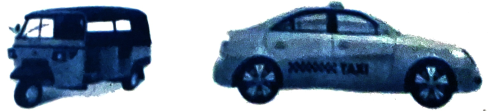
It is common that governments revise travel fares from time to time based on various factors such as inflation (a general increase in prices and fall in the purchasing value of money) on different types of vehicles like auto rickshaws, taxis, radio cabs etc. The auto charges in a city comprise of a fixed charge together with the charge for the distance covered. Study the following situations:
Image

Name of the CityDistance travelled (km)( Amount paid (₹))
City A1075
15110
City B891
14145
(i) If the fixed charges of autorickshaw be ₹ $x$ and the running charges be ₹ $y$ per km, the pair of linoar equations representing the travel in city $A$ is
(a) $x+10 y=75, x+5 y=145$
(b) $x+10 y=75, x+15 y=110$
(c) $x+8 y=91, x+14 y=145$
(d) $x+8 y=145, x+14 y=91$
(ii) If the fixed charges of autorikshaw be ₹$ x$ and the running charges be ₹$ y$ per km, the pair of linoar equations representing the travel in City $B$ is
(a) $x+10 y=75, x+5 y=145$
(b) $x+10 y=75, x+15 y=110$
(c) $x+8 y=91, x+14 y=145$
(d) $x+8 y=145, x+14 y=91$
(iii) The amount paid by a person travelling 100 km in city $A$ is
(a) ₹ 310 $\qquad$ (b) ₹ 510 $\qquad$ (c) ₹ 705 $\qquad$ (d) ₹ 710
(iv) The amount paid by a person travelling 60 km in city $B$ is
(a) ₹ 370 $\qquad$ (b) ₹ 578 $\qquad$ (c) ₹ 559 $\qquad$ (d) ₹ 610
Answer
(i) (b): In travelling 10 km in City $A$, the amount paid is ₹$ 75$. Therefore, $x+10 y=75$. Similarly we obtain $x+15 y=110$.
(ii) (c): In travelling 8 km in City $B$, the amount paid is ₹ 91. Therefore, $x+8 y=91$.
Similarly, we obtain $x+14 y=145$.
(iii) (c): Two equations describing the travel in City $A$ are: $x+10 y=75$ and $x+15 y=110$
Solving these two equations, we obtain $x=5, y=7$.
$\therefore \quad$ Amount paid in travelling 100 km in City $A=$₹$(x+100 y)=$₹$(5+700)=$₹$705$.
(iv) (c): Two equations describing the travel in City $B$ are: $x+8 y=91$ and $x+14 y=145$
Solving these equations, we obtain: $x=19, y=9$
$\therefore \quad$ Amount paid in travelling 60 km in City $B$ ₹$(x+60 y)=$₹$(19+60 \times 9)=$₹$ 559$
View full question & answer
Question 44 Marks
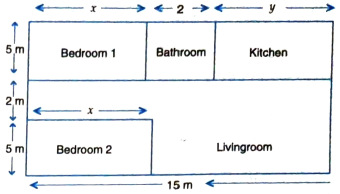
Ravish is planning to buy a house whose layout is given below. The design and the measurement has been made such that areas of two bedrooms and kitchen together is $95 m^2$.
Image
(i) The pair of linear equations in two variables describing this situation is
(a) $2 x+y=19, x+y=13$
(b) $x+2 y=19, x+y=13$
(c) $2 x+y=13, x+y=13$
(d) $2 x+y=13, x+y=19$
(ii) The perimeter and area of the house are respectively
(a) $54 m, 180 m^2$
(b) $180 m, 54 m^2$
(c) $27 m, 90 m^2$
(d) $108 m, 180 m^2$
(iii) The value of $x y$ is
(a) 42 $\qquad$ (b) 48 $\qquad$ (c) 49 $\qquad$ (d) 13
(iv) The value of $x-y$ is
(a) 13 $\qquad$ (b) 1 $\qquad$ (c) -1 $\qquad$ (d) .42
Answer
(i) (a): We observe that
$
x+2+y=15 \text { and } 5 x+5 x+5 y=95 \Rightarrow x+y=13 \text { and } 2 x+y=19
$
(ii) (a): Perimeter $=2(15+12)=54 m$, Area $=15 \times 12 m^2=180 m^2$
(iii) (a): Solving $x+y=13$ and $2 x+y=19$, we obtain: $x=6, y=7$. Therefore, $x y=42$.
(iv) (c): We have, $x=6, y=7$. Therefore, $x-y=6-7=-1$.
View full question & answer
Question 54 Marks
A test consists of 'True' or 'False' questions. One mark awarded for every correct answer while $\frac{1}{4}$ mark is deducted for every wrong answer. A student knew answers to some of the questions. Rest of the questions he attempted by guessing. He answered 120 questions and scored 95 marks.
(i) If answer to all questions he attempted by guessing were wrong, then the number of questions he answered correctly is
(a) 24 $\qquad$ (b) 96 $\qquad$ (c) 100 $\qquad$ (d) 90
(ii) The number of questions he guessed, is
(a) 20 $\qquad$ (b) 96 $\qquad$ (c) 20 $\qquad$ (d) 90
(iii) If answers to all questions he attempted by guessing were wrong and answered 80 correctly, then how many marks he got?
(a) 40 $\qquad$ (b) 45 $\qquad$ (c) 70 $\qquad$ (d) 35
(iv) If answer to all questions he attempted by guessing were wrong, then the number of questions answered correctly to score 95 marks is
(a) 100 $\qquad$ (b) 105 $\qquad$ (c) 90 $\qquad$ (d) 95
Answer
(i) (c): Suppose he answered $x$ questions by guessing and he knew answer to $y$ questions. Then,
$
x+y=120 \text { and } y-\frac{x}{4}=95 \Rightarrow(x+y)-\left(y-\frac{x}{4}\right)=25 \Rightarrow x=20
$
Putting $x=20$ in $x+y=120$, we get $y=100$.
(ii) (a): From (i), we obtain $x=20$
(iii) (c): He answered 80 questions correctly and the remaining 40 questions were wrong as he answered them by guessing.
$
\therefore \quad \text { Marks secured }=80-\frac{1}{4} \times 40=70
$
(iv) (a): Suppose $x$ questions were answered correctly. Then, the remaining ( $120-x$ ) were answered by guessing and were wrong.
$
\therefore \quad x-\frac{1}{4}(120-x)=95 \Rightarrow \frac{5 x}{4}-30=95 \Rightarrow \frac{5 x}{4}=125 \Rightarrow x=100
$
View full question & answer
Question 64 Marks
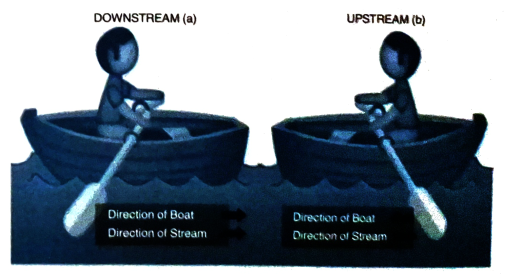
Mathematics teacher of a school took the standard 10 students to see the painting exhibition which was held at ART COLLEGE OF EDUCATION, Bangalore. It is the part of art integration of Mathematics. The teacher and students had interest in painting as well. Students were eager to see the above paintings. The teacher explained that the above paintings are based on concept of a pair of linear equations of two variables.
Image
(i) If the speed of boat is $5 km / hr$ and speed of stream is $2 km / hr$. What is the speed of the boat in downstream?
(a) $5 km / hr$ $\qquad$ (b) $2 km / hr$ $\qquad$ (c) $7 km / hr$ $\qquad$ (d) $3 km / hr$
(ii) If the speed of boat is $5 km / hr$ and speed of stream is $2 km / hr$. What is the speed of the boat in upstream?
(a) $5 km / hr$ $\qquad$ (b) $2 km / hr$ $\qquad$ (c) $7 km / hr$ $\qquad$ (d) $3 km / hr$
(iii) A boat goes 21 km downstream. What is the time required to cover it?
(a) 5 hr $\qquad$ (b) 2 hr $\qquad$ (c) 7 hr $\qquad$ (d) 3 hr
(iv) A boat goes 12 km upstream. What is the time required to cover it?
(a) 4 hr $\qquad$ (b) 2 hr $\qquad$ (c) 6 hr $\qquad$ (d) 3 hr
Answer
(i) (c) (ii) (d) (iii) (d) (iv) (a)
View full question & answer
Question 74 Marks
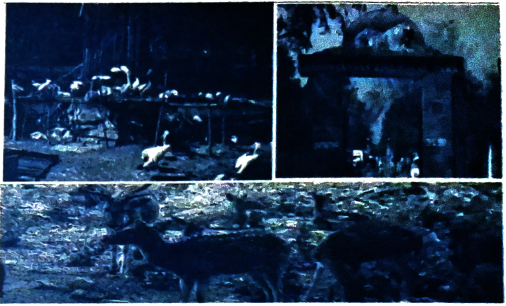
Teachers and students of class X of a school had gone to Nandan Kannan for study tour. After visiting different places of Nandan Kannan, lastly, they visited bird's sanctuary and deer park. Rohan is a clever boy and keen observer. He put the question to his friends "How many birds are there and how many deer are there (at particular time) in Nandan Kannan?" Rahul's friend, Nishith gave the correct answer as follows:
'Nishith answered that total animals have 1000 eyes and 1400 legs.'
Image
(i) If $x$ and $y$ be the number of birds and deer respectively, what is the equation of total number of eyes?
(a) $x+y=1000$ $\qquad$ (b) $x+y=500$
(c) $x-y=1000$ $\qquad$ (d) $x-y=500$
(ii) What is the equation of total number of legs?
(a) $2 x+y=70$ $\qquad$ (b) $x+2 y=500$
(c) $x+2 y=700$ $\qquad$ (d) $2 x-y=500$
(iii) How many birds are there in the Zoo?
(a) 1000 $\qquad$ (b) 5000 $\qquad$ (c) 300 $\qquad$ (d) 200
(iv) How many deer are there in the Zoo?
(a) 500 $\qquad$ (b) 200 $\qquad$ (c) 300 $\qquad$ (d) 700 $\qquad$
Answer
(i) (b) (ii) (c) (iii) (c) (iv) (b)
View full question & answer