Questions

3 Marks Question

🎯

Test yourself on this topic

8 questions · timed · auto-graded

Question 13 Marks
The difference between the outer and inner radii of a hollow right circular cylinder of length $14 \ cm$ is $1 \ cm$ . If the volume of the metal used in making the cylinder is $176 \ cm^3$, find the outer and inner radii of the cylinder.
Answer
Let outer radius be $r_2 \ cm$ and inner radius be $r_1 \ cm$.
$\therefore r_2-r_1=1......(i)$
Volume of metal used $=176 \ cm^3$
$\Rightarrow \frac{22}{7} \times 14 \times\left(r_2^2-r_1^2\right)=176$
$\Rightarrow r_2+r_1=4......(\text {ii) }$
Solving $(i)$ and $(ii)$, we get
$r_2=\frac{5}{2} \text { or } 2.5, r_1=\frac{3}{2} \text { or } 1.5$
Therefore, outer radius $=2.5 \ cm$ and inner radius $=1.5 \ cm$
View full question & answer
Question 23 Marks
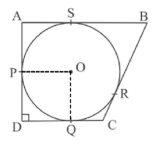
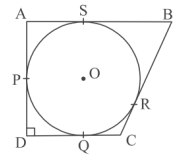
A circle with centre $O$ and radius $8 \ cm$ is inscribed in a quadrilateral $\text{ABCD}$ in which $\text{P , Q , R , S}$ are the points of contact as shown. If $AD$ is perpendicular to $DC , BC =30 \ cm$ and $BS =24 \ cm$, then find the length $DC .$
Image
Answer
$\text { Join } OP \text { and } OQ \text {. }$
$BR=BS=24 \ cm$
$\therefore CR=6 \ cm$
$\Rightarrow CQ=6 \ cm$
Also, $DQ = OP =8 \ cm$
Hence, $DC =8+6=14 \ cm$
Image
View full question & answer
Question 33 Marks
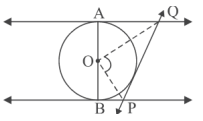
In the given figure, $\text{AB}$ is a diameter of the circle with centre $\text{O . AQ , BP}$ and $\text{PQ}$ are tangents to the circle. Prove that $\angle POQ =90^{\circ}$.
Image
Answer

Image
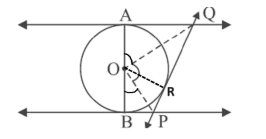
Join $OR.$
$ \triangle AOQ \cong \triangle ROQ$
$\Rightarrow \angle AOQ=\angle ROQ ......(i)$
$\Delta BOP \cong \triangle ROP$
$\Rightarrow \angle BOP=\angle ROP......(ii) $
Since $\angle A O R+\angle R O B=180^{\circ}$
$ \Rightarrow 2 \angle QOR+2 \angle ROP=180^{\circ}$
$\Rightarrow \angle QOR+\angle ROP=\angle POQ=90^{\circ} $
View full question & answer
Question 43 Marks
Three years ago, Rashmi was thrice as old as Nazma. Ten years later, Rashmi will be twice as old as Nazma. How old are Rashmi and Nazma now?
Answer

Let present age of Rashmi and Nazma be x years and y years respectively.
Therefore, $x-3=3(y-3)$
or $\quad x-3 y+6=0$
and $x+10=2(y+10)$
or $\quad x -2 y -10=0$
Solving equations to get $x=42, y=16$
$\therefore$ Present age of Rashmi is 42 years and that of Nazma is 16 years.
View full question & answer
Question 53 Marks
Prove that : $\frac{\tan \theta}{1-\cot \theta}+\frac{\cot \theta}{1-\tan \theta}=1+\sec \theta \operatorname{cosec} \theta$
Answer

$\begin{aligned} \text { LHS } & =\frac{\frac{\sin \theta}{\cos \theta}}{\frac{(\sin \theta-\cos \theta)}{\sin \theta}}+\frac{\frac{\cos \theta}{\sin \theta}}{\frac{(\cos \theta-\sin \theta)}{\cos \theta}} \\ & =\frac{1}{(\sin \theta-\cos \theta)}\left[\frac{\sin ^2 \theta}{\cos \theta}-\frac{\cos ^2 \theta}{\sin \theta}\right] \\ & =\frac{1}{(\sin \theta-\cos \theta)} \times \frac{(\sin \theta-\cos \theta)\left(\sin ^2 \theta+\cos ^2 \theta+\sin \theta \cos \theta\right)}{\sin \theta \cos \theta} \\ & =\frac{1}{\sin \theta \cos \theta}+1 \\ & =1+\sec \theta \operatorname{cosec} \theta=\text { RHS }\end{aligned}$
View full question & answer
Question 63 Marks
In a teachers' workshop, the number of teachers teaching French, Hindi and English are $48, 80$ and $144$ respectively. Find the minimum number of rooms required if in each room the same number of teachers are seated and all of them are of the same subject.
Answer
Minimum number of rooms required means there should be maximum number of teachers in a room. We have to find $\text{HCF}$ of $48,80$ and $144$.
$48=2^4 \times 3$
$80=2^4 \times 5$
$144=2^4 \times 3^2$
$\operatorname{HCF}(48,80,144)=2^4=16$
Therefore, total number of rooms required $=\frac{48}{16}+\frac{80}{16}+\frac{144}{16}=17$
View full question & answer
Question 73 Marks
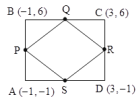
ABCD is a rectangle formed by the points $A (-1,-1), B (-1,6)$, $C (3,6)$ and $D (3,-1) . P , Q , R$ and S are mid-points of sides $A B, B C, C D$ and $D A$ respectively. Show that diagonals of the quadrilateral $\operatorname{PQRS}$ bisect each other.
Answer

Co-ordinates of point P are $\left(\frac{-1-1}{2}, \frac{-1+6}{2}\right)$ i.e. $\left(-1, \frac{5}{2}\right)$
Co-ordinates of point $Q$ are $\left(\frac{-1+3}{2}, \frac{6+6}{2}\right)$ i.e. $(1,6)$
Co-ordinates of point R are $\left(\frac{3+3}{2}, \frac{6-1}{2}\right)$ i.e. $\left(3, \frac{5}{2}\right)$
Co-ordinates of point S are $\left(\frac{-1+3}{2}, \frac{-1-1}{2}\right)$ i.e. $(1,-1)$
Co-ordinates of mid point of diagonal QS are $\left(\frac{1+1}{2}, \frac{6-1}{2}\right)$ i.e. $\left(1, \frac{5}{2}\right)$
Co-ordinates of mid point of diagonal PR are $\left(\frac{-1+3}{2}, \frac{\frac{5}{2}+\frac{5}{2}}{2}\right)$ i.e. $\left(1, \frac{5}{2}\right)$
Since coordinates of mid point of $QS =$ coordinates of mid point of PR
Therefore, diagonals PR and QS bisect each other.
Image
View full question & answer
Question 83 Marks
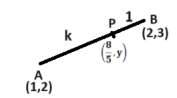
Find the ratio in which the point $\left(\frac{8}{5}, y\right)$ divides the line segment joining the points $(1,2)$ and $(2,3)$. Also, find the value of $y$.
Answer
Let $AP : PB = k : 1$
$\therefore \frac{2 k+1}{k+1}=\frac{8}{5}$
$\Rightarrow k=\frac{3}{2}$
$\therefore$ required ratio is $3: 2$.
$y=\frac{3 \times 3+2 \times 2}{3+2}=\frac{13}{5}$
Image
View full question & answer