Questions

2 Marks Questions

🎯

Test yourself on this topic

7 questions · timed · auto-graded

Question 12 Marks
$A (3,0), B (6,4)$ and $C (-1,3)$ are vertices of a triangle ABC . Find length of its median BE.
Answer

Mid-point of AC is $E\left(1, \frac{3}{2}\right)$
Length of median BE
$
=\sqrt{(6-1)^2+\left(4-\frac{3}{2}\right)^2}=\sqrt{\frac{125}{4}} \text { or } \frac{5 \sqrt{5}}{2}
$
View full question & answer
Question 22 Marks
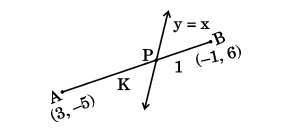
In what ratio is the line segment joining the points $(3,-5)$ and $(-1,6)$ divided by the line $y =x$ ?
Answer

Image
Let the required ratio be $K : 1$
Coordinates of point P are $\left(\frac{- K +3}{K+1}, \frac{6 K-5}{K+1}\right)$
Point $P$ lies on line $y=x \Rightarrow \frac{-K+3}{K+1}=\frac{6 K-5}{K+1}$
Solving, we get $K=\frac{8}{7}$
$\therefore$ Required ratio is $8: 7$
View full question & answer
Question 32 Marks
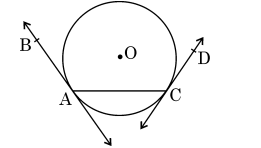
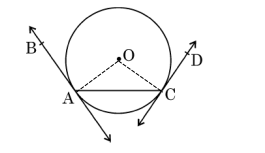
In the given figure, $AB$ and $CD$ are tangents to a circle centred at $O$ . Is $\angle BAC =\angle DCA$ ? Justify your answer.
Image
Answer
Image
$\text { Join } OA \text { and } OC$
$OA = OC$
$\angle OAC =\angle OCA$
$\text { Also, } \angle OAB =\angle OCD$
$\Rightarrow \angle OAC +\angle OAB =\angle OCA +\angle OCD$
$\Rightarrow \angle BAC =\angle DCA $
View full question & answer
Question 42 Marks
If $2 \sin (A+B)=\sqrt{3}$ and $\cos (A-B)=1$, then find the measures of angles A and B. $0 \leq A, B,(A+B) \leq 90^{\circ}$.
Answer

$
\sin (A+B)=\frac{\sqrt{3}}{2} \Rightarrow A+B=60^{\circ}.....(1)
$
$
\cos (A-B)=1 \Rightarrow A-B=0^{\circ}.....(2)$
Solving (1) and (2), we get $A=B=30^{\circ}$
View full question & answer
Question 52 Marks
Evaluate : $2 \sin ^2 30^{\circ} \sec 60^{\circ}+\tan ^2 60^{\circ}$.
Answer
$2 \sin ^2 30^{\circ} \sec 60^{\circ}+\tan ^2 60^{\circ}$
$=2 \times\left(\frac{1}{2}\right)^2 \times 2+(\sqrt{3})^2$
$=4$
View full question & answer
Question 62 Marks
Find the type of triangle $\text{ABC}$ formed whose vertices are $A (1,0), B (-5,0)$ and $C (-2,5)$.
Answer
$A(1,0) B(-5,0) C(-2,5)$
$AB=\sqrt{(-5-1)^2+(0-0)^2}=6$
$BC=\sqrt{(-5+2)^2+(0-5)^2}=\sqrt{34}$
$CA=\sqrt{(1+2)^2+(0-5)^2}=\sqrt{34}$
$\therefore BC=CA$
So, $\triangle ABC$ is isosceles.
View full question & answer
Question 72 Marks
Can the number $(15)^{ n }, n$ being a natural number, end with the digit 0 ? Give reasons.
Answer

$
15^n=5^n \times 3^n
$
A number ends with zero if it has two prime factors 2 and 5 both. Since $1 5 ^{ n }$ does not have 2 as a prime factor, so it can't end with zero
View full question & answer
2 Marks Questions - Maths STD 10 Questions - Vidyadip