Questions

3 Marks Question

Take a timed test

8 questions · self-marked practice — reveal the answer and mark yourself.

Question 13 Marks
Prove that the tangents drawn at the end points of a chord of a circle makes equal angles with the chord.
Answer
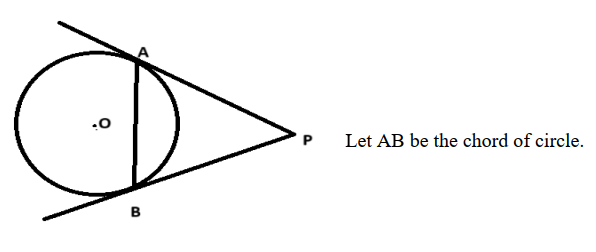
Image
In $\triangle PAB$
$PA = PB$
$\angle PAB =\angle PBA$
View full question & answer
Question 23 Marks
Prove that $\frac{\sin \theta-2 \sin ^3 \theta}{2 \cos ^3 \theta-\cos \theta}=\tan \theta$.
Answer

$\begin{aligned} \text { L.H.S } & =\frac{\sin \theta-2 \sin ^3 \theta}{2 \cos { }^3 \theta-\cos ^\theta \theta} \\ & =\frac{\sin \theta\left(1-2 \sin ^2 \theta\right)}{\cos \theta\left(2 \cos ^2 \theta-1\right)} \\ & =\frac{\tan \theta\left(1-2 \sin ^2 \theta\right)}{\left[2\left(1-\sin ^2 \theta\right)-1\right]} \\ & =\frac{\tan \theta\left(1-2 \sin ^2 \theta\right)}{\left(1-2 \sin ^2 \theta\right)} \\ & =\tan \theta=\text { R.H.S. }\end{aligned}$
View full question & answer
Question 33 Marks
$P (-2,5)$ and $Q (3,2)$ are two points. Find the coordinates of the point $R$ on line segment $PQ$ such that $PR=2QR$.
Answer
Let coordinates of $R$ be $(x ,y)$.
$PR: RQ=2: 1$
$x=\frac{2(3)+1(-2)}{2+1}=\frac{4}{3}$
$y=\frac{2(2)+1(5)}{2+1}=3$
$\therefore$ Cordinates of the point $R \left(\frac{4}{3}, 3\right)$
View full question & answer
Question 43 Marks
Find the ratio in which the line segment joining the points $(5,3)$ and $(-1,6)$ is divided by Y -axis.
Answer

Let the line segment divides y -axis at $(0, y )$.
Let the required ratio be $k : 1$
$
\begin{aligned}
\therefore \quad 0 & =\frac{(-1) k+5(1)}{k+1} \\
\Rightarrow \quad & k=5
\end{aligned}
$
Hence ratio is $5: 1$
View full question & answer
Question 63 Marks
Find the zeroes of the quadratic polynomial $x^2-15$ and verify the relationship between the zeroes and the coefficients of the polynomial.
Answer

Let $P(x)=x^2-15$
$
=(x-\sqrt{15})(x+\sqrt{15})
$
$\therefore$ Zeroes of $P ( x )$ are $-\sqrt{15}$ and $\sqrt{15}$
Verification-
Sum of zeroes $=-\sqrt{15}+\sqrt{15}=\frac{0}{1}=\frac{- \text { coefficient of } x}{\text { coefficient of } x^2}$
Product of zeroes $=-\sqrt{15} \times \sqrt{15}=-15=\frac{-15}{1}=\frac{\text { costant term }}{\text { coefficient of } x^2}$
View full question & answer
Question 73 Marks
The ratio of the $10^{\text {th }}$ term to its $30^{\text {th }}$ term of an $A.P.$ is $1: 3$ and the sum of its first six terms is $42$ . Find the first term and the common difference of $A.P.$
Answer
Let a be the first term and $d$ be the common difference.$\frac{a+9 d}{a+29 d}=\frac{1}{3}$
$\Rightarrow a=d ......(i)$
$\frac{6}{2}(2 a+5 d)=42$
$\Rightarrow 2 a+5 d=14.....(ii)$
Solving $(i)$ and $(ii)$
$a=2$ and $d=2$
View full question & answer
Question 83 Marks
If the sum of first $7$ terms of an $A.P.$ is $49$ and that of first $17$ terms is $289$, find the sum of its first $20$ terms.
Answer
Let a be the first term and d be the common difference.
$\frac{7}{2}(2 a+6 d)=49$
$a+3 d=7......(i)$
$S_{17}=289$
$\frac{17}{2}(2 a+16 d)=289$
$a+8 d=17......(ii)
\text{ solving (i) and (ii) }$
$d=2 a=1$
$S_{20}=\frac{20}{2}[2(1)+19(2)]$
$=400$
View full question & answer
3 Marks Question - Maths STD 10 Questions - Vidyadip