Question 13 Marks
Prove that the parallelogram circumscribing a circle is a rhombus.
Answer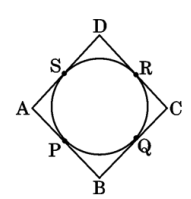
$\text {AP=AS----(i)}$
$\text {BP=BQ ---- (ii) }$
$\text {CR=CQ-----(iii)}$
$\text {DR=DS ---- (vi) }$
Adding $\text{(i), (ii), (iii) (iv)}$
$\text {AP+BP+CR+DR=AS+BQ+CQ+DS}$
$\Rightarrow \text {AB+CD=AD+BC}$
But $\text {A B C D}$ is a parallelogram $\Rightarrow \text {A B=C D}$ and $\text {A D=B C}$
$\therefore 2 AB=2 AD \text { or } AB=AD$
Hence, $\text {A B C D}$ is a rhombus.
View full question & answer→$\text {AP=AS----(i)}$
$\text {BP=BQ ---- (ii) }$
$\text {CR=CQ-----(iii)}$
$\text {DR=DS ---- (vi) }$
Adding $\text{(i), (ii), (iii) (iv)}$
$\text {AP+BP+CR+DR=AS+BQ+CQ+DS}$
$\Rightarrow \text {AB+CD=AD+BC}$
But $\text {A B C D}$ is a parallelogram $\Rightarrow \text {A B=C D}$ and $\text {A D=B C}$
$\therefore 2 AB=2 AD \text { or } AB=AD$
Hence, $\text {A B C D}$ is a rhombus.