Questions

3 Marks Question

Take a timed test

8 questions · self-marked practice — reveal the answer and mark yourself.

Question 13 Marks
An arc of a circle of radius 10 cm subtends a right angle at the centre of the circle. Find the area of the corresponding major sector. (Use $\pi=3 \cdot 14$ )
Answer
Area of circle $=3.14 \times 10 \times 10=314 cm^2$
Area of minor sector $=\frac{3.14 \times 10 \times 10 \times 90}{360}=\frac{157}{2} cm^2$ or $78.5 cm^2$
Area of major sector $=314-78.5=235.5 cm^2$
View full question & answer
Question 23 Marks
Three unbiased coins are tossed simultaneously. Find the probability of getting :
(i) at least one head.
(ii) exactly one tail.
(iii) two heads and one tail.
Answer
Total number of possible outcomes $=8$
(i) $ P ($ at least one head $)=\frac{7}{8}$
(ii) $ P ($ exactly one tail $)=\frac{3}{8}$
(iii) $P (2$ heads and one tail $)=\frac{3}{8}$
View full question & answer
Question 33 Marks
Prove that:
$
\frac{\tan A}{1-\cot A}+\frac{\cot A}{1-\tan A}=1+\sec A \operatorname{cosec} A
$
Answer
$\begin{aligned} LHS & =\frac{\frac{\sin A}{\cos A}}{\frac{(\sin A-\cos A)}{\sin A}}+\frac{\frac{\cos A}{\sin A}}{\frac{(\cos A-\sin A)}{\cos A}} \\ & =\frac{1}{(\sin A-\cos A)}\left[\frac{\sin ^2 A}{\cos A}-\frac{\cos ^2 A}{\sin A}\right] \\ & =\frac{1}{(\sin A-\cos A)} \times \frac{(\sin A-\cos A)\left(\sin ^2 A+\cos ^2 A+\sin A \cos A\right)}{\sin A \cos A} \\ & =\frac{1}{\sin A \cos A}+1 \\ & =1+\sec A \operatorname{cosec} A= RHS \end{aligned}$
View full question & answer
Question 43 Marks
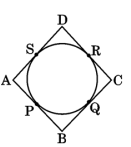
Prove that the parallelogram circumscribing a circle is a rhombus.
Answer
Image
$
\left.\begin{array}{rl}
\therefore AP & =AS \\
BP & =BQ \\
CR & =CQ \\
DR & =DS
\end{array}\right]
$
Adding,
$\ce{(AP + BP) + (CR + DR)=(AS + DS) + (BQ + CQ)}$
$ \Rightarrow \ce{AB + CD=AD + BC}$
Now $\ce{AB=CD}$ and $\ce{AD=BC}$
$\Rightarrow \ce{2 AB=2 BC}$
$\Rightarrow \ce{AB=BC}$
$\Rightarrow \ce{ABCD} \text { is a rhombus }$
View full question & answer
Question 53 Marks
The first term of an $A.P.$ is $5,$ the last term is $45$ and the sum of all the terms is $400 .$ Find the number of terms and the common difference of the $A.P.$
Answer
$ a =5, a _{ n }=45, S_{ n }=400$
$\frac{n}{2}(5+45)=400$
$\Rightarrow n =16$
$5+15 d=45$
$\Rightarrow d=\frac{40}{15} \text { or } \frac{8}{3}$
View full question & answer
Question 63 Marks
If the sum of the first $14$ terms of an $A.P.$ is $1050$ and the first term is $10 ,$ then find the $20^{\text {th }}$ term and the $n ^{\text {th }}$ term.
Answer
$\frac{14}{2}(20+13 d)=1050$
$\Rightarrow d=10$
$\therefore a_{20}=10+19 \times 10=200$
$ a_n=10+(n-1) 10=10 n$
View full question & answer
Question 73 Marks
Prove that $(\sqrt{2}+\sqrt{3})^2$ is an irrational number, given that $\sqrt{6}$ is an irrational number.
Answer
$
(\sqrt{2}+\sqrt{3})^2=2+3+2 \sqrt{6}=5+2 \sqrt{6}
$
Let us assume, to the contrary, that $5+2 \sqrt{6}$ is rational
$\therefore 5+2 \sqrt{6}=\frac{ a }{ b } ; a , b$ are integers, $b \neq 0$
$
\therefore \sqrt{6}=\frac{a-5 b}{2 b}
$
RHS is a rational number, whereas LHS is an irrational number.
$\therefore$ Our assumption is wrong.
$\Rightarrow 5+2 \sqrt{6}=(\sqrt{2}+\sqrt{3})^2$ is an irrational number
View full question & answer
Question 83 Marks
Prove that $\sqrt{3}$ is an irrational number.
Answer
Let $\sqrt{3}$ be a rational number.
$\therefore \sqrt{3}=\frac{ p }{ q }$, where $q \neq 0$ and $p \& q$ are coprime.
$3 q^2=p^2 \Rightarrow p^2$ is divisible by 3
$\Rightarrow p$ is divisible by $3----$ (i)
$\Rightarrow p =3 a$, where ' a ' is a postive integer
$9 a^2=3 q^2 \Rightarrow q^2=3 a^2 \Rightarrow q^2$ is divisible by 3
$\Rightarrow q$ is divisible by 3
(i) and (ii) leads to contradiction as ' $p$ ' and ' $q$ ' are coprime.
$\therefore \sqrt{3}$ is an irrational number.
View full question & answer
3 Marks Question - Maths STD 10 Questions - Vidyadip