Questions

Case study (4 Marks)

Take a timed test

3 questions · self-marked practice — reveal the answer and mark yourself.

Question 14 Marks
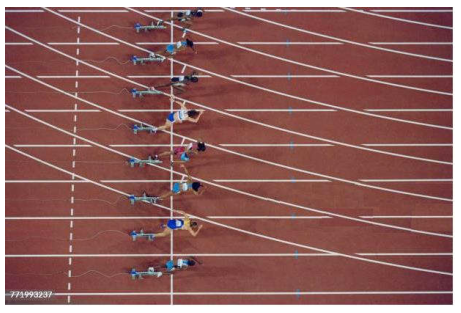
Activities like running or cycling reduce stress and the risk of menta disorders like depression. Running helps build endurance. Childrer develop stronger bones and muscles and are less prone to gain weight The physical education teacher of a school has decided to conduct an inte school running tournament in his school premises. The time taken by group of students to run 100 m , was noted as follows:
Image
Time (in seconds)0-2020-4040-6060-8080-100
Number of students8101363
Based on the above, answer the following questions:
(i) What is the median class of the above given data ?
(ii) (a) Find the mean time taken by the students to finish the race.
OR
(b) Find the mode of the above given data.
(iii) How many students took time less than 60 seconds?
Answer
Time (in sec)Number of students (f)Xicffi Xi
0-20810880
20-40103018300
40-60135031650
60-8067037420
80-10039040270
Total401720
(i) Correct Cummulative Frequency
Median class $=40-60$
(ii) (a) Correct table for $x _{ i }$ and $f _{ i } x _{ i }$
$
\text { Mean }=\frac{1720}{40}=43
$
OR
(b) Modal class $=40-60$
$
\begin{aligned}
\text { Mode } & =40+\frac{(13-10)}{(26-10-6)} \times 20 \\
& =46
\end{aligned}
$
(iii) 31 students took time less than 60 seconds
View full question & answer
Question 24 Marks
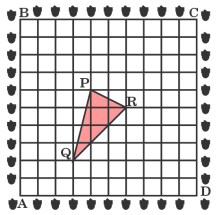
A garden is in the shape of a square. The gardener grew saplings of Ashoka tree on the boundary of the garden at the distance of $1 m$ from each other. He wants to decorate the garden with rose plants. He chose a triangular region inside the garden to grow rose plants. In the above situation, the gardener took help from the students of class $10$. They made a chart for it which looks like the given figure.
Image
Based on the above, answer the following questions :
$(i)$ If $A$ is taken as origin, what are the coordinates of the vertices of $\triangle PQR$ ?
$(ii) \ (a)$ Find distances $PQ$ and $QR$ .
OR
$(b)$ Find the coordinates of the point which divides the line segment joining points $P$ and $R$ in the ratio $2: 1$ internally.
$(iii)$ Find out if $\triangle PQR$ is an isosceles triangle.
Answer
$(i) P (4,6), Q (3,2), R (6,5)$
$(ii)\ (a) \ PQ =\sqrt{(4-3)^2+(6-2)^2}=\sqrt{17}$
$QR=\sqrt{(3-6)^2+(2-5)^2}=\sqrt{18}$
OR
$(b) $ The coordinate of required point are $\left(\frac{6 \times 2+1 \times 4}{3}, \frac{5 \times 2+1 \times 6}{3}\right)$
i.e. $\left(\frac{16}{3}, \frac{16}{3}\right)$
$(iii) \ PQ=\sqrt{(4-3)^2+(6-2)^2}=\sqrt{17}$
$QR=\sqrt{(3-6)^2+(2-5)^2}=\sqrt{18}$
$PR=\sqrt{(4-6)^2+(6-5)^2}=\sqrt{5}$
$PQ \neq QR \neq PR$
$\triangle PQR$ is not isosceles
View full question & answer
Question 34 Marks
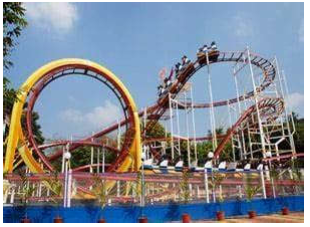
Essel World is one of India's largest amusement parks that offers a diverse range of thrilling rides, water attractions and entertainment options for visitors of all ages. The park is known for its iconic "Water Kingdom" section, making it a popular destination for family outings and fun$-$filled adventure. The ticket charges for the park are $₹ 150$ per child and $₹ 250$ per adult.
Image
On a day, the cashier of the park found that $300$ tickets were sold and an amount of $₹ 55,000$ was collected.
Based on the above, answer the following questions :
$(i)$ If the number of children visited be $x$ and the number of adults visited be $y$, then write the given situation algebraically.
$(ii) (a)$ How many children visited the amusement park that day?
OR
$(b)$ How many adults visited the amusement park that day?
$(iii)$ How much amount will be collected if $250$ children and $100$ adults visit the amusement park?
Answer
$(i)x+y=300 \ldots \ldots \text { (i) }$
$150 x+250 y=55000 \ldots \ldots(ii)$
$(ii) (a)$ Solving equation $(i)$ and $(ii)$
Number of children visited park $(x)=200$
OR
$(b)$ Solving equation $(i)$ and $(ii)$
Number of adults visited park $( y )=100$
$(iii)$ Amount collected $=250 \times 150+100 \times 250 =₹62500$
View full question & answer
Case study (4 Marks) - Maths STD 10 Questions - Vidyadip