Questions

2 Marks Questions

🎯

Test yourself on this topic

7 questions · timed · auto-graded

Question 12 Marks
What is the angle subtended at the centre of a circle of radius 6 cm by an arc of length $3 \pi$ cm?
Answer
We have
R = 6 cm
Length of the arc = $3 \pi cm$
as we know that arc length = $\frac{\theta}{360} \times 2 \pi r$
Substituting the values we get,
$3 \pi=\frac{\theta}{360} \times 2 \pi \times 6$...(1)
Now we will simplify the equation (1) as below,
$3 \pi=\frac{\theta}{360} \times 12 \pi$
$3 \pi=\frac{\theta}{30} \times \pi$
$3=\frac{\theta}{30}$
$\theta=90^{\circ}$
Therefore, the angle subtended at the centre of the circle is $90^{\circ}$.
View full question & answer
Question 22 Marks
To warm ships for underwater rocks, a lighthouse spreads a red coloured light over a sector of angle 80° to a distance of 16.5 km. Find the area of the sea over which the ships are warned.(use $\pi=3.14$ )
Answer
We have, r = 16.5 km and $\theta=80^{\circ}$.
Let A be the area of the sea over which the ships are warmed. Then,
$A=\frac{\theta}{360} \times \pi r^2=\frac{80}{360} \times 3.14 \times 16.5 \times 16.5 km^2=189.97 km^2$
View full question & answer
Question 32 Marks
If $\operatorname{cosec}^2 \theta(1+\cos \theta)(1-\cos \theta)=\lambda$.
Answer
Given:
$\operatorname{cosec}^2 \theta(1+\cos \theta)(1-\cos \theta)=\lambda$
$\Rightarrow \operatorname{cosec}^2 \theta\{(1+\cos \theta)(1-\cos \theta)\}=\lambda$
$\Rightarrow \quad \operatorname{cosec}^2 \theta\left(1-\cos ^2 \theta\right)=\lambda$
$\Rightarrow \quad \operatorname{cosec}^2 \theta \sin ^2 \theta=\lambda$
$\Rightarrow \quad \frac{1}{\sin ^2 \theta} \times \sin ^2 \theta=\lambda$
$\Rightarrow \quad 1=\lambda$
$\Rightarrow \quad \lambda=1$
Thus, the value of $\lambda$ is 1.
View full question & answer
Question 42 Marks
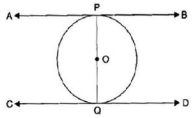
Prove that the tangents drawn at the ends of a diameter of a circle are parallel
Answer

Image
Given: PQ is a diameter of a circle with centre O.
The lines AB and CD are the tangents at P and Q respectively.
To Prove:$AB \| CD$
Proof: Since AB is a tangent to the circle at P and OP is the radius through the point of contact.
$\therefore \angle OPA =90^{\circ}$........ (i)
[The tangent at any point of a circle is $\perp$ to the radius through the point of contact]
$\because C D$ is a tangent to the circle at Q and OQ is the radius through the point of contact.
$\therefore \angle OQD =90^{\circ}$........ (ii)
[The tangent at any point of a circle is $\perp$ to the radius through the point of contact]
From eq. (i) and (ii), $\angle OPA =\angle OQD$
But these form a pair of equal alternate angles also,
$\therefore AB \| CD$
View full question & answer
Question 52 Marks
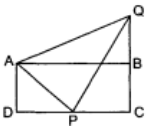
In the given figure, ABCD is a rectangle. P is mid-point of DC. If QB = 7 cm, AD = 9 cm and DC = 24 cm, then prove that $\angle APQ =90^{\circ}$.
Image
Answer
According to question it is given that ABCD is a rectangle and p is the midpoint of DC.
$\therefore A D=B C=9 cm$
QC = BQ + BC = 7 + 9 = 16 cm
$P C=\frac{1}{2} C D \Rightarrow P C=12 cm$
In right $\triangle PCQ$ using Pythagoras theorem
$PQ ^2= QC ^2+ PC ^2$
$P Q^2=16^2+12^2=400 \Rightarrow P Q=20 cm$
In right $\triangle ABQ$ using Pythagoras theorem
$AQ ^2= AB ^2+ BQ ^2 \Rightarrow AQ ^2=24^2+7^2=625$
$\Rightarrow A Q=25 cm$
In right $\triangle ADP$ using Pythagoras theorem
$AP ^2= AD ^2+ DP ^2 \Rightarrow AP ^2=9^2+12^2$
$\Rightarrow AP ^2=81+144$
$\Rightarrow AP ^2=255$
In $\triangle APQ$
$AP ^2=15^2=225$
$PQ ^2=20^2=400 \Rightarrow AP ^2+ PQ ^2=625$
Also, $AQ ^2=25^2=625 \Rightarrow AQ ^2= AP ^2+ PQ ^2$
$\therefore \triangle APQ$ is a right angled $\triangle($ using converse of BPT $)$
$\therefore \angle APQ =90^{\circ}$

View full question & answer
Question 62 Marks
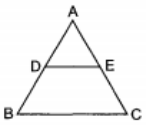
In figure, D and E are points on AB and AC respectively, such that $DE \| BC$. If $AD =\frac{1}{3} BD , AE =4.5 cm$ find AC.
Image
Answer
According to question it is given that D and E are the points on sides AB and AC respectively
Also $AD =\frac{1}{3} BD$,
$AE =4.5 cm, DE \| BC$
$\therefore \quad \frac{ AD }{ BD }=\frac{ AE }{ EC }$
$\Rightarrow \quad \frac{\frac{1}{3} BD }{ BD }=\frac{4.5}{ EC }$
$\Rightarrow \quad \frac{1}{3}=\frac{4.5}{E C}$
$\Rightarrow \quad EC =4.5 \times 3 cm$
Now, AC = AE + EC = 4.5 + 13.5 = 18 cm
View full question & answer
Question 72 Marks
Is the pair of linear equation consistent/inconsistent? If consistent, obtain the solution graphically: 2x – 2y – 2 = 0; 4x – 4y – 5 = 0
Answer
2 x - 2 y - 2 = 0................(1)
4 x - 4 y - 5 = 0..................(2)
Here, $a_1=2, \quad b=-2, c_1=-2$
$a_2=4, b_2=-4, c_2=-5$
We see that $\frac{a_1}{a_2}=\frac{b_1}{b_2} \neq \frac{c_1}{c_2}$
Hence, the lines represented by the equations(1) and ( 2 ) are parallel.
Therefore, equations ( 1) and (2) have no solution, i.e., the given pair of a linear equation is inconsistent.
View full question & answer
2 Marks Questions - Maths STD 10 Questions - Vidyadip