Questions

3 Marks Question

🎯

Test yourself on this topic

8 questions · timed · auto-graded

Question 13 Marks
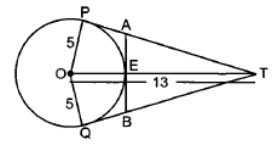
In figure, $O$ is the centre of a circle of radius $5 \ cm. T$ is a point such that $OT = 13 \ cm$ and $OT$ intersects circle at $E$. If $AB$ is a tangent to the circle at $E,$ find the length of $AB$. where $TP$ and $TQ$ are two tangents to the circle.
Image
Answer
According to the question,
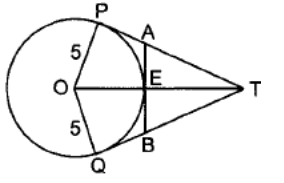
$O$ is the centre of a circle of radius $5 \ cm. T$ is a point such that $OT = 13 \ cm$ and $OT$ intersects circle at $E$.
Image
$\because OP \perp TP \ [$Radius from point of contact of the tangent$]$
$\therefore \angle OPT =90^{\circ}$
In right $\triangle OPT $
$OT ^2= OP ^2+ PT ^2$
$\Rightarrow(13)^2=(5)^2+ PT ^2 $
$\Rightarrow PT =12 \ cm$
Let $AP = x \ cm\  AE = AP $
$\Rightarrow AE = x \ cm$
and $AT =(12- x ) \ cm$
$TE = OT - OE $
$=13-5=8 \ cm$
$\because OE \perp AB \ [$Radius from the point of contact$]$
$\therefore \angle AEO =90^{\circ} $
$\Rightarrow \angle AET =90^{\circ}$
In right $\triangle AET$,
$AT^2=AE^2+ET^2$
$(12-x)^2=x^2+8^2$
$\Rightarrow 144+x^2-24 x=x^2+64$
$\Rightarrow 24 x=80 $
$\Rightarrow x=\frac{80}{24}=\frac{10}{3} \ cm$
Also $BE = AE =\frac{10}{3} \ cm$
$\Rightarrow A B=\frac{10}{3}+\frac{10}{3}$
$=\frac{20}{3} \ cm$
View full question & answer
Question 23 Marks
A plane left $30$ minutes late than its scheduled time and in order to reach the destination $1500 \ km $ away in time, it had to increase its speed by $100 \ km/h$ from the usual speed. Find its usual speed.
Answer
Let the usual speed of the plane $=x \ km / hr$.
Distance to the destination $=1500 \ km$
Case $(i)$:
we know that, Speed $=\frac{\text { Distance }}{\text { Time }}$
$\Rightarrow \text { Time }=\frac{\text { Distance }}{\text { speed }}$
So, in case(i) Time $=\frac{1500}{x} Hrs$
Case $(ii)$
Distance to the destination $=1500 \ km$
Increased speed $=100 \ km / hr$
So, speed $=x+100$
So, in case $(ii)$ Time $=\frac{1500}{x+100} Hrs$
So, according to the question
$\therefore \frac{1500}{x}-\frac{1500}{x+100}=\frac{30}{60}$
$\Rightarrow x^2+100 x-300000=0$
$\Rightarrow x^2+600 x-500 x-300000=0$
$\Rightarrow(x+600)(x-500)=0$
$\Rightarrow x=500 \text { or } x=-600$
Since, speed can not be negative, $x=500$
Therefore, Speed of plane $=500 \ km / hr$.
View full question & answer
Question 33 Marks
The percentage of marks obtained by $100$ students in an examination are given below:
Marks $30-35$ $35-40$ $40-45$ $45-50$ $50-55$ $55-60$ $60-65$
Frequency $14$ $16$ $18$ $23$ $18$ $8$ $3$
Determine the median percentage of marks.
Answer
Marks $($Class$)$ Number of Students $($Frequency$)$ Cumulative frequency
$30-35$ $14$ $14$
$35-40$ $16$ $30$
$40-45$ $18$ $48$
$45-50$ $23$ $71 ($Median class$)$
$50-55$ $18$ $89$
$55-60$ $8$ $97$
$60-65$ $3$ $100$
Here, $N =100$
Therefore, $\frac{N}{2}=50$, This observation lies in the class $45-50.$
$l$ (the lower limit of the median class$) =45$
$cf ($the cumulative frequency of the class preceding the median class$) =48$
$f ($the frequency of the median class$) =23$
$h ($the class size$) =5$
$\text { Median }=l+\left(\frac{\frac{n}{2}-cf}{f}\right) h$
$=45+\left(\frac{50-48}{23}\right) \times 5$
$=45+\frac{10}{23}=45.4$
So, the median percentage of marks is $45.4 .$
View full question & answer
Question 43 Marks
Prove that: $\frac{\tan \theta+\sec \theta-1}{\tan \theta-\sec \theta+1}=\frac{1+\sin \theta}{\cos \theta}$
Answer
We have,
$\text { LHS }=\frac{\tan \theta+\sec \theta-1}{\tan \theta-\sec \theta+1}$
$\Rightarrow \text { LHS }=\frac{(\tan \theta+\sec \theta)-1}{(\tan \theta-\sec \theta)+1}$
$\Rightarrow \text { LHS }=\frac{(\sec \theta+\tan \theta)-\left(\sec ^2 \theta-\tan ^2 \theta\right)}{\tan \theta-\sec \theta+1} \quad\left[\because \sec ^2 \theta-\tan ^2 \theta=1\right]$
$\Rightarrow \text { LHS }=\frac{(\sec \theta+\tan \theta)-(\sec \theta+\tan \theta)(\sec \theta-\tan \theta)}{\tan \theta-\sec \theta+1}$
$\Rightarrow \text { LHS }=\frac{(\sec \theta+\tan \theta)[1-(\sec \theta-\tan \theta)]}{\tan \theta-\sec \theta+1}$
$\Rightarrow \text { LHS }=\frac{(\sec \theta+\tan \theta)(1-\sec \theta+\tan \theta)}{(\tan \theta-\sec \theta+1)}$
$\Rightarrow \text { LHS }=\frac{(\sec \theta+\tan \theta)(\tan \theta-\sec \theta+1)}{(\tan \theta-\sec \theta+1)}$
$\Rightarrow \text { LHS }=\sec \theta+\tan \theta=\frac{1}{\cos \theta}+\frac{\sin \theta}{\cos \theta}=\frac{1+\sin \theta}{\cos \theta}=\text { RHS }$
View full question & answer
Question 53 Marks
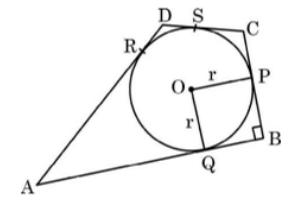
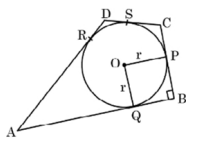
In the given figure, a circle is inscribed in a quadrilateral $\text{ABCD }$ in which $\angle B =90^{\circ}$. If $AD =17 \ cm, AB =20 \ cm $ and $DS =3 \ cm,$ then find the radius of the circle.
Image
Answer
Image
$D R=D S=3 \ cm$
$\therefore A R=A D-D R$
$=17-3=14 \ cm$
$\Rightarrow A Q=A R=14 \ cm$
$\therefore Q B=A B-A Q$
$=20-14=6 \ cm$
Since $ Q B=O P=r$
$ \therefore$ radius $=6 \ cm$
View full question & answer
Question 63 Marks
A two$-$digit number is $4$ times the sum of its digits. If $18$ is added to the number, the digits are reversed. Find the number.
Answer
Let us suppose that the digit at unit place be $x$
Suppose the digit at tens place be $y.$
Thus, the number is $10y + x.$
According to question it is given that the number is $4$ times the sum of the two digits.
Therefore, we have
$10 y+x=4(x+y)$
$\Rightarrow 10 y+x=4 x+4 y$
$\Rightarrow 4 x+4 y-10 y-x=0$
$\Rightarrow 3 x-6 y=0$
$\Rightarrow 3(x-2 y)=0$
$\Rightarrow x-2 y=0$"
After interchanging the digits, the number becomes $10x + y.$
Again according to question If $18$ is added to the number, the digits are reversed.
Thus, we have
$(10 y + x )+18=10 x + y$
$\Rightarrow 10 x + y -10 y - x =18$
$\Rightarrow 9 x -9 y =18$
$\Rightarrow 9( x - y )=18$
$\Rightarrow x-y=\frac{18}{9}$
$\Rightarrow x - y =2$
Therefore, we have the following systems of equations
$x - 2y = 0..............(1)$
$x - y = 2..............(2)$
Here $x$ and $y$ are unknowns.
Now let us solve the above systems of equations for $x$ and $y.$
Subtracting the equation $(1)$ from the $(2),$ we get
$(x-y)-(x-2 y)=2-0$
$\Rightarrow x-y-x+2 y=2$
$\Rightarrow y=2$
Now, substitute the value of $y$ in equation $(1),$ we get
$x-2 \times 2=0$
$\Rightarrow x-4=0$
$\Rightarrow x=4$
Therefore the number is $10 \times 2+4=24$
Thus the number is $24$
View full question & answer
Question 73 Marks
If $\alpha$ and $\beta$ are the zeros of the polynomial $f ( x )=6 x ^2+ x -2$, find the value of $\left(\frac{\alpha}{\beta}+\frac{\beta}{\alpha}\right)$
Answer
Let $f(x)=6 x^2+x-2$
$a=6, b=1 $ and $c=-2$
And $\alpha$ and $\beta$ are the zeros of polynomial,
$\alpha+\beta=-\frac{b}{a}=-\frac{1}{6}$
$\alpha \beta=\frac{c}{a}=\frac{-2}{6}=\frac{-1}{3}$
$\therefore \frac{\alpha}{\beta}+\frac{\beta}{\alpha}=\frac{\alpha^2+\beta^2}{\alpha \beta}$
$=\frac{(\alpha+\beta)^2-2 \alpha \beta}{\alpha \beta}$
$=\frac{\left(-\frac{1}{6}\right)^2-2\left(-\frac{1}{3}\right)}{\left(-\frac{1}{3}\right)}$
$=-\frac{\frac{1}{36}+\frac{2}{3}}{\frac{1}{3}}$
$=-\frac{\frac{25}{36}}{\frac{1}{3}}$
$=-\frac{25}{36} \times \frac{3}{1}$
$=-\frac{25}{12}$
View full question & answer
Question 83 Marks
Prove that $3+\sqrt{5}$ is an irrational number.
Answer
Let $3+\sqrt{5}$ is a rational number.
$3+\sqrt{5}=\frac{p}{q}, q \neq 0$
$3+\sqrt{5}=\frac{p}{q}$
$\Rightarrow \sqrt{5}=\frac{p}{q}-3$
$\Rightarrow \sqrt{5}=\frac{p-3 q}{q}$
Now in $\ce{RHS} \frac{p-3 q}{p}$ is rational
This shows that $\sqrt{5}$ is rational
But this contradict the fact that $\sqrt{5}$ is irrational,
This is because we assumed that $3+\sqrt{5}$ is a rational number.
$\therefore 3+\sqrt{5}$ is an irrational number.
View full question & answer
3 Marks Question - Maths STD 10 Questions - Vidyadip