Question 14 Marks
Read the text carefully and answer the questions:
Radio towers are used for transmitting a range of communication services including radio and television. The tower will either act as an antenna itself or support one or more antennas on its structure. On a similar concept, a radio station tower was built in two Sections $A$ and $B$ . Tower is supported by wires from a point $O$ .Distance between the base of the tower and point $O$ is $36 \ cm$ . From point $O,$ the angle of elevation of the top of the Section B is $30^{\circ}$ and the angle of elevation of the top of Section $A$ is $45^{\circ}$.
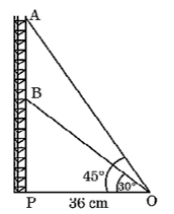
$(a)$ Find the length of the wire from the point $O$ to the top of Section $B$ .
$(b)$ Find the distance $AB$ .
OR
Find the height of the Section $A$ from the base of the tower.
$(c)$ Find the area of $\triangle OPB$.
Radio towers are used for transmitting a range of communication services including radio and television. The tower will either act as an antenna itself or support one or more antennas on its structure. On a similar concept, a radio station tower was built in two Sections $A$ and $B$ . Tower is supported by wires from a point $O$ .Distance between the base of the tower and point $O$ is $36 \ cm$ . From point $O,$ the angle of elevation of the top of the Section B is $30^{\circ}$ and the angle of elevation of the top of Section $A$ is $45^{\circ}$.
$(a)$ Find the length of the wire from the point $O$ to the top of Section $B$ .
$(b)$ Find the distance $AB$ .
OR
Find the height of the Section $A$ from the base of the tower.
$(c)$ Find the area of $\triangle OPB$.
Answer
View full question & answer→Radio towers are used for transmitting a range of communication services including radio and television. The tower will either act
as an antenna itself or support one or more antennas on its structure. On a similar concept, a radio station tower was built in two Sections $A$ and $B$. Tower is supported by wires from a point $O$.
Distance between the base of the tower and point $O$ is $36 \ cm$. From point $O,$ the angle of elevation of the top of the Section B is $30^{\circ}$ and the angle of elevation of the top of Section A is $45^{\circ}$.
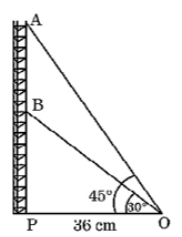
$(i)$ Let the length of wire $BO = x \ cm$
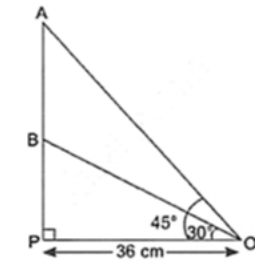
$\therefore \cos 30^{\circ}=\frac{P O}{B O}$
$\Rightarrow \frac{\sqrt{3}}{2}=\frac{36}{x}$
$\Rightarrow x=\frac{36 \times 2}{\sqrt{3}} \times \frac{\sqrt{3}}{\sqrt{3}}$
$=12 \times 2 \sqrt{3}$
$=24 \sqrt{3} \ cm$
$(ii)\text { In } \triangle APO, \tan 45^{\circ}=\frac{A P}{P O}$
$\Rightarrow 1=\frac{A P}{36}$
$\Rightarrow AP=36 \ cm \ldots(i)$
Now, In $\triangle PBO$,
$\tan 30^{\circ}=\frac{B P}{P O}$
$\Rightarrow \frac{1}{\sqrt{3}}=\frac{B P}{36}$
$\Rightarrow BP=\frac{36}{\sqrt{3}} \times \frac{\sqrt{3}}{\sqrt{3}}$
$=\frac{36}{3} \sqrt{3}$
$=12 \sqrt{3} \ cm$
$\therefore AB=AP-BP$
$=36-12 \sqrt{3} \ cm$
OR
$\text { In } \triangle APO, \tan 45^{\circ}=\frac{A P}{36}$
$1=\frac{A P}{36}$
$A=36 \ cm$
Height of section $A$ from the base of the tower $= AP =36 \ cm$.
$(iii)$ In $\triangle OPB$
$\tan 30^{\circ}=\frac{B P}{P O}$
$\Rightarrow \frac{1}{\sqrt{3}}=\frac{B P}{36}$
$BP=\frac{36}{\sqrt{3}}$
$=\frac{36}{\sqrt{3}} \times \frac{\sqrt{3}}{\sqrt{3}}$
$=12 \sqrt{3} \ cm$
Now, Area of $\triangle OPB =\frac{1}{2} \times$ height $\times$ base
$=\frac{1}{2} \times BP \times OP$
$=\frac{1}{2} \times 12 \sqrt{3} \times 36$
$=216 \sqrt{3} \ cm^2$
as an antenna itself or support one or more antennas on its structure. On a similar concept, a radio station tower was built in two Sections $A$ and $B$. Tower is supported by wires from a point $O$.
Distance between the base of the tower and point $O$ is $36 \ cm$. From point $O,$ the angle of elevation of the top of the Section B is $30^{\circ}$ and the angle of elevation of the top of Section A is $45^{\circ}$.
$(i)$ Let the length of wire $BO = x \ cm$
$\therefore \cos 30^{\circ}=\frac{P O}{B O}$
$\Rightarrow \frac{\sqrt{3}}{2}=\frac{36}{x}$
$\Rightarrow x=\frac{36 \times 2}{\sqrt{3}} \times \frac{\sqrt{3}}{\sqrt{3}}$
$=12 \times 2 \sqrt{3}$
$=24 \sqrt{3} \ cm$
$(ii)\text { In } \triangle APO, \tan 45^{\circ}=\frac{A P}{P O}$
$\Rightarrow 1=\frac{A P}{36}$
$\Rightarrow AP=36 \ cm \ldots(i)$
Now, In $\triangle PBO$,
$\tan 30^{\circ}=\frac{B P}{P O}$
$\Rightarrow \frac{1}{\sqrt{3}}=\frac{B P}{36}$
$\Rightarrow BP=\frac{36}{\sqrt{3}} \times \frac{\sqrt{3}}{\sqrt{3}}$
$=\frac{36}{3} \sqrt{3}$
$=12 \sqrt{3} \ cm$
$\therefore AB=AP-BP$
$=36-12 \sqrt{3} \ cm$
OR
$\text { In } \triangle APO, \tan 45^{\circ}=\frac{A P}{36}$
$1=\frac{A P}{36}$
$A=36 \ cm$
Height of section $A$ from the base of the tower $= AP =36 \ cm$.
$(iii)$ In $\triangle OPB$
$\tan 30^{\circ}=\frac{B P}{P O}$
$\Rightarrow \frac{1}{\sqrt{3}}=\frac{B P}{36}$
$BP=\frac{36}{\sqrt{3}}$
$=\frac{36}{\sqrt{3}} \times \frac{\sqrt{3}}{\sqrt{3}}$
$=12 \sqrt{3} \ cm$
Now, Area of $\triangle OPB =\frac{1}{2} \times$ height $\times$ base
$=\frac{1}{2} \times BP \times OP$
$=\frac{1}{2} \times 12 \sqrt{3} \times 36$
$=216 \sqrt{3} \ cm^2$