Questions

2 Marks Questions

Take a timed test

7 questions · self-marked practice — reveal the answer and mark yourself.

Question 12 Marks
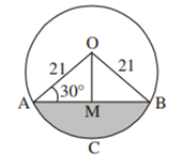
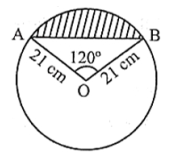
Find the area of the segment shown in Fig., if radius of the circle is $21 \ cm$ and $\angle A O B=120^{\circ}$ $($Use $\pi=\frac{22}{7} )$
Image
Answer
Draw $OM \perp AB$
Image
$\angle OAB =\angle OBA =30^{\circ}$
$\sin 30^{\circ}=\frac{1}{2}=\frac{ OM }{21} $
$\Rightarrow OM =\frac{21}{2}$
$\cos 30^{\circ}=\frac{\sqrt{3}}{2}=\frac{ AM }{21} $
$\Rightarrow AM =\frac{21}{2} \sqrt{3}$
$\text { Area of } \triangle OAB =\frac{1}{2} \times AB \times OM $
$=\frac{1}{2} \times 21 \sqrt{3} \times \frac{21}{2}$
$=\frac{441}{4} \sqrt{3} \ cm^2$
$\therefore \text { Area of shaded region }=\text { Area (sector OACB) - Area }(\triangle OAB )$
$=\frac{22}{7} \times 21 \times 21 \times \frac{120}{360}-\frac{441}{4} \sqrt{3}$
$=\left(462-441 \frac{\sqrt{3}}{4}\right) \ cm ^2 $ or $ 271.3 \ cm^2 \ ($approx.$)$
View full question & answer
Question 22 Marks
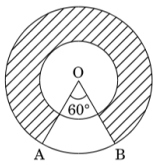
In Figure, two concentric circles with centre $O$, have radii $21 \ cm$ and $42 \ cm .$ If $\angle AOB=60^{\circ},$ find the area of the shaded region.
Image
Answer
Area of shaded region
$=\left[\pi(42)^2-\pi(21)^2\right] \frac{300^{\circ}}{360^{\circ}}$
$=\frac{22}{7} \times 63 \times 21 \times \frac{5}{6}$
$=3465 \ cm^2$
View full question & answer
Question 32 Marks
Prove the trigonometric identity: $\frac{\tan \theta}{\left(1+\tan ^2 \theta\right)^2}+\frac{\cot \theta}{\left(1+\cot ^2 \theta\right)^2}=\sin \theta \cos \theta$
Answer
$\frac{\tan \theta}{\left(1+\tan ^2 \theta\right)^2}+\frac{\cot \theta}{\left(1+\cot ^2 \theta\right)^2}$
$=\frac{\tan \theta}{\left(\sec ^2 \theta\right)^2}+\frac{\cot \theta}{\left(\operatorname{cosec}^2 \theta\right)^2}$
$=\frac{\sin \theta}{\cos \theta} \times \frac{1}{\sec ^4 \theta}+\frac{\cos \theta}{\sin \theta} \times \frac{1}{\operatorname{cosec} 4}$
$=\frac{\sin \theta}{\cos \theta} \times \cos ^4 \theta+\frac{\cos \theta}{\sin \theta} \times \sin ^4 \theta$
$=\sin \theta \cos ^3 \theta+\cos \theta \sin ^3 \theta$
$=\sin \theta \cos \theta\left(\cos ^2 \theta+\sin ^2 \theta\right)$
$=\sin \theta \cos \theta=\text { RHS }$
Hence proved.
View full question & answer
Question 42 Marks
If $\sin \theta+\sin ^2 \theta=1$, find the value of $\cos ^{12} \theta+3 \cos ^{10} \theta+3 \cos ^8 \theta+\cos ^6 \theta+2 \cos ^4 \theta+2 \cos ^2 \theta-2$
Answer
We have,
$\sin \theta+\sin ^2 \theta=1 \Rightarrow \sin \theta=1-\sin ^2 \theta \Rightarrow \sin \theta=\cos ^2 \theta$
$\therefore \cos ^{12} \theta+3 \cos ^{10} \theta+3 \cos ^8 \theta+\cos ^6 \theta+2 \cos ^4 \theta+2 \cos ^2 \theta-2$
$=\left(\cos ^{12} \theta+3 \cos ^{10} \theta+3 \cos ^8 \theta+\cos ^6 \theta\right)+2\left(\cos ^4 \theta+\cos ^2 \theta-1\right)$
$=\left(\cos ^4 \theta+\cos ^2 \theta\right)^3+2\left(\cos ^4 \theta+\cos ^2 \theta-1\right)$
$=\left(\sin ^2 \theta+\cos ^2 \theta\right)^3+2\left(\sin ^2 \theta+\cos ^2 \theta-1\right)$
$\left[\because \cos ^2 \theta=\sin \theta \because \cos ^4 \theta=\sin ^2 \theta\right]$
$=1+2(1-1)=1$
View full question & answer
Question 52 Marks
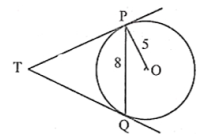
In Fig., PQ is a chord of length 8 cm of a circle of radius 5 cm and centre $O$. The tangents at $P$ and $Q$ intersect at point T. Find the length of TP.
Image
Answer
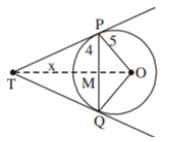
Join OT and OQ.
$
TP=TQ
$
Image
$\therefore TM \perp PQ$ and bisects PQ
Hence $PM =4 cm$
Therefore $OM =\sqrt{25-16}=\sqrt{9}=3 cm$.
Let $TM = x$
From $\triangle$ PMT, $PT ^2= x ^2+16$
From $\triangle POT , PT ^2=( x +3)^2-25$
Hence $x^2+16=x^2+9+6 x-25$
$
\Rightarrow 6 x=32 \Rightarrow x=\frac{16}{3}
$
Hence $PT ^2=\frac{256}{9}+16=\frac{400}{9}$
$
\therefore PT=\frac{20}{3} cm .
$
View full question & answer
Question 62 Marks
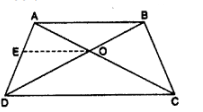
The diagonals of a quadrilateral $\text{ABCD}$ intersect each other at the point $O$ such that $\frac{A O}{B O}=\frac{C O}{D O}$. Show that $\text{ABCD}$ is a trapezium.
Answer
Given: The diagonals of a quadrilateral $\text{ABCD}$ intersect each other at the point $O$ such that $\frac{A O}{B O}=\frac{C O}{D O}$
To prove: $\text{ABCD}$ is trapezium.
Construction: Through $O$ draw a line $OE |\mid BA$ intersecting $AD$ at $E$.
Proof: In $\triangle D B A$
$ \because O E \| B A$
Image
$\therefore \frac{D O}{B O}=\frac{D E}{A E} $
$\Rightarrow \frac{C O}{A O}=\frac{D E}{A E}$
$\because \frac{A O}{B O}=\frac{C O}{D O} \ [$ Given$]$
$\Rightarrow \frac{D O}{B O}=\frac{C O}{A O} $
$\Rightarrow \frac{A O}{C O}=\frac{A E}{D E} ...........[$Taking reciprocals$]$
$\therefore \text { In } \triangle A D C$
$OE \| CD ............. [$By converse basic proportionality theorem$]$
But $OE \| BA$
$BA \| CD ............ [$By construction$]$
The quadrilateral $\text{ABCD}$ is a Trapezium.
View full question & answer
Question 72 Marks
Prove that $\frac{1}{\sqrt{2}}$ is irrational.
Answer
Let us assume, to the contrary, that is $\frac{1}{\sqrt{2}}$ rational.
So, we can find coprime integers a and $b (\neq 0)$ such that
$\frac{1}{\sqrt{2}}=\frac{a}{b} \Rightarrow \sqrt{2}=\frac{b}{a}$
Since, a and b are integers, $\frac{b}{a}$ is rational, and so is $\sqrt{2}$ rational
But this contradicts the fact that is $\sqrt{2}$ irrational.
So, we conclude that is $\frac{1}{\sqrt{2}}$ irrational.
View full question & answer
2 Marks Questions - Maths STD 10 Questions - Vidyadip