Questions

3 Marks Question

🎯

Test yourself on this topic

8 questions · timed · auto-graded

Question 13 Marks
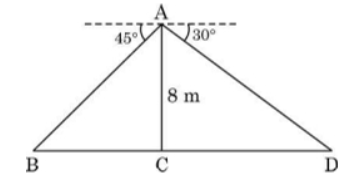
From a point on a bridge across a river, the angles of depression of the banks on opposite sides of the river are $30^{\circ}$ and $45^{\circ}$. If the bridge is at a height of $8 m$ from the banks, then find the width of the river.
Image
Answer
If the line through $A$ is the bridge
In $ \triangle ACB, \angle B=45^{\circ}$
$AC=8$
$BC=AC, \sqrt{3}=8 \sqrt{3}$
In $ \triangle ACD, \angle D=30^{\circ}$
$CD=AC=8$
Hence width of the river $8+8 \sqrt{3}=8(1+\sqrt{3}) m$
View full question & answer
Question 23 Marks
Prove the trigonometric identity: $\frac{\cot ^2 \theta(\sec \theta-1)}{(1+\sin \theta)}+\frac{\sec ^2 \theta(\sin \theta-1)}{(1+\sec \theta)}=0$
Answer
$\text { LHS }=\frac{\cot ^2 \theta(\sec \theta-1)}{(1+\sin \theta)}+\frac{\sec ^2 \theta(\sin \theta-1)}{(1+\sec \theta)}$
$=\frac{\cot ^2 \theta(\sec \theta-1)(1+\sec \theta)+\sec ^2 \theta(\sin \theta-1)(1+\sin \theta)}{(1+\sin \theta)(1+\sec \theta)}$
$=\frac{\cot ^2 \theta\left(\sec ^2 \theta-1\right)+\sec ^2 \theta\left(\sin ^2 \theta-1\right)}{(1+\sin \theta)(1+\sec \theta)}$
$=\frac{\cot ^2 \theta \tan ^2 \theta+\sec ^2 \theta\left(-\cos ^2 \theta\right)}{(1+\sin \theta)(1+\sec \theta)}$
$=\frac{\cot ^2 \theta \tan ^2 \theta-\sec ^2 \theta \cos ^2 \theta}{(1+\sin \theta)(1+\sec \theta)}$
$=\frac{\cot ^2 \theta \times \frac{1}{\cot ^2 \theta}-\sec ^2 \theta \times \frac{1}{\sec ^2 \theta}}{(1+\sin \theta)(1+\sec \theta)}$
$=\frac{1-1}{(1+\sin \theta)(1+\sec \theta)}$
$=0$
$=\text { RHS }$
View full question & answer
Question 33 Marks
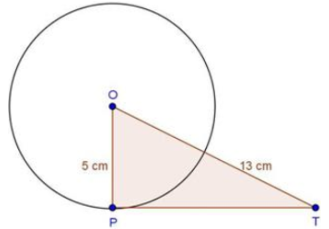
Find the length of a tangent drawn to a circle with radius $5 \ cm ,$ from a point $13 \ cm$ from the centre of the circle.
Answer
According to question draw a circle with centre $O$ and radius $5 \ cm$ also given that $T$ is any point outside of the circle
Now,Since tangent at a point on the circle is perpendicular to the radius through the point.
Image
Therefore, $OP$ is perpendicular to $PT$.
In right triangle $\text{OPT},$ we have
$OT^2=OP^2+PT^2$
$\Rightarrow(13)^2=(5)^2+PT^2$
$\Rightarrow PT^2=13^2-5^2$
$\Rightarrow PT^2=169-25$
$\Rightarrow PT^2=144$
$\Rightarrow PT^2=12^2$
$\Rightarrow PT=12 \ cm$
Hence, the length of a tangent is $12 \ cm$ .
View full question & answer
Question 43 Marks
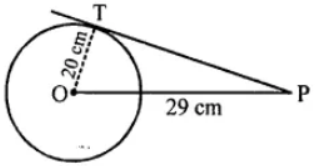
A point $P$ is at a distance of $29 \ cm$ from the centre of a circle of radius $20 \ cm .$ Find the length of the tangent drawn from $P$ to the circle.
Answer
$PT$ is the tangent to the circle with centre $O$ and radius $OT =20 \ cm$. $P$ is a point $29 \ cm$ away from $O$.
Image
$OP=29 \ cm, OT=20 \ cm$
$OT$ is radius and $PT$ is the tangent
$OT \perp PT$
Now, in right $\triangle OPT$,
$OP^2=OT^2+PT^2($ Pythagoras Theorem $)$
$\Rightarrow(29)^2=(20)^2+PT^2$
$\Rightarrow 841=400+PT^2$
$\Rightarrow PT^2=841-400$
$\Rightarrow PT^2=441=(21)^2$
$\Rightarrow PT=21$
Length of tangent, $PT =21 \ cm$
View full question & answer
Question 53 Marks
A 2-digit number is four times the sum of its digits and twice the product of its digits. Find the number.
Answer
Let the ten's place digit be y and unit's place be x .
Therefore, number is $10 y + x$.
According to given condition,
$10 y+x=4(x+y)$ and $10 y+x=2 x y$
$\Rightarrow x =2 y$ and $10 y + x =2 xy$
Putting $x=2 y$ in $10 y+x=2 x y$
$10 y +2 y =2.2 y \cdot y$
$12 y =4 y ^2$
$4 y^2-12 y=0 \Rightarrow 4 y(y-3)=0$
$\Rightarrow y-3=0$ or $y =3$
Hence, the ten's place digit is 3 and units digit is $6(2 y=x)$
Hence the required number is 36 .
View full question & answer
Question 63 Marks
To fill a swimming pool two pipes are used. If the pipe of larger diameter used for $4$ hours and the pipe of smaller diameter for $9$ hours, only half of the pool can be filled. Find how long it would take for each pipe to fill the pool separately, if the pipe of smaller diameter takes $10$ hours more than the pipe of larger diameter to fill the pool.
Answer
According to question,two pipes are used to fill a swimming pool.
Pipe with larger diameter is used for $4$ hours and pipe with smaller diameter is used for $9$ hours.
Let $x$ hours be the total time taken by the larger pipe to fill the tank
so in $1$ hour it would fill $\frac{1}{x}$ part of the tank.
Similarly, $y$ hours are needed for the smaller pipe,
then in $1$ hour it would fill $\frac{1}{y}$ part.
So $,  y=10+x \ldots(1)$
$\frac{4}{x}+\frac{9}{y}=1 / 2\ $  using $(1), $
$\frac{4}{x}+\frac{9}{10+x}=1 / 2$
$\Rightarrow x^2-16 x-80=0$
$\Rightarrow(x-20)(x+4)=0$
Since value of $x$ cannot be negative
Therefore, $x=20$ and $y=30$
Hence, Larger diameter pipe fills in $20$ hours, and
Smaller diameter pipe fills in $30$ hours.
View full question & answer
Question 73 Marks
Point $A$ is on $x-$ axis, point $B$ is on $y-$ axis and the point $P$ lies on line segment $A B,$ such that $P(4,-5)$ and $A P$ : $PB =5: 3$. Find the coordinates of point $A$ and $B$ .
Answer
Let coordinates of $A$ are $(x, 0)$ and coordinates of $B$ are $(0, y)$
Image
Using section formula, we get
$4=\frac{5 \times 0+3 \times x}{5+3}$
$\Rightarrow 32=3 x$
$\Rightarrow x=\frac{32}{3}$
Similarly, $5=\frac{5 \times y+3 \times 0}{5+3}$
$\Rightarrow 40=5 y$
$\Rightarrow y=8$
$\therefore$ Coordinate of $A$ are $\left(\frac{32}{3}, 0\right)$ and coordinates of $B$ are $(0,8)$.
View full question & answer
Question 83 Marks
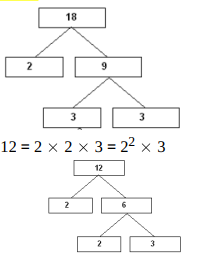
There is a circular path around a sports field. Sonia takes 18 minutes to drive one round of the field, while Ravi takes 12 minutes for the same. Suppose they both start at the same point and the same time and go in the same direction. After how many minutes will they meet again at the starting point?
Answer
By taking LCM of time taken (in minutes) by Sonia and Ravi, We can get the actual number of minutes after which they meet again at the starting point after both start at the same point and at the same time, and go in the same direction.
$
18=2 \times 3 \times 3=2 \times 3^2

Image
$
\operatorname{LCM}(18,12)=2^2 \times 3^2=36
$
Therefore, both Sonia and Ravi will meet again at the starting point after 36 minutes.
View full question & answer
3 Marks Question - Maths STD 10 Questions - Vidyadip