Questions

3 Marks Question

🎯

Test yourself on this topic

8 questions · timed · auto-graded

Question 13 Marks
Two tangents $TP$ and $TQ$ are drawn to a circle with centre $O$ from an external point $T$ . Prove that $\angle PTQ =2 \angle OPQ$.
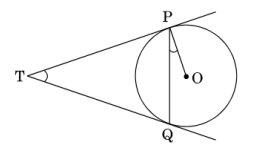
Image
Answer
$ TP = TQ \ldots  ($length of tangents drawn from external points$) $
$\therefore \angle TQP =\angle TPQ ( $angles oppo to equal sides are equal$) $
$OP \perp TP (\because \text { at point of contact radius and tangent are } \perp r )$
$\angle OPT =90^{\circ}$
$\angle OPQ +\angle CPQ =90^{\circ}$
$\angle TPQ =90-\angle OPQ$
$\text { Now, In } \triangle PTQ$
$\angle TPQ +\angle PTQ +\angle QTP =180^{\circ}$
$90^{\circ}-\angle OPQ +90-\angle OPQ +\angle PTQ =180^{\circ}$
$\angle PTQ =2 \angle OPQ$
$\text { Proved. }$
View full question & answer
Question 23 Marks
The sum of $5^{\text {th }}$ and $9^{\text {th }}$ terms of an $A.P.$ is $72$ and the sum of $7^{th}$ and $12^{th}$ terms is $97$ .Find the $A.P.$
Answer
It is given that the sum of $5^{\text {th }}$ and $9^{\text {th }}$ terms of an $A.P.$ is $72$ and the sum of $7^{th}$ and $12^{th}$ terms is $97.$
Let "a "be the first term and 'd' be the common difference of the Arithmetic progression .
It is given that $a_5+a_9=72$ and, $a_7+a_{12}=97$
$\Rightarrow(a+4 d)+(a+8 d)=72$ and, $(a+6 d)+(a+11 d)=97$
Therefore, we have
$\Rightarrow 2 a+12 d=72 \ldots(1)$
$\Rightarrow 2 a+17 d=97 \ldots(2)$
Subtracting $(1)$ from $(2),$ we get
$2 a+17 d-2 a-12 d=97-72$
$\Longrightarrow 5 d=25$
$\Rightarrow d=5$
Putting $d=5$ in $(1),$ we get
$2 a+60=72 \Rightarrow 2 a=12 \Rightarrow a=6$
Therefore, $a=6$ and $d=5$
Hence, the Arithmetic Progression $a,a+d,a+2d .....$ is $6,11,16,21,26, \ldots . .$.
View full question & answer
Question 33 Marks
If the median of the following frequency distribution is $32.5 $. Find the values of $f_1$ and $f_2$.
Class $0 - 10$ $10 - 20$ $20 - 30$ $30 - 40$ $40 - 50$ $50 - 60$ $60 - 70$ Total
Frequency $f _1$ $5$ $9$ $12$ $f _2$ $63$ $2$ $40$
Answer
Let $f _1$ and $f _2$ be the frequencies of class intervals $0-10$ and $40-50$.
$f_1+5+9+12+f_2+3+2=40$
$\Rightarrow f_1+f_2=9$
Median is $32.5$ which lies in $30-40,$ so the median class is $30-40$.
$l=30, h=10, f=12, N=40$ and  $c=f_1+5+9=\left(f_1+14\right)$
Now, median $=l+\left[h \times \frac{\left(\frac{N}{2}-c\right)}{f}\right]$
$\Rightarrow 32.5=\left[30+\left(10 \times \frac{20-f_1-14}{12}\right)\right]$
$=\left[30+\left(10 \times \frac{6-f_1}{12}\right)\right]$
$=\left[30+\left(\frac{30-5 f_1}{6}\right)\right]$
$\frac{30-5 f_1}{6}=2.5$
$30-5 f_1=15$
$5 f_1=15 $
$\Rightarrow f_1=3$
$f_1=3 $ and $ f_2=(9-3)=6$
View full question & answer
Question 43 Marks
Prove that $\left(\frac{1+\tan ^2 A}{1+\cot ^2 A}\right)=\left(\frac{1-\tan A}{1-\cot A}\right)^2=\tan ^2 A$
Answer
First, we will show that, $\frac{1+\tan ^2 A}{1+\cot ^2 A}=\tan ^2 A$
$\text { LHS }=\frac{1+\tan ^2 A}{1+\cot ^2 A}$
$=\frac{1+\tan ^2 A}{1+\frac{1}{\tan ^2 A}}$
$=\frac{1+\tan ^2 A}{\frac{1+\tan ^2 A}{\tan ^2 A}}$
$=\left(1+\tan ^2 A\right) \times \frac{\tan ^2 A}{1+\tan ^2 A}$
$=\tan ^2 A=\text { RHS } \ldots . \text { (i) }$
Now, we will show that, $\left(\frac{1-\tan A}{1-\cot A}\right)^2=\tan ^2 A$
$\text { LHS }=\left(\frac{1-\tan A}{1-\cot A}\right)^2$
$=\left(\frac{1-\tan A}{1-\frac{1}{\tan A}}\right)^2$
$=\left(\frac{1-\tan A}{\frac{\tan A-1}{\tan A}}\right)^2$
$=\left[(1-\tan A) \times\left(\frac{\tan A}{-(1-\tan A)}\right)\right]^2$
$=(\tan A)^2$
$=\tan ^2 A$
$=\text { RHS } \ldots \text { (ii) }$
Hence, from $(i)$ and $(ii),$
$\frac{1+\tan ^2 A}{1+\cot ^2 A}$
$=\left(\frac{1-\tan A}{1-\cot A}\right)^2$
$=\tan ^2 A$
Hence proved.
View full question & answer
Question 53 Marks
In the given figure, $O$ is the centre of the circle and $TP$ is the tangent to the circle from an external point $T$ . If $\angle P B T=30^{\circ}$, prove that $BA : AT =2: 1$.

Image
Answer
$O$ is the centre of the circle and $TP$ is the tangent to the circle from an external point $T$.

Image

From figure, $AB$ is the diameter
Since, angle in a semicircle is a right angle
$\angle A P B=90^{\circ}$
By using alternate segment theorem
We have $\angle A P B=\angle P A T=30^{\circ}$
Now, in $\triangle APB$
$\angle BAP+\angle APB+\angle ABP=180^{\circ} \text { (Angle sum property of triangle) }$
$\angle BAP=180^{\circ}-90^{\circ}-30^{\circ}=60^{\circ}$
Now, $\angle BAP =\angle APT +\angle PTA$ (Exterior angle property)
$60^{\circ}=30^{\circ}+\angle PTA$
$\angle P T A=60^{\circ}-30^{\circ}=30^{\circ}$
We know that sides opposite to equal angles are equal
$AP=AT$
In right triangle $\text{ABP ,}$
$\sin 30^{\circ}=\frac{AT}{BA}$
$\Rightarrow \frac{1}{2}=\frac{AT}{BA}$
$\therefore B A: A T=2: 1$
View full question & answer
Question 63 Marks
If the last term of an $A.P. $ of $30$ terms is $119$ and the $8^{\text {th }}$ term from the end $($towards the first term$)$ is $91$ , then find the common difference of the $A.P.$ Hence, find the sum of all the terms of the $A.P.$
Answer
Given, last term, $ l = 119$
No. of terms in $A.P. =30$
8th term from the end $=91$
Let d be a common difference and assume that the first term of $A.P.$ is $119 ($from the end$)$
Since the $n _{ th }$ term of $AP$ is
$\text { an }=1+(n-1) d$
$\therefore a 8=119+(8-1) d$
$\Rightarrow 91=119+7 d$
$\Rightarrow 7 d=91-119$
$\Rightarrow 7 d=-28$
$\Rightarrow d=-4$
Now, this common difference is from the end of $A.P.$
So, the common difference from the beginning $=- d$
$=(-4)=4$
Thus, a common difference for the $A.P.$ is $4 .$
Now, using the formula
$I=a+(n-1) d$
$\Rightarrow 119=a+(30-1) 4$
$\Rightarrow 119=a+29 \times 4$
$\Rightarrow 119=a+116$
$\Rightarrow a=119-116$
$\Rightarrow a=3$
Hence, using the formula for the sum of $n$ terms of an $A.P.$
$\text { i.e., } S_n=\frac{n}{2}[2 a+(n-1) d]$
$S 30=\frac{30}{2}[2 \times 3+(30-1) \times 4]$
$=15(6+29 \times 4)$
$=15 \times 122$
$=1830$
Therefore, the sum of $30$ terms of an $A.P.$ is $1830$
View full question & answer
Question 73 Marks
Find the quadratic polynomial, sum and product of whose zeroes are $-1$ and $-20$ respectively. Also find the zeroes of the polynomial so obtained.
Answer
Sum of the zeroes: $(2+\beta)=(-1)$
Product of the zeroes : $2 \beta=-20$
So, required Quadratic polynomial
$=\left[x^2+(\alpha+\beta) x+2 \beta\right]$
$=\left[x^2+(-1) x+(-20]\right.$
$=x^2-x-20$
$\Rightarrow x^2-x-20=0$ is the polynomial
View full question & answer
Question 83 Marks
Find the greatest number that will divide $445, 572$ and $699$ leaving remainders $4, 5$ and $6$ respectively.
Answer
We have to find the greatest number that divides $445,572$ and $699$ and leaves remainders of $4,5$ and $6$ respectively. This means when the number divides $445,572$ and $699$, it leaves remainders $4,5$ and $6$ . It means that
$445-4=441$
$572-5=567$
$\text { and } 699-6=693$
are completely divisible by the required number.
For the highest number which divides the above numbers we need to calculate $\text{HCF}$ of $441, 567$ and $693 .$
Therefore, the required number is the $\text{H.C.F.}$ of $441, 567$ and $693$ Respectively.
First, consider $441$ and $567.$
By applying Euclid's division lemma, we get
$567=441 \times 1+126$
$441=126 \times 3+63$
$126=63 \times 2+0$
Therefore, $\text{H.C.F.}$ of $441$ and $567=63$
Now, consider $63$ and $693$
again we have to apply Euclid's division lemma, we get
$693=63 \times 11+0 \text {. }$
Therefore, $\text{H.C.F.}$ of $441,567$ and $693$ is $63$
Hence, the required number is $63.63$ is the highest number which divides $445,572$ and 699 will leave $4,5$ and $6$ as remainder respectively.
View full question & answer
3 Marks Question - Maths STD 10 Questions - Vidyadip