Questions

2 Marks Questions

🎯

Test yourself on this topic

7 questions · timed · auto-graded

Question 12 Marks
Find the area of the segment of a circle of radius $14 \ cm,$ if the length of the corresponding arc $\text{APB}$ is $22 \ cm.$
Answer
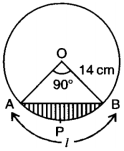
Image
$l = APB = 22 \ cm$
$\frac{\theta}{180^{\circ}} \times \frac{22}{7} \times 14=22 \ cm$
$\Rightarrow \theta=90^{\circ}$
Area of the sector $=\frac{l r}{2}=\frac{22 \times 14}{2}=154 \ cm^2$
Area of triangle $AOB =\frac{1}{2} \times OA \times OB =\frac{1}{2} \times 14 \times 14=98 \ cm^2$
Area of the segment $=(154-98) \ cm ^2=56 \ cm^2$
View full question & answer
Question 22 Marks
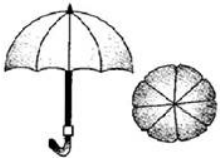
An umbrella has 8 ribs which are equally spaced (see figure). Assuming umbrella to be a flat circle of radius 45 cm, Find the area between the two consecutive ribs of the umbrella.
Image
Answer
Here, $r =45 cm$ and $\theta=\frac{360^{\circ}}{8}=45^{\circ}$
Area between two consecutive ribs of the umbrella $=\frac{\theta}{360^{\circ}} \times \pi r^2$ $=\frac{45^{\circ}}{360^{\circ}} \times \frac{22}{7} \times 45 \times 45=\frac{22275}{28} cm^2$
View full question & answer
Question 32 Marks
If $\sin \alpha=\frac{1}{\sqrt{2}}$ and $\cot \beta=\sqrt{3}$, then find the value of $ \operatorname{cosec} \alpha+\operatorname{cosec} \beta$.
Answer
$\operatorname{cosec} \alpha=\frac{1}{\sin \alpha}=\sqrt{2}$
$\operatorname{cosec} \beta=\sqrt{1+\cot ^2 \beta}=\sqrt{1+3}=2$
$\therefore \operatorname{cosec} \alpha+\operatorname{cosec} \beta=\sqrt{2}+2 \text { or } \sqrt{2}(\sqrt{2}+1)$
View full question & answer
Question 42 Marks
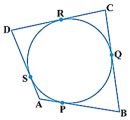
A quadrilateral ABCD is drawn to circumscribe a circle. Prove that AB + CD = AD + BC
Image
Answer

Image
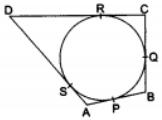
We know that the lengths of tangents drawn from an exterior point to a circle are equal.
AP = AS, ... (i) [tangents from A]
BP = BQ, ... (ii) [tangents from B]
CR = CQ, ... (iii) [tangents from C]
DR = DS. ... (iv) [tangents from D]
AB + CD = (AP + BP) + (CR + DR)
= (AS + BQ) + (CQ + DS) [using (i), (ii), (iii), (iv)]
= (AS + DS) + (BQ + CQ)
= AD + BC.
Hence, AB + CD = AD + BC.
View full question & answer
Question 52 Marks
Answer
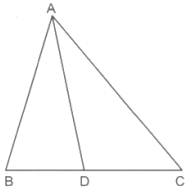
It is given that, AB = 6 cm, AC = 8 cm, BD = 1.5 cm and CD = 2 cm
We have to check whether AD is bisector of $\angle A$
First we will check proportional ratio between sides
So, $\frac{A B}{A C}=\frac{B D}{D C}$
$\Rightarrow \frac{6}{8}=\frac{1.5}{2}$
$\Rightarrow \frac{3}{4}=\frac{3}{4}$
Therefore, the sides are proportional.
Hence, AD is bisector of $\angle A$
View full question & answer
Question 62 Marks
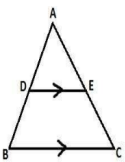
In $\triangle ABC , D$ and $E$ are the points on the sides AB and AC respectively such that DE||BC. If AD = 6x - 7, DB = 4x - 3, AE = 3x - 3 and EC = 2x - 1, find the value of x.
Answer

Image
Given: In $\triangle ABC , DE \| BC$. Also $AD =6 x -7, DB =4 x -3, AE =3 x -3$ and $EC =2 x -1$
By basic proportionality theorem,
$\frac{A D}{D B}=\frac{A E}{E C}$
$\Rightarrow \frac{6 x-7}{4 x-3}=\frac{3 x-3}{2 x-1}$
$\Rightarrow(6 x-7)(2 x-1)=(3 x-3)(4 x-3)$
$\Rightarrow 12 x^2-6 x-14 x+7=12 x^2-9 x-12 x+9$
$\Rightarrow-20 x+7=-21 x+9$
$\Rightarrow-20 x+21 x=9-7$
$\Rightarrow x=2$
View full question & answer
Question 72 Marks
On comparing the ratios $\frac{a_1}{a_2}, \frac{b_1}{b_2}$ and $\frac{c_1}{c_2}$, , find out whether the lines representing the pair of linear equations intersect at a point, are parallel or coincide: 6x − 3y + 10 = 0; 2x – y + 9 = 0.
Answer
Given equations are
6x − 3y + 10 = 0
2x – y + 9 = 0
Comparing equation 6x − 3y + 10 = 0 with $a_1 x+b_1 y+c_1=0$
and 2x – y + 9 = 0 with
$a_2 x+b_2 y+c_2=0$
We get, $a_1=6, b_1=-3, c_1=10, a_2=2, b_2=-1, c_2=9$
Hence, lines are parallel to each other.
View full question & answer
2 Marks Questions - Maths STD 10 Questions - Vidyadip