Questions

3 Marks Question

🎯

Test yourself on this topic

8 questions · timed · auto-graded

Question 13 Marks
Two different dice are rolled together. Find the probability of getting (i) the sum of numbers on two dice to be 5, (ii) even number on both dice, (iii) a doublet.
Answer
When two dice are thrown simultaneously, all possible outcomes are
(1,1), (1,2), (1,3), (1,4), (1,5), (1,6),
(2,1), (2,2), (2,3), (2,4), (2,5), (2,6),
(3,1), (3,2), (3,3), (3,4), (3,5), (3,6),
(4,1), (4,2), (4,3), (4,4), (4,5), (4,6),
(5,1), (5,2), (5,3), (5,4), (5,5), (5,6),
(6,1), (6,2), (6,3), (6,4), (6,5), (6,6).
Number of all possible outcomes = 36.
i. Let $E _1$ be the event of getting two numbers whose sum is 5.
Then, the favourable outcomes are (1,4) (2,3), (3,2), (4,1). Number of favourable outcomes = 4.
$\therefore P ($ getting two numbers whose sum is 5$)=P\left(E_2\right)=\frac{4}{36}=\frac{1}{9}$
ii. Let $E_2$ be the event of getting even numbers on both dice.
Then, the favourable outcomes are
(2,2), (2,4), (2,6), (4,2), (4,4), (4,6), (6,2), (6,4), (6,6). Number of favourable outcomes = 9.
$\therefore P ($ getting even number on both dice $)=P\left(E_2\right)=\frac{9}{36}=\frac{1}{4}$
iii. Let $E_3$ be the event of getting a doublet.
Then, the favourable outcomes are
(1,1), (2,2), (3,3), (4,4), (5,5), (6,6).
Number of favourable outcomes = 6.
$\therefore P ($ getting a doublet $)= P )=P\left(E_3\right)=\frac{0}{36}=\frac{1}{6}$.
View full question & answer
Question 23 Marks
Prove: $\frac{1}{(\cot A)(\sec A )-\cot A }-\operatorname{cosec} A =\operatorname{cosec} A -\frac{1}{(\cot A)(\sec A )+\cot A}$
Answer
To prove-
$\frac{1}{(\cot A)(\sec A )-\cot A }-\operatorname{cosec} A =\operatorname{cosec} A -\frac{1}{(\cot A)(\sec A )+\cot A}$
Taking LHS
$=\frac{1}{(\cot A)(\sec A)-\cot A}-\operatorname{cosec} A$
$=\frac{1}{\left(\frac{\cos A}{\sin A}\right)\left(\frac{1}{\cos A}\right)-\left(\frac{\cos A}{\sin A}\right)}-\frac{1}{\sin A}$
$\frac{1}{\left(\frac{1}{\sin A}\right)-\left(\frac{\cos A}{\sin A}\right)}-\frac{1}{\sin A}=\frac{1}{\frac{1-\cos A}{\sin A}}-\frac{1}{\sin A}=\frac{\sin A}{1-\cos A}-\frac{1}{\sin A}=\frac{\sin ^2 A-1+\cos A}{(1-\cos A) \sin A}$
$=\frac{-\cos ^2 A+\cos A}{(1-\cos A) \sin A}=\frac{\cos A(1-\cos A)}{(1-\cos A) \sin A}\left\{\because \sin ^2 A+\cos ^2 A=1\right\}$
$=\frac{\cos A}{\sin A}=\cot A$
Now, taking RHS
$=\operatorname{cosec} A -\frac{1}{(\cot A)(\sec A )+\cot A}$
$=\frac{1}{\sin A}-\frac{1}{\left(\frac{\cos A}{\sin A}\right)\left(\frac{1}{\cos A}\right)+\frac{\cos A}{\sin A}}$
$=\frac{1}{\sin A}-\frac{1}{\left(\frac{1}{\sin A}\right)+\frac{\cos A}{\sin A}}=\frac{1}{\sin A}-\frac{\sin A}{(1+\cos A)}$
$=\frac{1+\cos A-\sin ^2 A}{(1+\cos A) \sin A}=\frac{\cos ^2 A+\cos A}{(1+\cos A) \sin A}$
$=\frac{\cos A(\cos A+1)}{(1+\cos A) \sin A}=\frac{\cos A}{\sin A}$
$=\cot A = LHS$
View full question & answer
Question 33 Marks
Prove that $\frac{\sin \theta-\cos \theta+1}{\sin \theta+\cos \theta-1}=\frac{1}{\sec \theta-\tan \theta}$, using identity $\sec ^2 \theta=1+\tan ^2 \theta$.
Answer
We have to prove that, $\frac{\sin \theta-\cos \theta+1}{\sin \theta+\cos \theta-1}=\frac{1}{\sec \theta-\tan \theta}$ using identity $\sec ^2 \theta=1+\tan ^2 \theta$
LHS $=\frac{\sin \theta-\cos \theta+1}{\sin \theta+\cos \theta-1}=\frac{\tan \theta-1+\sec \theta}{\tan \theta+1-\sec \theta}$ [ dividing the numerator and denominator by $\cos \theta$.]
$=\frac{(\tan \theta+\sec \theta)-1}{(\tan \theta-\sec \theta)+1}=\frac{\{(\tan \theta+\sec \theta)-1\}(\tan \theta-\sec \theta)}{\{(\tan \theta-\sec \theta)+1\}(\tan \theta-\sec \theta)}$ [ Multiplying and dividing by $\left.(\tan \theta-\sec \theta)\right]$
$=\frac{\left(\tan ^2 \theta-\sec ^2 \theta\right)-(\tan \theta-\sec \theta)}{\{(\tan \theta-\sec \theta)+1\}(\tan \theta-\sec \theta)}\left[\because(a-b)(a+b)=a^2-b^2\right]$
$=\frac{-1-\tan \theta+\sec \theta}{(\tan \theta-\sec \theta+1)(\tan \theta-\sec \theta)}\left[\because \tan ^2 \theta-\sec ^2 \theta=-1\right]$
$=\frac{-(\tan \theta-\sec \theta+1)}{(\tan \theta-\sec \theta+1)(\tan \theta-\sec \theta)}=\frac{-1}{\tan \theta-\sec \theta}$
$=\frac{1}{\sec \theta-\tan \theta}= R H S$
Hence Proved.
View full question & answer
Question 43 Marks
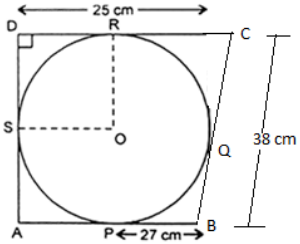
$\text{ABCD}$ is a quadrilateral such that $\angle D=90^{\circ}$. A circle $C (O, r)$ touches the sides $\text{AB, BC, CD}$ and $\text{DA}$ at $\text{P, Q, R}$ and $\text{S}$ respectively. If $\ce{BC = 38 \ cm, CD = 25 \ cm}$ and $\ce{BP = 27 \ cm,}$ Find $r.$
Answer
Image
Given that $\text{ABCD}$ is a quadrilateral such that $\angle D=90^{\circ}$.
$\text{BC} = 38 \ cm,\text{CD}= 25\ cm$ and $\text{BP} = 27 \ cm$
$\therefore$ From the figure,
$\text{BP = BQ}= 27 \ cm [$Tangents from an external point are equal $]$
Now, $\text{BC} = 38$
$\Rightarrow \text{BQ+QC}=38$
$\Rightarrow 27+\text{QC}=38$
$\Rightarrow \text{QC}=38-27$
$\Rightarrow \text{QC}=11 \ cm$
$\therefore \text{QC} =11 \ cm= \text{CR}$ [Tangents from an external point are equal]
$\text{CD} = 25 \ cm$
$\text{CR + RD}=25$
$\Rightarrow 11+\text{RD}=25$
$\Rightarrow \text{RD}=25-11$
$\Rightarrow \text{RD}=14 \ cm$
Also,
$\text{RD = DS}= 14 \ cm [$Tangents from an external point are equal$]$
$\text{OR}$ and $\text{OS}$ are radii of the circle.
From tangents $R$ and $S, \angle \text{ORD}=\angle \text{OSD}=90^{\circ}$
Thus, $\text{ORDS}$ is a square.
$\text{OR = DS} = 14 \ cm$
Hence, the radius of the circle, $r = \text{OR} = 14 \ cm$
View full question & answer
Question 53 Marks
The sum of a two-digit number and the number obtained by reversing the order of its digits is 165. If the digits differ by 3, find the number.
Answer
Let the digits at units and tens place of the given number be x and y respectively.
Then,
Number = $10 y+x$...........(i)
Number obtained by reversing the order of the digits = $10 x+y$
According to the question,
(10y + x) + (10x + y) = 165
$\Rightarrow x+y=15$
and, $x-y=3$
Thus, we obtain the following systems of linear equations.
i. $x+y=15$
x − y = 3
ii. x + y = 15
y − x = 3
Solving first system of equations, we get
x = 9, y = 6
Solving second system of equation, we. get
x = 6, y = 9
Substituting the values of x and y in equation (i), we have
Number = 69 or, 96.
View full question & answer
Question 63 Marks
The sum of the digits of a two-digit number is 9. Also, nine times this number is twice the number obtained by reversing the order of the number. Find the number. Solve the pair of the linear equation obtained by the elimination method.
Answer
Let the unit's digit and the ten's digit in the two-digit number be x and y respectively.
Then the number = 10y + x
Also, the number obtained by reversing the order of the digits = 10x + y
According to the question,
x + y = 9...............(1)
9(10y + x) = 2(10x + y)
$\Rightarrow$90y + 9x = 20x + 2y
$\Rightarrow$11x - 88y = 0
$\Rightarrow$x - 8y = 0 ..............(2)
Subtracting equation(2) from equation(1), we get
9y = 9
$\Rightarrow \quad y=\frac{9}{9}=1$
Substituting this value of y in equation (1), we get
x + 1 = 9
$\Rightarrow x=9-1=8$
Hence, the required number is 18.
Verification: substituting x = 8 and y = 1,
we find that both the equations (1) and (2) are satisfied as shown below:
x + y = 8 + 1 = 9
x - 8y = 8 - 8(1) = 0
Hence, the solution is correct.
View full question & answer
Question 73 Marks
Find the zeroes of the given quadratic polynomials and verify the relationship between the zeroes and the coefficients. $6 x^2-3-7 x$
Answer
Let $p(x)=6 x^2-3-7 x$
For zeroes of $p(x),$
$p(x) = 0$
$\Rightarrow 6 x ^2-3-7 x =0$
$\Rightarrow 6 x ^2-7 x -3=0$
$\Rightarrow 6 x ^2-9 x +2 x -3=0$
$\Rightarrow 3 x (2 x -3)+(2 x -3)=0$
$\Rightarrow(2 x -3)(3 x +1)=0$
$\Rightarrow 2 x -3=0$ or $3 x +1=0$
$\Rightarrow x=\frac{3}{2}$ or $x=-\frac{1}{3}$
$\Rightarrow x=\frac{3}{2},-\frac{1}{3}$
So, the zeroes of $p(x)$ are $\frac{3}{2}$ and $-\frac{1}{3}$
We observe that Sum of its zeroes $=\frac{3}{2}+\left(-\frac{1}{3}\right)=\frac{3}{2}-\frac{1}{3}$
$=\frac{3}{2}+\left(-\frac{1}{3}\right)=\frac{3}{2}-\frac{1}{3}$
$=\frac{9-2}{6}=\frac{7}{6}=\frac{-(-7)}{6}$
$=-\frac{\text { Coefficient of } x}{\text { Coefficient of } x^2}$
Product of its zeroes $=\left(\frac{3}{2}\right) \times\left(-\frac{1}{3}\right)$
$=-\frac{1}{2}$
$=-\frac{3}{6}$
$=\frac{\text { Constant term }}{\text { Coefficient of } x^2}$
View full question & answer
Question 83 Marks
Explain why 7 × 11 × 13 + 13 and 7 × 6 × 5 × 4 × 3 × 2 × 1 + 5 are composite numbers.
Answer
Numbers are of two types - prime and composite.
Prime numbers can be divided by 1 and only itself, whereas composite numbers have factors other than 1 and itself.
It can be observed that
7 × 11 × 13 + 13 = 13 × (7 × 11 + 1)
= 13 × (77 + 1)= 13 × 78= 13 ×13 × 6
The given expression has 6 and 13 as its factors.
Therefore, it is a composite number.
7 × 6 × 5 × 4 × 3 × 2 × 1 + 5
= 5 ×(7 × 6 × 4 × 3 × 2 × 1 + 1)
= 5 × (1008 + 1)= 5 ×1009
1009 cannot be factorized further
Therefore, the given expression has 5 and 1009 as its factors.
Hence, it is a composite number.
View full question & answer
3 Marks Question - Maths STD 10 Questions - Vidyadip