Questions

5 Marks Questions

🎯

Test yourself on this topic

6 questions · timed · auto-graded

Question 15 Marks
The following table gives the distribution of the life time of $400$ neon lamps:
Lite time $($in hours$)$ Number of lamps
$1500-2000$ $14$
$2000-2500$ $56$
$2500-3000$ $60$
$3000-3500$ $86$
$3500-4000$ $74$
$4000-4500$ $62$
$4500-5000$ $48$
Find the median life time of a lamp.
Answer
Life time Number of lamps $\left( f _i\right)$ Cumulative frequency
$1500-2000$ $14$ $14$
$2000-2500$ $56$ $14 + 56 = 70$
$2500-300$ $60$ $70 + 60 = 130$
$3000-3500$ $86$ $130 + 86 = 216$
$3500-4000$ $74$ $216 + 74 = 290$
$4000-4500$ $62$ $290 + 62 = 352$
$4500-5000$ $48$ $352 + 48 = 400$
  $400$  
$N = 400$
Now we may observe that cumulative frequency just greater than $\frac{n}{2} ($ie., $\frac{400}{2}=200)$ is $216$
Median class $= 3000 - 3500$
Median $=1+\left(\frac{\frac{n}{2}-c f}{f}\right) \times h$
Here,
$l =$ Lower limit of median class
$F =$ Cumulative frequency of class prior to median class.
$f =$ Frequency of median class.
$h =$ Class size.
Lower limit $(l)$ of median class $= 3000$
Frequency $(f)$ of median class $86$
Cumulative frequency $(cf)$ of class preceding median class $= 130$
Class size $(h) = 500$
Median $=3000+\left(\frac{200-130}{86}\right) \times 500$
$=3000+\frac{70 \times 500}{86}$
$=3406.98$
View full question & answer
Question 25 Marks
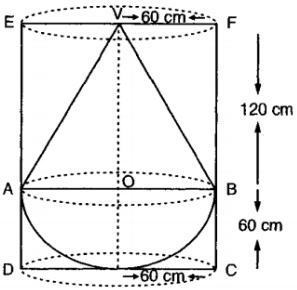
A solid consisting of a right cone standing on a hemisphere is placed upright in a right circular cylinder full of water and touches the bottom. Find the volume of water left in the cylinder, if the radius of the cylinder is $60 \ cm$ and its height is $180 \ cm,$ the radius of the hemisphere is $60 \ cm$ and height of the cone is $120 \ cm,$ assuming that the hemisphere and the cone have common base.
Answer
We have radius of cylinder $=$ radius of cone $=$ radius of hemisphere $= 60 \ cm$
Height of cone $= 120 \ cm$
$\therefore$ Height of cylindrical vessel $=120+60=180 \ cm$
$\therefore V =$ Volume of water that the cylinder contains $=\pi r^2 h=\left\{\pi \times(60)^2 \times 180\right\} \ cm ^3$
Let $V_1$ be the volume of the conical part. Then,
Image
$V_1=\frac{1}{3} \pi r^2 h_1$
$\Rightarrow V_1=\frac{1}{3} \times \pi \times 60^2 \times 120 \ cm^3=\left\{\pi \times 60^2 \times 40\right\} \ cm ^3$
For hemispherical part $r =$ Radius $= 60 \ cm$
Let $V_2$ be the volume of the hemisphere.
Then, $V_2=\left\{\frac{2}{3} \pi \times 60^3\right\} \ cm ^3$
$\Rightarrow V_2=\left\{2 \pi \times 20 \times 60^2\right\} \ cm ^3=\left\{40 \pi \cdot 60^2\right\} \ cm ^3$
Let $V_3$ the the volume of the water left$-$out in the cylinder. Then,
$V_3=V-V_1-V_2$
$V_3=\left\{\pi \times 60^2 \times 180-\pi \times 60^2 \times 40-40 \pi \times 60^2\right\} \ cm ^3$
$V_3=\pi \times 60^2 \times\{180-40-40\} \ cm ^3$
$V_3=\frac{22}{7} \times 3600 \times 100 \ cm^3$
$\Rightarrow V_3=\frac{22 \times 360000}{7} \ cm^3$
$=\frac{22 \times 360000}{7 \times(100)^3} m^3$
$=\frac{22 \times 36}{700} m^3$
$=1.1314 m^3$
View full question & answer
Question 35 Marks
A solid is in the shape of a cone surmounted on a hemisphere with both their diameters being equal to $7 \ cm$ and the height of the cone is equal to its radius. Find the volume of the solid.
Answer
Radius of hemisphere $=$ radius of cone $=\frac{7}{2} \ cm$
Height of cone $=\frac{7}{2} \ cm$
Volume of the solid $=$ Volume of hemisphere $+$ Volume of cone
$=\frac{2}{3} \pi r ^3+\frac{1}{3} \pi r ^2 h$
$=\frac{1}{3} \times \frac{22}{7} \times \frac{7}{2} \times \frac{7}{2}\left(2 \times \frac{7}{2}+\frac{7}{2}\right)$
$=\frac{539}{4} \ cm^3$ or $134.75 \ cm^3$
View full question & answer
Question 45 Marks
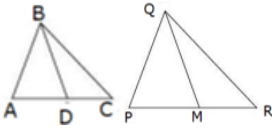
If $BD$ and $QM$ are medians of triangles $\text{ABC}$ and $\text{PQR},$ respectively, where $\triangle ABC \sim \triangle PQR$ prove that $\frac{A B}{P Q}=\frac{B D}{Q M}$.
Answer

Image
Given: $\triangle A B C \sim \triangle P Q R$ and $BD , QM$ are medians
To prove: $\frac{ AB }{ PQ }=\frac{ BD }{ QM }$
Proof: $\triangle A B C \sim \triangle P Q R \ ($given$)$
$\therefore \frac{ AB }{ PQ }=\frac{ AC }{ PR }$
$\Rightarrow \frac{ AB }{ PQ }=\frac{2 AD }{2 PM  \ BD}$ and  $QM $ are medians
$\Rightarrow \frac{ AB }{ PQ }=\frac{ AD }{ PM }$
$\text { In } \triangle A B D$ and  $\triangle P Q M$
$\frac{ AB }{ PQ }=\frac{ AD }{ PM } \ ($proved above$)$
$\angle A =\angle P (\triangle ABC \sim \triangle PQR )$
$\therefore \triangle ABD \sim \triangle PQM \ (\text{SAS}$ criteria$)$
$\therefore \frac{ AB }{ PQ }=\frac{ BD }{ QM } \text { (C.P.S.T) }$
View full question & answer
Question 55 Marks
If the price of a book is reduced by $₹\ 5,$ a person can buy $5$ more books for $₹\ 300$. Find the original list price of the book.
Answer
Let the original list price be $Rs\  x$
$\therefore$ No. of books bought for $Rs\ 300=\frac{300}{x}$
Reduced list price of the book $= Rs\ (x - 5)$
No. of books bought for $Rs\ 300=\frac{300}{x-5}$
According to question
$\frac{300}{x-5}-\frac{300}{x}=5$
$\Rightarrow \frac{300 x-300 x+1500}{x^2-5 x}=5$
$\Rightarrow x^2-5 x=300 $
$\Rightarrow x^2-5 x-300=0$
$\Rightarrow x^2-20 x+15 x-300=0$
$\Rightarrow(x-20)(x+15)=0$
$\Rightarrow x=20$ or $x=-15$
$\Rightarrow x=20$
The negative sign is rejected.
Therefore $x = 20$
Therefore the original price list is $Rs. 20$
View full question & answer
Question 65 Marks
A rectangular field is $20 m$ long and $14 m$ wide. There is a path of equal width all around it, having an area of $111\ sq\ m.$ Find the width of the path.
Answer
Let the width of the path be $x m$
Length of the field including the path $= (20 + 2x) m$
Breadth of the field including the path $= (14 + 2x) m.$
Area of rectangle $= L B$
Area of the field including the path $= (20+2 x)(14+2 x) m ^2$.
Area of the field excluding the path $= (20 \times 14) m ^2=280 m^2$
$\therefore$ Area of the path $=(20+2 x)(14+2 x)-280$
$(20 + 2x) (14 + 2x) - 280 = 111$
$\Rightarrow 4 x^2+68 x-111=0$
Factorise the equation,
$\Rightarrow 4 x^2+74 x-6 x-111=0$
$\Rightarrow 2 x (2 x +37)-3(2 x +37)=0$
$\Rightarrow(2 x+37)(2 x-3)=0$
$\Rightarrow x =-\frac{37}{2} \text { or } x =\frac{3}{2}$
As width can't be negative.
$\Rightarrow x=\frac{3}{2}=1.5$
Therefore, the width of the path is $1.5 m.$
View full question & answer
5 Marks Questions - Maths STD 10 Questions - Vidyadip