Questions

3 Marks Question

🎯

Test yourself on this topic

8 questions · timed · auto-graded

Question 13 Marks
In the given figure, a quadrilateral $\text{ABCD}$ is drawn to circumscribe a circle such that its sides $AB, BC, CD$ and $AD$ touch the circle at $P, Q, R $ and $S$ respectively. If $AB = x \ cm, BC = 7 \ cm, CR = 3 \ cm$ and $AS = 5 \ cm,$ find $x$.
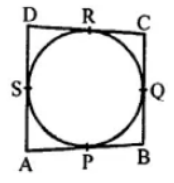
Image
Answer
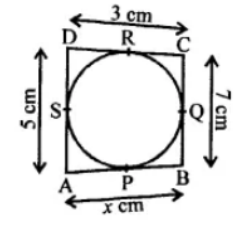
In the given figure, a quadrilateral $\text{ABCD}$ is circumscribed a circle touching its sides at $P, Q, R$ and $S$ respectively.
$AB = x \ cm, BC = 7 \ cm, CR = 3 \ cm$ and $AS = 5 \ cm$
Image
A circle touches the sides of a quadrilateral $\text{ABCD}$.
$AB+CD=BC+AD \ldots \text { (i) }$
Now, AP and AS are tangents to the circle
$AP=AS=5 \ cm \ldots \text { (ii) }$
Similarly $,  C Q=C R=3 \ cm$
$BP=BQ=x-5=4$
$BQ=BC-CQ$
​​​​​​​$=7-3=4 \ cm$
$x-5=4$
$\Rightarrow x=4+5=9 \ cm$
View full question & answer
Question 23 Marks
A man has only $20$ paisa coins and $25$ paisa coins in his purse. If he has $50$ coins in all totalling to $₹ 11.25, $ how many coins of each kind $38196$ does he have?
Answer
Let the number of $20$ paisa coins be $x$ and that of $25$ paisa coins be $y$.
Then,
$x + y =50 \ldots. (i)$
Total value of $20$ paisa coins $=20 x$ paisa
Total value of $25$ paisa coins $=25y$ paisa
$\therefore 20 x+25 y=1125 \ldots \  (\because Rs.11.25=1125$ paisa$)$
$\Rightarrow 4 x+5 y=225 \ldots \text { (ii) }$
Thus, we get the following system of linear equations
$x+y-50=0$
$4 x+5 y-225=0$
By using cross $-$ multiplication, we have
By elimination method,
$x+y-50=0 ....(1)$
$4 x + 5 y - 225 = 0 ...(2)$
Multiplying equation $(1)$ by $5 ,$
$5 x + 5 y - 250 = 0 ...(3)$
Subtracting, equation $(2)$ from $(3)$.
$5 x+5 y-250 =0$
$-4 x+5 y-225 =0$
$ x-25 = 0$
Substituting in equation $(1)$
$x = 25$
$25+y-50=0$
$y=25 .$
Hence there are $25$ of each kind.
View full question & answer
Question 33 Marks
Five coins were simultaneously tossed $1000$ times and at each toss the number of heads were observed. The number of tosses during which $0,1,2,3,4$ and $5$ heads were obtained are shown in the table below. Find the mean number of heads per toss.
No. of heads per toss No. of tosses
$0$ $38$
$1$ $144$
$2$ $342$
$3$ $287$
$4$ $164$
$5$ $25$
$\text{Total}$ $1000$
Answer
No of heads per toss No of tosses $f_ix_i$
$0$ $38$ $0$
$1$ $144$ $144$
$2$ $342$ $684$
$3$ $287$ $861$
$4$ $164$ $656$
$5$ $25$ $125$
  $\sum f _{ i }=1000$ $\sum f _{ i } x _{ i }=2470$
Mean number of heads per toss $=\frac{\sum f_i x_i}{\sum f_i}=\frac{2470}{1000}=2.47$
Therefore$,$ Mean $=2.47$
View full question & answer
Question 43 Marks
Prove that $\sec \theta(1-\sin \theta)(\sec \theta+\tan \theta)=1$
Answer
$\text { LHS }=\sec \theta(1-\sin \theta)(\sec \theta+\tan \theta)$
$=\left[\sec \theta-\frac{\sin \theta}{\cos \theta}\right] \times(\sec \theta+\tan \theta)$
$=(\sec \theta-\tan \theta)(\sec \theta+\tan \theta)$
$=\sec ^2 \theta-\tan ^2 \theta$
$=1$
$=\text { RHS }$
View full question & answer
Question 53 Marks
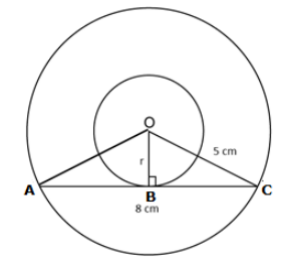
Out of the two concentric circles, the radius of the outer circle is $5 \ cm$ and the chord $AC$ of length $8 \ cm$ is a tangent to the inner circle. Find the radius of the inner circle.
Answer
Image
Since $AC$ is a tangent to the inner circle.
$\angle O B C=90^{\circ}$
$A C$ is a chord of the outer circle.
We know that, the perpendicular drawn from the centre to a chord of a circle, bisects the chord.
$A C=2 B C$
$8=2 B C$
$\Rightarrow B C=4 \ cm$
$\text { In } \Delta\ O B C,$
By Pythagoras theorem,
$OC^2=OB^2+BC^2$
$\Rightarrow 5^2=r^2+4^2$
$\Rightarrow r^2=5^2-4^2$
$\Rightarrow r^2=25-16$
$\Rightarrow r^2=9 \ cm$
$\Rightarrow r=3 \ cm$
View full question & answer
Question 63 Marks
A fraction is such that if the numerator is multiplied by $3$ and the denominator is reduced by $3,$ we get $18/11,$ but if the numerator is increased by $8$ and the denominator is doubled, we get $2/5.$ Find the fraction.
Answer
Let us suppose that the numerator be $x$ and denominator be $y$
Therefore, the fraction is $\frac{x}{y}$.
Then, according to the given conditions, we have
$\frac{3 x}{y-3}=\frac{18}{11}$ and $\frac{x+8}{2 y}=\frac{2}{5}$
$\Leftrightarrow 11 x=6 y-18$ and $5 x+40=4 y$
$\Leftrightarrow 11 x-6 y+18=0$ and $5 x-4 y+40=0$
By cross multiplication, we have
By substitution method,
$11 x-6 y+18=0 ...(1)$
$5 x+40=4 y ...(2)$
From equation $(2).$
$x=\frac{4 y-40}{5} ....(3)$
Substituting value of $x$ in $(i),$
$11\left(\frac{4 y-40}{5}\right)-6 y+18=0$
$\Rightarrow \frac{44 y-440}{5}-6 y=-18$
$\Rightarrow 44 y-440-30 y=-90$
$\Rightarrow 14 y=-90+440$
$\Rightarrow 14 y=350$
$\Rightarrow y=\frac{350}{14}$
$\Rightarrow y=25$
Substituting value of $y$ in $(3),$
$x =\frac{4(25)-40}{5}$
$\Rightarrow x =\frac{100-40}{5}$
$\Rightarrow x =\frac{60}{5}$
$\Rightarrow x =12$
$\therefore$ The fraction is $\frac{12}{25}$.
View full question & answer
Question 73 Marks
Find a quadratic polynomial whose sum and product of the zeroes are $-\frac{21}{8}$ and $\frac{5}{16}$ respectively. Also find the zeroes of the polynomial by factorisation.
Answer
We know, quadratic polynomial $=x^2- ($Sum of zeroes$) x\ +$ Product of zeroes
Given, Sum of zeroes $=-\frac{21}{8}$ and Product of zeroes $=\frac{5}{16}$
$\therefore$ Quadratic Polynomial $=x^2+\frac{21}{8} x+\frac{5}{16}$
$=\frac{1}{16}\left(16 x^2+42 x+5\right)$
$\Rightarrow$ Quadratic polynomial is $16 x^2+42 x+5$
Now, we rewrite the polynomial as $16 x^2+2 x+40 x+5$
$=2 x \cdot(8 x+1)+5 \cdot(8 x+1)$
$=(2 x+5) \cdot(8 x+1)$
Now, for Zeros $,(8 x+1) \cdot(2 x+5)=0$
$\Rightarrow x=\frac{-1}{8}, \frac{-5}{2}$
View full question & answer
Question 83 Marks
A shopkeeper has $120$ litres of petrol, $180$ litres of diesel and $240$ litres of kerosene. He wants to sell oil by filling the three kinds of oils in tins of equal capacity. What should be the greatest capacity of such a tin?
Answer
The required greatest capacity is the $\text{HCF}$ of $120, 180$ and $240.$
$240=180 \times 1+60$
$180=60 \times 3+0$
$\text{HCF}$ is $60.$
Now $\text{HCF}$ of $60,120$
$120=60 \times 2+0$
$\therefore \text{HCF}$ of $120,180$ and $240$ is $60.$
$\therefore$ The required capacity is $60$ litres.
View full question & answer
3 Marks Question - Maths STD 10 Questions - Vidyadip