Questions

5 Marks Questions

Take a timed test

6 questions · self-marked practice — reveal the answer and mark yourself.

Question 15 Marks
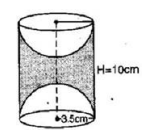
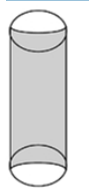
A wooden article was made by scooping out a hemisphere from each end of a solid cylinder as shown in the figure. If the height of the cylinder is $10 \ cm$ and its base is of radius $3.5 \ cm,$ find the total surface area of the article.
Image
Answer
Image

$\text { TSA of the article }=2 \pi rh +2\left(2 \pi r ^2\right)$
$=2 \pi(3.5)(10)+2\left[2 \pi(3.5)^2\right]$
$=70 \pi+49 \pi$
$=119 \pi$
$=119 \times \frac{22}{7}$
$=374 \ cm^2$
View full question & answer
Question 25 Marks
The product of Tanay's age $($in years$)$ five years ago and his age ten years later is $16.$ Determine Tanay's present age.
Answer
Let the present age of Tanay be $x$ years
By the question,
$(x-5)(x+10)=16$
or, $x^2+5 x-50=16$
or, $x^2+5 x-66=0$
or, $x^2+11 x-6 x-66=-66$
$x(x+1)-16(x-111)=0$
$(x+11)(x-6)=0$
$=-11,6$
Rejecting $x=-11$, as age cannot be negative.
$\therefore$ Present age of Tanay is $6$ years.
View full question & answer
Question 35 Marks
Find the mean of the following frequency distribution:
Class $5 - 15$ $15 - 25$ $25 - 35$ $35 - 45$ $45 - 55$ $55 - 65$
Frequency $6$ $11$ $21$ $23$ $14$ $5$
Answer
$CI$ $f_i$ $x_i$ $d_i$ $u_i$ $f_iu_i$
$5 - 15$ $6$ $10$ $-20$ $- 2$ $-12$
$15 - 25$ $11$ $20$ $-10$ $- 1$ $-11$
$25 - 35$ $21$ $30$ $0$ $0$ $0$
$35 - 45$ $23$ $40$ $10$ $1$ $23$
$45 - 55$ $14$ $50$ $20$ $2$ $28$
$55 - 65$ $5$ $60$ $30$ $3$ $15$
$\text{Total}$ $80$       $43$
$\text { Mean }= A +\frac{\Sigma f_i u_i}{\Sigma f_i} \times h$
$=30+\frac{43}{80} \times 10$
$=35.375$
View full question & answer
Question 45 Marks
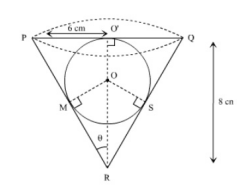
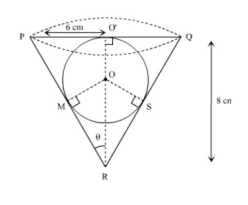
A conical vessel of radius $6 \ cm$ and height $8 \ cm$ is completely filled with water. A sphere is lowered into the water and its size is such that when it touches the sides, it is just immersed as shown in Figure. What fraction of water over flows?
Image
Answer
Radius $(R)$ of conical vessel $= 6 \ cm$
Height $(H)$ of conical vessel $= 8 \ cm$
Image
Volume of conical vessel $\left( V _{ c }\right)=\frac{1}{3} \pi r ^2 h$
$=\frac{1}{3} \times \pi \times 6 \times 6 \times 8$
$=96 \pi \ cm^3$
Let the radius of the sphere be $\text{rcm}$
In right $\Delta PO'R $ by pythagoras theorem We have
$l^2=6^2+8^2$
$l=\sqrt{36+64}=10 \ cm$
In right triangle $\text{MRO}$
$\sin \theta=\frac{O M}{O R}$
$\Rightarrow \frac{3}{5}=\frac{r}{8-r}$
$\Rightarrow 24-3 r=5 r$
$\Rightarrow 8 r=24$
$\Rightarrow r=3 \ cm$
$\therefore V _1=$ Volume of the sphere $=\frac{4}{3} \pi \times 3^3 \ cm^3=36 \pi \ cm^3$
$V _2=$ Volume of the water $=$ Volume of the cone $=\frac{1}{3} \pi \times 6^2 \times 8 \ cm^3=96 \pi \ cm^3$
Clearly, volume of the water that flows out of the cone is same as the volume of the sphere
i.e., $V _1$.
$\therefore$ Fraction of the water that flows out $=V_1: V_2=36 \pi: 96 \pi=3: 8$
View full question & answer
Question 55 Marks
If a line is drawn parallel to one side of a triangle to intersect the other two sides in distinct points, then prove that the other two sides are divided in the same ratio.
Answer
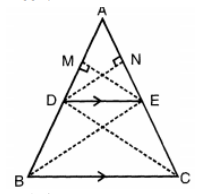
Given: $\text{ABC}$ is a triangle in which $DE \| BC$.
To prove: $\frac{A D}{B D}=\frac{A E}{C E}$
Construction: Draw $D N \perp A E$ and $E M \perp A D$.,
Join $BE$ and $CD$.
Proof :
Image
In $\triangle A D E$,
Area of $\Delta A D E=\frac{1}{2} \times A E \times D N...(i)$
In $\Delta D E C,$
Area of $\Delta D C E=\frac{1}{2} \times C E \times D N...(ii)$
Dividing equation $(i)$ by equation $(ii),$
$\Rightarrow \frac{\operatorname{area} \ (\Delta\ A D E)}{\text { area }(\Delta\ D E C)}=\frac{\frac{1}{2} \times A E \times D N}{\frac{1}{2} \times C E \times D N}$
$\Rightarrow \frac{\text { area }(\Delta\ A D E)}{\text { area }(\Delta\ D E C)}=\frac{A E}{C E} \ldots(\text { iii) }$
Similarly, In $\Delta\ A D E$,
Area of $\Delta\ A D E=\frac{1}{2} \times A D \times E M \ldots (iv)$
In $\Delta\ D E B$,
Area of $\Delta\ D E B=\frac{1}{2} \times E M \times B D$
Dividing equation $(iv)$ by equation $(v),$
$\Rightarrow \frac{\operatorname{area}(\Delta\ A D E)}{\text { area }(\Delta\ D E B)}=\frac{\frac{1}{2} \times A D \times E M}{\frac{1}{2} \times B D \times E M}$
$\Rightarrow \frac{\text { area }(\Delta\ A D E)}{\text { area }(\Delta\ D E B)}=\frac{A D}{B D} \ldots(vi)$
$\Delta D E B$ and $\Delta D E C$ lie on the same base $DE$ and between two parallel lines $DE$ and $BC$ .
$\therefore$ Area $(\Delta\ D E B)=$ Area $(\Delta\ D E C)$
From equation $(iii),$
$\Rightarrow \frac{\text { area }(\Delta\ A D E)}{\text { area }(\Delta\ D E B)}=\frac{A E}{C E} ...(i)$
From equation $(vi)$ and equation $(vii),$
$\frac{A E}{C E}=\frac{A D}{B D}$
$\therefore$ If a line is drawn parallel to one side of a triangle to intersect the other two sides in two points, then the other two sides are divided in the same ratio.
View full question & answer
Question 65 Marks
A 2-digit number is such that the product of its digits is 24. If 18 is subtracted from the number, the digits interchange their places. Find the number.
Answer
Let the ten's digit be $x$ and the one's digit be $y$.
The number will be $10 x + y$
Given, a product of digits is 24
$\therefore xy=24$
or, $y =\frac{24}{x}$
Given that when 18 is subtracted from the number, the digits interchange their places.
$\therefore 10 x+y-18=10 y+x$
or, $9 x -9 y =18$
Substituting y from equation (i) in equation (ii), we get
$9 x-9\left(\frac{24}{x}\right)=18$
or, $x-\frac{24}{x}=2$
or, $x ^2-24-2 x =0$
or, $x^2-2 x-24=0$
or, $x^2-6 x+4 x-24=0$
or, $x(x-6)+4(x-6)=0$
or, $(x-6)(x+4)=0$
or, $x-6=0$ and $x+4=0$
or, $x=6$ and $x=-4$
Since, the digit cannot be negative, so, $x=6$
Substituting $x=6$ in equation (i), we get
$y=\frac{24}{6}=4$
$\therefore$ The number $=10(6)+4=60+4=64$
View full question & answer
5 Marks Questions - Maths STD 10 Questions - Vidyadip