Questions

Case study (4 Marks)

Take a timed test

3 questions · self-marked practice — reveal the answer and mark yourself.

Question 14 Marks
Read the text carefully and answer the questions:
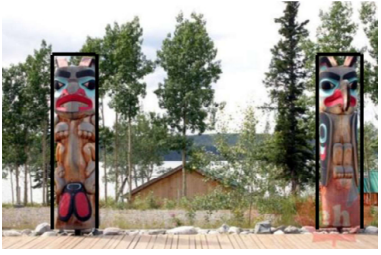
Totem poles are made from large trees. These poles are carved with symbols or figures and mostly found in western Canada and northwestern United States.
In the given picture, two such poles of equal heights are standing $28 m$ apart. From a point somewhere between them in the same line, the angles of elevation of the top of the two poles are $60^{\circ}$ and $30^{\circ}$ respectively.
Image

$(a)$ Draw a neat labelled diagram.
$(b)$ Find the height of the poles.
OR
Find the location of the point of observation.
$(c)$ If the distances of the top of the poles from the point of observation are taken as $p$ and $q,$ then find a relation between $p$ and $q$ .
Answer
Read the text carefully and answer the questions:
Totem poles are made from large trees.
These poles are carved with symbols or figures and mostly found in western Canada and northwestern United States.
In the given picture, two such poles of equal heights are standing $28 m$ apart.
From a point somewhere between them in the same line, the angles of elevation of the top of the two poles are $60^{\circ}$ and $30^{\circ}$ respectively.
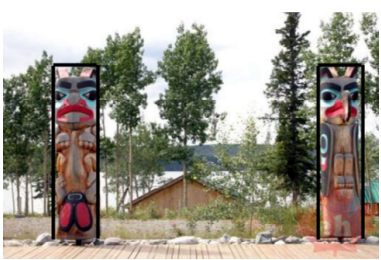
Image

$(i)$ Let $AB$ and $CD$ be the $2$ poles and $M$ be a point somewhere between their bases in the same line.
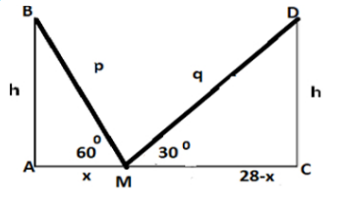
Image
$\text { (ii) } \tan 60^{\circ}=\frac{h}{x} $
$\Rightarrow h=x \sqrt{3}$
$\tan 30^{\circ}=\frac{h}{28-x} $
$\Rightarrow h=\frac{(28-x)}{\sqrt{3}}$
$\therefore h=7 \sqrt{3} m$
$\tan 60^{\circ}=\frac{7 \sqrt{3}}{x}$
$ \Rightarrow x=7 m=AM$
$M C=28-x=21 m$
$\text { (iii) BM = p }$ and $DM=q$
$\sin 60^{\circ}=\frac{h}{p} $
$\Rightarrow h=\frac{p \sqrt{3}}{2}$
$\sin 30^{\circ}=\frac{h}{q}$
$ \Rightarrow h=\frac{q}{2}$
$\therefore \frac{p \sqrt{3}}{2}=\frac{q}{2} $
$\Rightarrow q=\sqrt{3} p$
View full question & answer
Question 24 Marks
Read the text carefully and answer the questions:
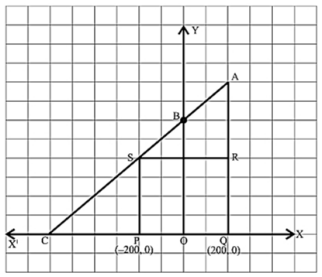
Jagdish has a field which is in the shape of a right angled triangle $\text{AQC}$.
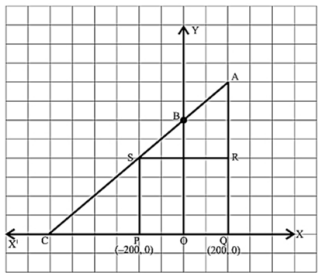
He wants to leave a space in the form of a square $\text{PQRS}$ inside the field for growing wheat and the remaining for growing vegetables $($as shown in the figure$)$. In the field, there is a pole marked as $O$.

Image

$(a)$ Taking $O$ as origin, coordinates of $P$ are $(-200,0)$ and of $Q$ are $(200,0). \text{PQRS}$ being a square, what are the coordinates of $R$ and $S$ ?
$(b)$ What is the area of square $\text{PQRS}$?
OR
If $S$ divides $CA$ in the ratio $K : 1,$ what is the value of $K,$ where point $A$ is $(200, 800)$?
$(c)$ What is the length of diagonal $PR$ in square $\text{PQRS}$?
Answer
Read the text carefully and answer the questions:
Jagdish has a field which is in the shape of a right angled triangle $\text{AQC}$.
He wants to leave a space in the form of a square $ \text{PQRS}$
inside the field for growing wheat and the remaining for growing vegetables $($as shown in the figure$)$. In the field, there is a pole marked as $O$.

Image
$ (i)$ Since $,\text{PQRS} $ is a square 
$\therefore PQ = QR = RS = PS$
Length of $ PQ =200-(-200)=400$
$\therefore$ The coordinates of $R =(200,400)$
and coordinates of $ S =(-200,400)$
$(ii)$ Area of square $\text{PQRS} =(\text { side })^2$
$=(P Q)^2$
$=(400)^2$
$=1,60,000 \text { sq. units }$
OR
Since, point $S$ divides $CA$ in the ratio $K : 1$
$\therefore\left(\frac{K x_2+x_1}{K+1}, \frac{K y_2+y_1}{K+1}\right)=(-200,400)$
$\Rightarrow\left(\frac{K(200)+(-600)}{K+1}, \frac{K(800)+0}{K+1}\right)=(-200,400)$
$\Rightarrow\left(\frac{200 K-600}{K+1}, \frac{800 K}{K+1}\right)=(-200,400)$
$\therefore \frac{800 K}{K+1}=400$
$\Rightarrow 800 K=400 K+400$
$\Rightarrow 400 K=400$
$\Rightarrow K=1$
$(iii)$ By Pythagoras theorem
$(PR)^2=(PQ)^2+(QR)^2$
$=1,60,000+1,60,000$
$=3,20,000$
$\Rightarrow PR =\sqrt{3,20,000}$
$=400 \times \sqrt{2} \text { units }$
View full question & answer
Question 34 Marks
Read the text carefully and answer the questions:
Akshat's father is planning some construction work in his terrace area.
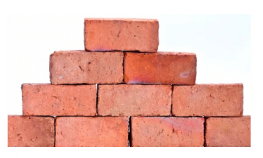
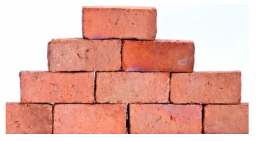
He ordered $360$ bricks and instructed the supplier to keep the bricks in such as way that the bottom row has $30$ bricks and next is one less than that and so on.
Image
The supplier stacked these $360$ bricks in the following manner, $30$ bricks in the bottom row, $29$ bricks in the next row, $28$ bricks in the row next to it, and so on.
$(a)$ In how many rows, $360$ bricks are placed?
$(b)$ How many bricks are there in the top row?
OR
If which row 26 bricks are there?
$(c)$ How many bricks are there in $10^{\text {th }}$ row?
Answer
Read the text carefully and answer the questions:
Akshat's father is planning some construction work in his terrace area.
He ordered $360$ bricks and instructed the supplier to keep the bricks in such as way that the bottom row has $30$ bricks and next is one less than that and so on.

Image

The supplier stacked these 360 bricks in the following manner, $30$ bricks in the bottom row, $29$ bricks in the next row, $28$ bricks in the row next to it, and so on.
$(i)$ Number of bricks in the bottom row $=30$. in the next row $=29$, and so on.
Therefore, Number of bricks stacked in each row form a sequence $30,29,28,27, \ldots$, which is an $AP$ with first term, $a = 30$ and common difference, $d=29-30=-1$
Suppose number of rows is $n$, then sum of number of bricks in $n$ rows should be $360$ .
$\text { i.e. } S_n=360$
$\Rightarrow \frac{n}{2}[2 \times 30+(n-1)(-1)]=360\left\{S_n=\frac{n}{2}(2 a+(n-1) d)\right\}$
$\Rightarrow 720=n(60-n+1)$
$\Rightarrow 720=60 n-n^2+n$
$\Rightarrow n^2-61 n+720=0$
$\Rightarrow n^2-16 n-45 n+720=0 \text { [by factorization] }$
$\Rightarrow n(n-16)-45(n-16)=0$
$\Rightarrow(n-16)(n-45)=0$
$\Rightarrow(n-16)=0 \text { or }(n-45)=0$
$\Rightarrow n=16 \text { or } n=45$
Hence, number of rows is either $45$ or $16$ .
$n =45$ not possible so $n =16$
$a_{45}=30+(45-1)(-1)\left\{a_n=a+(n-1) d\right\}$
$=30-44=-14[\because$ The number of logs cannot be negative $]$
Hence the number of rows is $16.$
$(ii)$ Number of bricks in the bottom row $=30$. in the next row $=29$, and so on.
Therefore, Number of bricks stacked in each row form a sequence $30,29,28,27, \ldots$, which is an $AP$ with first term, $a = 30$ and common difference, $d=29-30=-1$
Suppose number of rows is $n ,$ then sum of number of bricks in n rows should be $360$ .
Number of bricks on top row are $n=16$,
$a_{16}=30+(16-1)(-1)\left\{a_n=a+(n-1) d\right\}$
$=30-15=15$
Hence, and number of bricks in the top row is $15$ .
OR
Number of bricks in the bottom row $=30$. in the next row $=29$, and so on.
Therefore, Number of bricks stacked in each row form a sequence $30,29,28,27, \ldots,$ which is an $AP$ with first term,$ a = 30$ and common difference, $d =29-30=-1$.
Suppose number of rows is $n ,$ then sum of number of bricks in $n$ rows should be $360$ .
$a_n=26, a=30, d=-1$
$a_n=a+(n-1) d$
$\Rightarrow 26=30+(n-1) \times-1$
$\Rightarrow 26-30=-n+1$
$\Rightarrow n=5$
Hence $26$ bricks are in $5^{th}$ row.
$(iii)$ Number of bricks in the bottom row $=30$. in the next row $=29$, and so on.
therefore, Number of bricks stacked in each row form a sequence $30,29,28,27, \ldots$, which is an $AP$ with first term, $a= 30$ and common difference, $d=29-30=-1$.
Suppose number of rows is $n ,$ then sum of number of bricks in $n$ rows should be $360$
Number of bricks in $10^{th}$ row $a=30, d=-1, n=10$
$a_n=a+(n-1) d$
$\Rightarrow a_{10}=30+9 \times-1$
$\Rightarrow a_{10}=30-9=21$
Therefore, number of bricks in $10^{th}$ row are $21$.
View full question & answer
Case study (4 Marks) - Maths STD 10 Questions - Vidyadip