Questions

M.C.Q (1 Marks)

Take a timed test

18 questions · 17 auto-graded MCQ + 1 self-marked written.

MCQ 11 Mark
If the mode of the data: $64, 60, 48, x, 43, 48, 43, 34$ is $43,$ then $x + 3 =$
  • A
    $45$
  • B
    $48$
  • C
    $44$
  • $46$
Answer
Correct option: D.
$46$
Mode of $64,60,48, x, 43,48,43,34$ is $43$
$\because$ By definition mode is a number which has maximum frequency which is $43$
$\therefore x=43$
$\because x+3$
$=43+3$
$=46$
View full question & answer
MCQ 21 Mark
Two dice are rolled together. What is the probability of getting a sum greater than 10?
  • A
    $\frac{5}{18}$
  • B
    $\frac{1}{9}$
  • C
    $\frac{1}{6}$
  • $\frac{1}{12}$
Answer
Correct option: D.
$\frac{1}{12}$
(d) $\frac{1}{12}$
Explanation: Total number of outcomes $=36$
Favorable outcomes for sum greater than 10 are $\{(5,6),(6,5),(6,6)\}$ Number of favorable outcomes $=3$
$P=\frac{3}{36}=\frac{1}{12}$
View full question & answer
MCQ 31 Mark
A dice is thrown once. The probability of getting an odd number is
  • $\frac{1}{2}$
  • B
    1
  • C
    $\frac{2}{6}$
  • D
    $\frac{4}{6}$
Answer
Correct option: A.
$\frac{1}{2}$
(a) $\frac{1}{2}$
Explanation: $\frac{1}{2}$
View full question & answer
MCQ 41 Mark
Area of a sector of angle $p ($in degrees$)$ of a circle with radius $R$ is
  • A
    $\frac{p}{360} \times 2 \pi R$
  • B
    $\frac{ p }{180} \times \pi R ^2$
  • C
    $\frac{p}{180} \times 2 \pi R$
  • $\frac{p}{720} \times 2 \pi R^2$
Answer
Correct option: D.
$\frac{p}{720} \times 2 \pi R^2$
Area of the sector of angle $p$ of a circle with radius $R$
$=\frac{\theta}{360} \times \pi r^2$
$=\frac{p}{360} \times \pi R^2$
$=\frac{p}{2(360)} \times 2 \pi R^2$
$=\frac{p}{720} \times 2 \pi R^2$
View full question & answer
MCQ 51 Mark
In a circle of radius $21 \ cm ,$ an $arc$ subtends an angle of $60^{\circ}$ at the centre. The area of the sector formed by the $arc$ is:
  • $231 \ cm^2$
  • B
    $250 \ cm^2$
  • C
    $220 \ cm^2$
  • D
    $200 \ cm^2$
Answer
Correct option: A.
$231 \ cm^2$
The angle subtended by the arc $=60^{\circ}$
So, area of the sector $=\left(\frac{60^{\circ}}{360^{\circ}}\right) \times \pi r ^2 \ cm^2$
$=\left(\frac{441}{6}\right) \times\left(\frac{22}{7}\right) \ cm^2$
$=231 \ cm^2$
View full question & answer
MCQ 61 Mark
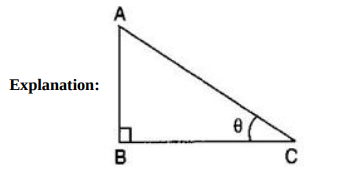
The angle of elevation of the sun when the shadow of a pole ' $h$ ' metres high is $\frac{h}{\sqrt{3}}$ metres long is
  • A
    $45^{\circ}$
  • B
    $30^{\circ}$
  • $60^{\circ}$
  • D
    $15^{\circ}$
Answer
Correct option: C.
$60^{\circ}$
(c) $60^{\circ}$

Image
Given: Height of the pole $= AB =h$ meters And the length of the shadow of the pole $= BC =\frac{h}{\sqrt{3}}$ meters $\therefore \tan \theta=\frac{h}{\frac{h}{\sqrt{3}}}$ $\Rightarrow \tan \theta=\sqrt{3} \Rightarrow \tan \theta=\tan 60^{\circ} \Rightarrow \theta=60^{\circ}$
View full question & answer
MCQ 71 Mark
The value of $\sin 45^{\circ}+\cos 45^{\circ}$ is
  • $\sqrt{2}$
  • B
    $\frac{1}{\sqrt{2}}$
  • C
    $1$
  • D
    $\frac{1}{\sqrt{3}}$
Answer
Correct option: A.
$\sqrt{2}$
Given: $\sin 45^{\circ}+\cos 45^{\circ}$
$=\frac{1}{\sqrt{2}}+\frac{1}{\sqrt{2}}$
$=\frac{2}{\sqrt{2}}$
$=\sqrt{2}$
View full question & answer
MCQ 81 Mark
$(\operatorname{cosec} \theta-\sin \theta)(\sec \theta-\cos \theta)(\tan \theta+\cot \theta)$ is equal
  • $1$
  • B
    $0$
  • C
    $2$
  • D
    $-1$
Answer
Correct option: A.
$1$
We have, $(\operatorname{cosec} \theta-\sin \theta)(\sec \theta-\cos \theta)(\tan \theta+\cot \theta)$
$=\left(\frac{1}{\sin \theta}-\sin \theta\right)\left(\frac{1}{\cos \theta}-\cos \theta\right)\left(\frac{\sin \theta}{\cos \theta}+\frac{\cos \theta}{\sin \theta}\right)$
$=\frac{1-\sin ^2 \theta}{\sin \theta} \times \frac{1-\cos ^2 \theta}{\cos \theta} \times \frac{\sin ^2 \theta+\cos ^2 \theta}{\sin \theta \cos \theta}$
$=\frac{\cos ^2 \theta}{\sin \theta} \times \frac{\sin ^2 \theta}{\cos \theta} \times \frac{1}{\sin \theta \cos \theta}$
$=\frac{\sin ^2 \theta \cos ^2 \theta}{\sin ^2 \theta \cos ^2 \theta}$
$=1$
View full question & answer
MCQ 91 Mark
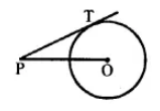
The length of the tangent drawn from a point P, whose distance from the centre of a circle is 25 cm, and the radius of the circle is 7 cm, is:
  • A
    28 cm
  • 24 cm
  • C
    25 cm
  • D
    22 cm
Answer
Correct option: B.
24 cm
(b) 24 cm
Explanation: 24 cm
View full question & answer
MCQ 101 Mark
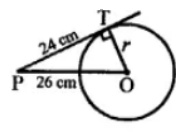
In the given figure, point $P$ is $26 \ cm$ away from the centre $O$ of a circle and the length $PT$ of the tangent drawn from $P$ to the circle is $24 \ cm.$ Then, the radius of the circle is
Image
  • A
    $13 \ cm$
  • $10 \ cm$
  • C
    $15 \ cm$
  • D
    $12 \ cm$
Answer
Correct option: B.
$10 \ cm$
In the given figure, point $P$ is $26 \ cm$ away from the centre $O$ of the circle.
Image
Length of tangent $PT =24 \ cm$
Let radius $=r$
In right $\triangle \text{OPT}$,
$\ce{OP^2=PT^2 + OT^2}$
$\Rightarrow 26^2=24^2+r^2$
$\Rightarrow r^2=26^2-24^2$
$=676-576$
$=100$
$=(10)^2$
$r=10$
Radius $=10 \ cm$
View full question & answer
MCQ 111 Mark
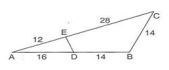
In the given figure if $\triangle A E D \sim \triangle A B C$, then DE is equal to
Image
  • A
    6.5 cm
  • 5.6 cm
  • C
    5.5 cm
  • D
    7.5 cm
Answer
Correct option: B.
5.6 cm
(b) 5.6 cm
Explanation: $\Delta AED \sim \Delta ABC$ (SAS Similarly) $\Rightarrow \frac{12}{30}=\frac{E D}{14} \Rightarrow ED =5.6 cm$
View full question & answer
MCQ 121 Mark
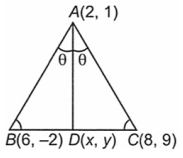
The vertices of a $\triangle ABC$ are $A (2,1), 8(6,-2), C (8,9)$. If AD is angle bisector of $\angle BAC$, where D meets on BC , then coordinates of D are __________.
  • A
    $(5,2)$
  • B
    $\left(\frac{14}{3}, \frac{7}{3}\right)$
  • C
    $(4,3)$
  • D
    $\left(\frac{20}{3}, \frac{5}{3}\right)$
View full question & answer
MCQ 131 Mark
A line segment is of length $10$ units. If the coordinates of its one end are $(2, - 3)$ and the abscissa of the other end is $10,$ then its ordinate is
  • A
    $-3,9$
  • B
    $9,-6$
  • C
    $9,6$
  • $3,-9$
Answer
Correct option: D.
$3,-9$
Explanation:
Let the ordinate of other end $=y$ then distance between $(2,-3)$ and $(10, y)=10$ units
$\Rightarrow \sqrt{\left(x_2-x_1\right)^2+\left(y_2-y_1\right)^2}=10$
$\Rightarrow \sqrt{(10-2)^2+(y+3)^2}=10$
$\Rightarrow \sqrt{(8)^2+(y+3)^2}=10$
Squaring both sides
$(8)^2+(y+3)^2=(10)^2 $
$\Rightarrow 64+(y+3)^2=100$
$\Rightarrow(y+3)^2=100-64$
$=36=(6)^2$
$\Rightarrow(y+3)^2-(6)^2=0 $
$\Rightarrow(y+3+6)(y+3-6)$
$=0\left\{\because a^2-b^2=(a+b)(a-b)\right\}$
$\Rightarrow(y+9)(y-3)=0$
Either $y +9=0$, then $y =-9$ or $y -3=0$,
then $y =3$
$\therefore y=3,-9$
View full question & answer
MCQ 141 Mark
If the second term of an $AP$ is $13$ and its fifth term is $25,$ then its $7^{th}$ term is
  • A
    $37$
  • $33$
  • C
    $38$
  • D
    $30$
Answer
Correct option: B.
$33$
Given: $a_2=13$
$\Rightarrow a+(2-1) d=13$
$\Rightarrow a+d=13 \ldots \text { (i) }$
And $a _5=25$
$\Rightarrow a+(5-1) d=25$
$\Rightarrow a+4 d=25 \ldots \text { (ii) }$
Solving $eq. (i)$ and $(ii),$ we get $a =9$ and $d =4$
$\therefore a_7=a+(7-1) d$
$=9+(7-1) \times 4$
$=9+6 \times 4$
$=9+24$
$=33$
View full question & answer
MCQ 151 Mark
Which of the following equations has two distinct real roots?
  • $x^2+x-5=0$
  • B
    $5 x^2-3 x+1=0$
  • C
    $4 x^2-3 x+1=0$
  • D
    $x^2+x+5=0$
Answer
Correct option: A.
$x^2+x-5=0$
In equation $x^2+x-5=0$
$a=1, b=1, c=-5$
$\therefore b^2-4 a c$
$=(1)^2-4 \times 1 \times(-5)$
$=1+20$
$=21$
Since $b^2-4 a c>0$
therefore, $x^2+x-5=0$ has two distinct roots.
View full question & answer
MCQ 161 Mark
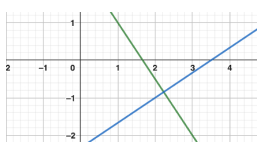
The pair of linear equations $3 x+2 y=5$ and $2 x-3 y=7$ are
Image
  • consistent
  • B
    dependent
  • C
    inconsistent
  • D
    independent
Answer
Correct option: A.
consistent
(a) consistent
Explanation: Given: $a _1=3, a _2=2, b_1=2, b_2=-3, c _1=5$ and $c _2=7$
Here, $\frac{a_1}{a_2}=\frac{3}{2}, \frac{b_1}{b_2}=\frac{2}{-3}$
$\because \frac{a_1}{a_2} \neq \frac{b_1}{b_2}$
Therefore, the pair of given linear equations is consistent.
View full question & answer
MCQ 171 Mark
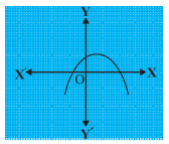
Find the number of zeroes of p(x) in the graph given below.
Image
  • A
    $3$
  • B
    $0$
  • $2$
  • D
    $1$
Answer
Correct option: C.
$2$
(c) 2
Explanation: The number of zeroes is 2 as the graph intersects the x-axis at two points.
View full question & answer
MCQ 181 Mark
If two positive integers $m$ and $n$ can be expressed as $m=x^2 y^5$ and $n=x^3 y^2$, where $x$ and $y$ are prime numbers, then $\operatorname{HCF}(m, n)=$
  • $x^2 y^2$
  • B
    $x^2 y^3$
  • C
    $x^3 y^2$
  • D
    $x^3 y^3$
Answer
Correct option: A.
$x^2 y^2$
(a) $x^2 y^2$
Explanation: $x^2 y^5=y^3\left(x^2 y^2\right)$
$x^3 y^3=x\left(x^2 y^2\right)$
Therefore HCF $( m , n )$ is $x ^2 y ^2$
View full question & answer
M.C.Q (1 Marks) - Maths STD 10 Questions - Vidyadip