Questions

3 Marks Question

🎯

Test yourself on this topic

8 questions · timed · auto-graded

Question 23 Marks
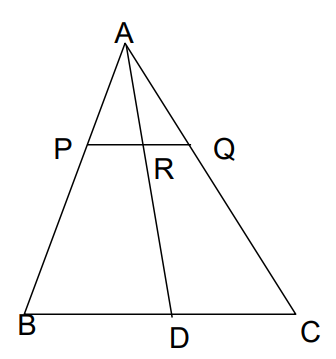
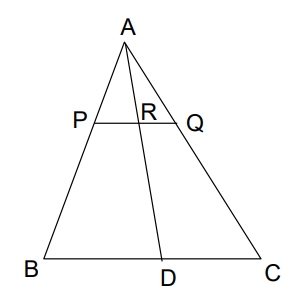
$(B)$ In $\triangle A B C, P$ and $Q$ are points on $A B$ and $A C$ respectively such that $P Q$ is parallel to $BC$. Prove that the median $A D$ drawn from $A$ on $B C$ bisects $P Q$.

Image
Answer
Image
Since $PQ \| BC$
therefore $\triangle APR \sim \Delta ABD$
$\Rightarrow \frac{A P}{A B}=\frac{P R}{B D}.............. (i)$
$\triangle AQR \sim \triangle ACD$
$\Rightarrow \frac{A Q}{A C}=\frac{R Q}{D C} \cdots (ii)$
Now, $\frac{A P}{A B}=\frac{A Q}{A C} ............(iii)$
Using $(i), (ii) , (iii), \frac{P R}{B D}=\frac{R Q}{D C}$
But $, BD = DC$
$\Rightarrow PR = RQ$ or $AD$ bisects $PQ$
View full question & answer
Question 33 Marks
Prove that $\sqrt{3}$ is an irrational number.
Answer

Let $\sqrt{ } 3$ be a rational number.
$\therefore \sqrt{ } 3=\frac{p}{q}$, where $q \neq 0$ and let $p \& q$ be co-prime.
$3 q^2=p^2 \Rightarrow p^2$ is divisible by $3 \Rightarrow p$ is divisible by $3----$ (i)
$\Rightarrow p=3 a$, where ' $a$ ' is some integer
$9 a^2=3 q^2 \Rightarrow q^2=3 a^2 \Rightarrow q^2$ is divisible by $3 \Rightarrow q$ is divisible by $3---$ (ii)
(i) and (ii) leads to contradiction as ' $p$ ' and ' $q$ ' are co-prime.
View full question & answer
Question 43 Marks
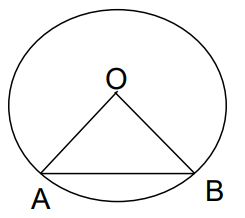
$(a)$ The minute hand of a wall clock is $18 \ cm$ long. Find the area of the face of the clock described by the minute hand in $35$ minutes.
Answer
Angle described by minute hand in $5\ min=30^{\circ}$.
length of minute hand $=18 \ cm=r$.
Area swept by minute hand in $35$ minutes
$=\left(\frac{22}{7} \times 18 \times 18 \times \frac{30}{360}\right) \times 7$
$=594 \ cm^2 .$
View full question & answer
Question 53 Marks
If $\cos \theta+\sin \theta=1$, then prove that $\cos \theta-\sin \theta= \pm 1$
Answer
$(\cos \theta+\sin \theta)^2+(\cos \theta-\sin \theta)^2=2\left(\cos ^2 \theta+\sin ^2 \theta\right)=2$
$=>(1)^2+(\cos \theta-\sin \theta)^2=2$
$=>(\cos \theta-\sin \theta)^2=1$
$=>\cos \theta-\sin \theta= \pm 1$
View full question & answer
Question 63 Marks
If $\alpha$ and $\beta$ are zeroes of a polynomial $6 x^2-5 x +1$ then form a quadratic polynomial whose zeroes are $\alpha^2$ and $\beta^2$.
Answer
From given polynomial $\alpha+\beta=\frac{5}{6}, \alpha \beta=\frac{1}{6}$
$\alpha^2+\beta^2=\left(\frac{5}{6}\right)^2-2 \times \frac{1}{6}=\frac{13}{36}$
And $\quad \alpha^2 \beta^2=\left(\frac{1}{6}\right)^2=\frac{1}{36}$
$x^2-\frac{13}{36} x+\frac{1}{36}$
$\Rightarrow$ Required polynomial is $36 x^2-13 x+1$
View full question & answer
Question 73 Marks
The sum of two numbers is $18$ and the sum of their reciprocals is $9/40$. Find the numbers.
Answer
Let the numbers be $x$ and $18-x$.
$\frac{1}{x}+\frac{1}{18-x}=\frac{9}{40}$
$\Rightarrow 18 \times 40=9 x(18-x)$
$\Rightarrow x^2-18 x+80=0$
$\Rightarrow(x-10)(x-8)=0$
$\Rightarrow x=10,8 .$
$\Rightarrow 18-x=8,10$
Hence two numbers are $8$ and $10 .$
View full question & answer
Question 83 Marks
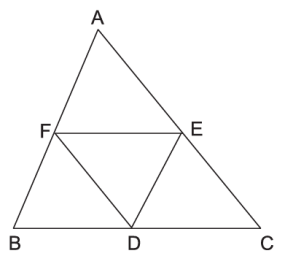
In $\triangle A B C, D, E$ and $F$ are midpoints of $B C, C A$ and $A B$ respectively. Prove that $\triangle F B D \sim \triangle DEF$ and $\triangle DEF \sim \triangle ABC$

Image
Answer

Image

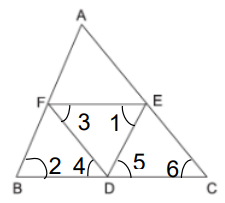
Since D, E, F are the mid points of BC, CA, AB respectively
Therefore, $E F\|B C, D F\| A C, D E \| A B$
BDEF is a parallelogram
$\begin{array}{c}\angle 1=\angle 2 \& \angle 3=\angle 4 \\ \triangle FBD \sim \Delta DEF \end{array}$
Also, DCEF is a parallelogram
$\angle 3=\angle 6 \& \angle 1=\angle 2$ (proved above)
$\Delta DEF \sim \Delta ABC$
View full question & answer
3 Marks Question - Maths STD 10 Questions - Vidyadip