Questions

3 Marks Question

Take a timed test

8 questions · self-marked practice — reveal the answer and mark yourself.

Question 13 Marks
The king, queen and jack of clubs are removed from a deck of 52 playing cards and the remaining cards are shuffled. A card is drawn from the remaining cards. Find the probability of getting a card of
i. heart
ii. queen
iii. clubs.
Answer
When king, queen and jack of clubs are removed, number of cards remaining = 52 - 3 = 49
Total no. of outcomes = 49
i. Let H be the event of getting a heart card.
Thus, favorable outcomes = 13
$P ( H )=\frac{\text { Favorable outcomes }}{\text { Total no. of outcomes }}=\frac{13}{49}$
ii. Let Q be the event of getting a queen card.
Thus, favorable outcomes = 3 (1 queen of clubs is removed)
$P ( Q )=\frac{\text { Favorable outcomes }}{\text { Total no. of outcomes }}=\frac{3}{49}$
iii. Let C be the event of getting a clubs card.
Thus out of 49 cards, there are 10 clubs cards, because king, queen and jack of clubs are removed
Hence, favorable outcomes = 10
$P ( C )=\frac{\text { Favorable outcomes }}{\text { Total no. of outcomes }}=\frac{10}{49}$
View full question & answer
Question 23 Marks
Prove: $\sin ^6 A+3 \sin ^2 A \cos ^2 A=1-\cos ^6 A$
Answer
Given- $\sin ^6 A+3 \sin ^2 A \cos ^2 A=1-\cos ^6 A$
Now, taking
$\sin ^6 A+\cos ^6 A=1-3 \sin ^2 A \cos ^2 A$
Taking $\ce{LHS}$
$=\sin ^6 A+\cos ^6 A=\left(\sin ^2 A\right)^3+\left(\cos ^2 A\right)^3$
$=\left(\sin ^2 A+\cos ^2 A\right)^3-3 \sin ^2 A \cos ^2 A\left(\sin ^2 A+\cos ^2 A\right)\left\{\because a^3+b^3=(a+b)^3-3 a b(a+b)\right\}$
$=(1)^3-3 \sin ^2 A \cos ^2 A(1)$
$=1-3 \sin ^2 A \cos ^2 A=\text { RHS }$
View full question & answer
Question 33 Marks
Find the acute angle $\theta$, when $\frac{\cos \theta-\sin \theta}{\cos \theta+\sin \theta}=\frac{1-\sqrt{3}}{1+\sqrt{3}}$.
Answer
According to question
$\frac{\cos \theta-\sin \theta}{\cos \theta+\sin \theta}=\frac{1-\sqrt{3}}{1+\sqrt{3}}$
$\Rightarrow \quad \frac{(\cos \theta-\sin \theta)+(\cos \theta+\sin \theta)}{(\cos \theta-\sin \theta)-(\cos \theta+\sin \theta)}=\frac{(1-\sqrt{3})+(1+\sqrt{3})}{(1-\sqrt{3})-(1+\sqrt{3})}[$ Applying componendo and dividendo $]$
$\Rightarrow \quad \frac{2 \cos \theta}{-2 \sin \theta}=\frac{2}{-2 \sqrt{3}}$
$\Rightarrow \quad \cot \theta=\frac{1}{\sqrt{3}} \Rightarrow \tan \theta=\sqrt{3} \Rightarrow \tan \theta=\tan 60^{\circ} \Rightarrow \theta=60^{\circ}$
View full question & answer
Question 43 Marks
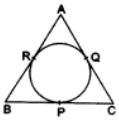
In the given figure, the incircle $-$ of $\triangle A B C$ touches the sides $BC, CA$ and $AB $ at $P, Q$ and $R$ respectively. Prove that $(AR + BP + CQ) = (AQ + BR + CP) =\frac{1}{2}($ perimeter of $\triangle A B C)$.
Image
Answer
Image
We know that the lengths of tangents from an exterior point to a circle are equal.
$\therefore A R=A Q, \ldots$ (i) $($ tangents from $A)$
$BP = BR, ... (ii) \ ($tangents from $B)$
$CQ = CP .... (iii)\  ($tangents from $C)$
$\therefore(A R+B P+C Q)$
$=(A Q+B R+C P)=k \ ($say$)$.
Perimeter of $\triangle A B C=( AB + BC + CA )$
$= (AR + BR) + (BP + CP) + (CQ+AQ)$
$= (AR + BP + CQ) + (AQ + BR + CP)$
$= (k + k) = 2k$
$\Rightarrow k=\frac{1}{2}($ perimeter of $ \triangle A B C)$
$\therefore( AR + BP + CQ )$
$=( AQ + BR + CP )$
$=\frac{1}{2}($ perimeter of $ \triangle A B C)$
View full question & answer
Question 53 Marks
If $x+1$ is a factor of $2 x^3+a x^2+2 b x+1$, then find the values of $a$ and $b$ given that $2 a-3 b=4$.
Answer
Since $(x+1)$ is a factor of $2 x^3+a x^2+2 b x+1$
$\Rightarrow x=-1$ is a zero of $2 x^3+a x^2+2 b x+1$
$\Rightarrow 2(-1)^3+a(-1)^2+2 b(-1)+1=0$
$\Rightarrow a-2 b-1=0$
$\Rightarrow a -2 b=1 \ldots \text { (i) }$
Given that $2a − 3b = 4 ...(ii)$
Multiplying equation $(i)$ by $2,$ we get
$2a − 4b = 2 ...(iii)$
Subtracting equation $(iii)$ from $(ii),$ we get
$b = 2$
Substituting $b = 2$ in equation $(i),$ we have
$a - 2(2) = 1$
$\Rightarrow a -4=1$
$\Rightarrow a =5$
Hence, $a = 5$ and $b = 2.$
View full question & answer
Question 63 Marks
Solve $2 x+3 y=11$ and $2 x-4 y=-24$ and hence find the value of $m$ for which $y=m x+3$.
Answer
The given pair of linear equations
$2x + 3y = 11 ...... (1)$
$2x - 4y = -24 ....... (2)$
From equation $(1), 3y = 11 - 2x$
$\Rightarrow y=\frac{11-2 x}{3}$
Substituting this value of $y$ in equation $(2),$ we get
$2 x-4\left(\frac{11-2 x}{3}\right)=-24$
$\Rightarrow 6 x-44+8 x=-72$
$\Rightarrow 14 x-44=-72$
$\Rightarrow 14 x=44-72$
$\Rightarrow 14 x=-28$
$\Rightarrow x=-\frac{28}{14}=-2$
Substituting this value of $x$ in equation $(3),$ we get
$y=\frac{11-2(-2)}{3}=\frac{11+4}{3}=\frac{15}{3}=5$
Verification, Substituting $x = -2$ and $y = 5,$
we find that both the equations $(1)$ and $(2)$ are satisfied as shown below:
$2x + 3y = 2(−2) + 3(5) = −4 + 15 = 11$
$2x − 4y = 2(−2) − 4(5) = −4 − 20 = −24$
This verifies the solution,
Now, $y = axe + 3$
$\Rightarrow 5=m(-2)+3$
$\Rightarrow-2 m=5-3$
$\Rightarrow-2 m=2$
$\Rightarrow m=\frac{2}{-2}=-1$
View full question & answer
Question 73 Marks
Find the zeroes of the quadratic polynomia $3 x^2-2$ and verify the relationship between the zeroes and the coefficients.
Answer
Here, $p(x)=3 x^2-2$
Now p(x) = 0
$\Rightarrow \quad 3 x^2-2=0$
$\Rightarrow 3 x^2=2$
$\Rightarrow \quad x^2=\frac{2}{3}$
$\Rightarrow x= \pm \sqrt{\frac{2}{3}}$
Therefore, zeroes are
$\sqrt{\frac{2}{3}}$ and $-\sqrt{\frac{2}{3}}$.
If $p(x)=3 x^2-2$, then $a=3, b=0$ and $c=-2$
Now, sum of zeroes = $\sqrt{\frac{2}{3}}+\left(-\sqrt{\frac{2}{3}}\right)=0 \ldots$ (i)
Also, $\frac{-b}{a}=\frac{-0}{3}=0$ $\qquad$ (ii)
From (i) and (ii)
Sum of zeroes $=\frac{-b}{a}$
and product of zeroes =$\sqrt{\frac{2}{3}} \times-\sqrt{\frac{2}{3}}=\frac{-2}{3} \ldots \ldots \ldots$. (iii)
Also, $\frac{c}{a}=\frac{-2}{3} \ldots \ldots \ldots .$. (iv)
From (iii) and (iv)
Product of zeroes$=\frac{c}{a}$
View full question & answer
Question 83 Marks
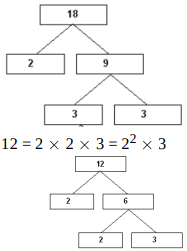
There is a circular path around a sports field. Sonia takes 18 minutes to drive one round of the field, while Ravi takes 12 minutes for the same. Suppose they both start at the same point and at the same time and go in the same direction. After how many minutes will they meet again at the starting point?
Answer
By taking LCM of time taken (in minutes) by Sonia and Ravi, We can get the actual number of minutes after which they meet again at the starting point after both start at the same point and at the same time, and go in the same direction.
$18=2 \times 3 \times 3=2 \times 3^2$
Image
$\operatorname{LCM}(18,12)=2^2 \times 3^2=36$
Therefore, both Sonia and Ravi will meet again at the starting point after 36 minutes.
View full question & answer
3 Marks Question - Maths STD 10 Questions - Vidyadip