Questions

3 Marks Question

🎯

Test yourself on this topic

8 questions · timed · auto-graded

Question 13 Marks
Solve algebraically the following pair of linear equations for $x$ and $y\ 31 x+29 y=33 , 29 x+31 y=27$
Answer
$31 x+29 y=33 ----------(1)$
$29 x+31 y=27----------(2)$
Multiply $(1) $ by $29$ and $(2)$ by $31 ($ Since $29,31$ are primes and $Lcm$ is $29 \times 31 )$
$(1)$ becomes $31 x \times 29+29 \times 29 y=33 \times 29 ........(3)$
$(2)$ becomes $29 x \times 31+31 \times 31 y=27 \times 31 ......(4)$
Subtracting $(3)$ from $(4),$
$(312-292) y=27 \times 31-33 \times 29=-120$
$(31-29)(31+29) y=-120$
$120 y=-120$
$y=-1$
Substituting in $(1),$
$31 x-29=33$
$31 x=62$
Hence,
$x=2 \text { and } y=-1$
View full question & answer
Question 23 Marks
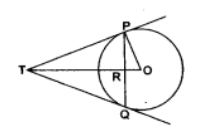
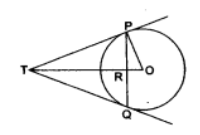
$PQ$ is a chord of length $4.8 \ cm$ of a circle of radius $3 \ cm$. The tangents at $P$ and $Q$ intersect at a point $T$ as shown in the figure. Find the length of $TP$.
Image
Answer
Given, Chord $PQ =4.8 \ cm$, radius of circle $=3 \ cm$
Also, The tangents at $P$ and $Q$ intersect at a point $T$ as shown in the figure.
We have to find the length of $TP$.
Image

Let $TR = y$ and $TP = x$
We know that the perpendicular drawn from the center to the chord bisects It.
Hence, $PR = RQ \ldots ... (1)$
Since, $P Q=4.8$
or, $PR + RQ =4.8$
or, $PR + PR =4.8\ [$ from $(1)]$
So, $PR =2.4$
Now, in right triangle $\text{POR},$
Using Pythagoras theorem, we have
$PO^2=OR^2+PR^2$
$\Rightarrow 3^2=O R^2+(2.4)^2$
$\Rightarrow O R^2=3.24$
$\Rightarrow O R=1.8$
Now, in right triangle $\text{TPR},$
By Using Pythagoras theorem, we have
$T P^2=T R^2+P R^2$
$\Rightarrow x^2=y^2+(2.4)^2$
$\Rightarrow x^2=y^2+5.76 ..........(2)$
Again, In right triangle $\text{TPO}$
By Using Pythagoras theorem, we have,
$T O^2=T P^2+P O^2$
$\Rightarrow(y+1.8)^2=x^2+3^2$
$\Rightarrow y^2+3.6 y+3.24=x^2+9$
$\Rightarrow y^2+3.6 y=x^2+5.76 .......(3)$
Solving $(2)$ and $(3),$ we get
$x=4 \ cm$ and $y =3.2 \ cm$
$\therefore TP=4 \ cm$
View full question & answer
Question 33 Marks
Compute the median for the following cumulative frequency distribution:
Less than
20
Less than
30
Less than
40
Less than
50
Less than
60
Less than
70
Less than
80
Less than
90
Less than
100
04163046668292100
Answer
We are given the cumulative frequency distribution. So, we first construct a frequency table from the given cumulative frequency distribution and then we will make necessary computations to compute median
Class intervals Frequency (f)Cumulative frequency (c.f.)
20-3044
30-401216
40-501430
50-601646
60-702066
70-801682
80-901092
90-1008100
$N =\Sigma f_i=100$
Here, $N =\Sigma f_i=100 \therefore \frac{N}{2}=50$
We observe that the cumulative frequency just greater than $\frac{N}{2}=50$ is 66 and the corresponding class is 60-70.
So, $60-70$ is the median class.
$\therefore l=60, f=20, F=46 \text { and } h=10$
Now, Median $=1+\frac{\frac{N}{2}-F}{f} \times h$
$\Rightarrow \text { Median }=60+\frac{50-46}{20} \times 10=62$
View full question & answer
Question 43 Marks
Prove that: $\frac{1}{\operatorname{cosec} A-\cot A}-\frac{1}{\sin A}=\frac{1}{\sin A}-\frac{1}{\operatorname{cosec} A+\cot A}$.
Answer
We have,
$\Rightarrow \frac{1}{\operatorname{cosec} A-\cot A}-\frac{1}{\sin A}=\frac{1}{\sin A}-\frac{1}{\operatorname{cosec} A+\cot A}$
$\Rightarrow \frac{1}{\operatorname{cosec} A-\cot A}+\frac{1}{\operatorname{cosec} A+\cot A}=\frac{1}{\sin A}+\frac{1}{\sin A}$
$\Rightarrow \frac{1}{\operatorname{cosec} A-\cot A}+\frac{1}{\operatorname{cosec} A+\cot A}=\frac{2}{\sin A}$
$\text { LHS }=\frac{1}{\operatorname{cosec} A-\cot A}+\frac{1}{\operatorname{cosec} A+\cot A}$
$\Rightarrow \frac{\operatorname{cosec} A+\cot A+\operatorname{cosec} A-\cot A}{(\operatorname{cosec} A-\cot A)(\operatorname{cosec} A+\cot A)}$
$\Rightarrow \frac{2 \operatorname{cosec} A}{\operatorname{cosec}^2 A-\cot ^2 A}$
$\Rightarrow \frac{\frac{2}{\sin A}}{1}=\frac{2}{\sin A}=\text { RHS. }$
Hence Proved.
View full question & answer
Question 53 Marks
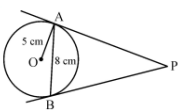
In a given figure $, AB$ is a chord of length $8 \ cm$ of a circle of radius $5 \ cm$. The tangents to the circle at $A$ and $B$ intersect at $P$. Find the length of $AP$.
Image
Answer
According to the question, radius of circle is $=5 \ cm$.
Also $, AB =8 \ cm$
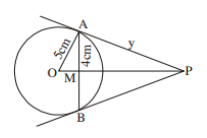
Now $, AM =\frac{A B}{2}=4 \ cm$

Image
$\text { In } \triangle OMA \text {, }$
By using pythagoras theorem, we get
$ OA ^2= OM ^2+ AM ^2$
$\therefore OM =\sqrt{5^2-4^2}=3 \ cm$
Let $ AP = y \ cm , PM = x \ cm $
In $ \triangle OAP \text {, }$
By using pythagoras theorem, we get
$OP^2=OA^2=AP^2$
$(x+3)^2=y^2+25$
$\Rightarrow x^2+9+6 x=y^2+25 ......(i)$
In $\triangle AMP$,
By using pythagoras theorem, we get
$x^2+4^2=y^2.........(ii)$
Substituting eq.$(ii)$ in eq.$(i),$ we get
$\Rightarrow x^2+6 x+9$
$=x^2+16+25$
$\Rightarrow 6 x=32$
$\Rightarrow x=\frac{32}{6}$
$=\frac{16}{3} cm$
Now, $y ^2= x ^2+16$
$=\frac{256}{9}+16$
$=\frac{400}{9}$
$\Rightarrow y =\frac{20}{3} \ cm$.
Therefore, length of $AP = y =\frac{20}{3} \ cm$.
View full question & answer
Question 63 Marks
Half of the difference between two numbers is $2$ . The sum of the greater number and twice the smaller number is $13$. Find the numbers.
Answer
Let the greater numbers be  $'x\ '$ and the smaller number  $'y\ '.$
It is said that half the difference between the two numbers is $2$ .
So, we can write it as;
$\frac{1}{2} \times(x-y)=2$
$\Rightarrow(x-y)=4 \ldots$
It is also said that the sum of the greater number and twice the smaller number is $13$ .
So, we can write it as; $x+2 y=13 \ldots(2)$
Subtracting $(2)$ from $(1),$ we get;
$(x-y)-(x+2 y)=4-13$
$\Rightarrow x-y-x-2 y=-9$
$\Rightarrow-3 y=-9$
$\Rightarrow y=\frac{9}{3}$
$\Rightarrow y=3$
Putting $y=3$ in $(1), $ we get;
$x-y=4$
$\Rightarrow x-3=4$
$\Rightarrow x=4+3$
$\Rightarrow x=7$
Hence, the greater number is $7$ .
The smaller number is $3$ .
View full question & answer
Question 73 Marks
Find the zeroes of the quadratic polynomial $6 x^2-3-7 x$ and verify the relationship between the zeroes and the coefficients of the polynomial.
Answer
The given polynomial is
$p(x)=6 x^2-7 x-3$
Factorize the above quadratic polynomial, we have
$6 x^2-7 x-3$
$=6 x^2-9 x+2 x-3$
$=3 x(2 x-3)+1(2 x-3)$
$=(3 x+1)(2 x-3)$
For $p ( x )=0$, either $3 x +1=0$ or $2 x -3=0$
$\Rightarrow x=\frac{-1}{3} $ or $ x=\frac{3}{2}$
Verification : we have $a =6, b=-7, c =-3$
Sum of zeroes $=\frac{-1}{3}+\frac{3}{2}=\frac{7}{6}$
Also, $\frac{-b}{a}=\frac{-(-7)}{6}=\frac{7}{6}$
Now, product of zeroes $=\left(-\frac{1}{3}\right) \times \frac{3}{2}=\frac{-1}{2}$
Also, $\frac{c}{a}=\frac{-3}{6}=\frac{-1}{2}$
View full question & answer
Question 83 Marks
For a morning walk, three persons steps off together. The measure of their steps is $80,85$ and $90 \ cm$ respectively.What is the minimum distance each should walk so that all can cover the same distance in complete steps?
Which value is preferred in this situation?
Answer
Since, the three persons start walking together.
$\therefore$ The minimum distance each should walk so that all can cover the same distance in complete steps will be equal to $\text{LCM}$ of $80,85$ and $90$ .
Prime factors of $80,85$ and are as following
$80=16 \times 5=2^4 \times 5$
$85=5 \times 17$
$90=2 \times 9 \times 5=2 \times 3^2 \times 5$
So $\text{LCM}$ of $80,85$ and $90$
$=2^4 \times 3^2 \times 5 \times 17$
$=16 \times 9 \times 5 \times 17=12240$
$\therefore$ Each person should walk the minimum distance
$=12240 \ cm=122 $ meter $ 40 \ cm$
Value of morning walk :
"An early morning walk is a blessing for the whole day."
View full question & answer
3 Marks Question - Maths STD 10 Questions - Vidyadip