Questions

5 Marks Questions

🎯

Test yourself on this topic

6 questions · timed · auto-graded

Question 15 Marks
From a cubical piece of wood of side $21 \ cm ,$ a hemisphere is carved out in such a way that the diameter of the hemisphere is equal to the side of the cubical piece. Find the surface area and volume of the remaining piece.
Answer
Given side of a cube $=21 \ cm$
Diameter of the hemisphere is equal to the side of the cubical piece $(d) =21 \ cm$
$\Rightarrow$ Radius of the hemisphere $=10.5 \ cm$
Volume of cube $=$ Side $^3$
$=(21)^3$
$=9261 \ cm^3$
Surface area of cubical piece of wood $=6 a ^2$
$=6 \times 21 \times 21 \ cm^2$
$=2646 \ cm^2$
Volume of the hemisphere $=\frac{2}{3} \pi r^3$
$=\frac{2}{3} \times \frac{22}{7} \times 10.5 \times 10.5 \times 10.5$
$=44 \times 0.5 \times 10.5 \times 10.5$
$=2425.5 \ cm^3$
Surface area of hemisphere $=2 \pi r^2$
$=2 \times \pi \times 10.5 \times 10.5 \ cm$
$=693 \ cm$
Volume of remaining solid $=$ Volume of cubical piece of wood $-$ Volume of hemisphere
$\Rightarrow$ Volume of the remaining solid $=9261-2425.5$
$=6835.5 \ cm^3$
Surface area remaining piece of solid $=$ surface area of cubical piece of wood $-$ Area of circular base of hemisphere $+$ Curved Surface area of hemisphere
$=6 a^2-\pi r^2+2 \pi r^2$
$=\left(2646-\pi \times 10.5^2+693\right) \ cm^2$
$=2992.5 \ cm^2$
View full question & answer
Question 25 Marks
If $x =-4$ is a root of the equation $x^2+2 x+4 p=0$, find the values of k for which the equation $x ^2+ px (1+3 k )+$ $7(3+2 k)=0$ has equal roots.
Answer
$x =-4$ is the root of the equation $x^2+2 x+4 p=0$
$(-4)^2+(2 \times-4)+4 p=0$
or, $p =-2$
Equation $x^2-2(1+3 k) x+7(3+2 k)=0$ has equal roots.
$\therefore 4(1+3 x)^2-28(3+2 k)=0$
or, $9 k^2-8 k-20=0$
or, $(9 k +10)( k -2)=0$
or, $k=\frac{-10}{9}, 2$
Hence, the value of $k=-\frac{10}{9}, 2$
View full question & answer
Question 35 Marks
Find the mean and the median of the following data:
Marks Number of Students
$0 - 10$ $3$
$10 - 20$ $3$
$20 - 30$ $16$
$30 - 40$ $12$
$40 - 50$ $13$
$50 - 60$ $20$
$60 - 70$ $6$
$70 - 80$ $5$
Answer
Marks $x$ $f$ $u =\frac{x-35}{10}$ $fu$ $cf$
$0-10$ $5$ $3$ $-3$ $-9$ $3$
$10-20$ $15$ $5$ $-2$ $-10$ $8$
$20-30$ $25$ $16$ $-1$ $-16$ $24$
$30-40$ $35$ $12$ $0$ $0$ $36$
$40-50$ $45$ $13$ $1$ $13$ $49$
$50-60$ $55$ $20$ $2$ $40$ $69$
$60-70$ $65$ $6$ $3$ $18$ $75$
$70-80$ $75$ $5$ $4$ $20$ $80$
    $80$   $56$  
Mean $=35+\left(10 \times \frac{56}{80}\right)=42$
Median class : $ 40-50$
Median $=40+\frac{10}{13}(40-36)=43$
View full question & answer
Question 45 Marks
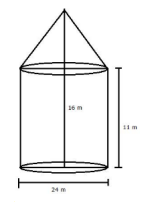
A tent is in the form of a right circular cylinder surmounted by a cone. The diameter of the base of the cylinder or the cone is $24 \ m$ . The height of the cylinder is $11\ m$ . If the vertex of the cone is $16\ m$ above the ground, find the area of the canvas required for making the tent. $($Use $\pi=\frac{22}{7} )$
Answer

Image
Diameter of cyliner $=24 m$
$\therefore $ radius of cylinder $=$ radius of cone $=12 m$
Height of cylinder $=11 m$
Total height of tent $=16 m$
$\therefore $ Height of cone $=16-11=5 m$
Now $,  l ^2= r ^2+ h ^2$
$\Rightarrow l ^2=12^2+5^2$
$\Rightarrow l ^2=144+25=169$
$\Rightarrow l =\sqrt{169}=13 m$
$\therefore $ Canvas required for tent $=$ curved surface area of cone $+$ curved surface area of cylinder 
$=\pi rl+2 \pi rh$
$=\frac{22}{7} \times 12 \times 13+2 \times \frac{22}{7} \times 12 \times 11$
$=\frac{22}{7} \times 12[13+2 \times 11]$
$=\frac{22}{7} \times 12 \times 35$
$=22 \times 12 \times 5=1320 m^2$
View full question & answer
Question 55 Marks
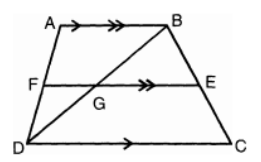
In a trapezium $\text{ABCD}, A B \| D C$ and $D C=2 A B$. $E F \| A B$, where $E$ and $F$ lie on $B C$ and $A D$ respectively such that $\frac{B E}{E C}=\frac{4}{3}$. Diagonal $DB$ intersects $EF$ at $G$ . Prove that, $7 EF =11 AB$.
Answer

Image

In a trapezium $A B C D, A B\|D C, . $
$E F\| A B$ and $C D=2 A B$ and also $\frac{B E}{E C}=\frac{4}{3}\ldots\ldots(1)$
$AB \| CD$ and $AB \| EF$
$\therefore \frac{A F}{F D}=\frac{B E}{E C}=\frac{4}{3}$
In $\Delta B G E$ and $\Delta B D C$
$\angle B E G=\angle B C D \ (  \because$ corresponding angles$)$
$\angle G B E=\angle D B C \ ($Common$)$
$\therefore \Delta B G E \sim \Delta B D C \ ($by $AA$ similarity$)$
$\Rightarrow \frac{E G}{C D}=\frac{B E}{B C} \ldots\ldots(2)$
Now, from $ (1) \frac{B E}{E C}=\frac{4}{3}$
$\Rightarrow \frac{E C}{B E}=\frac{3}{4}$
$\Rightarrow \frac{E C}{B E}+1=\frac{3}{4}+1$
$\Rightarrow \frac{E C+B E}{B E}=\frac{7}{4}$
$\Rightarrow \frac{B C}{B E}=\frac{7}{4} \text { or } \frac{B E}{B C}=\frac{4}{7}$
from equation $ (2), \frac{E G}{C D}=\frac{4}{7}$
So $E G=\frac{4}{7} C D\ldots\ldots(3)$
Similarly, $\Delta D G F \sim \Delta D B A \ ($by $AA$ similarity$)$
$\Rightarrow \frac{D F}{D A}=\frac{F G}{A B}$
$\Rightarrow \frac{F G}{A B}=\frac{3}{7}$
$\Rightarrow F G=\frac{3}{7} A B \ldots\ldots(4)$
${\left[\because \frac{A F}{A D}=\frac{4}{7}=\frac{B E}{B C}\ \Rightarrow \frac{E C}{B C}=\frac{3}{7}=\frac{D E}{D A} \right]}$
Adding equations $(3)$ and $(4),$ we get,
$E G+F G=\frac{4}{7} C D+\frac{3}{7} A B$
$\Rightarrow E F=\frac{4}{7} \times(2 A B)+\frac{3}{7} A B$
$=\frac{8}{7} A B+\frac{3}{7} A B=\frac{11}{7} A B$
$\therefore 7 E F=11 A B$
View full question & answer
Question 65 Marks
Solve for $x \frac{1}{a+b+x}=\frac{1}{a}+\frac{1}{b}+\frac{1}{x}$ where $a+b+x \neq 0$ and $a, b x \neq 0$
Answer
$\frac{1}{a+b+x}=\frac{1}{a}+\frac{1}{b}+\frac{1}{x}$
$\Rightarrow \frac{1}{a+b+x}-\frac{1}{x}=\frac{1}{a}+\frac{1}{b}$
$\Rightarrow \frac{-(a+b)}{x^2+(a+b) x}=\frac{b+a}{a b}$
$\Rightarrow x^2+(a+b) x+a b=0$
$\Rightarrow \quad(x+a)(x+b)=0$
$\Rightarrow x=-a, x=-b$
Hence $, x =- a ,- b$.
View full question & answer
5 Marks Questions - Maths STD 10 Questions - Vidyadip