Questions

3 Marks Question

🎯

Test yourself on this topic

8 questions · timed · auto-graded

Question 13 Marks
During the $2011$ census, the records of various aspects like good health, death rate and literacy rate were recorded for all the States and Union territories of India. The Literacy rates of $40$ cities are given in the following table:
Literacy rate $($in $\%)$ $35-40$ $40-45$ $45-50$ $50-55$ $55-60$ $60-65$ $65-70$ $70-75$ $75-80$ $80-85$ $85-90$
Number of cities $1$ $2$ $3$ $x$ $y$ $6$ $8$ $4$ $2$ $3$ $2$
If it is given that the mean literacy rate is $63.5,$ then find the missing frequencies $x$ and $y.$
Answer
$C.I.$ $x _{ i }$ $u _{ i }$ $f _{ i }$ $f _{ i } u _{ i }$
$35-40$ $37.5$ $- 5$ $1$ $- 5$
$40-45$ $42.5$ $- 4$ $2$ $- 8$
$45-50$ $47.5$ $- 3$ $3$ $- 9$
$50-55$ $52.5$ $- 2$ $X$ $- 2x$
$55-60$ $57.5$ $- 1$ $Y$ $- y$
$60-65$ $62.5 = A$ $0$ $6$ $0$
$65-70$ $67.5$ $1$ $8$ $8$
$70-75$ $72.5$ $2$ $4$ $8$
$75-80$ $77.5$ $3$ $2$ $6$
$80-85$ $82.5$ $4$ $3$ $12$
$85-90$ $87.5$ $5$ $2$ $10$
Total     $\Sigma f _{ i }=31+ x + y$ $\Sigma f _{ i } u _{ i }=22-2 x - y$
Let Assumed Mean$, A = 62.5$
Here$, \Sigma f_i=31+x+y=40$
$\Rightarrow x+y=9 \ldots \ldots \ldots . .( i )$
$\Sigma f _{ i } u _{ i }=22-2 x - y$
Now, Mean $= A +\frac{\Sigma f_i u_i}{\Sigma f_i} \times h$
$\Rightarrow 63.5=62.5+\frac{(22-2 x-y)}{40} \times 5$
$\Rightarrow 2 x+y=14 \ldots . . . . . . . . .(i i)$
Solving eqns $(i)$ and $(ii), x = 5$ and $y = 4$
View full question & answer
Question 23 Marks
Prove the trigonometric identity : $\sqrt{\sec ^2 \theta+\operatorname{cosec}^2 \theta}=\tan \theta+\cot \theta$
Answer
We have to prove :-
$\sqrt{\sec ^2 \theta+\operatorname{cosec}^2 \theta}=\tan \theta+\cot \theta$
Now, take $\text{LHS }=\sqrt{\sec ^2 \theta+\operatorname{cosec}^2 \theta}$
$=\sqrt{\frac{1}{\cos ^2 \theta}+\frac{1}{\sin ^2 \theta}}$
$=\sqrt{\frac{\sin ^2 \theta+\cos ^2 \theta}{\cos ^2 \theta \sin ^2 \theta}}$
$=\sqrt{\frac{1}{\sin ^2 \theta \cdot \cos ^2 \theta}}$
$=\frac{1}{\sin \theta \cos \theta}$
$=\operatorname{cosec} \theta \sec \theta \ldots . . .(1)$
Now, take $\text{RHS} =\tan \theta+\cot \theta$
$=\frac{\sin \theta}{\cos \theta}+\frac{\cos \theta}{\sin \theta}$
$=\frac{\sin ^2 \theta+\cos ^2 \theta}{\sin \theta \cos \theta}$
$=\frac{1}{\sin \theta \cdot \cos \theta}$
$=\operatorname{cosec} \theta \cdot \sec \theta \ldots . . \text { (2) }$
Hence, from $(1) (2)$
$\text{LHS=RHS} ,$ Proved.
View full question & answer
Question 33 Marks
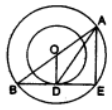
In the given figure, the radii of two concentric circles are $13 \ cm$ and $8 \ cm. AB$ is a diameter of the bigger circle and $BD$ is a tangent to the smaller circle touching it at $D$. Find the length of $AD$.
Image
Answer
Given, the radii of two concentric circles are $13 \ cm$ and $8 \ cm.$
Image
We have $\angle A E B=90^{\circ}\  [$angle in a semicircle$]$.
Also, $O D \perp B E$ and $OD$ bisects $BE.$
In right $\triangle O B D$, we have
$O B^2=O D^2+B D^2$ [by Pythagoras' theorem]
$\Rightarrow BD =\sqrt{O B^2-O D^2}$
$=\sqrt{13^2-8^2} \ cm$
$=\sqrt{105} \ cm$
$BE =2 BD =2 \sqrt{105} \ cm\ [\because D$ is the midpoint of $BE ]$
In right $\triangle A E B$, we have
$AB ^2= AE ^2+ BE ^2\ [$ by Pythagoras' theorem $]$
$\Rightarrow A E=\sqrt{A B^2-B E^2}$
$=\sqrt{26^2-(2 \sqrt{105})^2} \ cm$
$=\sqrt{256} \ cm$
$=16 \ cm .$
In right $\triangle A E D$, we have
$AD ^2= AE ^2+ DE ^2 \ [$by Pythagoras' theorem $]$
$\Rightarrow A D=\sqrt{A E^2+D E^2}$
$=\sqrt{16^2+(\sqrt{105})^2} \ cm$
$=19 \ cm$
View full question & answer
Question 43 Marks
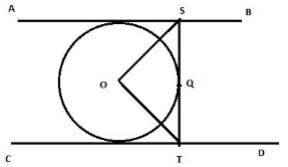
In the adjoining figure $, AB$ and $CD$ are two parallel tangents to a circle with centre $O. ST$ is the tangent segment between two parallel tangents touching the circle at $Q$. Show that $\angle SOT =90^{\circ}$.
Image
Answer

Image
From the given figure we have, $AB \perp ST,$
then $\angle ASQ =90^{\circ}$ and $CD \perp TS$ then $\angle CTQ =90^{\circ}$
$\angle A S O=\angle Q S O=\frac{90}{2}=45^{\circ}$
Similarly $,  \angle O T Q=45^{\circ}$
To find $\angle S O T$
Consider $\triangle SOT$
$\angle O T S=45^{\circ}$ and $ \angle O S T=45^{\circ}$
$\angle S O T+\angle O T S+\angle O S T=180^{\circ}\ ($ by angle sum property of a triangle$)$
$\angle S O T=180^{\circ}-(\angle O T S+\angle O S T)$
$=180^{\circ}-\left(45^{\circ}+45^{\circ}\right)$
$=180^{\circ}-90^{\circ}=90^{\circ}$
Therefore, $\angle S O T=90^{\circ}$
Hence proved
View full question & answer
Question 53 Marks
How many terms of the $AP : 9, 17, 25, ….$ must be taken to give a sum of $636?$
Answer
The given $AP$ is $9, 17, 25,...$
Here, $a = 9$
$d = 17 - 9 = 8$
Let n terms of the $AP$ must be taken
Then, $S _{ n }=636$
$\Rightarrow \frac{n}{2}[2 a+(n-1) d]=636$
$\Rightarrow \frac{n}{2}[2(9)+(n-1) 8]=636$
$\Rightarrow n [9+( n -1) 4]=636$
$\Rightarrow n [9+4 n -4]=636$
$\Rightarrow n [(4 n +5)]=636$
$\Rightarrow 4 n ^2+5 n -636=0$
$\Rightarrow 4 n ^2+53 n -48 n -636=0$
$\Rightarrow n (4 n +53)-12(4 n +53)=0$
$\Rightarrow(4 n +53)( n -12)=0$
$\Rightarrow 4 n +53=0$ or $n -12=0$
$\Rightarrow n=-\frac{53}{4}$ or $n =12$
$n=-\frac{53}{4}$ is in admissible as $n$ ,
being the number of terms, is a natural number
$\therefore n =12$
Hence, $12$ terms of the $AP$ must be taken.
View full question & answer
Question 63 Marks
The tenth term of an $A.P.,$ is $- 37$ and the sum of its first six terms is $- 27.$ Find the sum of its first eight terms.
Answer
Let the first term be $a$ and the common difference be $d.$
$a _{ n }= a +( n -1) d$
$S _{ n }=\frac{n}{2}[2 a +( n -1) d ]$
As per given condition
$a_{10}=-37$
$a+9 d=-37 \ldots \text {..(i) }$
Sum of first $6$ term is $- 27$
$S_6=\frac{6}{2}[2 a+(6-1) d]$
$3(2a + 5d) = -27$
or, $2a + 5d = - 9 ...(ii)$
Multiplying $(i)$ by $2$ and subtracting $(ii)$ from it, we get
$(2a + 18d) - (2a + 5d) = - 74 + 9$
$2a + 18d - 2a - 5d = -65$
$13d = - 65$
$d = -65/13$
$d = - 5$
Putting $d = -5$ in $(i)$ we get
$a + 9d = - 37$
$a+9 \times-5=-37$
$a = - 37 + 45$
$a = 8$
$S _{ n }=\frac{n}{2}[2 a +( n -1) d ]$
$=\frac{8}{2}[2 \times 8+(8-1)(-5)]$
$=4[16+(7)(-5)]$
$=4[16-35]$
$=4 \times-19$
$=-76$
Hence, $S _{ n }=-76$
View full question & answer
Question 73 Marks
If $\alpha, \beta$ are zeroes of the quadratic polynomial $x ^2+3 x +2$, find a quadratic polynomial whose zeroes are $\alpha+1$, $\beta+1$
Answer
$p(x)=x^2+3 x+2$
$\alpha, \beta$ are its zeroes
$\therefore \alpha+\beta=-3, \alpha \beta=2$
Now,
$(\alpha+1)+(\beta+1)=\alpha+\beta+2=-3+2=-1$
$(\alpha+1)(\beta+1)=\alpha \beta+(\alpha+\beta)+1=+2-3+1=0$
$\therefore$ Required Polynomial is $k \left( x ^2+ x \right)$ or $x ^2+ x$
View full question & answer
Question 83 Marks
A mason has to fit a bathroom with square marble tiles of the largest possible size. The size of the bathroom is $10 ft.$ by $8 ft.$ What would be the size $($in inches$)$ of the tile required that has to be cut and how many such tiles are required?
Answer
Given: Size of bathroom $= 10 ft$ by $8 ft.$
$=(10 \times 12)$ inch by $(8 \times 12)$ inch
$= 120$ inch by $96$ inch
Area of bathroom $= 120$ inch by $96$ inch
To find the largest size of tile required , we find $\text{HCF}$ of $120$ and $96.$
By applying Euclid’s division lemma
$120=96 \times 1+24$
$96=24 \times 4+0$
Therefore, Largest size of tile required $= 24$ inches
no.of tiles required$=\frac{\text { area of bathroom }}{\text { area of a tile }}=\frac{120 \times 96}{24 \times 24}=5 \times 4=20$ tiles
Hence number of tiles required is $20$ and size of tiles is $24$ inches.
View full question & answer
3 Marks Question - Maths STD 10 Questions - Vidyadip