Questions

5 Marks Questions

🎯

Test yourself on this topic

6 questions · timed · auto-graded

Question 15 Marks
Find the mean and the mode of the data given below:
Weight (in kg)Number of students
40 - 455
45 - 5011
50 - 5520
55 - 6024
60 - 6528
65 - 7012
Answer
Class$x _{ i }$$f _{ i }$$u _{ I }=\frac{x_i 57.5}{5}$$f _{ i } u _{ i }$
40 - 4542⋅55-3-15
45 - 5047⋅511-2-22
50 - 5552⋅520-1-20
55 - 6057⋅5=a2400
60 - 6562⋅528128
65 - 7067⋅514224
100 -5
Mean $= a +\frac{\sum f_i u_i}{\sum f_i} \times h$
$=57.5+\frac{-5}{100} \times 5=57.25$
Mode $=l+\left(\frac{ f _1- f _0}{2 f _1- f _0- f _2}\right) \times h$
$=60+\frac{28-24}{2(28)-24-12} \times 5=61$
View full question & answer
Question 25 Marks
From a solid cylinder of height $20 \ cm$ and diameter $12 \ cm,$ a conical cavity of height $8 \ cm$ and radius $6 \ cm$ is hallowed out. Find the total surface area of the remaining solid.
Answer
Given, Height of cylinder $h_1=20 \ cm$
Radius of cylinder $=\frac{12}{2}=6 \ cm$
Height of the cone $\left( h _2\right)=8 \ cm$
Radius of the cone $r=6 \ cm$
Total surface area of remaining solid $=$ Curved surface area of cylinder $ +$ Curved surface area of cone $+$ Area of the top face of the cylinder
Slant height of the cone $(l) = \sqrt{h_2^2+r^2}$
$=\sqrt{8^2+6^2}$
$=\sqrt{64+36}$
$=10 \ cm$
$\therefore$ Curved surface area of cone $=\pi r l$
$=\frac{22}{7} \times 6 \times 10$
$=\frac{1320}{7} \ cm^2$
Curved surface area of cylinder $=2 \pi r h$
$=2 \times \frac{22}{7} \times 6 \times 20$
$=\frac{5280}{7} \ cm^2$
Area of the top face of the cylinder $=\pi r^2$
$=\frac{22}{7} \times 6 \times 6$
$=\frac{792}{7} \ cm^2$
$\therefore$ Total surface area of the remaining solid
$=\frac{1320}{7}+\frac{5280}{7}+\frac{792}{7}$
$=\frac{7392}{7}$
$=1056 \ cm^2$
View full question & answer
Question 35 Marks
A solid is in the shape of a cone standing on a hemisphere with both their diameters being equal to $1 \ cm$ and the height of the cone is equal to its radius. Find the volume of the solid. $[$Use $\pi=3.14 ]$
Answer
Clearly $r =\frac{1}{2}, h=\frac{1}{2}$
Volume of solid $=$ Volume of Cone $+$ Volume of Hemisphere
$=\frac{1}{3} \pi r ^2 h+\frac{2}{3} \pi r ^3$
$=\frac{1}{3} \times 3.14 \times \frac{1}{2} \times \frac{1}{2} \times \frac{1}{2}+\frac{2}{3} \times 3.14 \times \frac{1}{2} \times \frac{1}{2} \times \frac{1}{2}$
$=\frac{1}{3} \times 3.14 \times \frac{1}{2} \times \frac{1}{2} \times\left[\frac{1}{2}+2\left(\frac{1}{2}\right)\right]$
$=\frac{1}{3} \times \frac{3.14}{4} \times \frac{3}{2}$
$=\frac{1.57}{4}$
$=\frac{157}{400} \ cm^3 \text { or } 0.3925 \ cm^3$
View full question & answer
Question 45 Marks
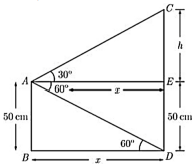
A girl on a ship standing on a wooden platform, which is $50 \ m$ above water level, observes the angle of elevation of the top of a hill as $30^{\circ}$ and the angle of depression of the base of the hill as $60^{\circ}$ . Calculate the distance of the hill from the platform and the height of the hill.
Answer
Image
Here $, CD = CE + ED = h + 50$
Now, In $\triangle ABD$
$\tan 60^{\circ}=\frac{A B}{B D}$
$\sqrt{3}=\frac{50}{x}$
$x=\frac{50}{\sqrt{3}}=\frac{50 \sqrt{3}}{3} m$
In $\triangle CEA$
$\tan 30^{\circ}=\frac{C E}{A E}$
$\frac{1}{\sqrt{3}}=\frac{h}{x}$
$h=\frac{x}{\sqrt{3}}=\frac{50 \sqrt{3}}{3 \times \sqrt{3}}$
$h=\frac{50}{3} m$
$CD = h + 50$
$C D=\frac{50}{3}+50$
$=\frac{50+150}{3}$
$C D=66.66\ m$
View full question & answer
Question 55 Marks
Solve for$ x: \frac{1}{(x-1)(x-2)}+\frac{1}{(x-2)(x-3)}=\frac{2}{3} ; x \neq 1,2,3$
Answer
$\text { Given, } \frac{1}{(x-1)(x-2)}+\frac{1}{(x-2)(x-3)}=\frac{2}{3}$
$\frac{(x-3)+(x-1)}{(x-1)(x-2)(x-3)}=\frac{2}{3}$
$\frac{x-3+x-1}{(x-1)(x-2)(x-3)}=\frac{2}{3}$
$\frac{2 x-4}{(x-1)(x-2)(x-3)}=\frac{2}{3}$
$\frac{2(x-2)}{(x-1)(x-2)(x-3)}=\frac{2}{3}$
$\frac{2}{(x-1)(x-3)}=\frac{2}{3}$
$(x - 1) (x - 3) = 3$
$x^2-4 x+3=3$
$x^2-4 x=0$
$x(x-4)=0$
$x=0, x-4=0$
$x=0, x=4$
View full question & answer
Question 65 Marks
A train travels a distance of $90 \ km$ at a constant speed. Had the speed been $15 \ km/h$ more, it would have taken $30$ minutes less for the journey. Find the original speed of the train.
Answer
Let the original speed of the train be $x \ km/hr.$
We know that time taken to cover $'d' \ km $ with speed $'s' \ km/h$
$=\frac{d}{s} \therefore$ time taken to cover $90 \ km=\frac{90}{x}$ hours
Time taken to cover $90 \ km$ when the speed is increased by $15 \ km/hr$
$=\frac{90}{x+15}$ hours
According to the question ;
$\frac{90}{x}-\frac{90}{x+15}=\frac{30}{60} \ ($time reduced by $30$ minutes with increased speed$)$
$\Rightarrow \frac{90}{x}-\frac{90}{x+15}=\frac{1}{2}$
$\Rightarrow \frac{90 x+1350-90 x}{x^2+15 x}=\frac{1}{2}$
$\Rightarrow \frac{1350}{x^2+15 x}=\frac{1}{2}$
$\Rightarrow 2700=x^2+15 x$
$\Rightarrow x^2+15 x-2700=0$
$\Rightarrow x^2+60 x-45 x-2700=0$
$\Rightarrow x(x+60)-45(x+60)=0$
$\Rightarrow(x+60)(x-45)=0$
$\Rightarrow x+60=0$ or $ x-45=0$
$\Rightarrow x=-60$ or $ x=45$
Since the speed cannot be negative, $x \neq-60$.
$\Rightarrow x=45$
Thus, the original speed of the train is $45 \ km/hr.$
View full question & answer
5 Marks Questions - Maths STD 10 Questions - Vidyadip