Question 14 Marks
Read the following text carefully and answer the questions that follow:
Jagdish has a field which is in the shape of a right angled triangle $\text{AQC.}$ He wants to leave a space in the form of a square $\text{PQRS}$ inside the field for growing wheat and the remaining for growing vegetables $($as shown in the figure$)$. In the field, there is a pole marked as $O.$
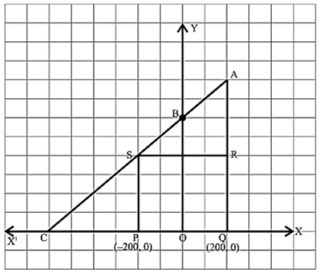
$i.$ Taking $O$ as origin, coordinates of $P$ are $(-200, 0)$ and of $Q$ are $(200, 0). \text{PQRS}$ being a square, what are the coordinates of $R$ and $S\ ?$
$ii.$ What is the area of square $\text{PQRS}\ ?$
$iii.$ What is the length of diagonal $\text{PR}$ in square $\text{PQRS}\ ?$
OR
If $S$ divides $\text{CA}$ in the ratio $K : 1,$ what is the value of $K,$ where point $A$ is $(200, 800)\ ?$
Jagdish has a field which is in the shape of a right angled triangle $\text{AQC.}$ He wants to leave a space in the form of a square $\text{PQRS}$ inside the field for growing wheat and the remaining for growing vegetables $($as shown in the figure$)$. In the field, there is a pole marked as $O.$
$i.$ Taking $O$ as origin, coordinates of $P$ are $(-200, 0)$ and of $Q$ are $(200, 0). \text{PQRS}$ being a square, what are the coordinates of $R$ and $S\ ?$
$ii.$ What is the area of square $\text{PQRS}\ ?$
$iii.$ What is the length of diagonal $\text{PR}$ in square $\text{PQRS}\ ?$
OR
If $S$ divides $\text{CA}$ in the ratio $K : 1,$ what is the value of $K,$ where point $A$ is $(200, 800)\ ?$
Answer
View full question & answer→$i.$ Since, $\text{PQRS}$ is a square
$\therefore\text{PQ = QR = RS = PS}$
Length of $\text{PQ} = 200 - (-200) = 400$
$\therefore$The coordinates of $R = (200, 400)$
and coordinates of $S = (-200, 400)$
$ii.$ Area of square $\text{PQRS}=($ side $)^2$
$=\text{(PQ)}^2$
$=(400)^2$
$=1,60,000 \text { sq. units }$
$iii.$ By Pythagoras theorem
$\ce{( PR )^2=( PQ )^2 + ( QR )^2}$
$=1,60,000+1,60,000$
$=3,20,000$
$\Rightarrow \text{PR}=\sqrt{3,20,000}$
$=400 \times \sqrt{2} \text { units }$
OR
Since, point $S$ divides $\text{CA}$ in the ratio $K : 1$
$\therefore\left(\frac{K x_2+x_1}{K+1}, \frac{K y_2+y_1}{K+1}\right)=(-200,400)$
$\Rightarrow\left(\frac{K(200)+(-600)}{K+1}, \frac{K(800)+0}{K+1}\right)=(-200,400)$
$\Rightarrow\left(\frac{200 K-600}{K+1}, \frac{800 K}{K+1}\right)=(-200,400)$
$\therefore \frac{800 K}{K+1}=400$
$\Rightarrow 800 K=400 K+400$
$\Rightarrow 400 K=400$
$\Rightarrow K=1$
$\therefore\text{PQ = QR = RS = PS}$
Length of $\text{PQ} = 200 - (-200) = 400$
$\therefore$The coordinates of $R = (200, 400)$
and coordinates of $S = (-200, 400)$
$ii.$ Area of square $\text{PQRS}=($ side $)^2$
$=\text{(PQ)}^2$
$=(400)^2$
$=1,60,000 \text { sq. units }$
$iii.$ By Pythagoras theorem
$\ce{( PR )^2=( PQ )^2 + ( QR )^2}$
$=1,60,000+1,60,000$
$=3,20,000$
$\Rightarrow \text{PR}=\sqrt{3,20,000}$
$=400 \times \sqrt{2} \text { units }$
OR
Since, point $S$ divides $\text{CA}$ in the ratio $K : 1$
$\therefore\left(\frac{K x_2+x_1}{K+1}, \frac{K y_2+y_1}{K+1}\right)=(-200,400)$
$\Rightarrow\left(\frac{K(200)+(-600)}{K+1}, \frac{K(800)+0}{K+1}\right)=(-200,400)$
$\Rightarrow\left(\frac{200 K-600}{K+1}, \frac{800 K}{K+1}\right)=(-200,400)$
$\therefore \frac{800 K}{K+1}=400$
$\Rightarrow 800 K=400 K+400$
$\Rightarrow 400 K=400$
$\Rightarrow K=1$