Questions

M.C.Q (1 Marks)

🎯

Test yourself on this topic

18 questions · timed · auto-graded
MCQ 11 Mark
Using empirical relationship, the mode of a distribution whose mean is 7.2 and the median 7.1, is:
  • A
    6.5
  • 6.9
  • C
    6.2
  • D
    6.3
Answer
Correct option: B.
6.9
(B) 6.9
Explanation: 6.9
View full question & answer
MCQ 21 Mark
Which of the following numbers cannot be the probability of an event?
  • A
    5%
  • B
    0.5
  • $\frac{1}{0.5}$
  • D
    $\frac{0.5}{14}$
Answer
Correct option: C.
$\frac{1}{0.5}$
(C) $\frac{1}{0.5}$
Explanation:  The probability of an event cannot be greater then 1.
$\therefore \frac{1}{0.5}=2$,cannot be the possible value of probability.
View full question & answer
MCQ 31 Mark
A coin is tossed thrice. The probability of getting at least two tails is
  • A
    $\frac{4}{5}$
  • B
    $\frac{2}{3}$
  • C
    $\frac{1}{4}$
  • $\frac{1}{2}$
Answer
Correct option: D.
$\frac{1}{2}$
(D) $\frac{1}{2}$
Explanation: Total outcomes = = {HHH, TTT, HHT, HTH, HTT, THH, THT, TTH} = 8
Number of possible outcomes (at least two tails) = 4
$\therefore$ Required Probability $=\frac{4}{8}=\frac{1}{2}$
View full question & answer
MCQ 41 Mark
If the area of a sector of a circle is $\frac{5}{18}$ of the area of the circle, then the sector angle is equal to
  • $100^{\circ}$
  • B
    $120^{\circ}$
  • C
    $190^{\circ}$
  • D
    $60^{\circ}$
Answer
Correct option: A.
$100^{\circ}$
(A) $100^{\circ}$
Explanation: We have given that area of the sector is $\frac{5}{18}$ of the area of the circle.
Therefore, area of the sector $=\frac{5}{18} \times$ area of the circle
$\Rightarrow \frac{\theta}{360} \times \pi r^2=\frac{5}{18} \times \pi r^2$
Now we will simplify the equation as below,
$\Rightarrow \frac{\theta}{360}=\frac{5}{18}$
$\therefore \theta=\frac{5}{18} \times 360$
$\therefore \theta=100$
Therefore, sector angle is $100^{\circ}$.
View full question & answer
MCQ 51 Mark
In a circle of radius 21 cm, an arc subtends an angle of $60^0$ at the centre. The length of the arc is
  • A
    18.16 cm
  • B
    23.5 cm
  • 22 cm
  • D
    21 cm
Answer
Correct option: C.
22 cm
(C) 22 cm
Explanation:  Arc length $=\frac{2 \pi r \theta}{360}=\left(2 \times \frac{22}{7} \times 21 \times \frac{60}{360}\right) cm =22 cm$
View full question & answer
MCQ 61 Mark
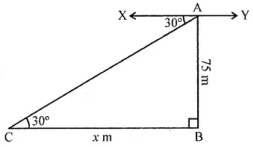
The angle of depression of a car, standing on the ground, from the top of a $75 m$ tower, is $30^{\circ}$. The distance of the car from the base of the tower $($in metres$)$ is
  • A
    $25 \sqrt{3}$
  • $75 \sqrt{3}$
  • C
    $150$
  • D
    $50 \sqrt{3}$
Answer
Correct option: B.
$75 \sqrt{3}$
$AB$ is as tower and $AB = 75 m$ From$ A,$ the angle of depression of a car $C$ on the ground is $30^{\circ}$
Image
Let distane $\text{BC} = x$
Now in right $\triangle \text{ACB}$,
$\tan \theta=\frac{AB}{BC}$
$\Rightarrow \tan 30^{\circ}=\frac{75}{x}$
$\Rightarrow \frac{1}{\sqrt{3}}=\frac{75}{x}$
$\Rightarrow x =75 \sqrt{3} m$
$\therefore \text{BC} =75 \sqrt{3} m$
View full question & answer
MCQ 71 Mark
If $2 \sin 2 \theta=\sqrt{3}$ then $\theta= ?$
  • A
    $45^{\circ}$
  • B
    $90^{\circ}$
  • C
    $60^{\circ}$
  • $30^{\circ}$
Answer
Correct option: D.
$30^{\circ}$
We have, $2 \sin 2 \theta=\sqrt{3} $
$\Rightarrow \sin 2 \theta=\frac{\sqrt{3}}{2}=\sin 60^{\circ}$
$\Rightarrow 2 \theta=60^{\circ}$
$\Rightarrow \theta=30^{\circ}$
View full question & answer
MCQ 81 Mark
$\left(\frac{1-\tan ^2 30^{\circ}}{1+\tan ^2 30^{\circ}}\right)$ is equal to:
  • A
    $\sin 60^{\circ}$
  • B
    $\tan 60^{\circ}$
  • C
    $\cos 30^{\circ}$
  • $\cos 60^{\circ}$
Answer
Correct option: D.
$\cos 60^{\circ}$
$\frac{1-\tan ^2 30^{\circ}}{1+\tan ^2 30^{\circ}}=\frac{1-\left(\frac{1}{\sqrt{3}}\right)^2}{1+\left(\frac{1}{\sqrt{3}}\right)^2}$
$=\frac{1-\frac{1}{3}}{1+\frac{1}{3}}$
$=\frac{\frac{2}{3}}{\frac{4}{3}}$
$=\frac{1}{2}$
$=\cos 60^{\circ}$
View full question & answer
MCQ 91 Mark
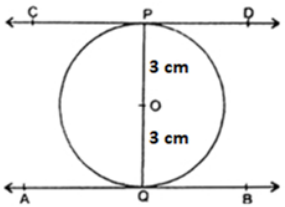
A circle is of radius $3 \ cm$. The distance between two of its parallel tangents is :
  • A
    $3 \ cm$
  • B
    $4.5 \ cm$
  • $6 \ cm$
  • D
    $12 \ cm$
Answer
Correct option: C.
$6 \ cm$
Image
Distance between the two parallel tangent to a circle $=$ diameter
$=2 \times r$
$=2 \times 3=6 \ cm .$
View full question & answer
MCQ 101 Mark
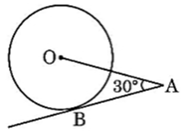
In the given figure, $AB$ is a tangent to the circle centered at $O.$ If $OA = 6 \ cm$ and $\angle OAB =30^{\circ}$, then the radius of the circle is:
Image
  • A
    $3 \sqrt{3} \ cm$
  • B
    $2 \ cm$
  • C
    $\sqrt{3} \ cm$
  • $3 \ cm$
Answer
Correct option: D.
$3 \ cm$
$\sin 30^{\circ}=\frac{O B}{O A}$
$\frac{1}{2}=\frac{r}{6}$
$r =3 \ cm$
View full question & answer
MCQ 111 Mark
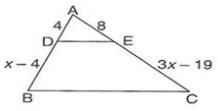
In the given figure if $D E \| B C$, then $x$ is equal to $-$
Image
  • A
    $17$
  • B
    $15$
  • $11$
  • D
    $19$
Answer
Correct option: C.
$11$
Given: $D E \| B C$
$\therefore \frac{ AD }{ DB }=\frac{ AE }{ EC } $
$\Rightarrow \frac{4}{x-4}=\frac{8}{3 x-19}$ by using Thale's theorem
$\Rightarrow 12 x-76=8 x-32$
$\Rightarrow 4 x=44$
$\Rightarrow x=11$
View full question & answer
MCQ 121 Mark
If (3, –6) is the mid-point of the line segment joining (0, 0) and (x, y), then the point (x, y) is:
  • A
    (6, - 6)
  • (6, -12)
  • C
    $\left(\frac{3}{2},-3\right)$
  • D
    (- 3, 6)
Answer
Correct option: B.
(6, -12)
(B) (6, -12)
Explanation: If (a, b) and (c, d) be the coordinates of any two points, then the coordinates of the mid-point joining those points be$\left(\frac{(a+c)}{2}, \frac{(b+d)}{2}\right)$.
The line segment is formed by points are (0, 0) and (x, y), whose mid-point is (3, -6).
Then,
$\frac{(0+x)}{2}=3$ and $\frac{(0+y)}{2}=-6$
or, $\frac{x}{2}=3$ or, $\frac{y}{2}=-6$
or, x = 6 or, y = -12
Therefore the required point is (6, -12).
View full question & answer
MCQ 131 Mark
The points (-4, 0), (4, 0) and (0, 3) are the vertices of a:
  • isosceles triangle
  • B
    scalene triangle
  • C
    equilateral triangle
  • D
    right triangle
Answer
Correct option: A.
isosceles triangle
(A) isosceles triangle
Explanation: $AB ^2=(4+4)^2+(0-0)^2=8^2+0^2=64+0=64$
$\Rightarrow AB =\sqrt{64}=8$ units
$BC ^2=(0-4)^2+(3-0)^2=(-4)^2+3^2=16+9=25$
$\Rightarrow B C=\sqrt{25}=5$ units.
$A C^2=(0+4)^2+(3-0)^2=4^2+3^2=16+9=25$
$\Rightarrow A C=\sqrt{25}=5$ units.
$\therefore \triangle ABC$ is isosceles.
View full question & answer
MCQ 141 Mark
If p - 1, p + 1 and 2p + 3 are in A.P., then the value of p is
  • 0
  • B
    4
  • C
    2
  • D
    -2
Answer
Correct option: A.
0
(A) 0
Explanation: 0
View full question & answer
MCQ 151 Mark
The discriminant of the quadratic equation $2 x^2-4 x+3=0$ is:
  • -8
  • B
    10
  • C
    8
  • D
    $2 \sqrt{2}$
Answer
Correct option: A.
-8
(A) (-8)
Explanation:  The given equation is of the form: $ax ^2+ bx + c =0$, where; $a =2, b=-4$ and $c =3$.
Therefore, the discriminant ( D ) is given as $D = b ^2$ - 4 ac
$D=(-4)^2-(4 \times 2 \times 3)=16-24=-8$
View full question & answer
MCQ 161 Mark
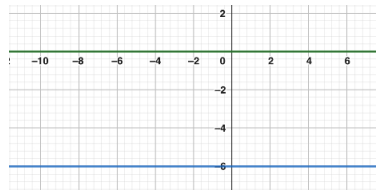
The pair of linear equations y = 0 and y = - 6 has:
Image
  • no solution
  • B
    only solution (0, 0)
  • C
    infinitely many solutions
  • D
    a unique solution
Answer
Correct option: A.
no solution
(A) no solution
Explanation:  Since, we have y = 0 and y = -6 are two parallel lines.
therefore, no solution exists.
View full question & answer
MCQ 171 Mark
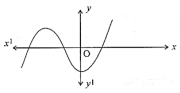
The graph of a polynomial is shown in Figure, then the number of its zeroes is:
Image
  • A
    4
  • 3
  • C
    1
  • D
    2
Answer
Correct option: B.
3
(B) 3
Explanation: The graph of given polynomial cuts the x-axis at 3 distinct points. therefore, No. of zeroes are 3.
View full question & answer
MCQ 181 Mark
Which of the followings is an irrational number?
  • $(\sqrt{2}-1)^2$
  • B
    $\left(2 \sqrt{3}-\frac{1}{\sqrt{3}}\right)^2$
  • C
    $\frac{(\sqrt{2}+5 \sqrt{2})}{\sqrt{2}}$
  • D
    $\sqrt{2}-(2+\sqrt{2})$
Answer
Correct option: A.
$(\sqrt{2}-1)^2$
(A) $(\sqrt{2}-1)^2$
Explanation: $(\sqrt{2}-1)^2$
View full question & answer
M.C.Q (1 Marks) - Maths STD 10 Questions - Vidyadip