Questions

2 Marks Questions

🎯

Test yourself on this topic

7 questions · timed · auto-graded

Question 12 Marks
A car has two wipers which do not overlap. Each wiper has a blade of length $25 \ cm$ sweeping through an angle of $115^{\circ}$. Find the total area cleaned at each sweep of the blades.
Answer
Radius of each wiper $=25 \ cm,$
Angle $=115^{\circ}$
$\therefore \theta=115^{\circ}$
Total area cleaned at each sweep of the blades
$=2\left[\frac{115}{360} \times \frac{22}{7} \times 25 \times 25\right] \ (\because $ Area $=\frac{\theta}{360} \pi r^2)$
$=\frac{230 \times 22 \times 5 \times 25}{72 \times 7}$
$=\frac{230 \times 11 \times 125}{36 \times 7}$
$=\frac{115 \times 11 \times 125}{18 \times 7}$
$=\frac{158125}{126} \ cm^2$
$=1254.96 \ cm^2$
View full question & answer
Question 22 Marks
Prove that: $\frac{1-\cos A}{1+\cos A}=(\cot A-\operatorname{cosec} A)^2$
Answer
$\text { LHS }=\frac{1-\cos A}{1+\cos A}$
Multiplying numerator and denominator by $1-\cos A$
$=\frac{(1-\cos A)(1-\cos A)}{(1+\cos A)(1-\cos A)}$
$=\frac{(1-\cos A)^2}{1-\cos ^2 A}\left[\because(a+b)(a-b)=a^2-b^2\right]$
$=\frac{\left(1-\cos ^2\right)^2}{\sin ^2 A}\left[\because 1-\cos ^2 A=\sin ^2 A\right]$
$=\left(\frac{1-\cos A}{\sin A}\right)^2$
$=\left(\frac{1}{\sin A}-\frac{\cos A}{\sin A}\right)^2$
$=(\cos e c A-\cot A)^2\left[\because \frac{1}{\sin A}=\operatorname{cosec} A, \frac{\cos A}{\sin A}=\cot A\right]$
$=[-1(\cot A-\operatorname{cosec} A)]^2$
$=(\cot A-\operatorname{cosec} A)^2$
Hence proved.
View full question & answer
Question 32 Marks
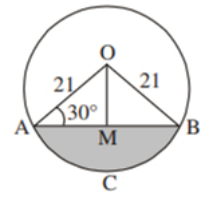
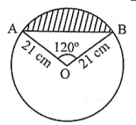
Find the area of the segment shown in Fig., if radius of the circle is $21 \ cm$ and $\angle A O B=120^{\circ}$ $($Use $\pi=\frac{22}{7} )$
Image
Answer
Draw $OM \perp AB$
Image
$\angle OAB =\angle OBA =30^{\circ}$
$\sin 30^{\circ}=\frac{1}{2}=\frac{ OM }{21} $
$\Rightarrow OM =\frac{21}{2}$
$\cos 30^{\circ}=\frac{\sqrt{3}}{2}=\frac{ AM }{21} $
$\Rightarrow AM =\frac{21}{2} \sqrt{3}$
$\text { Area of } \triangle OAB =\frac{1}{2} \times AB \times OM $
$=\frac{1}{2} \times 21 \sqrt{3} \times \frac{21}{2}$
$=\frac{441}{4} \sqrt{3} \ cm^2$
$\therefore \text { Area of shaded region }=\text { Area (sector } OACB )- \text { Area ( } \triangle OAB \text { ) }$
$=\frac{22}{7} \times 21 \times 21 \times \frac{120}{360}-\frac{441}{4} \sqrt{3}$
$=\left(462-441 \frac{\sqrt{3}}{4}\right) \ cm ^2 $ or $ 271.3 \ cm^2 \ ($approx.$)$
View full question & answer
Question 42 Marks
Prove that: $\sin ^4 A-\cos ^4 A=\sin ^2 A-\cos ^2 A=2 \sin ^2 A-1=1-2 \cos ^2 A$
Answer
We have,
$\text { LHS }=\sin ^4 A-\cos ^4 A$
$\Rightarrow \text { LHS }=\left(\sin ^2 A\right)^2-\left(\cos ^2 A\right)^2$
$\Rightarrow \text { LHS }=\left(\sin ^2 A+\cos ^2 A\right)\left(\sin ^2 A-\cos ^2 A\right)$
$\Rightarrow \text { LHS }=\sin ^2 A-\cos ^2 A \ldots\left[\because \sin ^2 A+\cos ^2 A=1\right]$
$\Rightarrow \text { LHS }=\sin ^2 A-\left(1-\sin ^2 A\right)=2 \sin ^2 A-1$
$\Rightarrow \text { LHS }=2\left(1-\cos ^2 A\right)-1=1-2 \cos ^2 A=\text { RHS }$
View full question & answer
Question 52 Marks
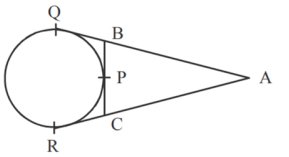
If a circle touches the side $B C$ of a triangle $A B C$ at $P$ and extended sides $A B$ and $A C$ at $Q$ and $R$, respectively, prove that $AQ=\frac{1}{2}(BC+CA+AB)$
Answer
$ AQ =\frac{1}{2}(2 AQ )$
$=\frac{1}{2}( AQ + AQ )$
$=\frac{1}{2}( AQ + AR )$
$=\frac{1}{2}( AB + BQ + AC + CR )$
$=\frac{1}{2}( AB + BC + CA )$
$\because[ BQ = BP , CR = CP ]$
Image
View full question & answer
Question 62 Marks
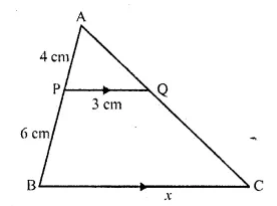
In $\Delta \text{ABC} , P$ and $Q$ are points on sides $AB$ and $AC$ respectively such that $PQ \| BC$. If $AP =4 \ cm, PB =6 \ cm$ and $PQ=3 \ cm$, determine $BC$.
Answer
Let $BC = x \ cm$
Image

In $\Delta^{\prime}$ s $\text{APQ}$ and $\text{ABC},$ we have,
$\angle A=\angle A$
$\angle \text{APQ}=\angle \text{ABC}$
Therefore, by $\text{AA}$ criteria of similar $\Delta$ 's , we have,
$\because \ce{PQ \| BC}$
$\therefore \Delta \text{APQ} \sim \Delta \text{ABC}$
$\therefore \frac{AP}{AB}=\frac{AQ}{AC}=\frac{PQ}{BC}$
$\Rightarrow \frac{AP}{AP+PB}=\frac{PQ}{BC}$
$\Rightarrow \frac{4}{4+6}=\frac{3}{x}$
$\Rightarrow \frac{4}{10}=\frac{3}{x}$
$\Rightarrow x=\frac{10 \times 3}{4}=\frac{15}{2}$
$\therefore \text{BC}=\frac{15}{2} \ cm$
$=7.5 \ cm$
View full question & answer
Question 72 Marks
Find the least number which when divided by 12, 16 and 24 leaves remainder 7 in each case.
Answer
LCM of 12, 16, 24 = 48
Required number is 48 + 7 = 55.
View full question & answer
2 Marks Questions - Maths STD 10 Questions - Vidyadip