Questions

3 Marks Question

🎯

Test yourself on this topic

8 questions · timed · auto-graded

Question 13 Marks
In the given figure, $O$ is the centre of a circle. PT and PQ are tangents to the circle from an external point $P$. If $\angle T P Q=70^{\circ}$, find $\angle T R Q$.
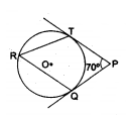
Image
Answer
In the given figure, O is the centre of a circle. PT and PQ are tangents to the circle from an extemal point P . If $\angle T P Q=70^{\circ}$, then, we have to find $\angle T R Q$.
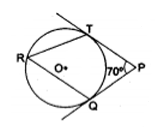
Image
We know that the radius and tangent are perpendicular at their point of contact.
$\angle O T P=\angle O Q P=90^{\circ}$
Now, In quadrilateral OQPT
$\angle Q O T+\angle O T P+\angle O Q P+\angle T P Q=360^{\circ}$ [Angle sum property of a quadrilateral]
$\angle Q O T+90^{\circ}+90^{\circ}+70^{\circ}=360^{\circ}$
$250^{\circ}+\angle Q O T=360^{\circ}$
$\angle Q O T=110^{\circ}$
We know that the angle subtended by an arc at the centre is double of the angle subtended by the arc at any point on the circumference of the circle.
$\angle T R Q=\frac{1}{2} \angle Q O T \Rightarrow \angle T R Q=\frac{1}{2} \times 110^{\circ}=55^{\circ}$
View full question & answer
Question 23 Marks
Find median for the following data:
Class Interval Frequency
$10 - 19$ $2$
$20 - 29$ $4$
$30 - 39$ $8$
$40 - 49$ $9$
$50 - 59$ $4$
$60 - 69$ $2$
$70 - 79$ $1$
Answer
Class Interval Frequency c.f.
$9.5 - 19.5$ $2$ $2$
$19.5 - 29.5$ $4$ $6$
$29.5 - 39.5$ $8$ $14$
$39.5 - 49.5$ $9$ $23$
$49.5 - 59.5$ $4$ $27$
$59.5 - 69.5$ $2$ $29$
$69.5 - 79.5$ $1$ $30$
$ n =30, \frac{n}{2}=15,$ Median class $=39.5-49.5$
$l=39.5, c . f .=14, f=9, h=10$
Median $=39.5+\left(\frac{15-14}{9}\right) \times 10$
$=39.5+\frac{1}{9} \times 10$
$=39.5+1.11$
$=40.61$
View full question & answer
Question 33 Marks
If $1+\sin ^2 \theta=3 \sin \theta \cos \theta$, then prove that $\tan \theta=1$, or $\frac{1}{2}$.
Answer
Given, $1+\sin ^2 \theta=3 \sin \theta \cos \theta$, then we have to prove that $\tan \theta=1$, or $\frac{1}{2}$.
Now, $1+\sin ^2 \theta=3 \sin \theta \cos \theta$
$[$Dividing by $\sin ^2 \theta$ on both sides$]$
$\Rightarrow \frac{1}{\sin ^2 \theta}+\frac{\sin ^2 \theta}{\sin ^2 \theta}=\frac{3 \sin \theta \cos \theta}{\sin ^2 \theta}$
$\Rightarrow \operatorname{cosec}^2 \theta+1=3 \cot \theta$
$\Rightarrow 1+\cot ^2 \theta+1-3 \cot \theta=0$
$\Rightarrow \cot ^2 \theta-3 \cot \theta+2=0$
$\Rightarrow \cot ^2 \theta-2 \cot \theta-\cot \theta+2=0$
$\Rightarrow \cot \theta(\cot \theta-2)-1(\cot \theta-2)=0$
$\Rightarrow(\cot \theta-2)(\cot \theta-1)=0$
$\Rightarrow \cot \theta-2=0 \text { or }(\cot \theta-1)=0$
$\Rightarrow \cot \theta=2 \text { or } \cot \theta=1$
$\Rightarrow \tan \theta=\frac{1}{2} \text { or } \tan \theta=1$
Hence, either, $\tan \theta=\frac{1}{2}$, or 1
View full question & answer
Question 43 Marks
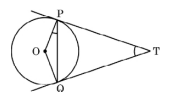
Two tangents $TP$ and $TQ$ are drawn to a circle with centre $O$ from an external point $T$ . Prove that $\angle PTQ =2\ \angle O P Q$.
Image
Answer
Given :
A circle with centre $O$ and an external point $T$ and two tangents $TP$ and $TQ$ to the circle, where $P, Q$ are the points of contact.
To Prove: $\angle PTQ =2 \angle OPQ$
Proof: Let $\angle PTQ =\theta$
Since $TP, TQ$ are tangents drawn from point $T$ to the circle.
$TP = TQ$
$\therefore \text{TPQ}$ is an isoscles triangle
$\therefore \angle TPQ =\angle TQP $
$=\frac{1}{2}\left(180^{\circ}-\theta\right)$
$=90^{\circ}-\frac{\theta}{2}$
Since $,TP$ is a tangent to the circle at point of contact $P$
$\therefore \angle OPT=90^{\circ}$
$\therefore \angle OPQ=\angle OPT-\angle TPQ$
$=90^{\circ}-\left(90^{\circ}-\frac{1}{2} \theta\right)$
$=\frac{\theta}{2}=\frac{1}{2} \angle PTQ$
Thus, $\angle PTQ =2 \angle OPQ$
View full question & answer
Question 53 Marks
Graphically, solve the following pair of equations:
$2 x+y=6$
$2 x-y+2=0$
Find the ratio of the areas of the two triangles formed by the lines representing these equations with the $x-$ axis and the lines with the $y-$ axis.
Answer
Given equation is $2 x+y=6$
$\Rightarrow y=6-2 x \ldots \ldots(i)$
If, $x=0, y=6-2(0)=6$
$x=3, y=6-2(3)=0$
Image
Given equation is $2 x-y+2=0$
$\Rightarrow y=2 x+2 \ldots\ldots( ii )$
If, $x=0, y=2(0)+2=0+2=2$
$x=-1, y=2(-1)+2=0$
Image
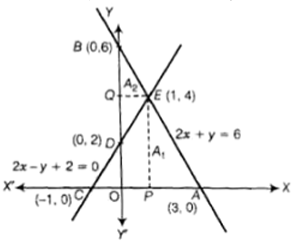
Plotting $2 x+y=6$ and $2 x-y+2=0$, as shown below, we obtain two lines $AB$ and $CD$ respectively intersecting at point, $E(1,4)$.
Image
Now, $ A_1=$ Area of $\text{ ACE}=\frac{1}{2} \times A C \times P E$
$=\frac{1}{2} \times 4 \times 4=8$
And $ A_2=$ Area of $\text{ BDE}=\frac{1}{2} \times B D \times Q E$
$=\frac{1}{2} \times 4 \times 1=2$
$\therefore A_1: A_2$
$=8: 2=4: 1$
$\therefore$ Ratio of areas of two $\triangle s=\frac{\text { Area } \triangle ACE }{\text { Area } \triangle BDE }$
$=\frac{8}{2}=\frac{4}{1}=4: 1$
View full question & answer
Question 63 Marks
The sum of the digits of a two$-$digit number is $9.$ Also, nine times this number is twice the number obtained by reversing the order of the digits. Find the number.
Answer
Let the digits at units and tens place of the given number be $x$ and $y$ respectively
Thus, the number is $10 y+x$.
The sum of the two digits of the number is $9.$
Thus, we have $x+y=9\ldots\ldots(i)$
After interchanging the digits, the number becomes $10 x+y$.
Also, $9$ times the number is equal to twice the number obtained by reversing the order of the digits.
Thus, we have
$9(10 y+x)=2(10 x+y)$
$\Rightarrow 90 y+9 x=20 x+2 y$
$\Rightarrow 20 x+2 y-90 y-9 x=0$
$\Rightarrow 11 x-88 y=0$
$\Rightarrow 11(x-8 y)=0$
$\Rightarrow x-8 y=0 \ldots . \text { (ii) }$
So, we have the systems of equations
$x+y=9$
$x-8 y=0$
Here $x$ and $y$ are unknowns.
Substituting $x=8 y$ from the second equation to the first equation, we get
$8 y+y=9$
$\Rightarrow 9 y=9$
$\Rightarrow y=\frac{9}{9}$
$\Rightarrow y=1$
Substituting the value of $y$ in the second equation, we have
$x-8 \times 1=0$
$\Rightarrow x-8=0$
$\Rightarrow x=8$
$\therefore$ the number is $10 \times 1+8=18$
View full question & answer
Question 73 Marks
If $\alpha$ and $\beta$ are zeroes of the quadratic polynomial $4 x^2+4 x+1$, then form a quadratic polynomial whose zeroes are $2 \alpha$ and $2 \beta$.
Answer
Let the given polynomial is $p ( x )=4 x ^2+4 x +1$
Since, $\alpha, \beta$ are zeroes of $p ( x )$,
$\therefore \alpha+\beta=\text { sum of zeroes }=\frac{-4}{4}$
Also, $\alpha . \beta=$ Product of zeroes = $\alpha . \beta=\frac{1}{4}$
Now a quadratic polynomial whose zeroes are $2 \alpha$ and $2 \beta$
$x^2-(\text { sum of zeroes) } x+\text { Product of zeroes }$
$=x^2-(2 \alpha+2 \beta) x+2 \alpha \times 2 \beta$
$=x^2-2(\alpha+\beta) x+4(\alpha \beta)$
$=x^2-2 \times(-1) x+4 \times \frac{1}{4}$
$=x^2+2 x+1$
The quadratic polynomial whose zeroes are $2 \alpha$ and $2 \beta$ is $x ^2+2 x +1$
View full question & answer
Question 83 Marks
Maya has two pieces of cloth. One piece is 36 inches wide and the other piece is 24 inches wide. She wants to cut both pieces into strips of equal width that are as wide as possible. How wide should she cut the strips?
Answer
This problem can be solved using H.C.F. because we are cutting or "dividing" the strips of cloth into smaller pieces of 36 and 24 and we are looking for the widest possible strips .
So,
H.C.F. of 36 and 24 is 12
So we can say that
Maya should cut each piece to be 12 inches wide.
View full question & answer
3 Marks Question - Maths STD 10 Questions - Vidyadip