Questions

M.C.Q (1 Marks)

Take a timed test

18 questions · auto-graded multiple-choice test.

MCQ 11 Mark
Consider the frequency distribution of the heights of 60 students of a class:
Height (in cm)No. of StudentsCumulative Frequency
150-155 1616
155-1601228
160-165937
165-170744
170-1751054
175-180660
The sum of the lower limit of the modal class and the upper limit of the median class is
  • A
    320
  • 315
  • C
    330
  • D
    310
Answer
Correct option: B.
315
(b) 315
Explanation: Class having maximum frequency is the modal class.
hence, modal class : $150-155$
$\therefore$ Lower limit of the modal class $=150$
Also, $N =60 \Rightarrow \frac{N}{2}=30$
The cumulative frequency just greater than 30 is 37 .
Hence, the median class is $160-165$.
$\therefore$ Upper limit of the median class $=165$
Required sum $=150+165=315$
View full question & answer
MCQ 21 Mark
A bag contains $5$ red balls and n green balls. If the probability of drawing a green ball is three times that of a red ball, then the value of n is:
  • A
    $20$
  • B
    $18$
  • $15$
  • D
    $10$
Answer
Correct option: C.
$15$
Explanation:
Given, Number of red ball $=5$
Number of green ball $= n$
$\therefore$ Total ball $= n +5$
Now $P ($ red ball $)=\frac{5}{n+5}$
and $P($ green ball $)=\frac{n}{n+5}$
Now, according to the question
$\frac{n}{n+5}=\frac{3 \times 5}{n+5}$
$n=15$
So, number of green ball $=15$
View full question & answer
MCQ 31 Mark
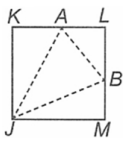
In the given figure. JKLM is a square with sides of length 6 units. Points $A$ and $B$ are the mid-points of sides KL and LM respectively. If a point is selected at random from the interior of the square. What is the probability that the point will be chosen from the interior of $\triangle JAB$ ?
Image
  • A
    $\frac{5}{8}$
  • $\frac{3}{8}$
  • C
    $\frac{7}{8}$
  • D
    $\frac{3}{4}$
Answer
Correct option: B.
$\frac{3}{8}$
(b) $\frac{3}{8}$
Explanation : Area of square JMLK $=6^2=36$ sq. units
$A$ and $B$ are the mid-points of sides KL and LM.
$\therefore AL=KA=LB=BM=3 \text { units }$

Now, Area of $\triangle ALB =\frac{1}{2} \times AL \times LB =\frac{1}{2} \times 3 \times 3=\frac{9}{2}$ sq. units

Area of $\triangle JMB =\frac{1}{2} \times BM \times JM =\frac{1}{2} \times 6 \times 3=9$ sq. units
Area of $\triangle KAJ =\frac{1}{2} \times KJ \times KA =\frac{1}{2} \times 6 \times 3=9$ sq. units
Total area of all the three triangles $=\left(\frac{9}{2}+9+9\right)$
$=\frac{45}{2}$ sq. units
$\therefore$ Area of $\triangle JAB =\left(36-\frac{45}{2}\right)=\frac{27}{2}$ sq. units
$\therefore$ Required probability $=\frac{27}{\frac{2}{36}}=\frac{27}{2 \times 36}=\frac{3}{8}$
View full question & answer
MCQ 41 Mark
Area of a segment of a circle of radius $r$ and central angle $90^{\circ}$ is:
  • A
    $\frac{2 \pi r}{4}-\frac{1}{2} r^2$
  • $\frac{\pi r^2}{4}-\frac{1}{2} r^2$
  • C
    $\frac{\pi r ^2}{2}-\frac{1}{2} r ^2$
  • D
    $\frac{2 \pi r}{4}-r^2 \sin 90^{\circ}$
Answer
Correct option: B.
$\frac{\pi r^2}{4}-\frac{1}{2} r^2$
(b) $\frac{\pi r^2}{4}-\frac{1}{2} r^2$
Explanation: $\frac{\pi r^2}{4}-\frac{1}{2} r^2$
View full question & answer
MCQ 51 Mark
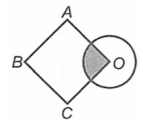
$O$ is the centre of a circle of diameter $4 \ cm$ and $\text{OABC}$ is a square, if the shaded area is $\frac{1}{3}$ area of the square, then the side of the square is $....... .$
Image
  • $\sqrt{3 \pi} \ cm$
  • B
    $\pi \sqrt{3} \ cm$
  • C
    $3 \pi \ cm$
  • D
    $3 \sqrt{\pi} \ cm$
Answer
Correct option: A.
$\sqrt{3 \pi} \ cm$
Explanation:
Let the length of side of square be $x \ cm$
Then area of square $=x^2 \ cm^2$
Area of sector of circle
$=\frac{\theta}{360^{\circ}} \times \pi r^2$
$=\frac{90^{\circ}}{360^{\circ}} \times \pi r^2\ [\because$ angle of square $=\theta=90^{\circ}]$
$\therefore $ Shaded area $=\frac{\pi \times 4}{4}=\pi$
According to question, Area of square $=3 \times$ shaded area
$\Rightarrow 3 \pi=x^2 $
$\therefore x=\sqrt{3 \pi} \ cm$
View full question & answer
MCQ 61 Mark
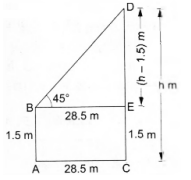
An observer $1.5 m$ tall is $28.5 m$ away from a tower and the angle of elevation of the top of the tower from the eye of the observer is $45^{\circ}$. The height of the tower is
  • $30 m$
  • B
    $26.5 m$
  • C
    $28.5 m$
  • D
    $27 m$
Answer
Correct option: A.
$30 m$
Explanation:
Let $AB$ be the observer and $CD = h$ metres be the tower.
$BE=AC=28.5 m \text {. }$
From right $\triangle B E D$, we have
$\frac{D E}{B E}=\tan 45^{\circ} $
$\Rightarrow \frac{D E}{28.5 m}=1$
$\Rightarrow De=28.5 m$
$\therefore h-1.5=28.5$
​​​​​​​$ \Rightarrow h=30 .$

Image
View full question & answer
MCQ 71 Mark
If $\tan \theta=\frac{a}{b}$, then $\frac{a \sin \theta+b \cos \theta}{a \sin \theta-b \cos \theta}$ is
  • A
    $\frac{a+b}{a-b}$
  • B
    $\frac{a^2-b^2}{a^2+b^2}$
  • C
    $\frac{a-b}{a+b}$
  • $\frac{a^2+b^2}{a^2-b^2}$
Answer
Correct option: D.
$\frac{a^2+b^2}{a^2-b^2}$
(d) $\frac{a^2+b^2}{a^2-b^2}$
Explanation : $\tan \theta=\frac{a}{b}$
$\frac{a \sin \theta+b \cos \theta}{a \sin \theta-b \cos \theta}=\frac{a \frac{\sin \theta}{\cos \theta}+b \frac{\cos \theta}{\cos \theta}}{a \frac{\sin \theta}{\cos \theta}-b \frac{\cos \theta}{\cos \theta}}$ (Dividing by $\cos \theta$ )
$=\frac{a \tan \theta+b}{a \tan \theta-b}=\frac{a \times \frac{a}{b}+b}{a \times \frac{a}{b}-b}$
$=\frac{\frac{a^2}{b}+b}{\frac{a^2}{b}-b}=\frac{\frac{a^2+b^2}{b}}{\frac{a^2-b^2}{b}}$
$=\frac{a^2+b^2}{b} \times \frac{b}{a^2-b^2}$
$=\frac{a^2+b^2}{a^2-b^2}$
View full question & answer
MCQ 81 Mark
If $\sin \theta+\cos \theta=\sqrt{2} \cos \theta$, then the value of $\cos \theta-\sin \theta$ is
  • $\sqrt{2} \sin \theta$
  • B
    $3 \sin \theta$
  • C
    $\sin \theta$
  • D
    $2 \sin \theta$
Answer
Correct option: A.
$\sqrt{2} \sin \theta$
Given: $\sin \theta+\cos \theta=\sqrt{2} \cos \theta$
Squaring both sides, we get
$\Rightarrow \sin ^2 \theta+\cos ^2 \theta+2 \sin \theta \cos \theta=2 \cos ^2 \theta$
$\Rightarrow \cos ^2 \theta-2 \sin \theta \cos \theta=\sin ^2 \theta$
$\Rightarrow \cos ^2 \theta-2 \sin \theta \cos \theta+\sin ^2 \theta=2 \sin ^2 \theta$
$\Rightarrow(\cos \theta-\sin \theta)^2=2 \sin ^2 \theta$
$\Rightarrow \cos \theta-\sin \theta=\sqrt{2} \sin \theta$
View full question & answer
MCQ 91 Mark
Quadrilateral $\text{ABCD}$ is circumscribed to a circle. If $AB = 6 \ cm, BC = 7 \ cm$ and $CD = 4 \ cm$ then the length of $AD$ is
  • A
    $6 \ cm$
  • B
    $4 \ cm$
  • C
    $7 \ cm$
  • $3 \ cm$
Answer
Correct option: D.
$3 \ cm$
Explanation:
A quadrilateral $\text{ABCD}$ is circumscribed to a circle with centre $O$ .
$AB=6 \ cm, BC=7 \ cm, CD=4 \ cm, AD=7 \ cm$
$\text{ABCD}$ circumscribed to a circle.
$AB+CD=BC+AD$
$\Rightarrow 6+4=7+AD$
$\Rightarrow 10=7+AD$
$AD=10-7=3 \ cm$
View full question & answer
MCQ 101 Mark
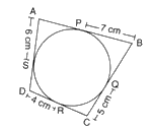
In the given figure, the perimeter of $\text{ABCD}$ is
Image
  • $44 \ cm$
  • B
    $36 \ cm$
  • C
    $40 \ cm$
  • D
    $48 \ cm$
Answer
Correct option: A.
$44 \ cm$
Explanation:
Since tangents from an external point to a circle are equal in length.
$\therefore A S=A P=6 \ cm $ and $ A B=6+7=13 \ cm$
$P B=B Q=7 \ cm $ and $ B C=7+5=12 \ cm$
$C Q=C R=5 \ cm$ and $ C D=5+4=9 \ cm$
$R D=S D=4 \ cm$ and $ A D=4+6=10 \ cm$
Therefore, perimeter of quadrilateral $\text{ABCD} =13+12+9+10=44 \ cm$
View full question & answer
MCQ 111 Mark
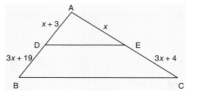
In the given figure value of $x$ for which $\ce{DE \| BC}$ is
Image
  • A
    $3$
  • $2$
  • C
    $4$
  • D
    $1$
Answer
Correct option: B.
$2$
In $\triangle \ce{ABC , DE \| BC}$
$\therefore \frac{AD}{DB}=\frac{AE}{EC}$
$\Rightarrow \frac{x+3}{3 x+19}=\frac{x}{3 x+4}$
$\Rightarrow(x+3)(3 x+4)=x(3 x+19)$
$\Rightarrow 3 x^2+4 x+9 x+12=3 x^2+19 x$
$\Rightarrow 3 x^2+13 x+12=3 x^2+19 x$
$\Rightarrow 12=3 x^2+19 x-3 x^2-13 x$
$\Rightarrow 12=6 x$
$\Rightarrow x=\frac{12}{6}=2$
$\therefore x=2$
View full question & answer
MCQ 121 Mark
The coordinates of the mid-point of the line segment joining the points (-2, 3) and (4, -5) are
  • A
    $(0,0)$
  • B
    $(-1,1)$
  • $(1,-1)$
  • D
    $(-2,4)$
Answer
Correct option: C.
$(1,-1)$
(c) $(1,-1)$
Explanation: Let the coordinates of midpoint $C ( x , y )$ of the line segment joining the points $A (-2,3)$ and $B (4,-5)$ $\therefore x =\frac{x_1+x_2}{2}=\frac{-2+4}{2}=\frac{2}{2}=1$
And $y=\frac{y_1+y_2}{2}=\frac{3-5}{2}=\frac{-2}{2}=-1$
Therefore, the coordinates of mid-point C are $(1,-1)$
View full question & answer
MCQ 131 Mark
If three points $(0,0),(3, \sqrt{3})$ and $(3, \lambda)$ form an equilateral triangle, then $\lambda=$
  • A
    $-4$
  • None of these
  • C
    $-3$
  • D
    $2$
Answer
Correct option: B.
None of these
Explanation:
Let the points $(0,0),(3, \sqrt{3})$ and $(3, \lambda)$ from an equilateral triangle $AB = BC = CA$
$\Rightarrow AB ^2= BC ^2= CA ^2$
Now $,  AB ^2=\left( x _2- x _1\right)^2+\left( y _2- y _1\right)^2$
$=(3-0)^2+(\sqrt{3}-0)^2$
$=(3)^2+(\sqrt{3})^2$
$=9+3=12$
$BC ^2=(3-3)^2+(\lambda-\sqrt{3})^2$
$=(0)^2+(\lambda-\sqrt{3})^2=(\lambda-3)^2$
and $ CA ^2=(0-3)^2+(0-\lambda)^2$
$=(-3)^2+(-\lambda)^2$
$=9+\lambda^2$
$A B^2=C A^2 $
​​​​​​​$\Rightarrow 12=9+\lambda^2$
$\Rightarrow \lambda^2=12-9=3$
$\therefore \lambda= \pm \sqrt{3}$
View full question & answer
MCQ 141 Mark
If S,, denote the sum of n terms of an A.P. with first term a and common difference d such that $\frac{S_x}{S_{k x}}$ is independent of $x$, then
  • A
    a = 2d
  • B
    d = a
  • C
    d = - a
  • d = 2a
Answer
Correct option: D.
d = 2a
(d) $d =2 a$
Explanation: Given AP in which
First term $= a$
Common difference $= d$
Number of terms $= n$
Given $S_n$ denotes the sum of $n$ terms
So
$\quad$$S_{kx}=(kx / 2)\{2 a+(kx-1) d\}$

and$\quad$$S_{x}=(x / 2)\{2 a+(x-1) d\}$
Now
$\quad$$\begin{aligned}
S_{x} / S_{kx} & =\frac{\left(\frac{x}{2}\right)[2 a+(x-1) d]}{\left(\frac{k x}{2}\right)[2 a+(k x-1) d]} \\
& =\frac{[2 a+(x-1) d]}{k[2 a+(k x-1) d]} \\
& =\frac{[2 a+x d-d]}{k[2 a+k x d-d]} \\
& =\frac{[(2 a-d)+x d]}{k[(2 a-d)+k x d]]}
\end{aligned}$
If $d =2 a$
then
$\begin{aligned}
S_{x} / S_{kx} & =[(2 a-2 a)+x \times 2 a] /[k \times\{(2 a-2 a)+k \times x \times 2 a\}] \\
& =(x \times 2 a) /\left(k^2 \times x \times 2 a\right) \\
& =1 / k^2
\end{aligned}$
View full question & answer
MCQ 151 Mark
The equation $x^2-8 x+k=0$ has real and distinct roots if
  • A
    $k = 8$
  • B
    $k > 16$
  • C
    $k = 16$
  • $k < 16$
Answer
Correct option: D.
$k < 16$
$D >0$
$b^2-4 ac >0$
$(-8)^2-4(1)( k )>0$
$64-4 k >0$
$64>4 k$
$\left(\frac{64}{4}\right)> k$
$16> k $
View full question & answer
MCQ 161 Mark
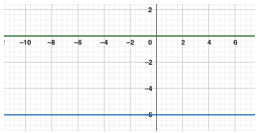
The pair of linear equations y = 0 and y = - 6 has:
Image
  • no solution
  • B
    only solution (0, 0)
  • C
    infinitely many solutions
  • D
    a unique solution
Answer
Correct option: A.
no solution
(a) no solution
Explanation: Since, we have $y=0$ and $y=-6$ are two parallel lines. therefore, no solution exists.
View full question & answer
MCQ 171 Mark
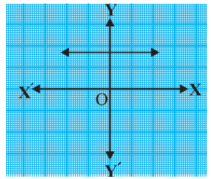
The graph of y = p(x) in a figure given below, for some polynomial p(x). Find the number of zeroes of p(x).
Image
  • A
    $4$
  • $0$
  • C
    $1$
  • D
    $2$
Answer
Correct option: B.
$0$
(b) 0
Explanation: There is no zero as the graph does not intersect the x -axis at any point.
View full question & answer
MCQ 181 Mark
7 × 11 × 13 + 13 is a/an
  • A
    odd number but not composite
  • B
    square number
  • C
    prime number
  • composite number
Answer
Correct option: D.
composite number
(d) composite number
Explanation: We have $7 \times 11 \times 13+13=13(77+1)=13 \times 78$. Since the given number has 2 more factors other than 1 and itself, therefore it is a composite number.
View full question & answer
M.C.Q (1 Marks) - Maths STD 10 Questions - Vidyadip