Questions

3 Marks Question

🎯

Test yourself on this topic

8 questions · timed · auto-graded

Question 13 Marks
The weights $($in $kg)$ of $50$ wild animals of a National Park were recorded and the following data was obtained:
Weight $($in $kg)$ Number of animals
$100 - 110$ $4$
$110 - 120$ $12$
$120 - 130$ $23$
$130 - 140$ $8$
$140 - 150$ $3$
Find the mean weight $($in $kg)$ of animals, using assumed mean method.
Answer
Weight $($in $kg) ($Class Interval$)$ Number of animals$\left( f _{ i }\right)$ Mid point $\left( x _{ i }\right)$ $d _{ i }= x _{ i }- a$ $f _{ i } d _{ i }$
$100-110$ $4$ $105$ $-20$ $-80$
$110-120$ $12$ $115$ $-10$ $-120$
$120-130$ $23$ $125$ $0$ $0$
$130-140$ $8$ $135$ $10$ $80$
$140-150$ $3$ $145$ $20$ $60$
Total 50     $-60$
let $a=125, \sum f_i=50, \sum f_i d_i=60$
Now, Mean $=a+\frac{\sum f_i d_i}{\sum f_i}$
Mean $=125+\frac{(-60)}{50}$
Mean $=125-1.2$
Mean $=123.8$
View full question & answer
Question 23 Marks
If $\tan \theta+\frac{1}{\tan \theta}=2$, find the value of $\tan ^2 \theta+\frac{1}{\tan ^2 \theta}$
Answer
We have,
$\tan \theta+\frac{1}{\tan \theta}=2$
Squaring both sides, we get
$\Rightarrow\left(\tan \theta+\frac{1}{\tan \theta}\right)^2=2^2$
$\Rightarrow \tan ^2 \theta+\frac{1}{\tan ^2 \theta}+2 \times \tan \theta \times \frac{1}{\tan \theta}=4$
$\Rightarrow \tan ^2 \theta+\frac{1}{\tan ^2 \theta}+2=4$
$\Rightarrow \tan ^2 \theta+\frac{1}{\tan }=2$
Alternate method, We have
$\tan \theta+\frac{1}{\tan \theta}=2$
$\Rightarrow \tan ^2 \theta+1=2 \tan \theta$
$\Rightarrow \tan ^2 \theta-2 \tan \theta+1=0$
$\Rightarrow (\tan \theta-1)^2=0$
$\Rightarrow \tan \theta=1$
$\therefore \tan ^2 \theta+\frac{1}{\tan ^2 \theta}=1+1=2$
View full question & answer
Question 33 Marks
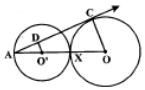
Equal circles with centres $O$ and $O\ '$ touch each other at $X. OO\ '$ produced to meet a circle with centre $O\ ', $ at $A. AC$ is a tangent to the circle whose centre is $O. O\ ' \ D$ is perpendicular to $AC$. Find the value of $\frac{ DO ^{\prime}}{ CO }$
Image
Answer

Image
Let the radius of both the circles is $r.$
In the fig, $O ^{\prime} D \perp AC$ and $AC$ is tangent of circle $(O,r)$
So, $OC \perp AC \ ($as line joining center to tangent is $\perp$ to the tangent$)$
Now in $\triangle A O^{\prime} D$ and $\triangle A O C$,
$\angle O ^{\prime} DA =\angle OCA =90^{\circ}$
$\angle A =\angle A \ ($ common$)$
Therefore, $\Delta AO { }^{\prime} D \sim \triangle AOC \ [$by $AA$ rule$]$
So, $\frac{D O^{\prime}}{C O}=\frac{A O^{\prime}}{A O}......(1)$
Now $, AO= r + r + r = 3r$
and $O\ ' A=r$
Putting the value of $AO$ and $AO\ '$ in equation $(1),$ we get
$\frac{D O^{\prime}}{C O}=\frac{r}{3 r}=\frac{1}{3}$
Therefore $, DO\ ' :CO = 1:3$
View full question & answer
Question 43 Marks
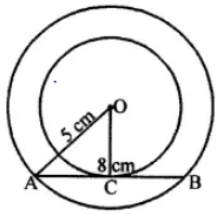
In two concentric circles, a chord of length $8 \ cm$ of the larger circle touches the smaller circle. If the radius of the larger circle is $5 \ cm$ then find the radius of the smaller circle.
Answer
In two concentric circles with center $O,$ a chord $AB$ of the larger circle touches the smaller circle at $C$.
$AB = 8 \ cm$ and radius of larger circle $= 5 \ cm$
Join $OA, OC$
To find, the radius of the smaller circle,
$AB$ is the tangent and $OC$ is the radius
$OC \perp AB$
Image
$ AC = CB =\frac{8}{2}=4 \ cm$
$OA =5 \ cm$
In right $\triangle O C A$,
$ OA ^2= OC ^2+ AC ^2 \ ($Pythagoras Theorem$)$
$(5)^2= OC ^2+\left(4^2\right.$
$OC ^2=(5)^2-(4)^2$
$=25-16=9=\left(3^2\right)$
$OC =3$
Radius of smaller circle $= 3 \ cm$
View full question & answer
Question 53 Marks
The ratio of the sums of first m and first $n$ terms of an $A.P.$ is $m^2: n^2$. Show that the ratio of its $m ^{\text {th }}$ and $n ^{\text {th }}$ terms is $(2m - 1):(2n -1 ).$
Answer
Let first term of given $A.P.$ be a and common difference be $d$ also sum of first $m$ and first $n$ terms be $S _{ m }$ and $S _{ n }$ respectively
$\therefore \frac{S_m}{S_n}=\frac{m^2}{n^2}$
or, $\frac{\frac{m}{2}[2 a+(m-1) d]}{\frac{n}{2}[2 a+(n-1) d]}=\frac{m^2}{n^2}$
or, $\frac{2 a+(m-1) d}{2 a+(n-1) d}=\frac{m^2}{n^2} \times \frac{n}{m}$
or, $\frac{2 a+(m-1) d}{2 a+(n-1) d}=\frac{m}{n}$
or, $m(2 a+(n-1) d)=n[2 a+(m-1) d]$
Now, $\frac{a_m}{a_n}=\frac{a+(m-1) d}{a+(n-1) d}$
$=\frac{a+(m-1) \times 2 a}{a+(n-1) \times 2 a}$
or, $=\frac{a+2 m a-2 a}{a+2 n a-2 a}$
or, $=\frac{2 m a-a}{2 n a-a}$
or, $=\frac{a(2 m-1)}{a(2 n-1)}$
or, $=\frac{(2 m-1)}{(2 n-1)}$
$=2 m-1: 2 n-1$
The ratio of its $m ^{\text {th }}$ and $n ^{\text {th }}$ terms is $2 m-1: 2 n-1$.
Hence proved
View full question & answer
Question 63 Marks
Find the sum of all the natural numbers less than $100$ which are divisible by $6.$
Answer
All the natural numbers less than $100$ which are divisible by $6$ are
$6, 12, 18, 24,................., 96$
Here, $a_1=6$
$a2 = 12$
$a3 = 18$
$a4 = 24$
$: :$
$\therefore a_2-a_1=12-6=6$
$a_3-a_2=18-12=6$
$a_4-a_3=24-18=6$
$a_2-a_1=a_3-a_2=a_4-a_3=6(=6$ in each case $)$
$\therefore$ This sequence is an arithmetic progression whose difference is $6.$
Here, $a = 6$
$d = 6$
$l = 96$
Let the number of terms be $n.$ Then,
$l = a + (n - 1)d$
$\Rightarrow 96=6+( n -1) 6$
$\Rightarrow 96-6=( n -1) 6$
$\Rightarrow 90=( n -1) 6$
$\Rightarrow( n -1) 6=90$
$\Rightarrow n -1=\frac{90}{6}$
$\Rightarrow n -1=15$
$\Rightarrow n =15+1$
$\Rightarrow n =16$
$\therefore S_n=\frac{n}{2}(a+l)$
$=\left(\frac{16}{2}\right)(6+96)$
$=(8)(102)$
$=816$
View full question & answer
Question 73 Marks
If $\alpha, \beta$ are the zeroes of the $x ^2+7 x +7$, find the value of $\frac{1}{\alpha}+\frac{1}{\beta}-2 \alpha \beta$.
Answer
Let the given polynomial is $p ( x )= x ^2+7 x +7$
Here,$a = 1, b = 7, c = 7$
$\therefore \alpha, \beta$ are both zeroes of $p( x )$
$\therefore \alpha+\beta=\frac{-b}{a}=-7.....(i)$
$\alpha \beta=\frac{c}{a}=7......(ii)$
Now,
$\frac{1}{\alpha}+\frac{1}{\beta}-2 \alpha \beta=\frac{\beta+\alpha}{\alpha \beta}-2 \alpha \beta$
$=\frac{-7}{7}-2 \times 7$
$=-1-14$
$=-15$
Hence the value of $\frac{1}{\alpha}+\frac{1}{\beta}-2 \alpha \beta$ is $-15 .$
View full question & answer
Question 83 Marks
If two positive integers $p$ and $q$ are written as $p=a^2 b^3$ and $q=a^3 b,a$ and $b$ are a prime number then.Verify.$\ce{LCM} \times (p.q. ) \times \operatorname{HCF}(p.q.)=p q$
Answer

Given, $p = a ^2 b^3$
and $q = a ^3 b$
$\operatorname{HCF}(p, q)=a^2 b$
$\operatorname{LCM}(p, q)=a^3 b^3$
$p q=a^2 b^3 \times a^3 b=a^5 b^4.........(1)$
$\ce{LCM(p, q) \times HCF(p, q)=a^3b^3 \times a^2b=a^5b^4}.......(2)$
From equation $(1)$ and $(2)$ We get
$\ce{LCM(p, q) \times HCF(p, q) = pq}$
View full question & answer
3 Marks Question - Maths STD 10 Questions - Vidyadip