Questions

2 Marks Questions

🎯

Test yourself on this topic

7 questions · timed · auto-graded

Question 12 Marks
The short and long hands of a clock are $4 \ cm $ and $6 \ cm$ long respectively. Find the sum of distances travelled by their tips in $2$ days.$ [$Take $\pi=3.14.]$
Answer
The hour hand covers $4$ complete circles in $2$ days $( 48$ hours$)$
Distance $=2 \times \frac{22}{7} \times 4 \times 4$
$=100.57 \ cm$
The minute hand covers $=48$
Circles in $2$ days $($Each hour $=1$ circle$)$
Distance $=2 \times \frac{22}{7} \times 6 \times 48$
$=1810.23 \ cm$
Total distance $=100.57+1810.23$
$=1910.8 \ cm$
View full question & answer
Question 22 Marks
If $3 \tan \theta=4$, evaluate $\frac{3 \sin \theta+2 \cos \theta}{3 \sin \theta-2 \cos \theta}$.
Answer
$3 \tan \theta=4 \Rightarrow \tan \theta=\frac{4}{3}$
Given,
$=\frac{3 \sin \theta+2 \cos \theta}{3 \sin \theta-2 \cos \theta}$
$=\frac{3 \tan \theta+2}{3 \tan \theta-2}[\text { Dividing numerator and denominator by } \cos \theta]$
$=\frac{\left(3 \times \frac{4}{3}+2\right)}{\left(3 \times \frac{4}{3}-2\right)}=\frac{6}{2}=3$
View full question & answer
Question 42 Marks
Prove the trigonometric identity: $\frac{1+\cos \theta-\sin ^2 \theta}{\sin \theta(1+\cos \theta)}=\cot \theta$
Answer
We have,
$\text { L.H.S }=\frac{1+\cos \theta-\sin ^2 \theta}{\sin \theta(1+\cos \theta)}$
$=\frac{1-\sin ^2 \theta+\cos \theta}{\sin \theta(1+\cos \theta)}$
$=\frac{\cos \theta+\cos \theta}{\sin \theta(1+\cos \theta)}\left[\because 1-\sin ^2 \theta=\cos ^2 \theta\right]$
$=\frac{\cos \theta(1+\cos \theta)}{\sin \theta(1+\cos \theta)}$
$=\frac{\cos \theta}{\sin \theta}$
$=\cot \theta\left[\because \frac{\cos \theta}{\sin \theta}=\cot \theta\right]$
$=\text { R.H.S }$
View full question & answer
Question 52 Marks
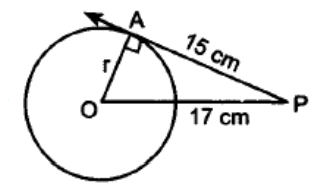
From a point $P, $ the length of the tangent to a circle is $15 \ cm$ and distance of $P$ from the centre of the circle is $17 \ cm.$ Then what is the radius of the circle?
Answer
Image

$\angle OAP=90^{\circ}$
$\text { in } \triangle O A P$
By applying Pythagoras theorem, we get
$\Rightarrow 17^2=r^2+15^2$
$\Rightarrow r^2=17^2-15^2=(17-15)(17+15)$
$=2 \times 32$
$\Rightarrow r^2=64 \Rightarrow r= \pm 8 \ cm$
we should not take negative value because length cannot be negative.
$\Rightarrow r=8 \ cm$
View full question & answer
Question 62 Marks
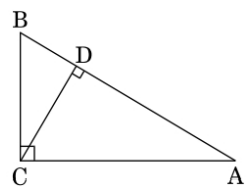
In Figure, $\angle ACB =90^{\circ}$ and $CD \perp AB$. Prove that $\frac{ BC ^2}{ AC ^2}=\frac{ BD }{ AD }$.
Image
Answer
$\triangle ABC \sim \triangle CBD \ ($By $AA$ similarity$)$
$\frac{AB}{CB}=\frac{BC}{BD}=\frac{AC}{CD}$
$\Rightarrow CB^2=AB \times BD \ldots \text { (i) }$
Similarly $\triangle ABC \sim \triangle ACD$
$\frac{AB}{AC}=\frac{BC}{CD}=\frac{AC}{AD}$
$\Rightarrow AC^2=AB \times AD \ldots \text { (ii) }$
By $(i)$ and $(ii)$
$\frac{CB^2}{AC^2}=\frac{AB \times BD}{AB \times AD}=\frac{BD}{AD}$
View full question & answer
Question 72 Marks
Prove that $\frac{2}{\sqrt{7}}$ is irrational.
Answer
Let us assume that $\frac{2}{\sqrt{7}}$ is rational.
Then, there exist positive co$-$primes a and $b$ such that
$\frac{2}{\sqrt{7}}=\frac{a}{b}$
$\sqrt{7}=\frac{2 b}{a}$
As $2b$ and $a$ are rational numbers.
Then $\frac{2 b}{a}$ is rational number.
But $\sqrt{7}$ is not a rational number.
Since a rational number cannot be equal to an irrational number.
Our assumption that $\frac{2}{\sqrt{7}}$ is rational number is wrong .
Hence $\frac{2}{\sqrt{7}}$ is an irrational number
View full question & answer
2 Marks Questions - Maths STD 10 Questions - Vidyadip