Questions

3 Marks Question

🎯

Test yourself on this topic

8 questions · timed · auto-graded

Question 13 Marks
Prove that the tangents drawn at the ends of a chord of a circle make equal angles with chord.
Answer
Let NM be chord of circle with centre C.
Let tangents at M and N meet at the point O .
Since $O M$ is a tangent
$\therefore MO \perp CM$ i.e. $\angle OMC =90^{\circ}$
$\because$ ON is a tangent
$\therefore ON \perp CN$ i.e. $\angle ONC =90^{\circ}$
Again in $\Delta CMN , CM = CN = r$
$\therefore \angle CMN =\angle CNM$
$\therefore \angle OMC -\angle CMN =\angle ONC -\angle CNM$
$\Rightarrow \angle OML \cong \angle ONL$
Thus, tangents make equal angle with the chord.
View full question & answer
Question 23 Marks
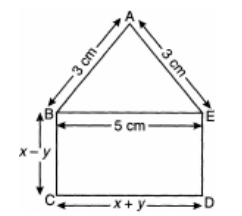
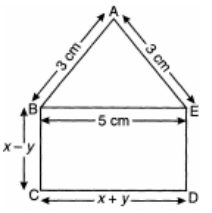
In the figure below $\text{ABCDE}$ is a pentagon with $BE \| CD$ and $BC \| DE. BC$ is perpendicular to $CD$. If the perimeter
of $\text{ABCDE}$ is $21 \ cm,$ find the Values of $x$ and $y$.
Image
Answer
Image
Since $B C \| D E$ and $B E \| C D$ with $B C \perp C D, B C, D E$ is a rectangle.
Since, $BE = CD$
$\therefore x+y=5 .... (i) $
Also, $DE = BC = x - y$
Since, perimeter of $\text{ABCDE}$ is $21$
$\therefore A B+B C+C D+D E+E A=21$
$\Rightarrow 3+x-y+x+y+x-y+3=21$
$\Rightarrow 6+3 x-y=21$
$\Rightarrow 3 x-y=15 \ldots . . \text { (ii) }$
Adding eqns. $(i)$ and $(ii),$ we get
$4 x=20$
$\Rightarrow x=5$
On substituting the value of $x$ in $(i),$ we get
$y=0$
$\therefore x=5 $ and $ y=0 .$
View full question & answer
Question 33 Marks
Find the median of the following data.
Class Interval0 - 1010 - 2020 - 3030 - 4040 - 50Total
Frequency81636346100
Answer
Class Interval FrequencyCumulative Frequency
0 - 10 88
10 - 20 1624
20 - 303660
30 - 403494
40 - 506100
Here, $N =100 \Rightarrow \frac{N}{2}=50$
The cumulative frequency just greater than 50 is 60 .
Hence, median class is $20-30$.
$\therefore l =20, h=10, f =36, cf = cf$ of preceding class is 24
Now, Median $=l+\left\{ h \times \frac{\left(\frac{N}{2}-c f\right)}{f}\right\}$
$=20+\left\{10 \times \frac{(50-24)}{36}\right\}$
$=20+\left\{10 \times \frac{26}{36}\right\}$
$=20+7.22$
$=27.2$
Thus, the median of the data is 27.2.
View full question & answer
Question 43 Marks
Prove the following identity : $\frac{\sin \theta}{1-\cos \theta}+\frac{\tan \theta}{1+\cos \theta}=\sec \theta \cdot \operatorname{cosec} \theta+\cot \theta$
Answer
$\text{LHS}$
$=\frac{\sin \theta}{1-\cos \theta}+\frac{\tan \theta}{1+\cos \theta}$
$=\frac{\sin \theta}{1-\cos \theta}+\frac{\frac{\sin \theta}{\cos \theta}}{1+\cos \theta}$
$=\frac{\sin \theta}{1-\cos \theta}+\frac{\sin \theta}{\cos \theta(1+\cos \theta)}$
$=\frac{\sin \theta \cdot \cos \theta(1+\cos \theta)+\sin \theta(1-\cos \theta)}{(1-\cos \theta) \cos \theta(1+\cos \theta)} \ [$ taking $\text{LCM ] }$
$=\frac{\sin \theta \cdot \cos \theta+\sin \theta \cdot \cos ^2 \theta+\sin \theta-\sin \theta \cdot \cos \theta}{\cos \theta\left(1-\cos ^2 \theta\right)}\ [$Since $,(a-b)(a+b) =a^2-b^2]$
$=\frac{\sin \theta \cdot \cos ^2 \theta+\sin \theta}{\cos \theta \cdot \sin 2} \cdot\ [$ Since $, \sin ^2 A+\operatorname{Cos}^2 A=1]$
$=\frac{\sin \theta \cdot \cos { }^2 \theta}{\cos \theta \cdot \sin ^2 \theta}+\frac{\sin \theta}{\cos \theta \cdot \sin ^2 \theta}$
$=\frac{\cos \theta}{\sin \theta}+\frac{1}{\cos \theta \cdot \sin \theta}$
$=\cot \theta+\sec \theta \cdot \operatorname{cosec} \theta$
$=\sec \theta \cdot \operatorname{cosec} \theta+\cot \theta$
$=\text { RHS }$
Hence, Proved.
View full question & answer
Question 53 Marks
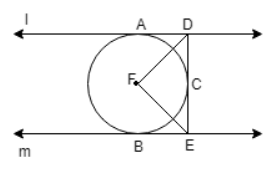
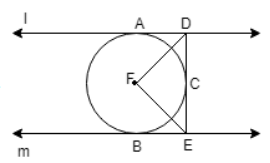
In Fig. $1$ and $m$ are two parallel tangents at $A$ and $B$ . The tangent at $C$ makes an intercept $DE$ between $l$ and $m$ . Prove that $\angle D F E=90^{\circ}$.
Image
Answer
Image
Since tangents drawn from an external point to a circle are equal.
Therefore, $DA = DC$.
Thus, in triangles $\text{ADF}$ and $\text{DFC},$ we have
$DA=DC$
$DF=DF \ [$ Common$]$
$AF=CF \ ($radii of the circle$)$
So, by $ \text{SSS}-$ criterion of congruence, we obtain
$\Delta A D F \cong \Delta D F C$
$\Rightarrow \angle A D F=\angle C D F$
$\Rightarrow \angle A D C=2 \angle C D F \ldots \text { (i) }$
Similarly, we can prove that
$\angle B E F=\angle C E F$
$\Rightarrow \angle C E B=2 \angle C E F \ldots(ii)$
Now, $\angle A D C+\angle C E B=180^{\circ}$
$($Sum of the interior angles on the same side of transversal is $180^{\circ})$
$\Rightarrow 2 \angle C D F+2 \angle C E F=180^{\circ} \ [$Using equations $(i)$ and $(ii)]$
$\Rightarrow \angle C D F+\angle C E F=90^{\circ}$
$\Rightarrow 180^{\circ}-\angle D F E=90^{\circ}\ [\because \angle C D F, \angle C E F $ and $\angle D F E$ are angles of a triangle $]$
$\therefore \angle C D F+\angle C E F+\angle D F E=180^{\circ}.$
$\Rightarrow \angle D F E=90^{\circ}$
View full question & answer
Question 63 Marks
Solve the following system of equation by elimination method: $\frac{x}{2}-\frac{y}{5}=4$ and $\frac{x}{7}+\frac{y}{15}=3$
Answer
The given system of equation is
$\frac{x}{2}-\frac{y}{5}=4 \ldots(1)$
$\frac{x}{7}+\frac{y}{15}=3 \ldots(2)$
Multiplying equation $(2)$ by $3$ , we get
$\frac{3 x}{7}+\frac{y}{5}=9\ldots(3)$
Adding equation $(1)$ and equation $(3),$ we get
$\frac{x}{2}+\frac{3 x}{7}=13$
$\Rightarrow \frac{13}{14} x=13$
$\Rightarrow x=\frac{13 \times 14}{13}=14$
Substituting this value of $x$ in equation $(2),$ we get
$\frac{14}{7}+\frac{y}{15}=3$
$\Rightarrow 2+\frac{y}{15}=3$
$\Rightarrow \frac{y}{15}=3-2$
$\Rightarrow \frac{y}{15}=1$
$\Rightarrow y=15$
So, the solution of the given system of equations is
$x=14, y=15$
Verification ; Substituting $x=14, y=15$.
We find that both the equations $(1)$ and $(2)$ are satisfied as shown below;
$\frac{x}{2}-\frac{y}{5}=\frac{14}{2}-\frac{15}{5}=7-3=4$
$\frac{x}{7}+\frac{y}{15}=\frac{14}{7}+\frac{15}{15}=2+1=3$
Hence, the solution is correct.
View full question & answer
Question 73 Marks
If $\alpha, \beta$ are the zeroes of the $x ^2+7 x +7$, find the value of $\frac{1}{\alpha}+\frac{1}{\beta}-2 \alpha \beta$.
Answer
Let the given polynomial is $p ( x )= x ^2+7 x +7$
$\text { Here, } a=1, b=7, c=7$
$\therefore \alpha, \beta$ are both zeroes of $p ( x )$
$\therefore \alpha+\beta=\frac{-b}{a}=-7 .......(i)$
$\alpha \beta=\frac{c}{a}=7........(ii)$
Now,
$\frac{1}{\alpha}+\frac{1}{\beta}-2 \alpha \beta=\frac{\beta+\alpha}{\alpha \beta}-2 \alpha \beta$
$=\frac{-7}{7}-2 \times 7$
$=-1-14$
$=-15$
Hence the value of $\frac{1}{\alpha}+\frac{1}{\beta}-2 \alpha \beta$ is $-15 .$
View full question & answer
Question 83 Marks
In order to promote reading habits among students, a school organized a Library Week. As part of the celebration, three genres of books: Biography, Mystery, and Self$-$help books were bought. For optimum arrangement, the organizers have stacked the books in such a way that all the books are stored topic$-$wise and the height of each stack is the same. The number of Biography books is $96,$ the number of Mystery books is $240$ and the number of Self-help books is $336.$ Assuming that the books are of the same thickness, determine the number of stacks of Biography, Mystery, and Self$-$help books.
Answer
In order to arrange the books as required,
we have to find the largest number that divides $96,240$ and $336$ exactly.
Clearly, such a number is their $\text{HCF.}$
We have,
$96=2^5 \times 3$
$240=2^4 \times 3 \times 5$
$336=2^4 \times 3 \times 7$
$\therefore \text{HCF}$ of $96,240$ and $336$ is $2^4 \times 3=48$
So, there must be $48$ books in each stack.
$\therefore$ Number of stacks of Biography books $=\frac{96}{48}=2$
Number of stacks of Mystery books $=\frac{240}{48}=5$
Number of stacks of Self$-$help books $=\frac{336}{48}=7$
View full question & answer
3 Marks Question - Maths STD 10 Questions - Vidyadip