Questions

M.C.Q (1 Marks)

🎯

Test yourself on this topic

18 questions · timed · auto-graded

MCQ 11 Mark
The most frequent value in the data is known as
  • A
    mean
  • mode
  • C
    all the three
  • D
    median
Answer
Correct option: B.
mode
(b) mode
Explanation: The most frequent value in the data is known as the Mode. e.g let us consider the following data set: $3,5,7,5,9,5,8,4$ the mode is 5 since it occurs most often in data set.
View full question & answer
MCQ 21 Mark
What is the probability that a leap year has 52 Mondays?
  • $\frac{5}{7}$
  • B
    $\frac{6}{7}$
  • C
    $\frac{2}{7}$
  • D
    $\frac{4}{7}$
Answer
Correct option: A.
$\frac{5}{7}$
(a) $\frac{5}{7}$

Explanation: No. of days in a leap year $=366$
No. of Mondays $=52$
Extra days $=366-52 \times 7$
$=366-364=2$
$\therefore$ Remaining days in the week $=7-2=5$
$\therefore$ Probability of being 52 Mondays in the leap
$\text { year }=\frac{5}{7}$
View full question & answer
MCQ 31 Mark
A card is drawn at random from a pack of 52 cards. The probability that the drawn card is not a king is
  • A
    $\frac{9}{13}$
  • $\frac{12}{13}$
  • C
    $\frac{1}{13}$
  • D
    $\frac{4}{13}$
Answer
Correct option: B.
$\frac{12}{13}$
(b) $\frac{12}{13}$
Explanation: Total number of possible outcomes $=52$
Number of king cards in the pack $=4$
$\therefore$ Number of cards that are not king $=52-4=48$
So, favourable number of outcomes $=48$
$\therefore$ Required probability $=\frac{48}{52}=\frac{12}{13}$
View full question & answer
MCQ 41 Mark
if the perimeter of a sector of a circle of radius $6.5 \ cm$ is $29 \ cm,$ then its area is
  • A
    $56 \ cm^2$
  • B
    $58 \ cm^2$
  • $52 \ cm^2$
  • D
    $25 \ cm^2$
Answer
Correct option: C.
$52 \ cm^2$
Explanation:
We know that perimeter of a sector of radius, $r=2 r+\frac{\theta}{360} \times 2 \pi r \ldots (1)$
Therefore, substituting the corresponding values of perimeter and radius in equation $(1),$ we get,
$29=2 \times 6.5+\frac{\theta}{360} \times 2 \pi \times 6.5 \ldots(2)$
$29=2 \times 6.5\left(1+\frac{\theta}{360} \times \pi\right)$
$\frac{29}{2 \times 6.5}=\left(1+\frac{\theta}{360} \times \pi\right)$
$\frac{29}{2 \times 6.5}-1=\frac{\theta}{360} \times \pi \ldots \ldots . .(3)$
We know that area of the sector $=\frac{\theta}{360} \times \pi r^2$
From equation $(3),$ we get
Area of the sector $=\left(\frac{29}{2 \times 6.5}-1\right) r^2$
Substituting $r =6.5$ we get,
Area of the sector $=\left(\frac{29}{2 \times 6.5}-1\right) 6.5^2$
$=\left(\frac{29 \times 6.5^2}{2 \times 6.5}-6.5^2\right)$
$=\left(\frac{29 \times 6.5}{2}-6.5^2\right)$
$=(94.25-42.25)$
$=52$
Therefore, area of the sector is $52 \ cm^2$.
View full question & answer
MCQ 51 Mark
The minute hand of a clock is $10 \ cm$ long. Find the area of the face of the clock described by the minute hand between $8\ am$ and $8.25\ am.$
  • A
    $120 \ cm^2$
  • B
    $125.5 \ cm^2$
  • $130.95 \ cm^2$
  • D
    $100 \ cm^2$
Answer
Correct option: C.
$130.95 \ cm^2$
Here the angle swept is $150^{\circ}$.
We need to find the area of this sector which subtends $150^{\circ}$ at the centre.
So, area $=\pi r^2 \times \frac{\theta}{360^{\circ}}$
$=\frac{22}{7} \times 10^2 \times \frac{150}{360}$
$=130.95 \ cm^2$
View full question & answer
MCQ 61 Mark
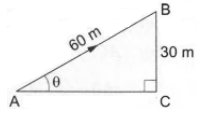
A kite is flying at a height of 30 m from the ground. The length of string from the kite to the ground is 60 m. Assuming that there is no slack in the string, the angle of elevation of the kite at the ground is
  • A
    $30^{\circ}$
  • B
    $45^{\circ}$
  • C
    $90^{\circ}$
  • D
    $60^{\circ}$
View full question & answer
MCQ 71 Mark
Which of the following is true for all values of $\theta\left(0^{\circ} \leq \theta \leq 90^{\circ}\right)$ ?
  • A
    $\operatorname{cosec}^2 \theta-\sec ^2 \theta=1$
  • B
    $\cos ^2 \theta-\sin ^2 \theta=1$
  • C
    $\cot ^2 \theta-\tan ^2 \theta=1$
  • $\sec ^2 \theta-\tan ^2 \theta=1$
Answer
Correct option: D.
$\sec ^2 \theta-\tan ^2 \theta=1$
(d) $\sec ^2 \theta-\tan ^2 \theta=1$
Explanation: $\because \sec ^2 \theta=1+\tan ^2 \theta$
$\therefore \sec ^2 \theta-\tan ^2 \theta=1$
View full question & answer
MCQ 81 Mark
If $\sin \theta+\cos \theta= p$ and $\sec \theta+\operatorname{cosec} \theta= q$, then $q \left( p ^2-1\right)=$
  • $2p$
  • B
    $\frac{2 q}{p^2}$
  • C
    $\frac{q}{p^2}$
  • D
    $2$
Answer
Correct option: A.
$2p$
Given: $\sin \theta+\cos \theta= p$ squaring both sides we get
$\sin ^2 \theta+\cos ^2 \theta+\cos ^2 \theta+2 \sin \theta \cos \theta=p^2$
$1+2 \sin \theta \cos \theta=p^2\left(\sin ^2 \theta+\cos ^2 \theta=1\right)$
$2 \sin \theta \cos \theta=p^2-1 \ldots \text { (i) }$
and also $\sec \theta+\operatorname{cosec} \theta= q ($given$)$
$\frac{1}{\cos \theta}+\frac{1}{\sin \theta}=q$
$\frac{\sin \theta+\cos \theta}{\sin \theta \cos \theta}=q$
but $\sin \theta+\cos \theta=p \ldots($ given $)$
$\frac{p}{\sin \theta \cos \theta}=q \ldots \text { (ii) }$
from $(i)$ and $(ii)$ we get
$q\left(p^2-1\right)=2 p$
View full question & answer
MCQ 91 Mark
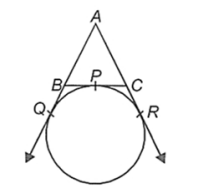
In the given figure, a circle touches the side $B C$ of $\triangle A B C$ at $P$ and touches $A B$ and $A C$ produced at $Q$ and $R$ respectively. If $A Q=5 \ cm$, then find the perimeter of $\triangle A B C$.
Image
  • A
    $6 \ cm$
  • $10 \ cm$
  • C
    $7 \ cm$
  • D
    $11 \ cm$
Answer
Correct option: B.
$10 \ cm$
Perimeter of $\triangle ABC = AB + BC + AC$
$=A B+(B P+P C)+A C$
$=(A B+B Q)+(C R+A C)[\because B P=B Q, P C=C P]$
$=A Q+A P=2 A Q(\because A Q=A R)$
$=2 \times 5$
$=10 \ cm$
View full question & answer
MCQ 101 Mark
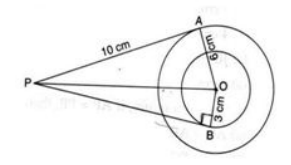
Two concentric circles with centre O are of radii 6 cm and 3 cm. From an external point P, tangents PA and PB are drawn to these circles as shown in the figure. If AP = 10 cm, then BP is equal to
Image
  • A
    $\sqrt{91}$
  • B
    $\sqrt{119} cm$
  • $\sqrt{127} cm$
  • D
    $\sqrt{109} cm$
Answer
Correct option: C.
$\sqrt{127} cm$
(c) $\sqrt{127} cm$
Explanation: Here $\angle OAP =90^{\circ}[ OA \perp AP ]$
$\therefore$ In right angled triangle APO,
$OP=\sqrt{(10)^2+(6)^2}=\sqrt{100+36}=\sqrt{136} cm$
Now, again, $\angle OBP =90^{\circ}[ OB \perp PB ]$
$\therefore$ In right angled triangle BPO ,
$PB=\sqrt{(\sqrt{136})^2-(9)^2}=\sqrt{136-9}=\sqrt{127} cm$
View full question & answer
MCQ 111 Mark
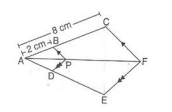
In the given figure if $BP \| CF, DP \| EF,$ then $AD : DE$ is equal to
Image
  • $1: 3$
  • B
    $1: 4$
  • C
    $3: 4$
  • D
    $2: 3$
Answer
Correct option: A.
$1: 3$
Explanation:
Since $BP \| CF,$
Then, $\frac{ AP }{ PF }=\frac{ AB }{ BC } \ [$Using Thales Theorem$]$
$\Rightarrow \frac{AP}{PF}=\frac{2}{6}=\frac{1}{3}$
Again, since $DP \| EF,$
Then, $\frac{ AP }{ PF }=\frac{ AD }{ DE } \ [$Using Thales Theorem$]$
$\Rightarrow \frac{AD}{DE}=\frac{1}{3}$
$\Rightarrow AD: DE=1: 3$
View full question & answer
MCQ 121 Mark
If (3, –6) is the mid-point of the line segment joining (0, 0) and (x, y), then the point (x, y) is:
  • A
    (6, - 6)
  • (6, -12)
  • C
    $\left(\frac{3}{2},-3\right)$
  • D
    (- 3, 6)
Answer
Correct option: B.
(6, -12)
(b) $(6,-12)$
Explanation: If (a, b) and (c, d) be the coordinates of any two points, then the coordinates of the mid-point joining those points be $\left(\frac{(a+c)}{2}, \frac{(b+d)}{2}\right)$.
The line segment is formed by points are $(0,0)$ and $(x, y)$, whose mid-point is $(3,-6)$.
Then,
$\frac{(0+x)}{2}=3 \text { and } \frac{(0+y)}{2}=-6$
or, $\frac{x}{2}=3$ or, $\frac{y}{2}=-6$
or, $x =6$ or, $y =-12$
Therefore the required point is $(6,-12)$.
View full question & answer
MCQ 131 Mark
The distance of point $P(4, -5)$ from origin is
  • A
    $\sqrt{40}$ units
  • B
    $1$ unit
  • C
    $3$ units
  • $\sqrt{41}$ units
Answer
Correct option: D.
$\sqrt{41}$ units
$\text { (d) } \sqrt{41} \text { units }$
$\text { Explanation: } OP =\sqrt{(4-0)^2+(0-(-5))^2}$
$=\sqrt{(16+25)}$
$=\sqrt{41} \text { units }$
View full question & answer
MCQ 141 Mark
If the sum of $n$ terms of an $A.P.$ be $3 n^2+n$ and its common difference is $6$ then its first term is
  • A
    $2$
  • B
    $1$
  • C
    $3$
  • $4$
Answer
Correct option: D.
$4$
Sum of $n$ terms of an $A.P =3 n^2+n$ and common difference $( d )=6$
Let the first term be a, then
$S_n=\frac{n}{2}[2 a+(n-1) d]$
$=3 n^2+n$
$\Rightarrow \frac{n}{2}[2 a+(n-1) 6]$
$=3 n^2+n$
$2 a+6 n-6=\left(3 n^2+n\right) \times \frac{2}{n}$
$=n \frac{(3 n+1) \times 2}{n}$
$\Rightarrow 2 a+6 n-6=(3 n+1) 2$
$=6 n+2$
$\Rightarrow 2 a=6 n+2-6 n+6$
$=8$
$a=\frac{8}{2}=4$
View full question & answer
MCQ 151 Mark
If the equation $x^2+5 kx +16=0$ has no real roots then
  • A
    $k>\frac{8}{5}$
  • B
    $k<\frac{-8}{5}$
  • $\frac{-8}{5} < k < \frac{8}{5}$
  • D
    $k>\frac{-8}{5}$
Answer
Correct option: C.
$\frac{-8}{5} < k < \frac{8}{5}$
(c) $\frac{-8}{5} < k < \frac{8}{5}$
Explanation: For no real roots, we must have $b ^2-4 ac <0$.
$\therefore$ $\left(25 k^2-4 \times 16\right)<0 \Rightarrow 25 k^2<64 \Rightarrow k^2<\frac{64}{25} \Rightarrow \frac{-8}{5} < k < \frac{8}{5}$
View full question & answer
MCQ 161 Mark
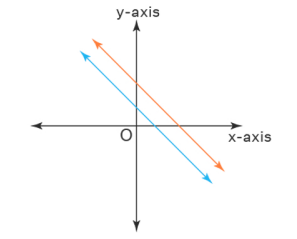
A system of linear equations is said to be inconsistent if it has
Image
  • A
    one solution
  • B
    at least one solution
  • C
    two solutions
  • no solution
Answer
Correct option: D.
no solution
(d) no solution
Explanation: A system of linear equations is said to be inconsistent if it has no solution means two lines are running parallel and not cutting each other at any point.
View full question & answer
MCQ 171 Mark
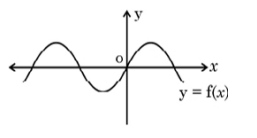
The graph of y = f(x) is shown in the figure for some polynomial f(x). The number of zeroes of f(x) are
Image
  • A
    2
  • B
    3
  • 4
  • D
    1
Answer
Correct option: C.
4
(c) 4
Explanation: f(x) intersects the x -axis at 4 points. hence , f(x) has 4 zeroes
View full question & answer
MCQ 181 Mark
If $a =\left(2^2 \times 3^3 \times 5^4\right)$ and $b =\left(2^3 \times 3^2 \times 5\right)$ then $\operatorname{HCF}( a , b )=$ ?
  • A
    360
  • B
    90
  • 180
  • D
    540
Answer
Correct option: C.
180
(c) 180
Explanation: It is given that: $a =\left(2^2 \times 3^3 \times 5^4\right)$ and $b =\left(2^3 \times 3^2 \times 5\right)$
$\therefore \operatorname{HCF}( a , b )=$ Product of smallest power of each common prime factor in the numbers $=2^2 \times 3^2 \times 5=180$
View full question & answer
M.C.Q (1 Marks) - Maths STD 10 Questions - Vidyadip